



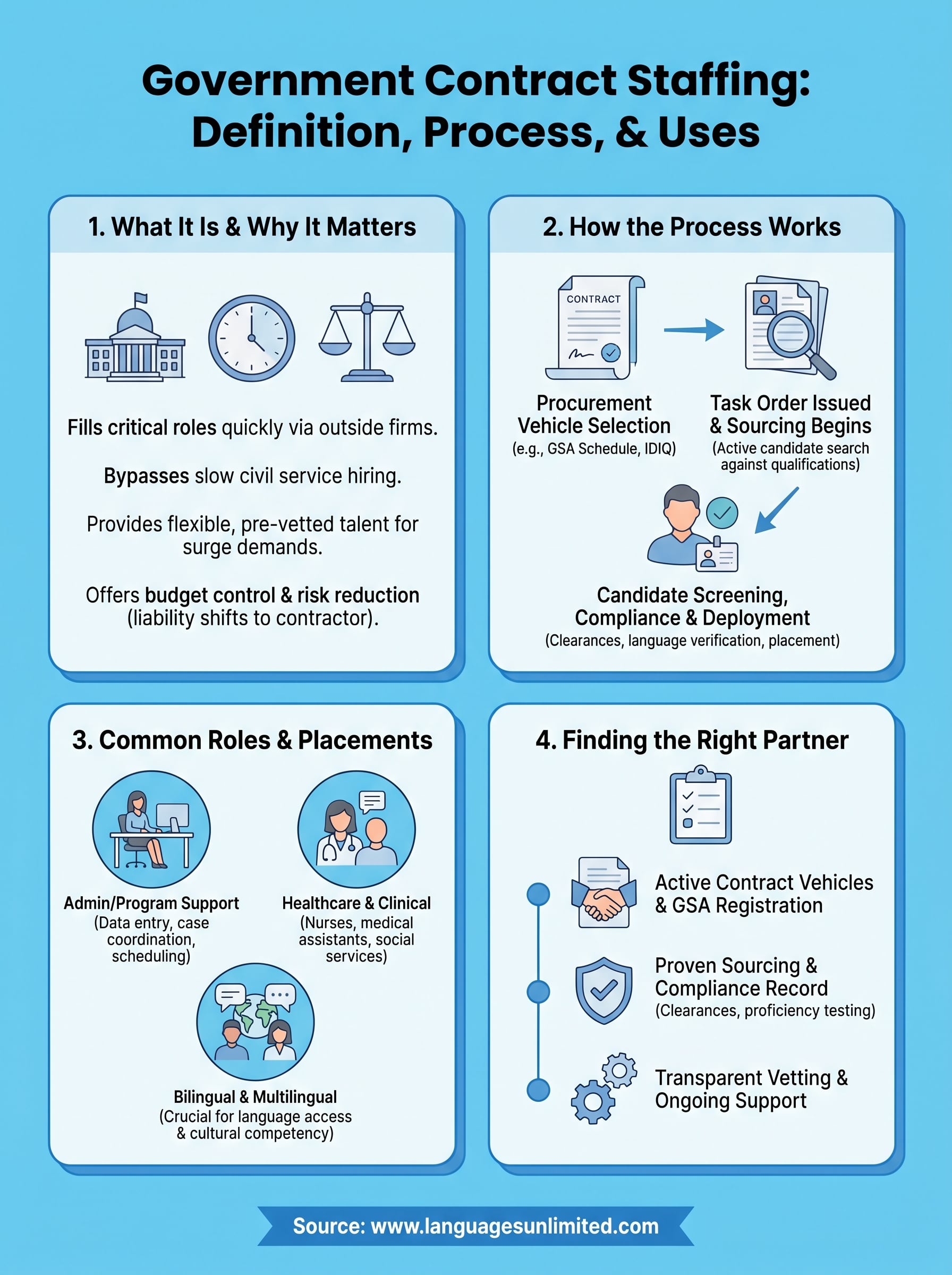
Federal, state, and local agencies rely on outside firms to fill critical roles, from administrative support to bilingual healthcare professionals, through a process known as government contract staffing. It’s how agencies meet workforce demands without the delays and limitations of traditional civil service hiring. For organizations that provide these services, and for those trying to procure them, understanding how the process works is essential to winning contracts, staying compliant, and placing the right people in the right positions.
At Languages Unlimited, we’ve supported government agencies with qualified multilingual and bilingual personnel since 1994. As a GSA Contract Holder with nationwide reach, we staff roles across healthcare, social services, and public-facing programs where language access and cultural competency aren’t optional, they’re mission-critical. That experience gives us a grounded perspective on what government contract staffing actually involves, from the procurement side to day-one deployment.
This article breaks down what government contract staffing means, how the procurement and staffing process works step by step, and where this model is used most. Whether you’re a government program manager looking for a staffing partner or a staffing firm exploring public-sector opportunities, you’ll walk away with a clear, practical understanding of the process and what it takes to participate in it.
Why government contract staffing matters
Government agencies face a fundamental tension: they need specialized, often bilingual or technically skilled workers fast, but federal and state civil service hiring processes can take months or even years to complete. Contract staffing resolves that tension by letting agencies bring qualified personnel on board quickly through pre-vetted vendors, without the full burden of permanent employment. For program managers and agency leaders, this isn’t a workaround, it’s a core workforce strategy.
The scale of government workforce demand
The federal government is the largest single employer in the United States, and state and local agencies collectively employ millions more. When you add grant-funded programs, surge events like natural disasters or public health emergencies, and specialized projects with short timelines, the demand for flexible and qualified personnel grows far beyond what any agency can maintain through direct hiring alone. Government contract staffing steps in to fill that gap, giving agencies access to talent pools that would otherwise take years to build internally.
When a public health agency needs bilingual case managers deployed across three states in 30 days, direct hiring simply cannot move fast enough.
Many of these workforce needs are also language-dependent. Agencies serving immigrant communities, patients in federally qualified health centers, or non-English-speaking families in social services programs need staff who can communicate accurately in the target language. Finding those candidates through standard civil service pipelines is difficult; finding them through a specialized staffing partner with a large multilingual database is significantly more practical.
Why the contract model benefits agencies
From a financial standpoint, contract staffing gives your agency tighter budget control. You pay for the workforce you need, during the period you need it, without incurring long-term salary obligations, pension costs, or benefits packages tied to permanent headcount. Workforce costs become predictable and directly tied to program scope rather than organizational structure.
There’s also a risk-reduction dimension worth understanding. Staffing firms that hold GSA contracts or similar procurement vehicles carry liability for background checks, compliance screening, and professional vetting. That shifts a meaningful share of workforce risk away from the agency and onto the contractor, who is contractually obligated to deliver personnel that meet defined qualifications. For roles requiring security clearances or language proficiency verification, this division of responsibility is especially valuable.
Finally, contract staffing gives your program the ability to scale up or scale down without legislative action or union negotiation. When a program ends or funding shifts, you adjust the contract, not the workforce structure. That flexibility is one of the primary reasons agencies at every level of government continue to rely on this model, and why choosing the right staffing partner from the start has a direct impact on program outcomes.
What government contract staffing includes
Government contract staffing covers more ground than simply filling open positions. Agencies use it to source temporary, contract-to-hire, and project-based personnel across a wide range of functional areas, from front-line program support to highly specialized roles requiring security clearances, language proficiency, or clinical credentials. Understanding the full scope helps you identify where your needs fit and what to look for in a staffing partner.
Personnel categories and roles
The roles filled through government contract staffing span nearly every function within a public agency. Administrative and program support staff handle document processing, data entry, scheduling, and case coordination. Healthcare and social services positions include certified nursing assistants, licensed practical nurses, registered nurses, patient care representatives, and medical assistants. For agencies operating public-facing programs, bilingual and multilingual professionals are among the most in-demand placements, particularly in communities where English is not the primary language spoken.
Cleared and non-cleared personnel represent another important distinction within this category. Some contract roles require candidates to hold active federal security clearances, while others involve access to sensitive but unclassified information that still requires thorough background verification. Your staffing partner should be equipped to source candidates across both categories without adding delays to your deployment timeline.
The demand for bilingual personnel in government programs has grown alongside rising diversity in the populations agencies serve, making language-qualified staffing a distinct category of its own.
Accessibility and compliance-driven roles
Some government programs carry specific legal obligations around accessibility that directly shape the workforce they need. Agencies subject to Section 508 of the Rehabilitation Act, for example, may need staff who can support CART services, captioning, or real-time communication accommodations for individuals with disabilities. These requirements are built into the scope of the work from the start, not added later.
Programs funded under federal grants often require personnel with documented language proficiency or cultural competency credentials rather than general bilingual ability. Your staffing partner needs to screen for those specific qualifications before placement, not after.
How government contract staffing works
Government contract staffing follows a defined sequence that moves from procurement authorization through candidate deployment. Agencies don’t simply call a staffing firm and request workers; they operate within structured procurement frameworks that govern which vendors they can engage, under what terms, and at what cost. Knowing where your program sits within that framework tells you exactly what steps come next.
The procurement and vehicle selection phase
Before a single candidate is sourced, your agency must identify the correct procurement vehicle for the engagement. GSA Schedule contracts, Blanket Purchase Agreements (BPAs), and Indefinite Delivery/Indefinite Quantity (IDIQ) contracts are the most common mechanisms at the federal level. State and local agencies often use comparable mechanisms, such as master service agreements or cooperative purchasing contracts. Selecting the right vehicle determines which vendors are eligible to respond and what pricing structures apply.

Agencies that skip or rush the vehicle selection step often face compliance reviews that delay deployment by weeks or months, directly impacting program timelines.
Once the vehicle is in place, your agency issues a task order or statement of work that outlines the specific roles, required qualifications, performance standards, and period of performance. This document becomes the contractual foundation for everything that follows, including how the staffing firm will screen and present candidates.
Sourcing, screening, and deployment
After receiving the task order, your staffing partner begins active candidate sourcing against the qualifications you’ve defined. For multilingual or bilingual roles, this includes language proficiency verification and cultural competency screening, not just resume review. For cleared positions, the firm coordinates background investigation requirements with the appropriate federal authority before finalizing any placement.
Your agency then reviews presented candidates, conducts interviews where required, and issues placement authorization for approved personnel. From that point, the staffing partner manages onboarding logistics, compliance documentation, and ongoing workforce support for the duration of the contract. This keeps administrative burden off your program team and ensures the placement remains compliant throughout the entire contract period.
Common contract types and roles
Government contract staffing operates through several distinct contract structures, and the type your agency uses shapes how personnel are engaged, how costs are calculated, and what flexibility you have to adjust scope mid-performance. Knowing the differences before you issue a task order prevents procurement delays and keeps your program budget on track.
Contract structures you’ll encounter
The most widely used contract vehicles in federal government contract staffing include Time-and-Materials (T&M) contracts, which bill based on hours worked plus direct costs, and Firm-Fixed-Price (FFP) contracts, which set a defined deliverable for a set price. IDIQ contracts allow agencies to issue multiple task orders under a single award, making them a practical choice when staffing needs are recurring or unpredictable. BPAs establish pre-negotiated terms with approved vendors so your agency can move faster when an urgent need arises.
Selecting the wrong contract type for a staffing engagement creates billing disputes, audit exposure, and delays that damage program timelines and agency relationships.
State and local agencies often use cooperative purchasing agreements or master service agreements as their equivalent mechanism, allowing them to access pre-vetted vendors without running a full competitive solicitation each time. Your procurement office can confirm which vehicles are currently active and eligible for the type of staffing engagement you’re planning.
Roles most commonly filled
Across every level of government, certain positions appear consistently in contract staffing engagements. Administrative and program support roles make up a large share of placements, covering data entry, case coordination, scheduling, and records management. Public-facing programs regularly require bilingual and multilingual staff, particularly for healthcare outreach, social services navigation, and community education initiatives where language barriers directly affect service delivery.
Clinical roles including registered nurses, licensed practical nurses, certified nursing assistants, and medical assistants are in high demand at federally qualified health centers, VA facilities, and public health agencies. Specialized roles in IT support, communications, and compliance monitoring also appear regularly at the federal level, where program complexity demands a broader professional mix and tighter qualification screening at the point of sourcing.
Compliance, clearances, and risk control
Government contract staffing carries compliance obligations that go well beyond standard commercial hiring. Agencies are accountable to oversight bodies, auditors, and sometimes the public, which means every placement must meet documented qualification standards before anyone reports to work. Treating compliance as a checkbox rather than a structured process creates audit exposure that can delay your program or disqualify your vendor entirely.
Security clearances and personnel verification
Some roles require candidates to hold active federal security clearances, ranging from Confidential to Top Secret/SCI depending on the program. Others require thorough background investigations even without a formal clearance designation, particularly for positions involving access to personally identifiable information, protected health data, or law enforcement records. Your staffing partner should maintain a clear process for tracking clearance status and investigation timelines so that no candidate is placed before the required verifications are complete.

Placing personnel before background verification is finished is one of the most common compliance failures in government contract staffing, and it creates liability for both the agency and the contractor.
For bilingual and multilingual roles, language proficiency verification adds another layer to the screening process. General conversational ability is not sufficient for healthcare intake, legal case support, or social services navigation. Your staffing partner needs to verify proficiency at the level the program requires, using defined assessment methods rather than self-reporting from candidates.
Managing compliance risk throughout the contract
Compliance does not end at placement. Throughout the contract period of performance, your agency should require regular documentation updates from your staffing partner, including refreshed background checks, license verifications for clinical staff, and confirmation that any required certifications remain active. Gaps in that documentation chain become findings during audits.
Your staffing partner carries direct responsibility for maintaining worker eligibility documentation under the contract terms, but your program office should confirm that reporting structure is in place from day one. Building a compliance review cadence into your task order requirements, rather than relying on informal check-ins, gives your agency a clear and defensible record if questions arise during the performance period.
How to find opportunities and choose a partner
Whether you’re a program manager sourcing a staffing vendor or a staffing firm pursuing public-sector work, knowing where to look is the first practical step. Government contract staffing opportunities don’t surface through informal channels; they flow through official procurement systems that publish solicitations, award data, and vendor eligibility requirements in one place. Familiarizing yourself with those systems early saves you from chasing opportunities you’re not positioned to win.
Where to search for contract opportunities
The primary federal resource for identifying opportunities is SAM.gov, the System for Award Management. Every federal agency posts active solicitations there, and vendors must register on the platform before they can respond to any federal procurement. For award and spending data, USASpending.gov gives you a clear picture of which agencies are contracting, at what dollar levels, and with which firms, which helps you assess whether a particular agency is an active buyer of staffing services.
Reviewing award history on USASpending.gov before targeting an agency gives you a realistic picture of contract size, competition, and incumbent vendor relationships before you invest time in a proposal.
State and local opportunities typically appear on individual agency procurement portals or state-level eProcurement systems. Checking those portals regularly and registering as an approved vendor on the relevant systems puts you in position to respond when task orders open.
What to look for in a staffing partner
When your agency is selecting a government contract staffing partner, GSA Schedule registration and active contract vehicles are the starting point, not the finish line. You also need to confirm that the firm has a proven record placing personnel in roles that match your program’s specific requirements, whether that means clinical credentials, security clearance experience, or verified language proficiency in the target languages your program serves.
Ask directly about sourcing timelines, compliance documentation practices, and how the firm handles placements that don’t meet performance expectations. A partner with a large, qualified candidate pool and a structured compliance process gives your program a substantially better foundation than one that leads with low rates and delivers underqualified personnel after award.
Next steps
Government contract staffing works when every piece of the process is in place before you need it: the right procurement vehicle, a compliant staffing partner, and verified candidates who meet your program’s specific requirements. If any of those elements is missing, you face delays, audit exposure, or personnel gaps that directly affect the people your program serves. The guidance in this article gives you a complete picture of what the process involves, what compliance looks like in practice, and what separates a strong staffing partner from one that creates problems after award.
Languages Unlimited has held a GSA contract and supported government agencies with multilingual and bilingual personnel across healthcare, social services, and public-facing programs since 1994. If your agency needs qualified staff with verified language proficiency, cultural competency, and the compliance infrastructure to back it up, we’re ready to support your program. Contact our team today to discuss your staffing needs.