



Government agencies at the federal, state, and local level face hiring challenges that most private employers never encounter. Security clearances, compliance mandates, union requirements, budget cycles, and strict qualification standards all add layers of complexity to recruitment. Public sector staffing exists to solve exactly this problem, connecting agencies with qualified personnel who meet the specific demands of government work, without the delays and bottlenecks of traditional civil service hiring.
But how does the process actually work? What separates a staffing firm that serves government clients from one that staffs a corporate office? And what should you look for when choosing a partner to fill roles that carry real public accountability? These are the questions agency directors, procurement officers, and program managers ask when staffing gaps start affecting operations, and they deserve straightforward answers.
At Languages Unlimited, we’ve supported government agencies with staffing solutions since 1994, placing cleared and non-cleared personnel across administrative, healthcare, social services, and public-facing roles. As a GSA Contract Holder with deep roots in multilingual workforce placement, we understand the compliance standards, cultural competency requirements, and rapid deployment timelines that define public sector hiring. That hands-on experience shapes everything in this article, from how public sector staffing is structured to how agencies like ours deliver results at scale.
This guide breaks down what public sector staffing is, how specialized agencies operate within it, the types of roles typically filled, and what to evaluate before signing a contract.
Why public sector staffing matters
Government agencies operate under constraints that most HR teams in the private sector simply don’t face. Budget cycles tied to fiscal years, rigid qualification requirements, clearance processes, and union agreements all slow down traditional hiring timelines significantly. When a key position stays vacant for three or four months, real services suffer in real, measurable ways. That’s precisely why public sector staffing has grown into a specialized discipline with its own rules, timelines, and compliance standards, requiring partners who know the territory rather than generalists who are learning it as they go.
The staffing gap government agencies face
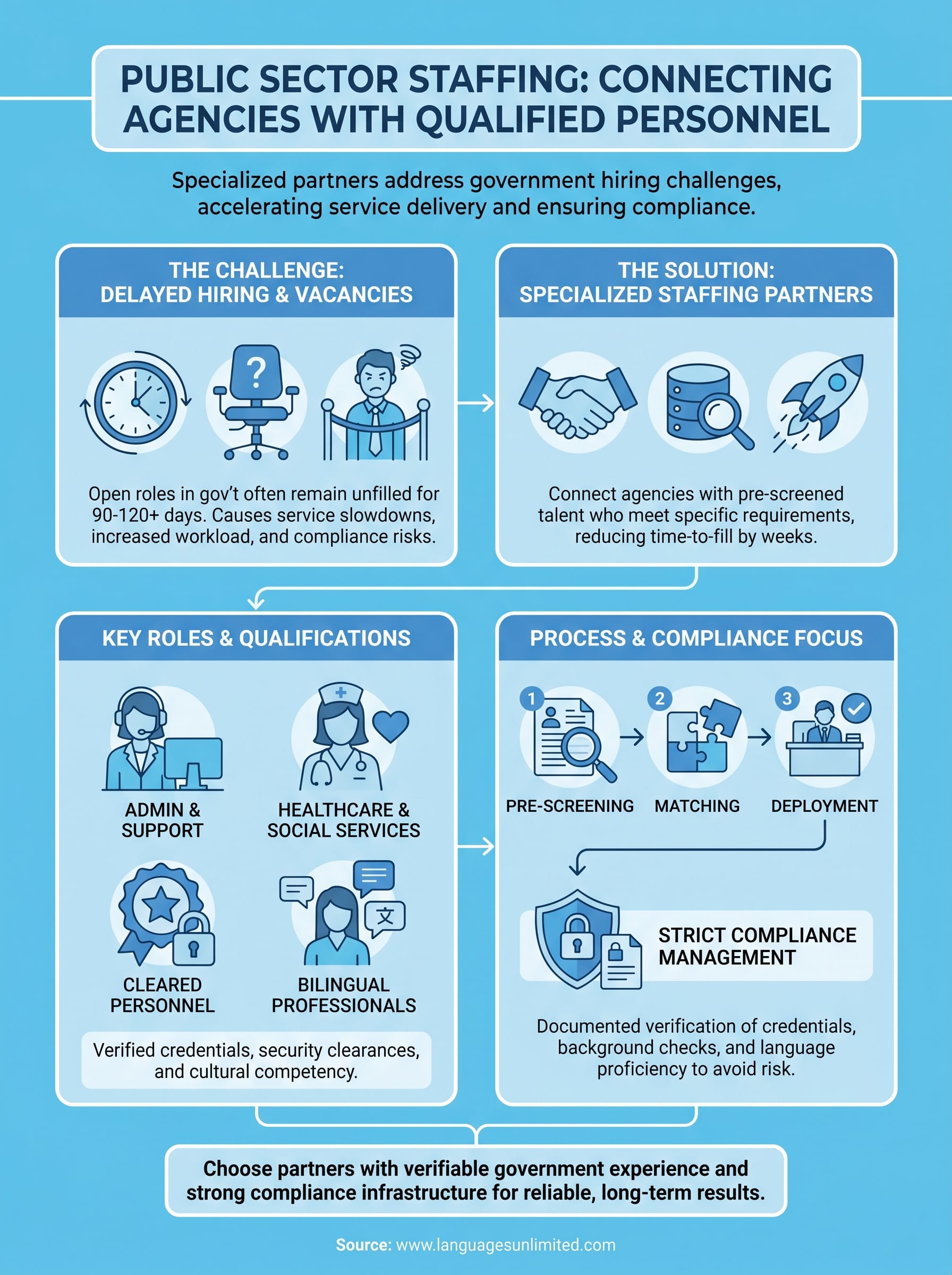
The numbers behind government vacancies tell a consistent story. Federal, state, and local agencies regularly report open roles that go unfilled for 90 to 120 days or longer, particularly in healthcare, social services, and administrative support. These aren’t abstract HR statistics. They represent case managers who aren’t processing applications, nurses who aren’t at the bedside in public health clinics, and program staff who aren’t returning constituent calls on time.
Common roles that face the longest vacancy periods in government settings include:
- Administrative and program support staff who manage constituent services and case processing
- Healthcare workers, including nurses, medical assistants, and patient care representatives in public health settings
- Bilingual and multilingual professionals needed to serve non-English-speaking populations
- Social services coordinators handling benefits, housing, and community outreach programs
When a vacancy drags on, the workload doesn’t disappear, it shifts onto the remaining staff. That creates burnout, errors, and turnover cycles that cost agencies far more than a well-timed placement would have. Addressing this gap early, through a staffing partner who already understands government hiring requirements, is one of the most direct steps you can take to protect program continuity, staff morale, and service quality across the board.
Agencies that move quickly on vacancies through specialized staffing partners consistently cut their time-to-fill by weeks compared to those relying solely on civil service posting processes.
How delayed hiring affects public services
Delayed hiring creates a chain reaction that moves well beyond internal HR metrics. Front-line services slow down, response times increase, and the populations that depend most on public agencies, often the most vulnerable communities, absorb the impact first. A county health department short on bilingual intake staff can’t process patient registrations at the pace the community needs, regardless of how capable the remaining team is.
Beyond service delivery, delayed hiring also creates compliance exposure your agency may not have fully mapped out. Federal programs tied to grant funding often carry staffing ratio requirements. If your agency can’t demonstrate adequate qualified headcount during a program review, you risk losing funding that sustains entire services, making timely, qualified placement a financial imperative, not just an operational preference.
Why specialized expertise changes the outcome
Generic staffing firms can fill positions. Specialized government staffing partners fill the right positions faster, with candidates who already understand security requirements, compliance obligations, and public accountability standards. That distinction matters because onboarding a candidate who doesn’t clear a background check, or who lacks a required certification, wastes weeks you simply don’t have when a program is already running lean.
Working with a partner experienced in public sector hiring means you receive candidates who have already been vetted against the specific standards your program requires, whether that’s a federal security clearance, a bilingual fluency requirement, or a specialized clinical credential. That expertise compresses the cycle from job order to productive employee in ways that general-purpose staffing cannot replicate at scale or speed.
What public sector staffing includes
Public sector staffing covers a broader range of roles and functions than most agencies anticipate when they first engage a specialized partner. It’s not limited to filling administrative vacancies or plugging short-term gaps. It spans clinical healthcare positions, social services coordination, bilingual workforce placement, and cleared personnel for sensitive federal environments. Understanding what falls within scope helps you structure your contract correctly from day one and avoid the disruption of switching partners mid-program when additional role types emerge.
Administrative and program support
Administrative and program support roles form the backbone of day-to-day government operations at every level. These positions include case processors, data entry specialists, constituent services representatives, benefits coordinators, and public-facing front-desk staff who keep agency workflows moving. When these roles go unfilled, backlogs form quickly and cascade into delayed service delivery across the entire department or program.
A well-structured staffing engagement for administrative roles typically covers:
- Case management and intake processing staff
- Records management and document control personnel
- Program coordinators supporting federally funded initiatives
- Front-line public contact roles across county, state, and federal offices
Healthcare and social services positions
Government agencies and public health systems regularly need qualified clinical and support staff to meet both regulatory requirements and direct care demands. This includes registered nurses, licensed practical nurses, certified nursing assistants, medical assistants, and patient care representatives who work in community health centers, Veterans Affairs facilities, and county public health departments. These roles carry strict credentialing requirements that a capable staffing partner must verify and document before a candidate starts work.
Verifying credentials before placement protects your agency from compliance violations that can affect both program funding and patient safety outcomes.
Cleared and non-cleared personnel
Federal programs often require personnel who have completed specific background investigations, ranging from basic suitability determinations to full security clearances depending on the sensitivity of the work. Non-cleared positions still carry thorough vetting requirements to satisfy agency standards. Whether your program needs staff with access to restricted systems or professionals in public-facing roles with no clearance requirement, a specialized partner manages both tracks within the same engagement, keeping your hiring process consolidated and your compliance documentation clean.
How public sector staffing agencies deliver talent
Specialized public sector staffing agencies follow a structured process that differs substantially from how a general staffing firm operates. Rather than pulling from a broad, undifferentiated candidate pool, government-focused agencies maintain pre-screened talent databases built specifically around the credential, clearance, and compliance requirements that public programs demand. That infrastructure is what allows them to compress hiring timelines without cutting corners on candidate quality.
Candidate Sourcing and Pre-Screening
A government staffing partner doesn’t start sourcing when you submit a job order. Ongoing talent pipeline development happens continuously, so that when your agency identifies a vacancy, candidates who already meet your program’s baseline requirements are ready to move forward immediately. This means your team reviews people who have already passed initial screening, not raw applicants who may fail a background check two weeks into the process.

Pre-screening at a qualified agency typically covers:
- Credential and licensure verification for clinical and specialized roles
- Background investigation history and clearance eligibility assessment
- Language fluency testing for bilingual positions
- Cultural competency evaluation for public-facing and community services roles
Agencies that invest in ongoing pipeline development consistently place candidates faster than those who begin sourcing only after receiving a job order.
Matching Candidates to Program Requirements
Once your requirements are clear, an experienced staffing partner maps each open role against the specific qualifications your program mandates, rather than sending the closest available match and hoping for the best. That distinction matters because a mismatch in a government role, whether on credentials, clearance level, or language capability, creates compliance exposure that can affect your entire program.
Rapid Deployment and Scalability
Government programs don’t always grow at a predictable pace. Seasonal demand spikes, emergency response situations, and new grant awards can require additional qualified staff within days, not months. A staffing agency built for public sector work maintains the bench depth and operational processes to scale your workforce up or down without disrupting existing placements or program continuity.
Your staffing partner should also provide a dedicated account manager who understands your agency’s structure and can move quickly when hiring needs shift, because delays at the staffing level translate directly into delays at the program level.
Compliance and risk in public sector hiring
Public sector hiring carries compliance obligations that go well beyond standard employment law. Federal and state regulations, grant program requirements, and agency-specific policies all create a compliance landscape that your staffing partner must understand before placing a single candidate. When a staffing firm doesn’t know these requirements deeply, the compliance risk transfers directly to your agency, not to the firm that made the placement.
Documentation and regulatory requirements
Government agencies must maintain detailed placement documentation to satisfy audits, program reviews, and grant compliance checks. This includes credential verification records, background investigation results, and signed attestations confirming that placed personnel meet the specific qualifications your program requires. A staffing partner who handles this documentation systematically protects your agency from findings that can freeze funding or trigger corrective action plans.
When evaluating a partner’s compliance capabilities, look for these specific practices:
- Written credential verification for every licensed or certified role before the start date
- Clear documentation of background check results tied to each placement record
- Audit-ready files maintained for the duration of each staffing engagement
- Documented processes for handling credential expirations mid-assignment
Agencies that audit their staffing partner’s documentation practices before a contract begins are far less likely to face compliance findings during federal program reviews.
Managing turnover risk in government programs
Turnover in a government program doesn’t just create a vacancy. It creates a gap in compliance coverage when the departing employee held a credential or clearance your program depends on. Your staffing partner should carry bench depth in each specialty area so that a replacement candidate is already in the pipeline before the vacancy becomes an operational problem. That readiness directly reduces the risk that a single departure disrupts your program’s ability to meet its contractual or grant-mandated staffing ratios.
Staffing partners who proactively track assignment end dates, clearance renewal timelines, and credential expiration schedules give your agency the lead time needed to maintain continuity without scrambling. This type of forward-looking workforce management is what separates firms that simply fill seats from those that protect your public sector staffing program over the long term.
Bilingual staffing and language access in government
Government agencies serve populations that speak dozens of languages, and federal law requires many of those agencies to provide meaningful access to services for people with limited English proficiency. Title VI of the Civil Rights Act obligates recipients of federal financial assistance to take reasonable steps to ensure language access. That legal obligation makes bilingual staffing a compliance requirement, not just a service enhancement, and it means your staffing partner needs to understand language access standards before placing a single multilingual professional.
Finding qualified bilingual professionals
Bilingual staff are harder to source than most agencies expect. Fluency in conversation doesn’t automatically mean a candidate can handle complex terminology in healthcare intake, legal proceedings, or benefits determination interviews with the accuracy those settings demand. A qualified staffing partner tests language proficiency formally rather than accepting self-reported fluency, because a placement who misinterprets a medical instruction or a benefits eligibility question creates real harm for the constituent and real liability for your agency.

Formal language proficiency testing before placement protects your agency from errors that self-reported fluency assessments routinely miss.
When you evaluate a staffing partner’s bilingual capabilities, look specifically for:
- Formal proficiency testing protocols rather than candidate self-assessment
- Coverage across the specific languages your constituents actually speak, not just Spanish
- Cultural competency screening that goes beyond language alone
- Experience placing bilingual staff in high-stakes public-facing roles
Multilingual workforce as a public sector staffing advantage
Agencies that build multilingual capacity into their staffing strategy consistently deliver faster, more accurate service to diverse populations. That outcome matters directly to your program’s performance metrics, constituent satisfaction scores, and compliance standing under language access obligations. A staffing partner with access to professionals fluent in more than 200 languages gives you the coverage to serve communities that other agencies struggle to reach due to language barriers.
Building this capacity through a specialized staffing partner is faster and more cost-effective than recruiting bilingual staff entirely through internal HR processes. Your team gains qualified, pre-screened professionals ready to serve from day one, without the months-long sourcing cycle that limits most public sector hiring efforts on multilingual roles.
How to choose a public sector staffing partner
Choosing the wrong staffing partner in a government environment creates problems that are difficult and expensive to unwind. Contract missteps, compliance failures, and unqualified placements all land on your agency’s record, not on the firm that made the error. Before you sign any agreement, evaluate your candidates against the criteria that actually predict performance in government work, not just the ones that appear in a sales presentation.
Verify government-specific experience
Your partner should carry documented, verifiable experience placing personnel in government settings, not just general staffing history. Ask for specific examples of agencies served, types of roles filled, and how they handled clearance or credentialing requirements in those engagements. A firm that primarily staffs corporate environments will face a steep learning curve on the compliance and documentation standards that public sector staffing demands, and that learning curve costs your program time and risk exposure.
Look for the following markers of genuine government experience:
- Active or past GSA contract holder status
- Experience with federally funded program staffing requirements
- Documented placement history across administrative, clinical, and bilingual roles in government settings
- Familiarity with clearance track management for both cleared and non-cleared positions
A partner who has held a GSA contract has already passed federal vetting standards that general staffing firms simply have not faced.
Evaluate their compliance infrastructure
Compliance capabilities separate staffing firms that protect your agency from those that create additional risk. Ask specifically how they verify credentials, how they document background investigation results, and how they maintain placement records through the full assignment lifecycle. Vague answers here signal that your agency will carry the compliance burden while the staffing firm collects its fee.
Request to see a sample placement file. If the documentation is audit-ready, organized, and complete, you have evidence that their compliance process works under real conditions. Your team should also confirm that the firm tracks credential expiration dates and clearance renewal timelines proactively, because waiting for your internal HR team to catch a lapse midway through a program engagement is not a risk worth accepting when the right partner eliminates it entirely.
Next steps for your hiring plan
Public sector staffing decisions carry real consequences for your program’s continuity, your compliance standing, and the communities you serve. Acting early, before vacancies become operational emergencies, gives you the time to evaluate partners properly, verify their government experience, and confirm their compliance infrastructure meets your program’s specific requirements. Waiting until a gap is already affecting service delivery limits your options and puts your agency in a reactive posture that costs significantly more to recover from than a well-timed placement would have.
Your next step is straightforward. Review your current and projected vacancies, identify the roles that carry the highest compliance or language access complexity, and bring those requirements to a partner who has already solved them for agencies like yours. Languages Unlimited has supported government programs since 1994 with cleared and non-cleared personnel, bilingual professionals, and healthcare staff across all 50 states. Contact our team to discuss your hiring plan and get started today.