



Government agencies at every level, federal, state, and local, deal with fluctuating workloads, seasonal demands, and unexpected vacancies that full-time hiring simply can’t keep up with. That’s where temporary government staffing comes in. It gives agencies a way to bring in qualified personnel on a contract or short-term basis, filling critical roles without the lengthy timelines and overhead of permanent recruitment.
But how does it actually work? What types of roles can be filled this way, and what should agencies look for in a staffing partner? These are practical questions, and they deserve straightforward answers, especially when the stakes involve public services, compliance requirements, and sensitive government operations.
At Languages Unlimited, we’ve provided staffing solutions to government agencies since 1994. Our work spans administrative support, healthcare roles, social services, and multilingual positions across all 50 states. We place both cleared and non-cleared personnel, and our deep roots in the language industry give us access to bilingual and multilingual professionals that most staffing firms can’t reach. That experience informs everything in this article, it’s written from the perspective of a GSA contract holder that does this work every day.
This guide breaks down what temporary government staffing is, how the process works from requisition to placement, the types of roles typically filled, and what agencies should prioritize when choosing a provider. Whether you’re managing a short-term project surge or covering a gap in your workforce, you’ll walk away with a clear picture of your options.
What temporary government staffing is and isn’t
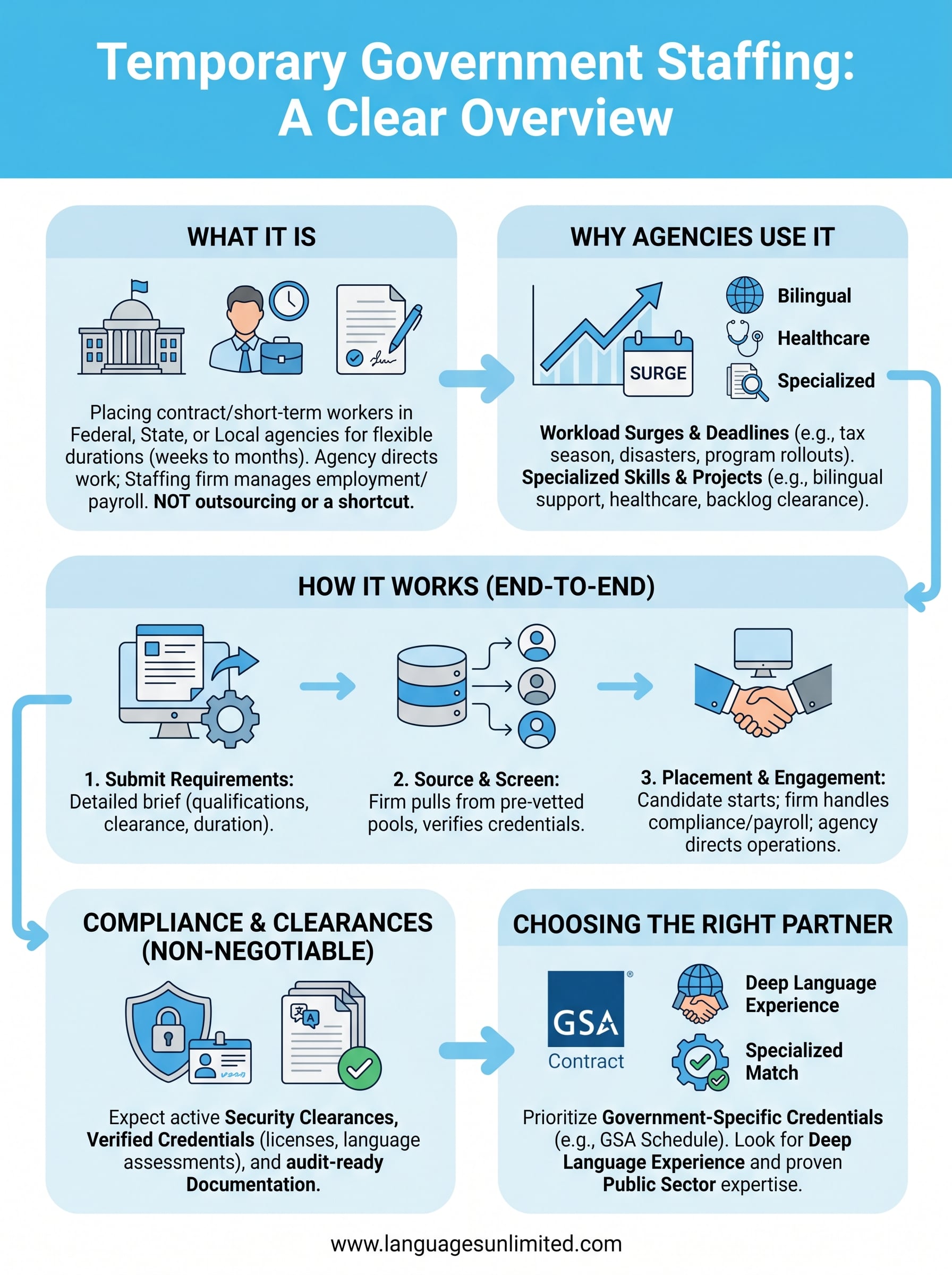
Temporary government staffing refers to placing contract or short-term workers within federal, state, or local government agencies to meet specific workforce needs. These placements have a defined duration, whether it’s a few weeks to cover an unexpected vacancy or several months to support a project with a hard deadline. The key feature is flexibility: you get qualified people in place fast, without committing to a permanent hire.
What it is
Agencies use this model for a wide range of roles and engagement types. You might need an administrative coordinator to manage a backlog while you recruit permanently, or a bilingual case manager for a surge in public services demand. Staffing firms that specialize in government work maintain pools of pre-vetted candidates who already understand public sector environments, documentation standards, and reporting expectations.
The strongest government staffing providers don’t just fill seats: they send people who already understand how public sector operations run.
These engagements can also move into longer contract-to-hire arrangements, where you evaluate a worker on the job before making a permanent offer. In healthcare, social services, and administrative support, this model reduces the risk of a poor long-term hire while keeping your operations running in the meantime.
What it isn’t
Temporary staffing is not the same as outsourcing an entire function or department. You still direct the day-to-day work of the placed personnel; the staffing firm handles the employment relationship, payroll, and compliance paperwork. That distinction matters because it keeps you in control of the work while removing the administrative burden of employment.
It’s also not a shortcut around qualification standards. Government roles often require verified credentials and background checks, and in some cases, active security clearances. Legitimate agencies screen candidates rigorously before presenting them to you. If a provider skips that process, that’s a signal to look elsewhere. The positions may be temporary, but the standards and accountability attached to them are not.
Why agencies use temporary staffing
Government agencies don’t turn to temporary staffing out of convenience. They use it because permanent hiring cycles simply don’t match the pace of real operational demands. Federal hiring alone can take months, and state and local agencies face similar timelines. When a key position opens up or a program launches ahead of schedule, you need qualified personnel ready now, not six months from now.
Workload surges and program deadlines
Agencies frequently face situations where demand spikes sharply within a short window: tax season, disaster response, enrollment periods, or a new federal program rollout. These aren’t steady-state needs, and staffing permanently for them creates long-term payroll costs that outlast the surge. Temporary government staffing lets you match your workforce size to your actual workload, scaling up when volume is high and scaling back once it stabilizes.
Filling a role with the wrong person costs more than the vacancy itself, which is why experienced providers prioritize pre-vetted candidate pools before any placement is made.
Specialized skills for specific projects
Some projects require expertise that doesn’t exist in your current workforce, whether that’s bilingual case managers for a community outreach initiative or healthcare professionals for a short-term public health program. Temporary staffing gives you access to targeted skill sets without permanently restructuring your team or expanding your long-term headcount.
Common reasons agencies bring in temporary specialists include:
- Bilingual or multilingual program support
- Healthcare and social services surges
- Administrative backlog clearance
- Short-term compliance or reporting projects
How temporary government staffing works end to end
Understanding the process from start to finish helps you set realistic timelines and know exactly what to provide upfront. Temporary government staffing follows a clear sequence: you submit your requirements, the firm sources and screens candidates, and a qualified person starts contributing to your operations. Each step has its own checkpoints, and knowing what happens at each one puts you in a stronger position to move quickly.
Submitting requirements and sourcing candidates
Your engagement starts with a detailed position brief. You share the role’s responsibilities, required qualifications, any language or security clearance needs, the expected duration, and your target start date. The more specific your brief, the faster the firm can identify the right candidates from its existing pool.

Pre-vetted candidate pools are what separate experienced government staffing firms from general recruiters: they can move in days rather than weeks when your brief is clear.
Once the firm has your requirements, it pulls from its screened talent database first, then broadens the search if needed. Candidates are evaluated against your criteria, including credentials, background history, and any clearance or language requirements you specified.
Placement and the start of the engagement
After you review and approve a candidate, the staffing firm handles employment paperwork, payroll, and compliance documentation. You don’t manage any of that administrative load. Your focus stays on the work itself while the firm manages the employment relationship behind the scenes.
During the engagement, the firm stays available to resolve any performance or administrative concerns quickly. That keeps your operations running smoothly without adding to your day-to-day management responsibilities.
Compliance, clearances, and documentation to expect
Compliance is non-negotiable in government work, and temporary government staffing is no exception. The roles you fill through a staffing firm carry the same legal and regulatory expectations as your permanent positions. Before any candidate starts, you should expect a clear picture of what documentation is required and what the staffing firm has already verified on your behalf.
Security clearances and background screening
Many government roles require candidates to hold active security clearances, and some positions demand specific clearance levels before a candidate can even be considered. Your staffing partner should confirm clearance status upfront, not after a candidate is selected. At Languages Unlimited, we place both cleared and non-cleared personnel, which means we screen for the right level before presenting anyone to you.

Cleared candidates who are already active are faster to place than those requiring a new investigation, which can add weeks or months to your timeline.
Documentation your staffing firm should provide
Beyond clearances, expect your staffing provider to supply verified credential documentation for every placed candidate. This includes employment eligibility verification, professional licenses where required, and any language proficiency assessments for bilingual or multilingual roles. Government agencies also require that placed workers meet specific standards around reporting, timekeeping, and conduct, and your staffing firm should confirm that each candidate has been briefed on those expectations before the engagement begins.
Having this paperwork organized and on file from day one keeps your audit trail clean and protects your agency from compliance gaps that surface later.
Choosing a temporary government staffing partner
Not every staffing firm is equipped to handle government work. The right partner brings verified experience placing personnel in public sector environments, holds the credentials that make procurement straightforward, and can support specialized requirements like security clearances or bilingual placements. Choosing the wrong provider creates delays, compliance gaps, and turnover that disrupts your operations.
Certifications and contract vehicles
Your first filter should be government-specific credentials. A firm with a GSA Schedule contract has already cleared federal procurement vetting, which makes engaging them faster and significantly reduces your administrative burden. Look for providers that are established members of professional associations and have documented experience with federal, state, or local agencies. These credentials aren’t just marketing; they reflect real operational standards.
A GSA contract holder has already passed federal procurement review, which means you can move directly to placement without the friction of a lengthy vendor qualification process.
Specialization that matches your actual needs
Temporary government staffing requires more than a large candidate database. You need a partner that screens for the specific qualifications your roles demand, whether that’s active clearances, licensed healthcare professionals, or verified bilingual fluency. Ask directly how they source candidates for government placements, how they verify credentials, and what their typical time-to-fill looks like for roles similar to yours.
A firm with deep language services experience, like Languages Unlimited, brings an added advantage when your agency serves diverse populations: access to multilingual professionals that general staffing firms simply don’t have in their pipelines.
Next steps
Temporary government staffing works best when you engage a provider that already understands public sector requirements and has the infrastructure to support them. You’ve seen what the model covers, why agencies rely on it, how placements move from requirement to role, and what compliance and clearance expectations look like. You now have a clear enough picture to evaluate your current workforce gaps and decide whether a short-term placement or a contract-to-hire arrangement fits your situation better.
If your agency needs qualified personnel quickly, whether that’s bilingual case managers, administrative support, or cleared professionals for sensitive roles, Languages Unlimited is built for exactly that. We hold a GSA contract, we’ve been placing government personnel since 1994, and we can source multilingual candidates that most staffing firms don’t have access to. Contact our government staffing team to discuss your requirements and get a clear timeline for your next placement.