



Government agencies at every level, federal, state, and local, face a persistent challenge: doing more with fewer people. Hiring freezes, retirement waves, and competition with the private sector for skilled talent have left many agencies stretched thin. Workforce augmentation for government offers a practical solution, allowing agencies to bring in qualified external professionals on a contract or temporary basis to fill gaps without the delays of traditional civil service hiring.
But workforce augmentation isn’t just about adding headcount. It’s about placing the right people with the right skills where they’re needed most, whether that means bilingual caseworkers for a social services office, clinical staff for a public health initiative, or administrative support during a seasonal surge. For agencies serving diverse communities, language capability and cultural competency are non-negotiable, and finding professionals who meet those standards adds another layer of complexity.
At Languages Unlimited, we’ve supported government agencies with multilingual staffing, interpretation, and translation services since 1994. As a GSA contract holder with deep roots in the language industry, we understand the compliance requirements, security considerations, and operational pressures that come with government workforce needs. That experience gives us a grounded perspective on what workforce augmentation looks like in practice, and where it delivers real value.
This article breaks down what workforce augmentation means for government, how agencies use it, and what to look for in a staffing partner. Whether you’re exploring contract staffing for the first time or looking to scale an existing program, you’ll find actionable guidance to help you move forward.
What workforce augmentation means in government
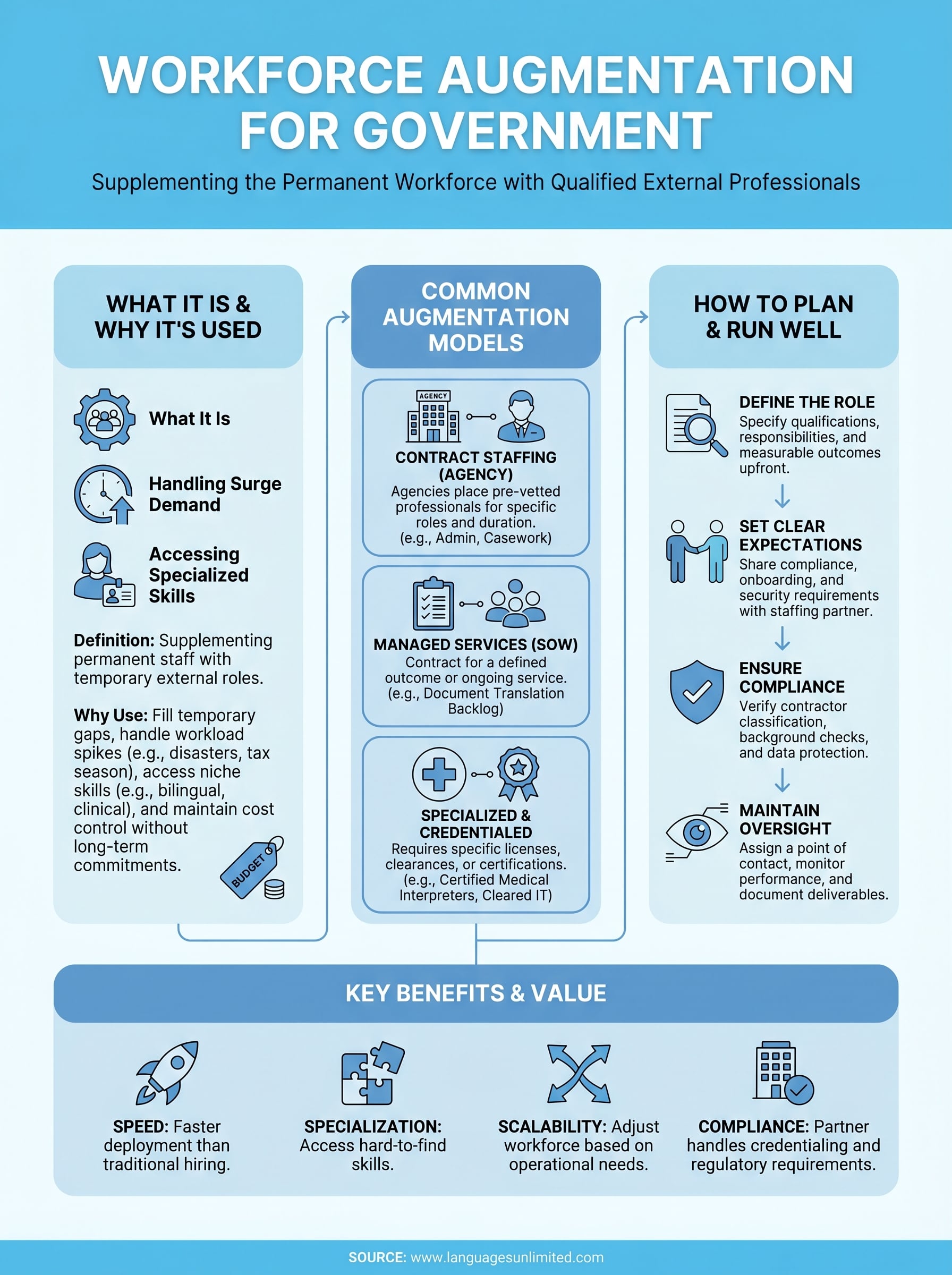
Workforce augmentation for government refers to the practice of supplementing a permanent government workforce with external professionals, whether through staffing agencies, contract labor, or specialized service providers, to fill skill gaps, handle surge demand, or meet project-specific needs. Unlike outsourcing, where an entire function moves outside the agency, augmentation keeps your internal team in control while external professionals step in to support specific roles or tasks. The result is a flexible workforce that can scale up or down based on operational reality rather than headcount limits.
Augmentation gives agencies the ability to respond to changing demands without waiting months for a traditional hire to clear the civil service process.
This approach applies across a wide range of functions, from administrative support and IT to healthcare delivery and language services. A public health department might bring in bilingual nurses during a vaccination campaign. A court system might contract with interpreters for ongoing proceedings. A federal agency might add cleared administrative staff to manage a policy rollout. In each case, the augmented professionals work alongside permanent staff, filling a defined role for a defined period.
How it differs from traditional government hiring
Traditional civil service hiring is thorough, and for good reason: it protects merit, ensures fairness, and builds institutional knowledge. But it moves slowly. Posting a position, reviewing applications, conducting interviews, and completing background checks can take months, sometimes over a year for security-cleared roles. When an agency needs someone in place quickly, that timeline creates a real operational problem.
Workforce augmentation sidesteps that delay by drawing on a pre-vetted pool of professionals. The staffing partner handles much of the initial screening, verification, and compliance work, so the agency receives qualified candidates faster. This doesn’t replace the career workforce; it supplements it when speed and flexibility matter most.
- Speed: Augmented staff can be deployed in days or weeks rather than months
- Specialization: Agencies can access niche skills, such as language fluency, clinical credentials, or security clearances, without building those capabilities permanently
- Cost control: You pay for the work you need during the period you need it, without long-term benefits and pension obligations
- Compliance: Reputable staffing partners handle certifications, background checks, and regulatory requirements as part of the engagement
Where augmented staff typically fit
Augmented professionals tend to fill one of three roles within a government setting. First, they cover temporary gaps left by retirement, leave, or turnover, keeping operations running while a permanent hire moves through the hiring process. Second, they support surge periods, such as tax season, disaster response, open enrollment, or a large-scale public program launch. Third, they bring specialized expertise the agency doesn’t have in-house and doesn’t need permanently, such as a certified medical interpreter for a short-term health initiative.

Understanding which category applies to your situation helps you define the scope of the engagement clearly. A well-scoped augmentation role has a defined start, a clear set of responsibilities, and measurable outcomes. That clarity benefits both the agency and the professional filling the role, and it’s the foundation of a staffing arrangement that actually delivers.
Why agencies use workforce augmentation
Government agencies turn to workforce augmentation for government for a straightforward reason: operational demands don’t wait for the civil service hiring process to catch up. Budget cycles, policy shifts, population changes, and public health emergencies create spikes in workload that a fixed headcount simply cannot absorb. Augmentation gives you a practical lever to pull when demand outpaces your current capacity, without adding permanent positions that require long-term budget commitments.
Budget constraints and hiring freezes drive the need
Many agencies operate under strict headcount caps or active hiring freezes imposed by legislative or executive mandates. These constraints don’t reduce workload; they just limit how you can staff for it. Contract professionals fall outside permanent headcount in most accounting frameworks, which means you can bring in qualified support without triggering a full-time position approval. That flexibility lets you stay compliant with budget directives while still delivering services on time.
When a hiring freeze hits, augmented staff often become the only practical path to keeping critical programs running on schedule.
Agencies also face retirement waves that are draining institutional knowledge faster than new hires can replace it. Augmented professionals can bridge that gap, keeping operations stable while permanent replacements move through the standard hiring pipeline.
Specialized roles require skills that are hard to build internally
Some skills take years to develop and aren’t needed every day. Certified medical interpreters, cleared IT specialists, bilingual caseworkers, and licensed clinical staff represent expertise that most agencies can’t justify hiring permanently when demand is project-based or seasonal. Workforce augmentation lets you access those professionals precisely when you need them, without carrying the cost year-round.
For agencies serving communities with limited English proficiency, language-qualified staff aren’t optional. Federal requirements under Executive Order 13166 obligate agencies to provide meaningful access to programs and services for people who don’t speak English fluently. Bringing in augmented bilingual and multilingual professionals is often the fastest way to meet that obligation without waiting months for a traditional hire to clear the process.
Common augmentation models and examples
Not all augmentation looks the same. Workforce augmentation for government takes several forms depending on the agency’s needs, timeline, and compliance requirements. Understanding which model fits your situation helps you structure the engagement correctly from the start, which saves time and reduces friction during oversight reviews.

Contract staffing through a staffing agency
The most common model is contract staffing through a third-party staffing firm. Your agency defines the role, required qualifications, and duration; the staffing partner recruits, screens, and places a qualified professional. The contractor works on-site or remotely alongside permanent staff, but remains employed by the staffing firm. This model works well for administrative support, casework, clinical roles, and language-qualified positions where the need is clear and the scope is well defined.
This is often the fastest path to filling a role, since the staffing partner handles verification, credentialing, and initial compliance checks before placement.
Managed service and statement-of-work arrangements
Some agencies need a team of professionals or an ongoing service rather than a single contractor. In those cases, a managed service arrangement or statement-of-work contract fits better. Your agency contracts with a provider to deliver a defined outcome, such as processing a backlog of translated documents or staffing a multilingual benefits hotline. The provider manages scheduling, quality, and reporting, while your agency monitors performance against agreed metrics.
This model is especially common in language services and accessibility support, where consistent coverage across many languages would require dozens of permanent hires if handled internally. A single contract with a qualified provider can cover interpretation, translation, and transcription across a broad range of languages and service types.
Specialized and credentialed professionals
Some augmentation roles require specific licenses, security clearances, or professional certifications that go beyond standard staffing. Clinical staff such as nurses, medical assistants, and patient care representatives must hold active credentials verified against state licensing boards. Bilingual professionals serving limited-English-proficient populations must demonstrate both language proficiency and cultural competency before placement. These requirements raise the bar for the staffing partner’s vetting process, but they are non-negotiable when serving vulnerable or regulated communities.
How to plan and run augmentation well
A workforce augmentation for government engagement only delivers results when it’s well-scoped from the beginning. Agencies that skip the planning phase often end up with contractors who don’t fit the role, deliverables that aren’t clearly owned, and compliance gaps that surface during audit reviews. Taking time to define what you need before you contact a staffing partner saves significant effort and reduces friction once the engagement is underway.
Define the role before you search
Before you post a requirement or contact a vendor, write a clear role description that specifies required qualifications, expected responsibilities, start date, duration, and any certification or language requirements. This sounds basic, but many agencies skip it and then spend weeks reworking the scope after placement. A well-defined role helps your staffing partner find the right candidate faster, and it gives the contractor a clear target from day one.
Consider what success looks like in measurable terms. If you’re bringing in a bilingual caseworker for a six-month program, define caseload expectations, required language pairs, and any reporting obligations. The more specific your scope, the easier it is to evaluate performance and extend or close the engagement on solid ground.
Set clear expectations with your staffing partner
Your staffing partner needs the same level of clarity you give your internal team. Share your compliance requirements, onboarding procedures, and any security or credentialing steps upfront so they can factor those timelines into the placement process. If your agency uses a GSA schedule or a specific contract vehicle, confirm that the partner holds the appropriate contract before you begin.
The agencies that get the most value from augmented staff are the ones that treat their staffing partner as an operational collaborator, not just a vendor.
Establish a single point of contact on both sides, schedule regular check-ins during the first 30 days, and build a clear process for flagging performance concerns early. Those practical structures prevent small issues from becoming costly ones and keep the engagement running smoothly throughout its term.
Risks, compliance, and governance
Workforce augmentation for government carries real compliance obligations that you need to address before a single contractor walks through the door. Misclassifying workers, skipping background check requirements, or using a vendor that doesn’t hold the right contract vehicle can trigger audit findings, program delays, or even legal liability. The good news is that most risks are manageable when you build compliance checkpoints into your planning process rather than treating them as an afterthought.
Understand contractor classification and procurement rules
Most government agencies must follow specific procurement regulations, such as the Federal Acquisition Regulation (FAR) for federal entities, before engaging a staffing vendor. If your agency uses a GSA schedule or a blanket purchase agreement, confirm that your vendor holds the correct contract vehicle before you begin. Engaging a vendor outside your authorized procurement pathway creates an audit risk that your contracting officer will flag, often at the worst possible moment.
Skipping the procurement verification step is one of the most common and preventable compliance failures in government staffing engagements.
You also need to confirm that your contractor classification structure is correct from the start. Contractors must not be treated as de facto employees, meaning you cannot direct their work methods the same way you manage permanent staff. Define deliverables and performance standards clearly in the statement of work, and keep your supervisory relationship within the boundaries your legal and HR teams have reviewed.
Protect data and maintain program oversight
Augmented staff frequently handle sensitive constituent data, protected health information, or controlled unclassified information, depending on the program they support. Your agency is responsible for ensuring that every contractor completes required data handling training and signs any applicable non-disclosure agreements or data access authorization forms before they access systems. Don’t assume the staffing partner has covered this; verify it in writing as part of onboarding.
Maintaining clear oversight throughout the engagement protects both your agency and the contractor. Assign a designated government point of contact to monitor deliverables, conduct periodic check-ins, and document performance formally. That documentation becomes critical if you need to extend, modify, or terminate the engagement, and it gives you a clean record if an oversight review surfaces questions later.
Next steps
Workforce augmentation for government works best when you approach it with a clear scope, the right vendor, and compliance built into the process from day one. The agencies that see the most consistent results treat augmentation as a deliberate workforce strategy, not a stopgap measure they reach for when things break down. Whether you need bilingual caseworkers for a social services program, cleared administrative staff for a policy rollout, or clinical professionals for a public health initiative, the path forward starts with defining exactly what your agency needs and when you need it.
At Languages Unlimited, we work with government agencies across all 50 states to place qualified multilingual professionals and deliver language services that meet federal compliance standards. Our GSA contract makes procurement straightforward, and our network covers more than 200 languages. Contact our government staffing team to discuss your requirements and get a staffing plan that fits your timeline and budget.