



Winning government or corporate contracts doesn’t start with submitting a bid, it starts with becoming a procurement ready vendor long before opportunities hit the market. Agencies and large organizations vet their suppliers carefully, and if your business isn’t properly registered, certified, and compliant, your proposal won’t make it past the first review.
At Languages Unlimited, we know this process from the inside. As a GSA Contract Holder and long-standing provider of language services to federal, state, and local government agencies since 1994, we’ve navigated the full procurement qualification pipeline, from SAM registration and capability statements to past performance documentation and compliance requirements. Every contract we’ve earned required deliberate preparation, not guesswork.
This guide breaks down the concrete steps your business needs to take to qualify for contracts and position itself as a vendor that procurement officers actually want to work with. Whether you’re pursuing your first government contract or tightening up your approach after a few unsuccessful bids, you’ll walk away with a clear action plan built on real procurement requirements. We’ll cover registration essentials, certifications that matter, how to build a strong capability statement, and what buyers look for when they evaluate potential vendors.
What "procurement ready vendor" means in practice
Being a procurement ready vendor means your business can pass a buyer’s vetting process before a contract opportunity is even announced. It is not a certificate you apply for once and forget. It is a continuous state of administrative, operational, and financial preparedness that signals to government agencies and large corporations that you can accept a contract, deliver on your obligations, and meet compliance requirements without support from the buying organization. Buyers at every level, from federal agencies to hospital systems, operate under tight timelines and stricter oversight than ever. They cannot afford to take a chance on a vendor who isn’t ready on day one.
Procurement officers don’t have time to coach vendors through the basics. If your registrations are expired, your documentation is incomplete, or your financials aren’t in order, they move to the next supplier on the list without a second look.
The core components buyers check
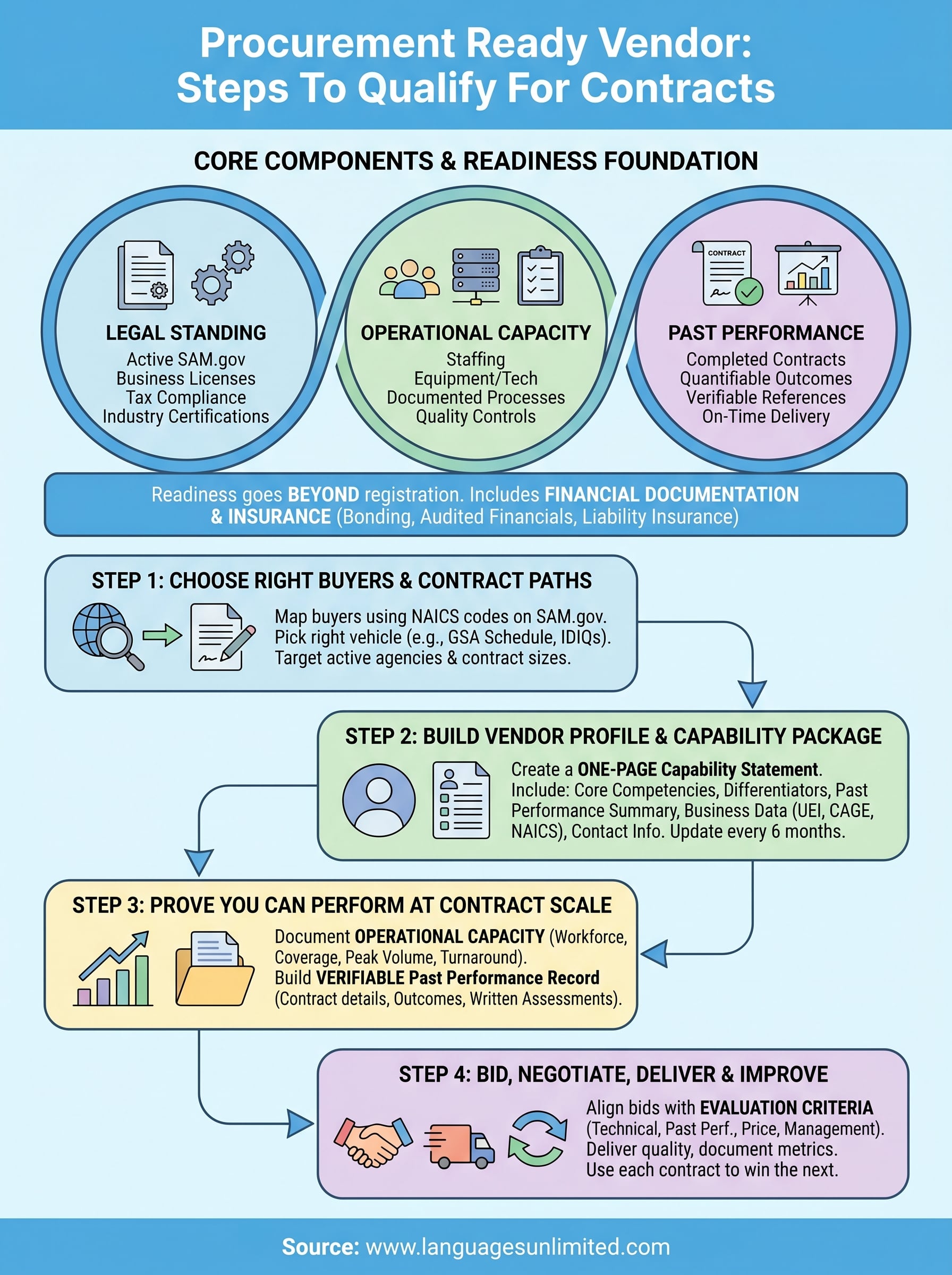
When a procurement officer evaluates your vendor profile, they’re looking at a specific set of factors across three broad areas: legal standing, operational capacity, and past performance. Understanding what falls under each category lets you audit your own readiness gaps before a buyer discovers them during evaluation. Use the table below as a quick reference for what each area typically requires.

| Area | What buyers evaluate |
|---|---|
| Legal standing | Active SAM.gov registration, state business licenses, tax compliance, required industry certifications |
| Operational capacity | Staffing levels, equipment or technology, documented processes, quality controls, subcontractor relationships |
| Past performance | Completed contracts, quantifiable outcomes, verifiable client references, on-time delivery records |
Each area carries weight in the evaluation. Missing or outdated information in any single area can disqualify your bid even when the other two are strong, so treat all three as equally important.
Why readiness goes beyond registration
Many vendors assume that completing their SAM.gov registration is the finish line. In reality, registration is the starting point. Buyers also expect a professional capability statement, documented internal processes, and clear evidence that your team can perform at the scale the contract demands. Registration confirms your business exists. Everything else confirms your business can deliver.
Your readiness also depends heavily on financial documentation. Some contracts require proof of bonding capacity, audited financials, or a minimum number of years in operation. Contracts in specialized sectors, including language services or healthcare staffing, may also require professional liability insurance at specific coverage levels. If you haven’t reviewed your financial and insurance records with contract requirements in mind, you’re almost certainly missing something that will surface during the buyer’s evaluation and cost you the award.
Step 1. Choose the right buyers and contract paths
Chasing every contract opportunity you can find is one of the fastest ways to burn time, money, and credibility. Before you spend a single hour on registration paperwork, identify exactly which buyers purchase what you sell and which contract vehicles they use to make those purchases. The right match between your capabilities and the buyer’s mission shortens your sales cycle and strengthens every bid you submit.
Map your buyers before you register
Start by researching the agencies or organizations that consistently buy services in your industry. For federal opportunities, use SAM.gov to search awarded contracts by NAICS code, the classification system that identifies your industry type. Filter by your relevant code and look at which agencies have awarded contracts in that category over the past two years. This tells you exactly where the active procurement activity sits, not where you assume it sits.
The agencies that appear repeatedly in past awards are far more likely to have budget and intent than those you find through cold outreach.
Pay attention to contract size and incumbent vendors in those awards. If most contracts in your space are awarded at the $500K or above level, you need to either scale your operations to match or target subcontracting opportunities under a prime contractor first.
Pick the contract vehicle that fits your stage
Contract vehicles determine how buyers access you. A GSA Schedule, for example, allows federal agencies to purchase from you without a full competitive bid process, which dramatically reduces the barrier to entry once you’re on the schedule. Blanket Purchase Agreements and IDIQs are other common vehicles worth understanding.
As a procurement ready vendor, you should match your registration efforts to the specific vehicle type your target buyers actively use, not the one that sounds most impressive on paper.
Step 2. Build your vendor profile and capability package
Your vendor profile and capability statement are what procurement officers review when your bid lands in front of them. A weak or generic profile loses contracts that your actual qualifications should win. Every element of your profile needs to be deliberate: your NAICS codes must reflect the work you actually do, your business description must align with the buyer’s mission, and your capability statement must show exactly what you deliver and why you’re the right choice.
Write a capability statement that gets read
A capability statement is a one-page document that introduces your business to a buyer in a format they already know how to evaluate. As a procurement ready vendor, your statement must include five specific elements: your core competencies, your differentiators, your past performance summary, your business data (UEI, CAGE, NAICS), and your direct contact information. Keep it to one page. Buyers read dozens of these, and a two-page statement signals that you haven’t done the work to prioritize what matters most.
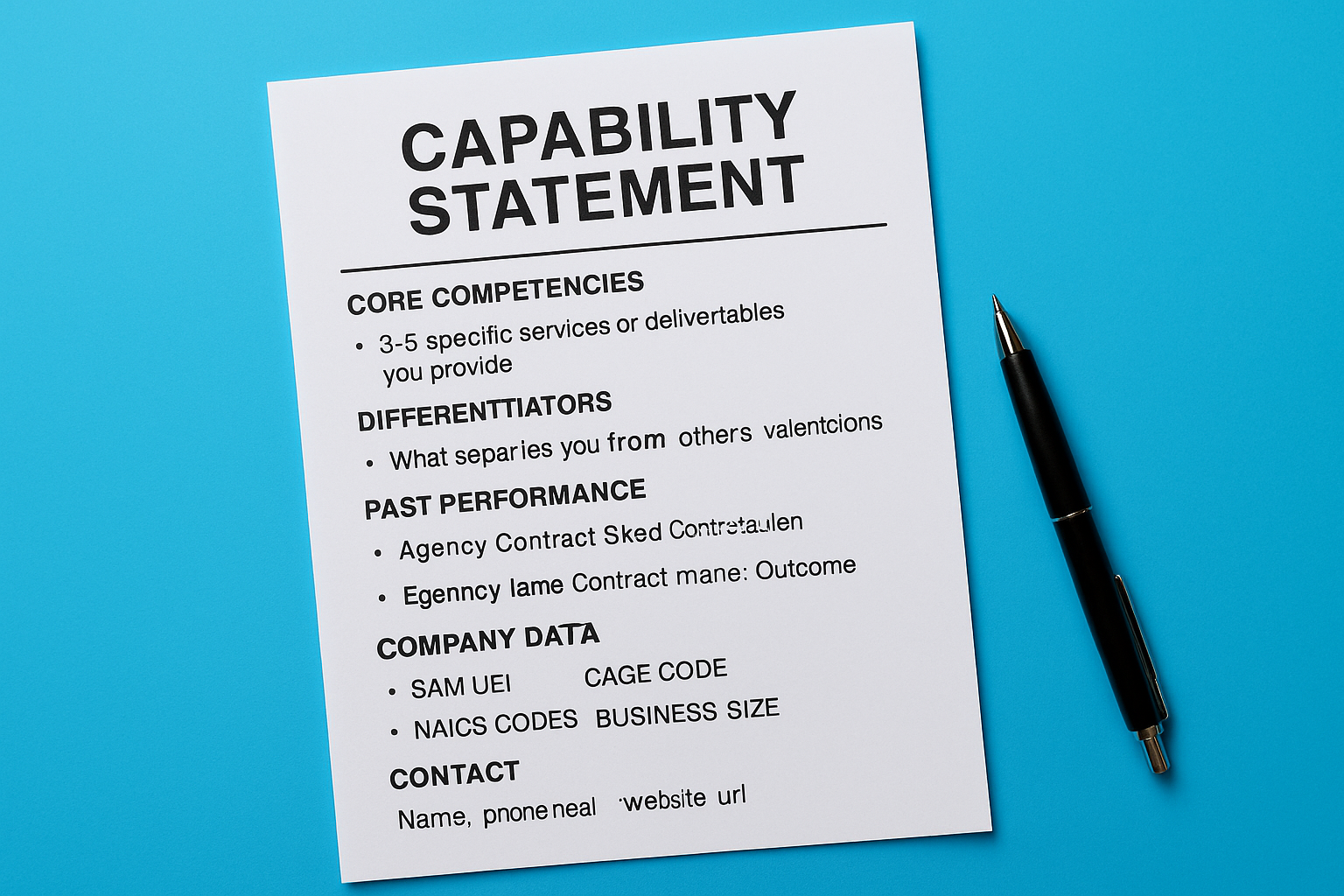
The capability statement is your first impression in procurement. If it doesn’t answer "what do you do, who have you done it for, and why are you better," it won’t get a second look.
Use the template structure below as your starting point:
| Section | What to include |
|---|---|
| Core competencies | 3-5 specific services or deliverables you provide |
| Differentiators | What separates you from others (certifications, speed, scale, coverage) |
| Past performance | 2-3 completed contracts with agency name, contract value, and outcome |
| Company data | SAM UEI, CAGE code, NAICS codes, business size classification |
| Contact | Name, phone, email, and website URL |
Updating this document every six months keeps your past performance current and ensures your certifications and business classifications reflect your current status accurately.
Step 3. Prove you can perform at contract scale
Qualifying on paper gets you to the evaluation stage. Proving you can deliver at the volume, speed, and quality a contract demands is what gets you the award. Buyers at the federal and corporate level take on significant risk every time they onboard a new vendor, so your job is to remove as much of that uncertainty as possible before they ask for it.
Document your operational capacity
Your capability claim means nothing without supporting evidence. If a contract requires you to deliver services across multiple states simultaneously, you need to show documented proof that your staffing, technology, and logistics infrastructure can handle that load. Pull together a capacity profile that includes your current headcount by role, your geographic coverage, your average turnaround time, and the peak volume you’ve handled in the past 24 months. This is not a marketing document. It is a factual summary that a procurement officer can verify.
Buyers aren’t impressed by what you say you can do. They’re persuaded by what you can prove you’ve already done.
Use this template to structure your capacity profile:
| Capacity factor | Your documented evidence |
|---|---|
| Workforce | Total qualified staff by role and location |
| Coverage area | States or regions where you actively operate |
| Peak volume handled | Highest project load completed within a single month |
| Turnaround benchmarks | Average delivery time by service or product type |
Build a past performance record that holds up
A procurement ready vendor keeps a living record of completed contracts, not just a list of former clients. For each completed engagement, document the agency or company name, the contract value, the scope of work, and the measurable outcome you delivered. Two or three strong, verified past performance references carry more weight than a long list of names with no supporting detail. Ask your former clients to confirm the details in writing so your references hold up when buyers call to verify them.
Step 4. Bid, negotiate, deliver, and improve
Submitting a bid is not the final step, it is the beginning of a cycle. Every proposal you write, every contract you negotiate, and every delivery you complete feeds back into your readiness for the next opportunity. A true procurement ready vendor treats each contract as both a revenue source and a performance record that strengthens future bids.
Submit bids that score against the evaluation criteria
Federal and corporate solicitations include an evaluation rubric, usually called a Source Selection Criteria or similar. Read it before you write a single line of your proposal. Structure your response to mirror the exact criteria buyers use to score submissions. If technical approach is weighted at 40%, your proposal needs to give that section the most depth and specificity. Use the table below to align your proposal sections with common evaluation weights.
| Evaluation factor | What buyers typically score |
|---|---|
| Technical approach | How clearly you explain your delivery method |
| Past performance | Relevance and quality of prior contracts |
| Price/cost | Competitiveness and supporting cost breakdown |
| Management plan | Staffing, oversight, and risk mitigation |
A proposal that mirrors the solicitation’s language and structure signals to evaluators that you understand their requirements, not just your own services.
Deliver, document, and use each contract to win the next one
Once you win a contract, your delivery quality and documentation determine how useful that contract becomes for future bids. Track your performance metrics throughout the contract period: on-time delivery rates, error rates, client satisfaction scores, and any scope expansions you managed successfully. Capture these numbers in a format you can drop directly into your next capability statement or past performance submission.
After each contract closes, request a written performance assessment from the contracting officer or client. This document becomes verified evidence that your claims hold up under scrutiny, and it removes the uncertainty buyers carry when evaluating vendors they haven’t worked with before.
Next steps to stay contract-ready
Staying qualified isn’t a one-time task. Your SAM.gov registration expires annually, your certifications have renewal windows, and your past performance record needs updating after every completed contract. Build a quarterly review habit that checks registration status, insurance coverage levels, and capability statement accuracy so you’re never caught flat-footed when an opportunity opens.
Work through each step in this guide systematically. Start with buyer research and NAICS code selection, then move into registration, capability documentation, and capacity evidence. Every layer you complete makes your profile stronger and your bids more competitive. A procurement ready vendor doesn’t wait for the perfect contract to appear. Build the infrastructure first, then pursue the opportunities that align with your documented capabilities and past performance record.
If your organization needs a language services partner that is already contract-ready and cleared to work with government agencies, contact Languages Unlimited to discuss your specific project requirements.