



Hiring someone who hasn’t been properly vetted is a risk most organizations can’t afford to take, especially in healthcare, government, and education, where the stakes involve vulnerable populations and sensitive information. Background checked personnel are employees or contractors who have gone through a formal screening process to verify their identity, criminal history, employment record, and other critical credentials before they’re placed in a role. It sounds straightforward, but the process has layers that trip up even experienced hiring managers.
At Languages Unlimited, we deal with this directly. Our staffing solutions place bilingual and multilingual professionals in hospitals, government agencies, schools, and nonprofits across the United States, and every one of those placements demands rigorous background screening. We’ve built our processes around compliance-focused staffing since 1994, so we understand what it takes to get this right, and what goes wrong when organizations cut corners.
This article breaks down what "background checked personnel" actually means, walks through the standard screening process from start to finish, and explains how to hire pre-vetted professionals efficiently. Whether you’re managing your own background checks or working with a staffing partner to source verified candidates, you’ll find practical guidance here to strengthen your hiring process and reduce risk.
What background checked personnel means
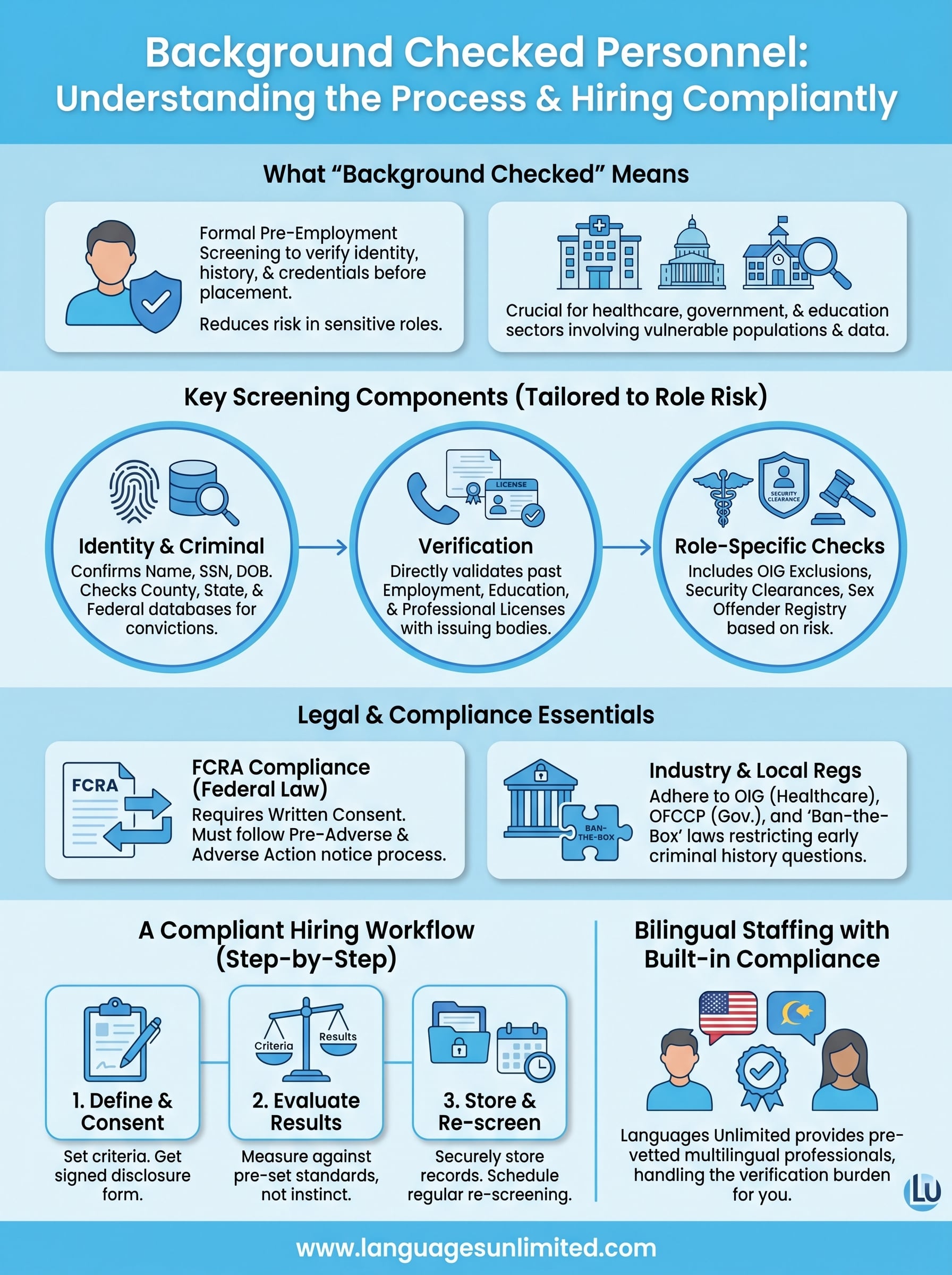
The phrase "background checked personnel" refers to any individual who has completed a formal pre-employment or pre-placement screening before being hired or assigned to a role. That screening typically covers identity verification, criminal history, and employment records, and depending on the position, professional licenses or security clearances. The goal is to give you a verifiable picture of who someone is before they have access to your patients, your data, your facilities, or your clients.
What the screening actually verifies
A background check is not a single database lookup. It’s a structured review process that pulls information from multiple sources to confirm that a candidate is who they say they are and that their history doesn’t present unacceptable risk for the role you’re filling. Identity verification typically comes first, confirming that a person’s name, Social Security Number, and date of birth match official records. From there, the check branches into criminal history, civil records, past employers, academic credentials, and professional certifications depending on what the position requires.
The depth of a background check should always match the risk level of the role. A patient-facing nurse requires a different scope of screening than an administrative assistant.
Verifying credentials goes beyond confirming that a certificate exists. It means contacting the issuing institution or licensing board directly to confirm that the credential is current, was legitimately earned, and hasn’t been revoked. This step catches credential fraud, which is more common than most employers expect, particularly in healthcare and government contracting.
Why the role determines what gets checked
Not every position carries the same risk profile, and that’s why background checked personnel placed in a hospital emergency department are vetted differently than those placed in a school administrative office. High-trust environments, such as roles involving direct patient care, access to classified government data, or work with minors, require deeper and more frequent screening. Federal contractors, for example, often need personnel who have undergone a formal security clearance process managed through the federal government.
Lower-risk roles still require baseline checks. The mistake many organizations make is applying a one-size-fits-all approach to screening, either over-screening for entry-level roles in ways that slow hiring unnecessarily, or under-screening for sensitive roles because the process feels burdensome. Neither extreme protects your organization, and both create liability.
How the definition shifts across industries
In healthcare, "background checked" typically means the individual has cleared federal exclusion databases like the OIG exclusion list, passed a criminal background check, and had their licenses verified with the relevant state board. In government staffing, the term often extends to include security clearance levels and adjudication outcomes. In education, it includes sex offender registry checks and may involve state-specific fingerprinting requirements.
Understanding what "background checked" means in your specific industry and jurisdiction is the starting point for building a defensible hiring process. If you work with a staffing partner, ask them directly what their screening protocol includes, how recently the checks were completed, and whether their process meets your sector’s compliance standards. A partner who can answer those questions clearly is one who takes verification seriously.
What a standard screening can include
Most hiring managers know that a background check involves a criminal history search, but a thorough screening covers significantly more ground than that. The components you include should reflect the responsibilities of the role, the sensitivity of the data or populations involved, and any regulatory requirements specific to your industry. Understanding what each component covers helps you build a screening protocol that protects your organization without creating unnecessary delays.
Criminal history and identity checks
Criminal background checks and identity verification form the foundation of any screening process. Identity verification confirms that the person in front of you is who they claim to be by cross-referencing their name, Social Security Number, and date of birth against official records. Once identity is confirmed, a criminal history search pulls records from county, state, and federal databases to surface any convictions, pending charges, or sex offender registry listings.
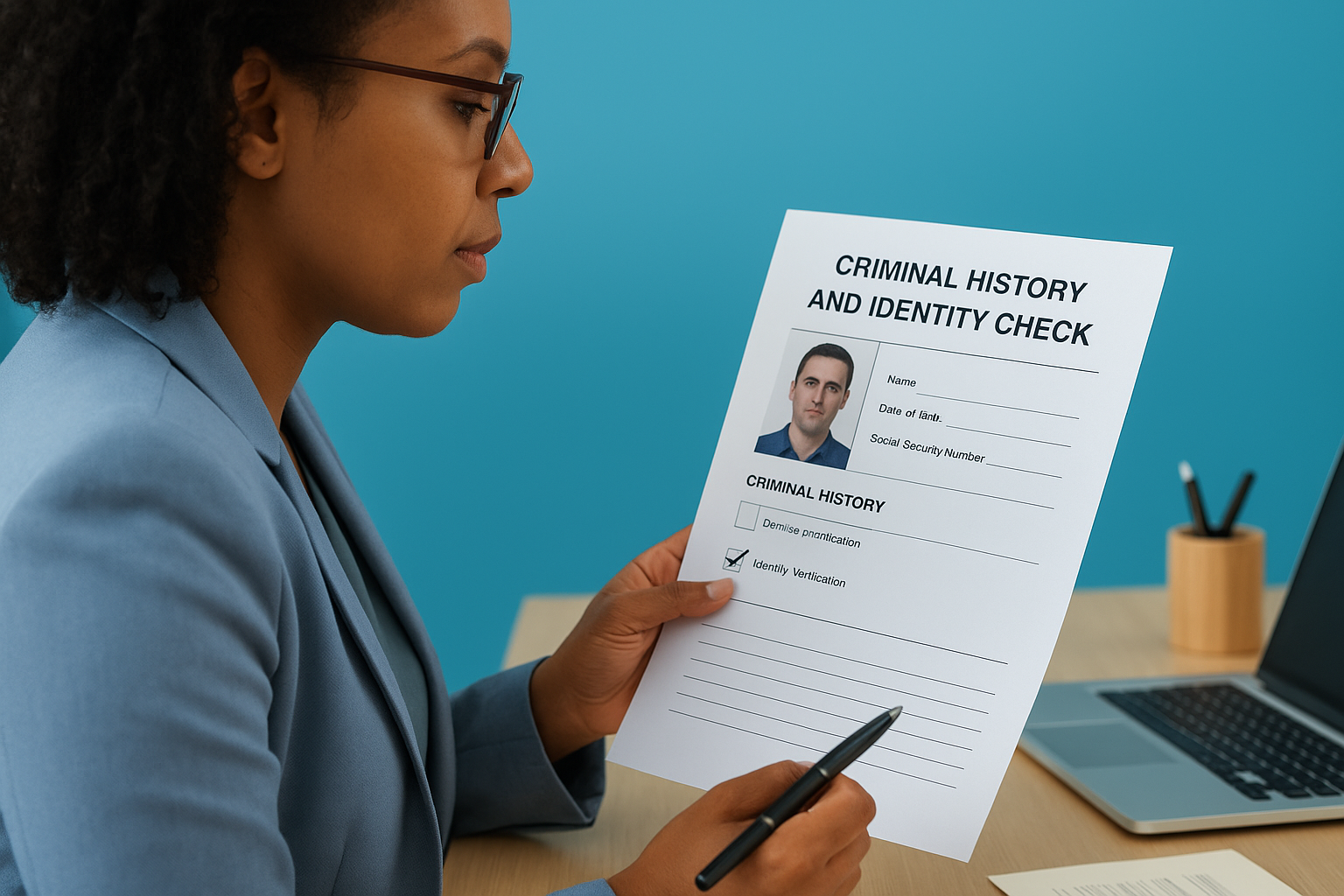
A criminal check is only as reliable as the databases it searches, so county-level checks often catch records that national database searches miss.
For background checked personnel placed in sensitive environments, you may also need to search federal criminal databases and check records in every jurisdiction where the candidate has lived or worked in recent years. Limiting the search to a single state or zip code leaves gaps.
Employment, education, and license verification
Verification checks confirm that what a candidate wrote on their resume is accurate and current. Employment verification means contacting previous employers directly to confirm job titles, dates of employment, and in some cases, eligibility for rehire. Education verification confirms that degrees or diplomas were actually awarded by the institution listed.
License verification goes further and is especially important in healthcare and legal roles. It means contacting the relevant state licensing board to confirm that a credential is active, has no disciplinary actions attached to it, and was not issued in error. Many employers skip this step and assume that a copy of a license is sufficient proof.
Additional checks for high-risk roles
Some roles require checks beyond the standard set, including federal exclusion database searches, credit history reviews for positions involving financial responsibility, and drug screening. Government roles often require candidates to complete a formal security clearance process, which includes an extensive background investigation conducted by the relevant federal agency. These extended checks take longer, but they are non-negotiable for the environments that require them.
Key laws and compliance risks to know
Background screening is regulated at both the federal and state level, and failing to follow the rules exposes your organization to lawsuits, fines, and potential loss of contracts. Before you run any checks on candidates, you need to understand the legal framework that governs how you collect, use, and store that information.
The Fair Credit Reporting Act (FCRA)
The Fair Credit Reporting Act (FCRA) is the primary federal law governing employment background checks in the United States. It requires employers to get written consent from candidates before running a check, use a compliant consumer reporting agency, and follow specific adverse action procedures if you decide not to hire someone based on what the check reveals.
Skipping the adverse action process is one of the most common and costly FCRA violations employers make, and it exposes your organization to individual lawsuits as well as class action claims.
Adverse action procedures require two steps. First, you send the candidate a pre-adverse action notice along with a copy of the background report and a summary of their rights. Then you wait a reasonable period before sending a final adverse action notice. Cutting this process short creates legal liability regardless of how clear-cut the disqualifying information appears.
Industry-specific regulations and ban-the-box laws
Beyond the FCRA, background checked personnel placed in healthcare, government, or education face additional regulatory requirements. Healthcare organizations must check the OIG List of Excluded Individuals and Entities before placing anyone in a federally funded role. Federal contractors must comply with OFCCP guidelines, and schools must follow state-mandated fingerprinting and sex offender registry checks.
Ban-the-box laws add another layer of complexity. These laws, now active in more than 35 states and 150 cities, restrict when and how employers can ask about criminal history during the hiring process. Some jurisdictions prohibit asking about convictions on initial applications entirely, while others require employers to conduct an individualized assessment before disqualifying a candidate based on their record. If you operate in multiple states, you need a screening policy that accounts for the strictest jurisdiction where you hire, or you risk applying an inconsistent standard that creates both legal exposure and candidates with legitimate grounds for a discrimination claim.
How to screen and document it step by step
A consistent, documented process is what separates organizations that can defend their hiring decisions from those that can’t. Whether you’re placing background checked personnel in a government facility or a healthcare clinic, following a structured sequence protects you legally and gives you a repeatable standard that holds up under audit.
Prepare your requirements and get written consent
Before you contact a consumer reporting agency, define the exact screening components required for the role based on its risk level, industry regulations, and any contractual obligations tied to your clients or agency contracts. Write these criteria down so your process stays consistent across candidates. Then, before you run any checks, collect written authorization from the candidate using a standalone disclosure form, not a clause buried in an application. The FCRA requires this step, and skipping it creates immediate legal exposure regardless of what the check later reveals.

Retain the signed consent form with a note of the date you received it, so you have a clear, defensible timeline if your process is ever reviewed.
Here’s a quick reference for what to gather before initiating a check:
- Signed FCRA-compliant disclosure and authorization form
- Candidate’s full legal name, date of birth, and Social Security Number
- A written list of the screening components required for the specific role
- Confirmation of which jurisdictions to include in the criminal history search
Evaluate results against pre-set criteria
When results come back, measure them against the written criteria you established before the process started, not against a judgment call made in the moment. If a finding is concerning, note exactly which information is relevant to the specific role and why, then follow the full FCRA adverse action process before making a final decision. Skipping the pre-adverse action notice or shortening the waiting period exposes you to individual claims and class action risk.
Store records and schedule re-screening
Keep all background check records in a secure file that is separate from the main personnel file, as several states require this separation by law. Set a scheduled re-screening cycle for roles involving direct access to vulnerable populations or classified data, typically every one to two years. Documenting that schedule and following it consistently shows regulators that verification is an ongoing commitment in your organization, not a one-time step at hire.
How to hire background-checked bilingual staff
Finding bilingual or multilingual professionals is already a specialized search. Finding ones who are fully vetted and verified adds another layer of complexity that most internal HR teams aren’t equipped to handle efficiently. The fastest and most reliable path is working with a staffing partner who builds background screening into their placement process, so you receive candidates who are already cleared rather than managing the verification workflow yourself.
Know what clearance level the role requires
Before you contact any staffing partner, define the exact clearance and screening requirements specific to the role you’re filling. A bilingual medical assistant working with Medicaid patients needs OIG exclusion checks and state license verification. A bilingual case worker placed in a federal agency may need a security clearance or suitability determination in addition to standard criminal and identity checks. If you don’t specify these requirements upfront, you risk receiving candidates who passed a generic check that doesn’t satisfy your regulatory obligations.
Getting requirements in writing before placement begins protects you if a client, regulator, or auditor later questions whether your background checked personnel met the required standard for the role.
Ask your staffing partner the right questions
Not every staffing firm screens at the same depth. When you evaluate a bilingual staffing partner, ask them directly which databases they search, how recently checks were completed, and whether their screening protocol aligns with the specific regulatory framework you operate under. A firm placing healthcare staff should demonstrate familiarity with OIG exclusion checks and state licensing board verification. One placing government staff should speak clearly to clearance levels, suitability standards, and federal compliance requirements.
You should also ask how they handle re-screening for long-term placements. A single background check at hire is not sufficient for roles involving ongoing access to vulnerable populations or sensitive government systems. A credible staffing partner will have a documented re-screening schedule built into their service model, not just a checkbox completed once before the initial placement.
Languages Unlimited places bilingual and multilingual professionals across healthcare, government, education, and nonprofit sectors with screening processes built around the compliance standards of each industry. If your organization needs verified, language-capable staff placed quickly and correctly, we have the network and the process to make that happen.
What to do next
You now have a clear picture of what background checked personnel means, what the screening process covers, and how to build a compliant, documented hiring workflow. The next step is putting that knowledge into practice in your specific environment. Start by reviewing your current screening protocol against the components and legal requirements covered here. Identify any gaps, whether that’s missing OIG exclusion checks, an inconsistent adverse action process, or no re-screening schedule for long-term placements.
If you need bilingual or multilingual staff who arrive already cleared and verified, working with a staffing partner removes the burden of managing that process internally. Languages Unlimited has placed language-capable professionals in healthcare, government, and education settings since 1994, with compliance-focused screening built into every placement. Contact our team to talk through your staffing and verification needs, and we’ll find the right fit for your organization.