



Verbit transcription has become a frequent topic among professionals who rely on accurate speech-to-text services and among freelancers exploring transcription work. Verbit combines artificial intelligence with human review to deliver transcription and captioning for industries like legal, education, and media, sectors where precision matters.
Whether you’re evaluating Verbit as a potential service provider, considering a transcription job with the company, or simply comparing your options, understanding how the platform works, what it pays, and what real users say about it is worth your time. Pay rates, application requirements, and day-to-day experience vary, and honest details on these points can be hard to pin down without digging through scattered reviews and forums.
At Languages Unlimited, we’ve provided professional transcription services since 1994, backed by a network of over ten thousand language professionals covering 200+ languages. We know this space well, not just the technology, but the human skill that accurate transcription demands. This article breaks down Verbit’s AI-driven transcription service, how their jobs and pay structure work, and what current and former transcriptionists actually report, so you can make an informed decision based on facts rather than marketing claims.
What Verbit transcription is and how it works
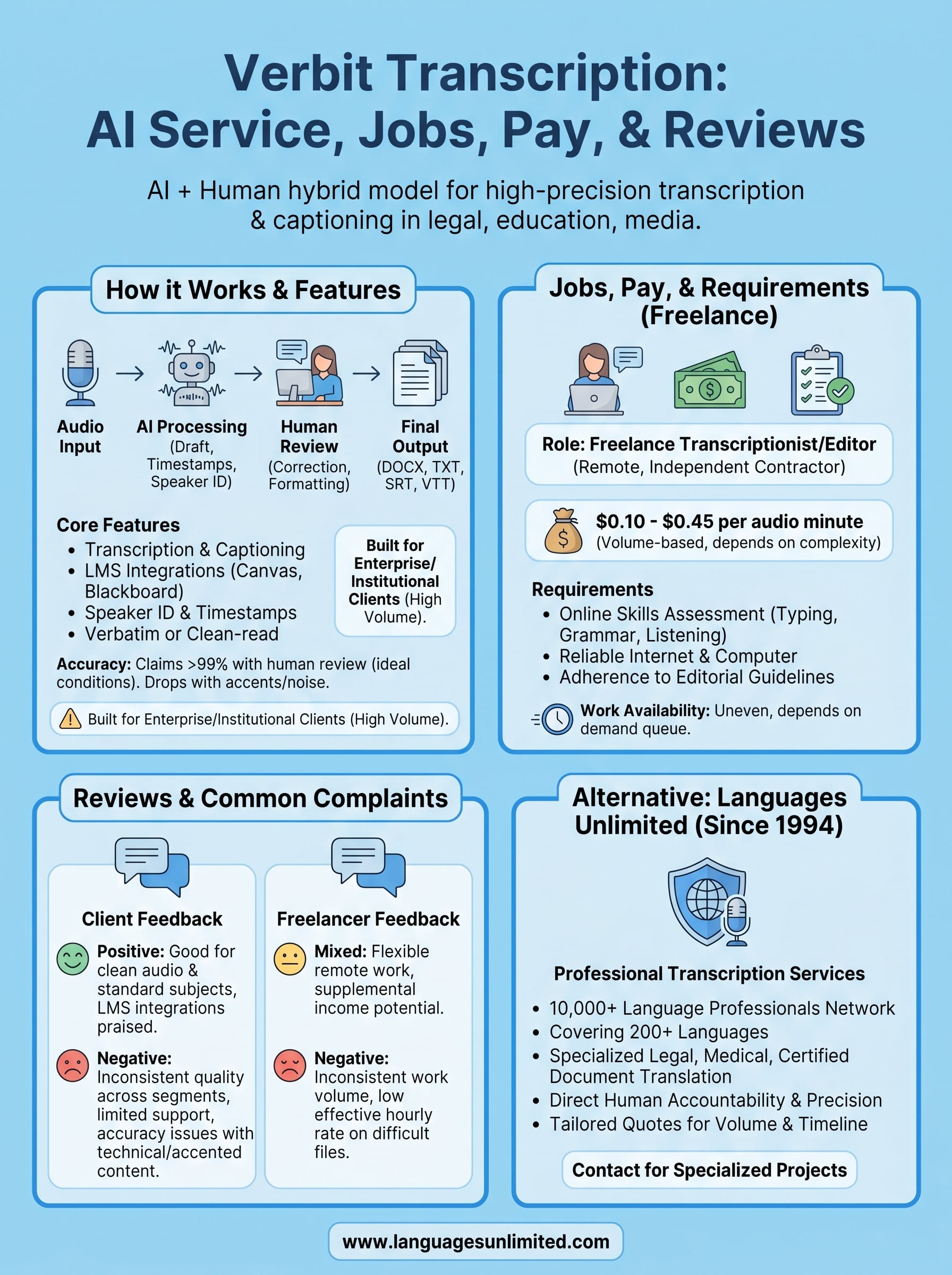
Verbit is a technology company founded in 2017 that delivers transcription and captioning services through a combination of proprietary artificial intelligence and human editors. The platform sits between fully automated tools like Otter.ai and purely human-driven transcription agencies. Rather than choosing one or the other, Verbit runs audio through its AI engine first, then routes the output to trained human transcriptionists who correct errors before the final file reaches you.
The AI layer: how Verbit processes audio
When you submit audio or video to Verbit, their AI model converts speech to text automatically. The system is trained on domain-specific language, meaning it handles legal terminology, academic lecture formats, and media content differently than a general-purpose speech recognition engine would. Verbit claims this training reduces the number of errors a human editor has to fix, which speeds up delivery and, in theory, lowers cost.

The AI layer handles the bulk of the transcription work, but accuracy still depends on audio quality, speaker clarity, and how well the model was trained on your specific subject matter.
The AI also captures speaker identification and timestamps, which are useful if you’re working with multi-party recordings like depositions, interviews, or classroom recordings. These structural elements carry through to the final transcript, so you don’t have to add them manually after the fact.
The human review layer
After the AI produces a draft, a human transcriptionist reviews and corrects the output before it’s returned to you. This hybrid approach is how Verbit positions itself against purely automated services, arguing that human review catches the errors AI misses, especially with accented speech, technical vocabulary, or low-quality audio. In practice, the human step adds time to delivery, and the quality of that review depends heavily on who picks up the file.
Verbit employs a distributed network of freelance editors who work remotely through the company’s internal platform. These editors review segments rather than full files, which keeps the process moving faster than traditional transcription but introduces variability. You may find that different segments of the same transcript have inconsistent formatting or editing quality if multiple editors handled different portions.
Who Verbit serves
Verbit transcription is built primarily for enterprise and institutional clients rather than individuals. Their main customer segments include universities, court reporting firms, media companies, and corporations that produce high volumes of audio or video content. If you’re a solo user looking to transcribe one file, the platform is not designed with you in mind, and the pricing model reflects that.
What you get: features, accuracy, and file types
Verbit transcription gives you a set of features designed for high-volume institutional use, which shapes what’s available, how it’s delivered, and what limitations you’ll run into. Before committing to the platform, knowing exactly what you’re getting helps you match the service to your actual workflow.
Core features
The platform delivers transcription, captioning, and subtitling as its primary outputs. You also get speaker identification, timestamps, and the option to receive verbatim or clean-read transcripts depending on your use case. For academic clients, Verbit integrates directly with learning management systems like Canvas and Blackboard, which simplifies the workflow for institutions that need captions attached to course videos automatically.
These integrations are useful if you manage large volumes of educational content, but they offer little value if your needs fall outside education or media.
Accuracy and what affects it
Verbit advertises accuracy rates above 99% for its human-reviewed output. That figure is possible under ideal conditions: clear audio, single speaker, standard vocabulary. When your recording includes heavy accents, technical terminology, or background noise, accuracy drops and the human editors carry more of the load. The AI component alone does not reliably hit that benchmark, which is why the human review step exists.
File types and output formats
You can submit MP3, MP4, WAV, and MOV files, among others. On the output side, Verbit returns transcripts in formats including DOCX, TXT, SRT, and VTT, with SRT and VTT being the standard choices for captioning video content. If you need a specialized format for a specific platform or compliance requirement, you’ll want to confirm availability directly with their team before placing an order.
Verbit pricing and turnaround times
Verbit does not publish a public pricing page, which makes it harder to budget before you contact their sales team. The platform is built for enterprise contracts, so pricing is typically customized based on volume, service type, and turnaround requirements. If you’re an individual or small organization, expect a conversation with a sales representative before you see any numbers.
What Verbit charges
Verbit transcription pricing is generally quoted per audio minute, with rates varying based on the complexity of your content and the level of human review involved. Industry reports and user discussions place the cost somewhere in the range of $1 to $2 per audio minute for standard transcription, though this can shift depending on subject matter, language, and whether you need verbatim output or a cleaned-up version. Captioning services and same-day turnaround options typically cost more.
If your organization produces high volumes of content regularly, Verbit’s pricing model may become more competitive than it appears at smaller scales.
Bulk contracts give institutional clients more favorable rates, which is another reason the platform skews toward universities and large media organizations rather than one-off users.
How long delivery takes
Standard turnaround for human-reviewed transcription is typically 24 to 48 hours, though Verbit offers expedited options for time-sensitive projects at a higher rate. For clients using the platform’s integrations with learning management systems, captioning can be applied automatically to uploaded video without manual submission, which reduces delivery friction for recurring content. That said, if your audio quality is poor or your content includes specialized terminology, build in extra time regardless of what the platform estimates.
Verbit transcription jobs, pay, and requirements
Verbit hires freelance transcriptionists and editors who work remotely through its internal platform. These are not traditional employment positions. You work as an independent contractor, picking up segments of audio files as they become available, which means your income depends directly on how much work is in the queue and how quickly you can process it.
How to apply and what Verbit requires
Verbit’s application process starts with an online skills assessment that tests your typing speed, grammar, and listening accuracy. You’ll also need to demonstrate familiarity with their editorial guidelines, which cover formatting conventions, speaker labeling, and how to handle unclear audio. The company does not publicly list a minimum words-per-minute requirement, but given the volume-based pay structure, slow typists will struggle to earn a meaningful hourly rate.
Most applicants report that passing the assessment is straightforward, but access to consistent work after acceptance depends heavily on demand at the time you log in.
Beyond the test, Verbit expects reliable internet access, a computer capable of running their platform, and the ability to work within their internal editor without customization. There is no indication that formal transcription credentials are required, though prior experience helps you move through files faster.
What Verbit pays transcriptionists
Pay is calculated per audio minute transcribed, not by the hour. Reported rates from current and former editors typically fall between $0.10 and $0.45 per audio minute, depending on the complexity of the file and how the segment pricing is structured at the time. Straightforward audio at the higher end of that range can translate to a reasonable pace of earnings, but difficult recordings with poor audio quality can significantly reduce your effective rate.

Verbit reviews and common complaints
Real-world feedback on Verbit transcription comes from two distinct groups: clients using the service and freelancers working inside the platform. Both groups have useful things to say, and the patterns across their reviews reveal where Verbit consistently delivers and where it falls short.
What clients say about the service
On the client side, institutional users from universities and media companies tend to report positive experiences when their audio is clean and their content stays within standard subject areas. The integrations with learning management systems draw consistent praise from education teams who handle large volumes of lecture recordings. Turnaround times generally meet expectations for standard orders.
Complaints from clients cluster around two issues: inconsistent quality across segments when multiple editors handle a single file, and limited responsiveness from support when something goes wrong.
Accuracy on specialized or technical content is the most frequent point of frustration. Clients working with legal terminology, scientific vocabulary, or non-native English speakers report that the human review layer does not always catch domain-specific errors, which means you may need to do a final pass yourself before using the transcript in a professional setting.
What transcriptionists say about working there
Freelancers who have worked inside the Verbit platform describe uneven work availability as the primary downside. Many report that work volume is inconsistent, meaning stretches of inactivity follow busy periods, which makes it difficult to predict income. The per-audio-minute pay structure rewards speed, so editors who work quickly on clear audio earn more, while those who receive difficult files see their effective hourly rate drop significantly. Positive reviews typically come from editors who treat it as supplemental income rather than a primary source.
What to do next
Now that you have a clear picture of verbit transcription, from how the AI-human hybrid works to what freelancers actually earn, you can match that information against your own situation. If your organization needs high-volume captioning with LMS integration and consistently clean audio, Verbit may serve you well. If you need specialized legal or medical transcription with consistent accuracy and direct human accountability, the platform’s segment-based editing model introduces risk you may not want.
Languages Unlimited has provided professional transcription services since 1994, with a network of over ten thousand language professionals covering 200+ languages. Whether you need certified document translation, legal transcription, or on-site interpretation, our team handles it with the precision your work requires. Contact our team to discuss your project and get a quote tailored to your volume and timeline.