



Every city clerk’s office, county health department, and state agency depends on having the right people in the right roles. But filling those roles isn’t as straightforward as posting a job listing and waiting. State & local government staffing involves a structured process shaped by civil service rules, compliance requirements, budget cycles, and public accountability, factors that don’t exist in the private sector. When positions stay open too long, services that communities rely on start to break down.
Whether you’re a hiring manager at a municipal agency trying to fill critical vacancies or you’re exploring how public sector recruitment actually works, this article covers the fundamentals. We’ll define what state and local government staffing means, walk through the typical hiring process, and explain where specialized staffing partners fit in.
At Languages Unlimited, we work directly with government agencies across all 50 states, providing qualified bilingual and multilingual professionals for administrative, healthcare, social services, and public-facing roles. That experience gives us a ground-level understanding of what government hiring demands, and what it takes to get it right. Here’s what you need to know.
Why state and local staffing works differently
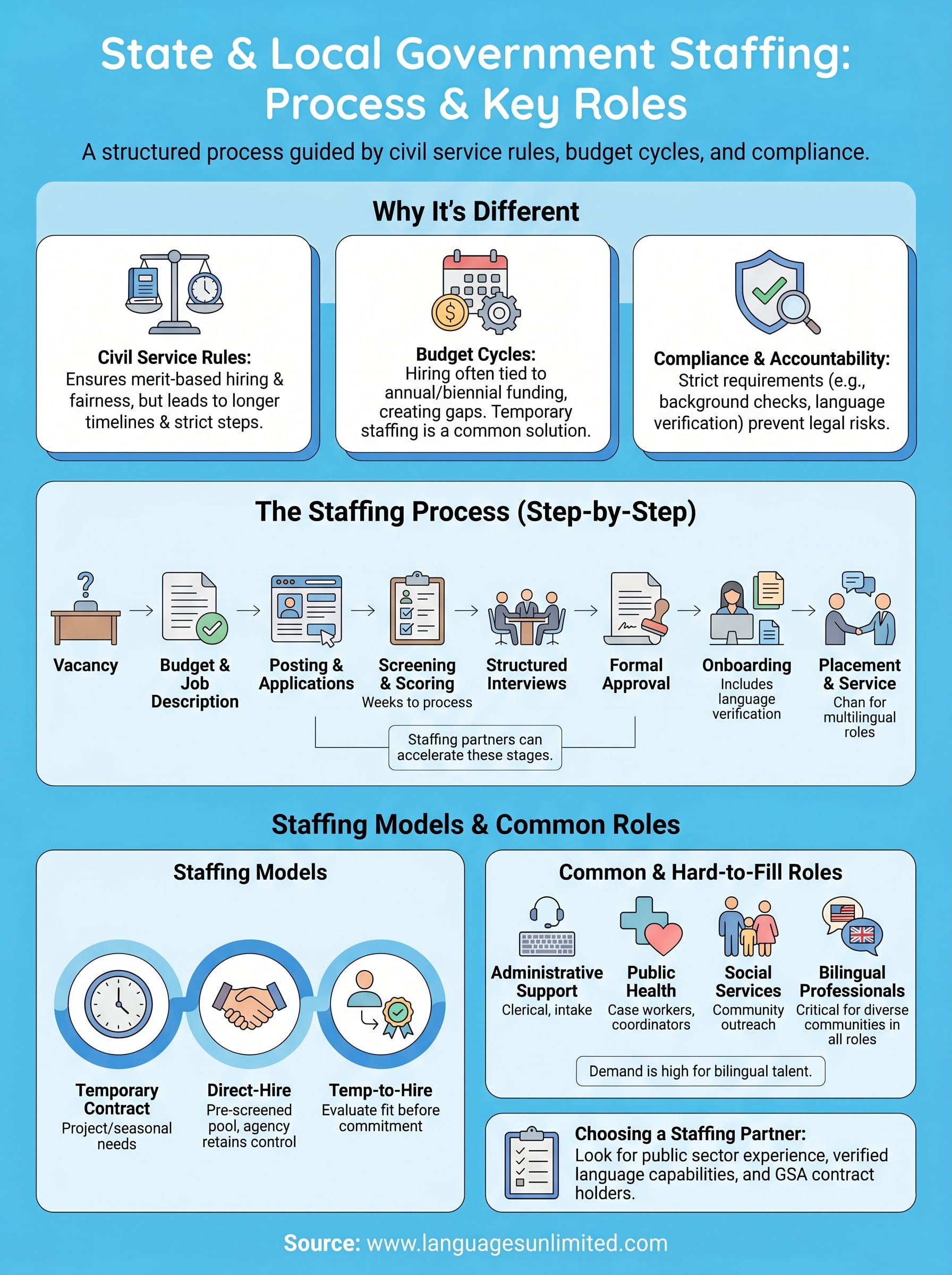
State and local government staffing doesn’t follow the same logic as corporate hiring. Public sector agencies operate under strict rules that prioritize accountability and fairness over speed, which means the typical hiring timeline is longer, the documentation requirements are stricter, and the approval chain involves more stakeholders. If you’re a hiring manager at a government agency, you already know that even a straightforward vacancy can take months to fill through standard civil service procedures.
Civil service rules shape every hire
Most government positions are governed by civil service regulations, which exist to ensure that hiring decisions are merit-based and free from political influence. These rules typically require agencies to post positions publicly for a set period, rank applicants using structured scoring systems, and document every step of the selection process. Skipping or shortcutting any part of this process can expose an agency to legal challenges and compliance violations.
Because civil service rules vary by jurisdiction, what works for a county agency in Texas may not apply to a state agency in Illinois.
Budget cycles create hiring gaps
Government agencies work on fixed annual or biennial budget cycles, which means staffing decisions are often tied to funding approvals rather than immediate operational need. When a position opens mid-cycle, the budget may already be allocated, or a hiring freeze may be in effect.
Temporary and contract staffing gives agencies a practical way to keep operations running without triggering the full civil service process, making it a common tool in state & local government staffing when permanent hiring stalls. For agencies serving multilingual communities, this also means quickly accessing bilingual and language-qualified professionals who can step into public-facing roles without a lengthy recruitment delay.
How the staffing process works step by step
The state & local government staffing process follows a more structured path than most private sector hiring. Understanding each phase helps you set realistic timelines and know exactly where a staffing partner can accelerate the work. This applies whether you’re filling temporary contract roles or permanent civil service positions.
From vacancy to candidate pool
When a position opens, your agency first needs to confirm budget authorization and draft a compliant job description that meets civil service standards. Once posted, applications flow in and must be screened and scored according to predefined criteria. This step alone can take several weeks depending on your jurisdiction’s rules and the volume of applicants.

Partnering with a staffing agency at this stage means you receive a pre-screened candidate pool that already meets your compliance requirements, cutting weeks off your timeline.
From interviews to placement
After you identify qualified candidates, the process moves to structured interviews, reference checks, and formal approval from the relevant oversight body. Once approved, onboarding begins, covering paperwork, orientation, and required training. For roles serving diverse or multilingual communities, this phase should also include language proficiency verification to ensure staff can communicate effectively with the populations they serve.
Common roles and staffing models
State & local government staffing covers a wide range of positions, from frontline public-facing roles to specialized administrative functions. Knowing which roles are hardest to fill and which staffing model fits your situation helps you plan before a vacancy becomes a service disruption.
Roles that see the most demand
Government agencies consistently struggle to fill positions in administrative support, public health, social services, and community outreach. Roles like case workers, benefits coordinators, and intake specialists require both technical knowledge and the ability to communicate with diverse populations. For agencies serving multilingual communities, bilingual professionals in these positions are especially difficult to source quickly.
If your agency serves communities where English is not the primary language, language-qualified candidates should be a non-negotiable part of your hiring criteria.
Staffing models available to agencies
Your agency has three primary options: temporary contract placements, direct-hire support, and temp-to-hire arrangements. Temporary contracts work well for project-based or seasonal needs. Direct-hire support gives you a pre-screened candidate pool while you retain full control over the final selection. Temp-to-hire lets you evaluate a candidate’s fit before committing to a permanent offer, which reduces turnover risk in critical roles.
Compliance, background checks, and onboarding
Compliance isn’t optional in state & local government staffing. Every candidate you place in a public sector role must clear a verification process that is stricter and more documented than most private sector equivalents. Cutting corners here puts your agency at legal and reputational risk.
Background checks in the public sector
Government roles often require multi-layer background checks, including criminal history, employment verification, and in some cases, security clearance. The specific requirements vary by role and jurisdiction, so your agency needs to confirm which checks apply before the hiring process begins, not after a candidate is already selected.
Partnering with a staffing agency that understands public sector requirements means background checks are handled correctly and documented in a format your agency can defend.
Onboarding new hires into government roles
Once a candidate clears compliance, onboarding in government settings involves more steps than a typical private sector orientation. Your new hire must complete required paperwork, role-specific training, and mandatory policy acknowledgment. For bilingual or language-qualified staff, confirm language proficiency in writing before they begin serving the public.
Key onboarding checkpoints to track:
- Required government forms and agreements
- Role-specific training completion
- Language proficiency verification for bilingual roles
- System access and credentialing
How to pick the right staffing partner
Not every staffing agency is equipped to handle state & local government staffing. The compliance requirements, civil service considerations, and timelines are specific enough that your staffing partner needs direct public sector experience, not just general recruiting knowledge. Before you sign a contract, ask direct questions about their track record with government clients and the types of roles they have filled.
Look for public sector experience
Your staffing partner should be able to name specific agencies they have worked with and describe the roles they placed. If they can’t point to concrete examples in administrative, healthcare, or social services positions, that is a clear signal they are learning on your time and budget. Government hiring has no room for a partner still figuring out how public sector contracts and compliance obligations actually work.
A staffing partner who holds a GSA contract already understands the compliance standards your agency operates under.
Confirm language and compliance capabilities
For agencies serving multilingual populations, your staffing partner must go beyond general recruiting. Ask directly how they verify language proficiency for bilingual candidates and whether they maintain an active database of language-qualified professionals ready to place. A partner who handles compliance documentation and delivers qualified candidates quickly is one worth keeping long-term.
Next steps
State & local government staffing is one of the most structured and compliance-heavy hiring environments you will encounter. Every step matters, from confirming budget authorization to verifying language proficiency before a bilingual candidate serves the public. If you’ve read this far, you have a clear picture of how the process works, where delays happen, and what to look for in a staffing partner.
Your next move is straightforward. Identify your open roles, determine whether you need temporary, temp-to-hire, or direct-hire support, and confirm whether any of those positions require language-qualified candidates for the populations you serve. The sooner you get that clarity, the faster you can fill gaps before they become service disruptions.
Languages Unlimited works with government agencies across all 50 states, placing qualified bilingual and multilingual professionals in roles that demand both competence and cultural awareness. If you’re ready to move forward, contact our team and we’ll get to work.