



When your organization processes thousands of hours of audio and video each quarter, from legal proceedings and medical consultations to internal meetings and compliance recordings, consumer-grade tools won’t cut it. Enterprise transcription services exist to solve this exact problem: converting spoken content into accurate, secure, and searchable text at a scale that matches how large organizations actually operate.
Most businesses don’t struggle with the concept of transcription. They struggle with doing it reliably across departments, languages, and compliance requirements, without creating bottlenecks. That’s where enterprise-grade solutions separate themselves from basic transcription apps or freelance arrangements. They’re built for high-volume workflows, and they’re held to standards around data security, accuracy, and turnaround that smaller services simply aren’t designed to meet.
At Languages Unlimited, transcription is one of our core service lines, and has been since 1994. We work with government agencies, healthcare systems, legal firms, and corporations that need their spoken content converted to written text with precision, confidentiality, and the ability to scale on demand. With a network of over ten thousand language professionals and certifications including ATA membership and GSA contract status, we understand what enterprise clients require because we’ve delivered it for decades.
This article breaks down what enterprise transcription services actually include, how they differ from standard transcription, and why the distinction matters for organizations managing sensitive, high-volume, or multilingual content.
What enterprise transcription services are
Enterprise transcription services are professional, managed solutions that convert audio and video content into accurate written text for organizations operating at scale. Unlike a basic transcription app or a one-off freelance arrangement, these services are built around ongoing volume, structured workflows, and strict compliance requirements. Think of them as the infrastructure layer beneath your organization’s spoken content, whether that’s recorded depositions, physician dictations, earnings calls, congressional hearings, or internal training sessions.
Enterprise transcription is not just about converting speech to text. It’s about doing it accurately, securely, and reliably across every department that depends on it.
How they differ from standard transcription
Standard transcription tools work fine when you have a handful of recordings and no special requirements around security, formatting, or turnaround time. Enterprise-level transcription becomes necessary when those conditions no longer hold. The core difference isn’t just volume; it’s the operational structure built around delivery. Enterprise providers assign dedicated project managers, establish service-level agreements for turnaround, and integrate with your existing content management or compliance systems.
Multilingual content is another dividing line. If your organization operates across multiple regions or serves diverse populations, your transcription provider needs to match that reality. A healthcare system serving Spanish-speaking patients and a legal firm handling international arbitration both require language-qualified professionals with subject matter knowledge, not generic automated tools that stumble on specialized vocabulary or regional dialects.
The core components of an enterprise solution
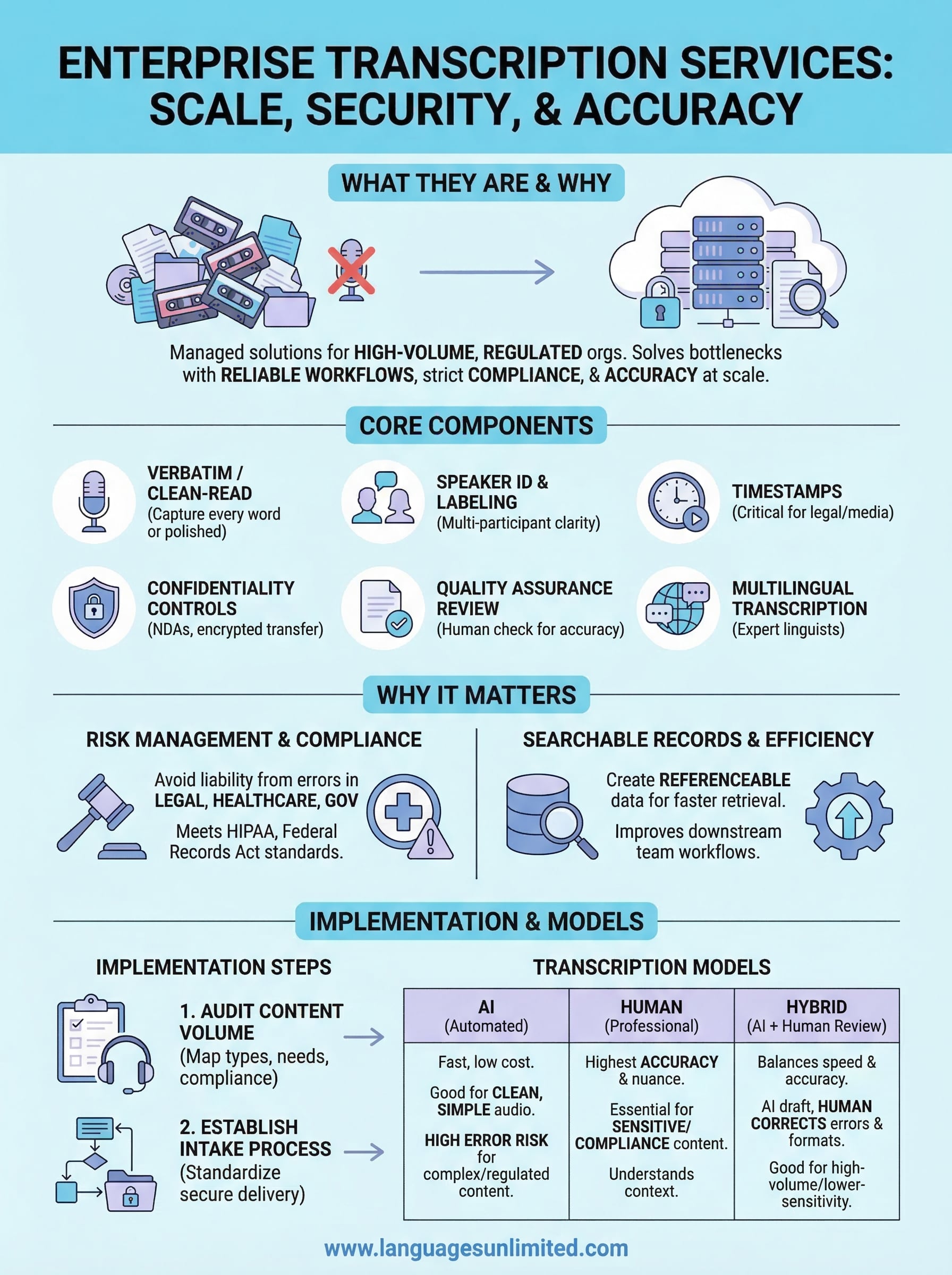
When you evaluate an enterprise provider, you’ll find that reputable services bundle several capabilities into a single managed offering. These components work together to ensure your content gets processed consistently, regardless of volume or complexity.

Key components typically include:
- Verbatim or clean-read transcription depending on whether you need every filler word captured or a polished, readable output
- Speaker identification and labeling for multi-participant recordings like depositions, panel discussions, or interviews
- Timestamps at regular intervals or on request, which are critical for legal and media applications
- Confidentiality controls, including non-disclosure agreements, encrypted file transfer, and restricted access for the transcription team
- Quality assurance review by a second human reviewer before delivery, ensuring accuracy rates that automated tools cannot consistently match
- Multilingual transcription across major and less common languages, handled by professionals who understand both the spoken dialect and the subject matter
Your provider should also offer formatting customization to match your internal standards, whether you’re submitting transcripts to a court, attaching them to a medical record, or archiving them for compliance audits. The ability to deliver in multiple file formats, including Word, PDF, or plain text, matters more than it sounds when your teams work across different systems and software environments.
Why enterprise transcription matters
If your organization handles sensitive recordings in regulated industries, the stakes for accuracy go well beyond convenience. Legal, healthcare, and government clients face real liability when transcripts contain errors, miss critical terminology, or get processed outside secure channels. A single inaccurate transcript in a legal proceeding can alter the official record. A misread physician dictation can affect patient care decisions. These aren’t hypothetical risks; they’re the documented consequences of treating transcription as a low-priority administrative task.
Compliance requirements don’t allow for shortcuts
Regulated industries operate under specific frameworks that directly govern how recorded content gets stored, processed, and documented. HIPAA in healthcare and Federal Records Act requirements for government agencies both create obligations that extend directly to your transcription workflow. If your provider doesn’t operate under appropriate data security protocols, your organization absorbs the compliance gap.
Choosing a provider that doesn’t match your compliance environment isn’t a vendor problem; it becomes your legal exposure.
Enterprise transcription services are designed with these obligations in mind from the start. That means your vendor shares responsibility for protecting sensitive content in transit and at rest, rather than leaving your team to retrofit security onto a process that wasn’t built for it.
Searchable records improve how your teams work
Beyond risk management, well-structured transcription output creates a searchable, referenceable record that your teams can actually use. Legal professionals reviewing deposition transcripts need accurate speaker labels and timestamps to locate relevant testimony quickly. Healthcare administrators auditing patient interaction records rely on consistent formatting and clean text to run meaningful analysis. When your transcription process is inconsistent, those downstream workflows break down and teams lose time compensating for gaps in the record.
Scaling transcription inside a large organization also reveals how much content currently goes undocumented. Recorded meetings, client calls, training sessions, and compliance reviews all represent information that exists in audio form but stays unsearchable until converted. Capturing that content systematically gives your organization a more complete operational record and reduces the risk of losing institutional knowledge when staff turn over or projects close.
What to look for in an enterprise provider
Not every transcription vendor has the infrastructure to support enterprise needs. When you’re evaluating providers, focus on operational capabilities rather than pricing alone. A vendor that looks affordable on a per-minute rate may lack the quality controls, security protocols, and language coverage your organization actually requires.
The right provider doesn’t just deliver text; they deliver accountability for every file that passes through their system.
Security and compliance credentials
Your provider should demonstrate verifiable data security practices before you share any sensitive recordings. Look for vendors that offer encrypted file transfer, access controls for the transcription team, and signed confidentiality agreements as standard practice. If your organization falls under HIPAA, the Federal Records Act, or similar frameworks, your provider needs to show they operate within those requirements, not just claim they do.
Key credentials worth confirming:
- HIPAA compliance documentation for healthcare content
- Signed NDAs and restricted-access policies for the transcription team
- Encrypted transmission and storage for all file types
- Documented experience in your regulated industry
Accuracy guarantees and quality control
Automated transcription tools often advertise high accuracy rates under ideal conditions, but real-world audio includes background noise, accented speech, technical vocabulary, and overlapping speakers. Any enterprise transcription services provider you consider should describe their quality review process clearly, including whether a human reviewer checks output before delivery and what accuracy benchmarks they commit to in writing.
Specialized content demands subject matter qualified transcriptionists, not generalists. Legal depositions, medical dictations, and government hearings carry terminology that requires more than general language proficiency to transcribe correctly, and errors in those contexts carry real consequences.
Scalability and turnaround commitments
Enterprise clients often face unpredictable spikes in volume, whether from litigation cycles, regulatory reviews, or large-scale training rollouts. Your provider needs to demonstrate they can absorb that volume without compromising turnaround time or accuracy. Ask directly whether they maintain dedicated capacity for enterprise clients or whether your work competes in a general queue.
Service-level agreements should specify turnaround windows by content type and volume tier so you know exactly what to expect before a deadline-sensitive project begins.
How to implement enterprise transcription at scale
Implementation starts before you send your first file. Jumping into a new transcription workflow without mapping your organization’s actual content types and volume leads to mismatched service tiers, avoidable delays, and format inconsistencies that create problems downstream. Before you contact a provider, spend time documenting what you currently have: recorded content volume per month, which departments generate it, and what each output is used for.
Start with an audit of your current content volume
Your first step is understanding the scope of your transcription needs across the organization. Different content types carry different requirements, and combining them without a clear inventory leads to gaps. Legal recordings may require verbatim output with timestamps, while internal training sessions may only need clean-read format. Getting that inventory done before you onboard a provider means your service agreement reflects actual workload rather than an optimistic estimate.
Key questions to answer during your audit:
- How many hours of audio or video does each department produce monthly?
- Which content types require specialized formatting or language coverage?
- What are your fastest turnaround windows, and how often do they occur?
- Which recordings fall under compliance requirements like HIPAA or federal records standards?
Establish a clear intake and delivery process
Once you know your volume and requirements, work with your provider to build a standardized intake workflow that every department can follow. This reduces friction and prevents the inconsistencies that come from teams submitting files in different formats or through unsecured channels. A defined process also makes it easier to track turnaround performance against your service-level agreement over time.

The organizations that scale transcription most effectively treat it as a managed workflow, not a series of one-off requests.
Specifying file formats, the metadata your team attaches to each submission, and who receives completed transcripts keeps the process consistent from the start. Pairing that structure with a dedicated point of contact at your enterprise transcription services provider reduces back-and-forth and keeps projects moving even during high-volume periods. When spikes occur, a structured process means your provider can absorb the load without losing track of your priorities or deadlines.
AI, human, and hybrid transcription options
Understanding the difference between AI, human, and hybrid transcription helps you make a smarter purchasing decision when you’re selecting enterprise transcription services. Each model has a distinct cost and accuracy profile, and the right choice depends on your content type, compliance requirements, and acceptable error tolerance.
AI transcription
Automated transcription tools process audio faster and at a lower per-minute cost than human transcriptionists. For clean, single-speaker audio with standard vocabulary, AI delivers usable output quickly. The problems appear when your recordings include background noise, accented speech, overlapping voices, or specialized terminology. In those situations, automated accuracy drops sharply, and errors in regulated content carry real consequences that offset any cost savings.
Relying on AI alone for legal depositions, medical dictations, or government hearings introduces a risk that no price advantage justifies.
Human transcription
Human transcriptionists catch what automated tools miss: industry-specific terminology, speaker nuance, and context-dependent word choices that require actual comprehension rather than pattern matching. Trained professionals also apply consistent formatting and flag content that needs clarification before delivery, which protects your organization from errors that would otherwise surface later. For sensitive or compliance-bound content, human transcription remains the most reliable option available.
Hybrid transcription
Hybrid transcription combines automated processing with human review and correction to balance speed and accuracy. Your provider uses AI to produce a rough draft, then a qualified human transcriptionist corrects errors, confirms speaker labels, and applies your formatting standards before the file reaches you. This model works well for high-volume, lower-sensitivity content where speed matters but accuracy still needs to meet a defined threshold.
When evaluating which model fits your organization, consider matching the approach to the content category:
- High-sensitivity content (legal, medical, government): human or hybrid with mandatory human review
- Internal content with standard vocabulary: hybrid or AI with spot-check review
- Multilingual content: human transcriptionists with subject matter expertise in the target language
Matching the transcription model to your actual content risk level gives you the accuracy you need without over-engineering workflows that don’t require it.
What to do next
Now that you understand what enterprise transcription services involve and how they differ from basic tools, the next step is matching your organization’s specific requirements to the right provider. Volume, compliance obligations, and language coverage are the three factors that should drive your decision, not per-minute pricing alone.
Start by pulling together the content audit described earlier in this article and identifying which departments generate your most critical recordings. Regulated content in legal, medical, or government contexts deserves special attention because the accuracy and security requirements are non-negotiable, and errors in those contexts carry real consequences. Once you have a clear picture of your workload, you’re ready to have a productive, specific conversation with a provider rather than working from guesswork.
Languages Unlimited has delivered professional transcription services for organizations across healthcare, government, and legal industries since 1994. If you’re ready to discuss your requirements and put scalable, compliant transcription in place, contact our team today.