



Expanding into international markets or serving a multilingual customer base requires more than just good intentions, it demands clear, accurate communication across languages. Corporate language services provide businesses with professional translation, interpretation, localization, and transcription solutions designed specifically for commercial and organizational needs.
Whether you’re negotiating contracts with overseas partners, onboarding employees who speak different languages, or ensuring compliance with accessibility regulations, these services bridge the gap between your message and your audience. At Languages Unlimited, we’ve supported organizations across healthcare, legal, government, and corporate sectors since 1994, connecting them with over ten thousand qualified language professionals worldwide.
This article breaks down what corporate language services actually include, the different types available, what you can expect to pay, and the tangible benefits they deliver. By the end, you’ll have a clear picture of how these services work and whether they’re the right fit for your organization’s communication needs.
Why corporate language services matter
Your company’s ability to communicate accurately across languages directly affects revenue, compliance, and reputation. When you enter new markets or serve diverse populations, miscommunication can derail partnerships, create legal liabilities, or alienate customers. Professional corporate language services eliminate these risks by providing vetted linguists who understand both the source and target languages, along with the cultural contexts that shape meaning.
Business expansion and market access
Companies that invest in professional translation and interpretation services access markets that competitors can’t serve effectively. You reach non-English speaking customers with marketing materials, product documentation, and customer support in their native languages, which builds trust and increases conversion rates. International contracts, regulatory filings, and partnership agreements require precision that machine translation cannot deliver, especially in industries like healthcare, legal, and finance where errors carry severe consequences.
Organizations with multilingual capabilities grow revenue 1.5 times faster than those without language support, according to research on global business expansion.
Compliance and risk management
Regulatory frameworks across industries mandate accurate translation of critical documents and accessible communication for limited English proficient populations. Healthcare providers must comply with Title VI of the Civil Rights Act, which requires meaningful language access. Government contractors face Section 508 accessibility requirements for all digital content. Corporate language services help you meet these obligations while avoiding penalties, lawsuits, and reputational damage that stem from inadequate language support or discriminatory communication practices.
Types of corporate language services
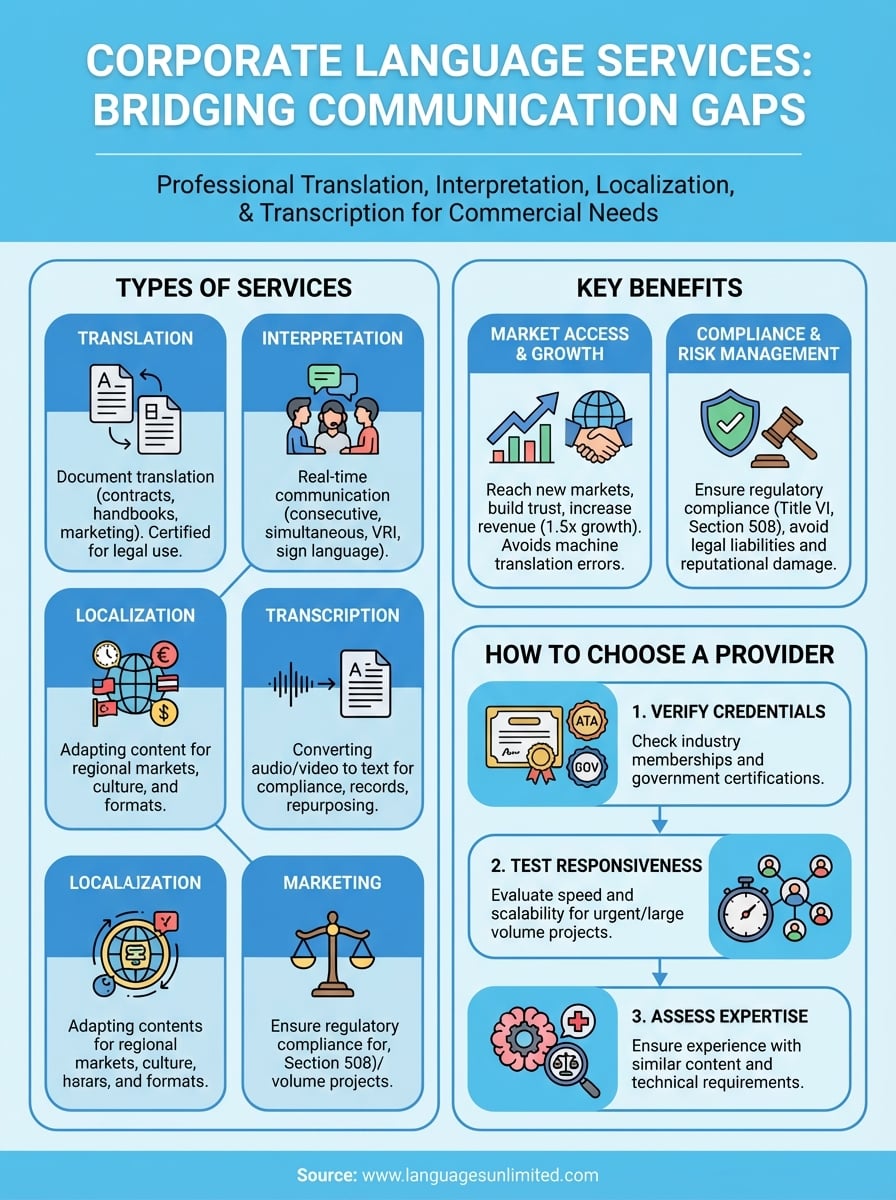
Your organization can access several distinct categories of language support, each serving specific communication needs. Corporate language services typically fall into four main categories that address written, spoken, and multimedia content across different business contexts.

Translation services
Document translation converts written materials from one language to another while preserving meaning, tone, and intent. You’ll use this for contracts, employee handbooks, marketing collateral, technical documentation, and regulatory filings. Certified translations add an official attestation that the translation accurately represents the source document, which government agencies and legal institutions often require for immigration papers, court documents, and official records.
Interpretation services
Consecutive and simultaneous interpretation enable real-time communication during meetings, negotiations, conferences, and training sessions. Video remote interpreting (VRI) and telephonic options let you connect with interpreters instantly without scheduling on-site visits, while sign language interpretation ensures accessibility for deaf and hard-of-hearing participants in your workforce or customer base.
Professional interpretation services reduce miscommunication errors by over 80% compared to using bilingual staff without formal interpreter training.
Localization and transcription
Localization adapts your content for specific regional markets by adjusting cultural references, measurements, and formats beyond literal translation. Transcription services convert audio and video recordings into written text, which supports compliance documentation, meeting minutes, and content repurposing across your organization.
How corporate language services work
Corporate language services operate through a structured workflow that matches your specific project requirements with qualified linguists who have expertise in your industry and target languages. The process typically begins when you submit a project request with source materials, deadline, and any special requirements like certification or subject matter expertise. Your provider then assigns a project manager who coordinates all aspects of delivery, from linguist selection through quality review and final file handoff.
Project intake and scoping
Your project manager evaluates the source content, target languages, and delivery timeline to determine resource needs and pricing. They identify any technical requirements such as file formats, terminology databases, or style guides you want applied. For complex projects involving multiple languages or large volumes, you’ll receive a detailed project plan with milestones and review checkpoints that keep everyone aligned throughout the engagement.
Linguist matching and delivery
Once your project specifications are clear, the provider matches you with vetted translators or interpreters who have demonstrated competency in your subject area through testing, certifications, or prior work samples. Quality assurance teams review completed work against industry standards before delivery, catching errors and inconsistencies that could undermine your message.
Professional language service providers maintain networks of thousands of linguists, enabling them to handle urgent requests and scale capacity for enterprise-level projects.
What corporate language services cost
Pricing for corporate language services varies based on several factors including language pair, turnaround time, subject matter complexity, and service type. You’ll typically encounter per-word rates for translation projects ranging from $0.08 to $0.35 per word, while interpretation services use hourly billing between $50 and $200 per hour depending on the mode (telephonic, VRI, or on-site) and language combination.
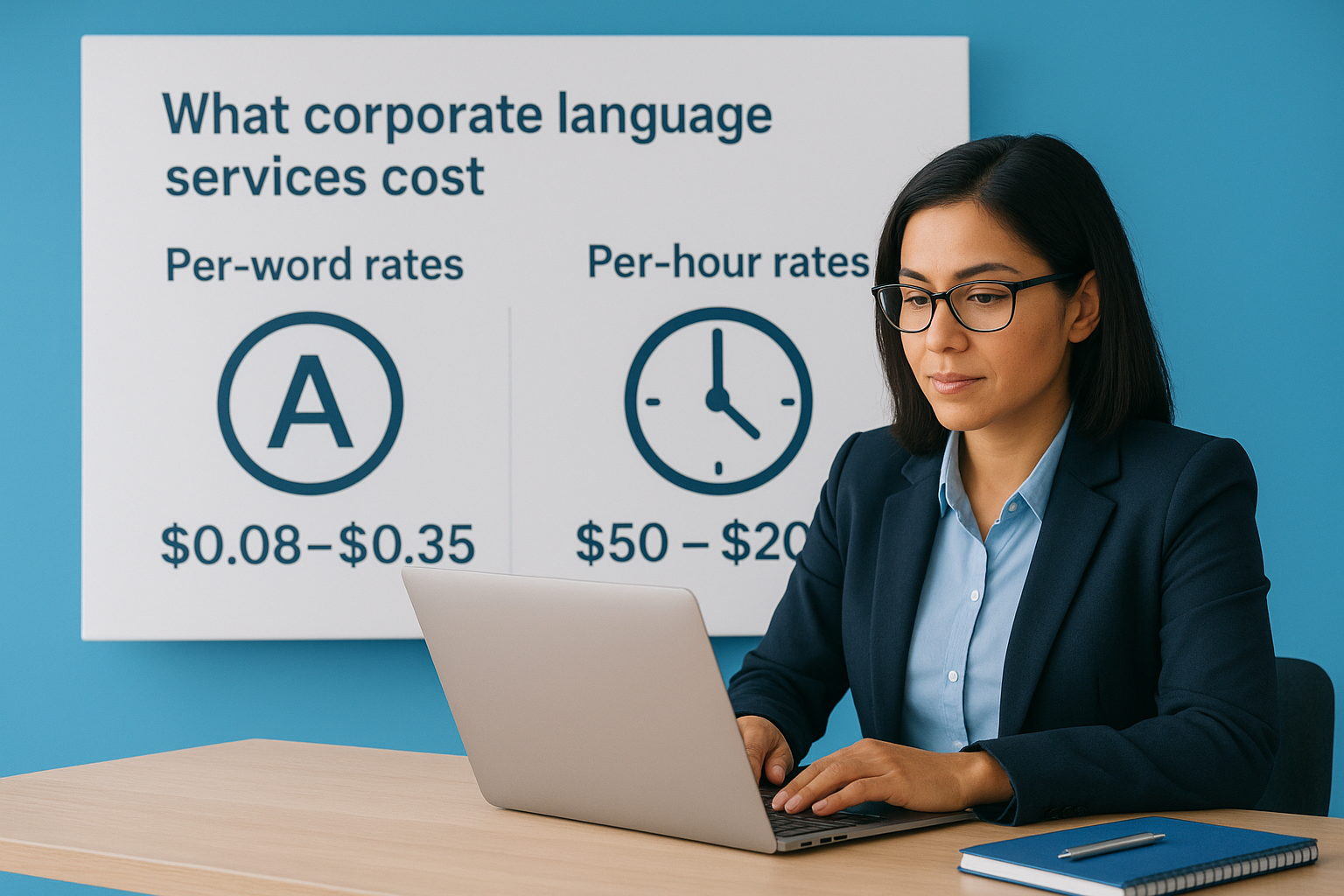
Per-word and per-hour models
Translation providers charge by the word count of your source document, with common European languages (Spanish, French, German) at the lower end of the range and specialized or rare languages commanding premium rates. Rush fees add 25% to 100% to standard pricing when you need delivery within 24 to 48 hours. Interpretation services bill by the hour with minimum hour requirements (typically two hours for on-site assignments), plus travel costs and cancellation policies that protect interpreter availability.
Volume and complexity factors
Your costs decrease when you commit to ongoing service agreements or high-volume projects that justify dedicated linguist teams and streamlined workflows. Technical content requiring subject matter expertise, certified translations with notarization, or projects involving multiple review cycles increase per-unit costs compared to general business correspondence.
Enterprise clients who establish annual contracts save 15% to 30% compared to one-time project pricing through volume discounts and priority scheduling.
How to choose a corporate language provider
Selecting the right language partner requires evaluating credentials, service capabilities, and industry expertise that align with your specific business needs. You want a provider who delivers consistent quality, meets your turnaround requirements, and understands the regulatory environment your organization operates within. The best corporate language services combine technical proficiency with responsive project management that adapts to your workflow and communication preferences.
Verify certifications and track record
Check whether your potential provider holds relevant industry memberships like the American Translators Association (ATA) and government approvals such as USCIS certification or GSA contract status. These credentials demonstrate commitment to professional standards and qualify the provider for projects requiring official documentation. Request client references from your industry to validate their experience with similar content types, compliance requirements, and quality expectations you’ll hold them accountable for delivering.
Providers with established government contracts and professional association memberships maintain higher quality standards through regular audits and peer review processes.
Test responsiveness and scalability
Evaluate how quickly the provider responds to inquiries and whether they can scale capacity for urgent or large volume projects. Ask about their linguist network size, available languages, and backup protocols for unexpected absences or increased demand.
Wrap up and next steps
Corporate language services give you the professional translation, interpretation, and localization capabilities your organization needs to communicate accurately across languages and markets. You’ve seen how these services break down into specific types (translation, interpretation, transcription), operate through structured workflows with vetted linguists, and deliver measurable benefits in market access, compliance, and risk reduction. Understanding the cost factors and provider selection criteria helps you make informed decisions about language support investments.
Your next step is identifying which services align with your current business challenges and growth plans. Languages Unlimited has supported organizations across all 50 states since 1994, delivering corporate language services through a network of over ten thousand qualified professionals. We handle everything from certified document translation to real-time interpretation, with expertise in healthcare, legal, government, and corporate sectors. Contact our team to discuss your specific language needs and get a detailed project quote tailored to your timeline and requirements.