



When your company expands into international markets or works with clients who speak different languages, clear communication becomes essential. Business interpretation bridges that gap by providing real-time spoken translation during meetings, negotiations, conferences, and other professional interactions. Without it, misunderstandings can derail deals, damage relationships, and cost your organization time and money.
This guide explains what business interpretation is, the different types available, and how to determine which service fits your specific needs. You’ll also learn practical tips for working with interpreters and what to look for when hiring a professional language partner.
At Languages Unlimited, we’ve provided interpretation services to businesses, government agencies, and healthcare organizations since 1994. Our network of over ten thousand language professionals covers more than 200 languages, giving us firsthand insight into what makes business interpretation effective, and where companies often go wrong.
Why business interpretation matters
Your organization’s reputation and bottom line depend on accurate communication during critical business interactions. When language barriers exist, even minor misunderstandings can escalate into costly mistakes. A misinterpreted contract clause might expose your company to legal liability. A lost-in-translation negotiation point could mean leaving millions on the table. Professional business interpretation prevents these scenarios by ensuring all parties understand exactly what’s being discussed, agreed upon, and committed to in real time.
Financial impact of miscommunication
Companies lose substantial revenue when cross-language communication breaks down. Research from the Project Management Institute found that poor communication contributes to project failure one-third of the time, and when you add language barriers to that equation, the risk multiplies. You might face contract renegotiations, shipment delays, product recalls, or regulatory fines because someone misunderstood specifications, deadlines, or compliance requirements during a meeting.

Without qualified interpreters, you’re essentially gambling with your company’s resources every time you conduct international business.
Beyond direct financial losses, you’ll waste employee time and productivity when teams must schedule multiple meetings to clarify what should have been understood the first time. Your staff spends hours writing follow-up emails, making phone calls, and managing confusion that professional interpretation would have prevented.
Legal and compliance considerations
Many industries require documented proof of language access during certain business activities. If you work with government contracts, healthcare organizations, or financial institutions, failing to provide qualified interpretation services can result in regulatory violations. Federal accessibility standards under Section 508 and other compliance frameworks mandate that you accommodate participants who speak different languages, particularly when those interactions involve rights, obligations, or sensitive information.
Contracts signed during interpreted sessions also carry legal weight, which means using an unqualified interpreter (or worse, a bilingual employee without formal training) puts your agreements at risk if disputes arise later.
Building trust across cultures
Your international partners and clients judge your professionalism and respect by how seriously you take communication. When you invest in quality interpretation, you signal that their input matters and that you value accurate understanding over convenience. This trust becomes the foundation for long-term business relationships that survive market changes and competitive pressures.
Professional interpreters also navigate cultural nuances that go beyond literal word-for-word translation. They understand context, business etiquette, and communication styles that vary across cultures, helping you avoid unintentional offense while building genuine rapport with stakeholders from different backgrounds.
Types of business interpretation
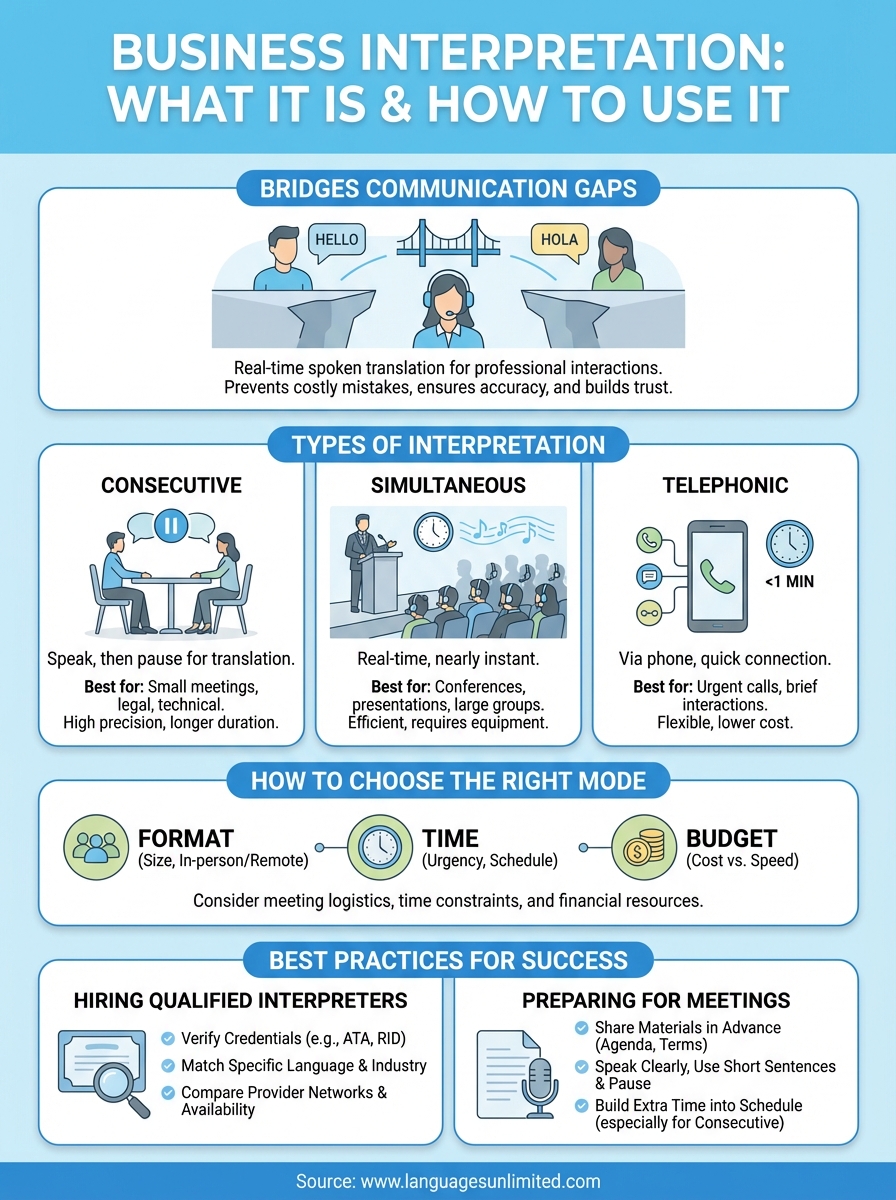
Your choice of interpretation method depends on the format of your meeting, the number of participants, and how critical real-time flow is to your discussion. Business interpretation comes in several distinct forms, each designed for specific scenarios you’ll encounter in professional settings. Understanding these differences helps you match the right service to your needs while staying within budget constraints.
Consecutive interpretation
The interpreter listens to you speak for 30 to 60 seconds, then delivers your message in the target language while you pause. This back-and-forth pattern works well for small meetings, negotiations, and one-on-one conversations where you can afford to extend the meeting time. Your business partner hears everything you say with full accuracy, but the session takes roughly twice as long as speaking in a shared language.
You’ll find consecutive interpretation particularly useful during legal consultations, contract signings, and technical discussions where precision matters more than speed. The interpreter can take notes and ask for clarification if needed, reducing the risk of misunderstanding complex terms or figures.
Simultaneous interpretation
An interpreter translates your words in real time as you speak, with only a few seconds of delay. This format requires specialized equipment like headsets and soundproof booths for in-person events, or dedicated platform features for virtual meetings. Your audience hears the interpretation through their headphones while you continue speaking at your natural pace.

Simultaneous interpretation keeps large conferences and multilingual board meetings moving efficiently without doubling your scheduled time.
This method suits conferences, product launches, annual shareholder meetings, and training sessions where you need to address dozens or hundreds of people simultaneously. The continuous flow maintains engagement and allows for dynamic presentations.
Telephonic interpretation
You connect with a professional interpreter via phone within minutes, making this the most flexible option for unexpected business calls or quick client conversations. The interpreter joins your call on a three-way line and provides consecutive interpretation between you and the other party. Languages Unlimited’s telephonic system connects you to interpreters in under one minute, which makes it practical for urgent business needs.
How to choose the right interpreting mode
Your decision between consecutive, simultaneous, and telephonic business interpretation depends on specific meeting logistics and what you need to accomplish. Start by examining the number of participants, whether they’ll gather in person or join remotely, and how much time you’ve allocated for the session. These practical factors narrow down which interpretation format will actually work for your situation before you consider other preferences.
Consider your meeting format
Large conferences with 50 or more attendees require simultaneous interpretation because consecutive would stretch a one-hour presentation into three hours. You need specialized audio equipment for in-person simultaneous interpretation, or a video platform that supports multiple audio channels for virtual events. Smaller meetings with two to ten people work perfectly with consecutive interpretation, where you can pause naturally between speaking turns without disrupting the conversation’s flow.
The size of your meeting and whether participants join in person or remotely determines which interpretation methods are technically feasible.
Remote meetings give you access to video remote interpreting (VRI) and telephonic options that don’t require on-site interpreters or equipment setup. Your team can conduct interpreted video calls with participants scattered across different time zones, which saves travel costs while maintaining face-to-face interaction.
Evaluate time constraints and budget
Consecutive interpretation doubles your meeting duration but costs less than simultaneous because you only need one interpreter without equipment. Budget for simultaneous when you’re running time-sensitive presentations, training sessions, or conferences where extending the schedule isn’t practical. Telephonic interpretation offers the lowest cost per minute and works well for quick calls that pop up unexpectedly, though it’s not ideal for complex discussions that require visual cues or document sharing during the conversation.
How to hire a business interpreter
Finding qualified interpreters requires vetting their credentials and confirming they have experience in your industry. You can’t assume that someone who speaks two languages fluently can interpret accurately during high-stakes business discussions. Professional business interpretation demands specialized training in terminology, ethics, and real-time language processing that goes beyond conversational fluency.
Verify credentials and experience
Ask potential interpreters for proof of certification from recognized professional organizations like the American Translators Association (ATA) or Registry of Interpreters for the Deaf (RID). These credentials confirm the interpreter completed formal training programs and passed rigorous competency exams. You should also request references from previous clients in your industry, particularly if you work in specialized fields like legal, medical, or financial services where technical vocabulary and compliance requirements differ significantly from general business settings.
Certified interpreters bring proven expertise that protects your organization from costly miscommunication during critical business interactions.
Request language-specific interpreters
Match the interpreter to your specific language pair and dialect. An interpreter qualified in Spanish doesn’t automatically handle Catalan, and someone fluent in Mandarin Chinese might struggle with Cantonese. Specify the exact languages, regional variations, and industry context when you contact interpretation service providers. This precision prevents situations where you discover mid-meeting that your interpreter can’t accurately convey technical terms or regional business expressions your partners use.
Compare service providers
Evaluate companies based on their network size, availability, and response time. Providers with larger interpreter pools can typically match you with industry-specialized professionals faster and handle last-minute requests more reliably. Check whether they offer the interpretation formats you need (consecutive, simultaneous, telephonic, or video remote) and confirm their experience supporting businesses similar to yours. Languages Unlimited maintains a network of over ten thousand language professionals, which gives you access to qualified interpreters across 200+ languages when urgent business needs arise.
How to prepare for interpreted meetings
Successful business interpretation requires preparation from you, not just the interpreter. You can’t walk into a multilingual meeting unprepared and expect flawless communication. Your advance work directly impacts how accurately the interpreter conveys your message and how smoothly the discussion flows.
Share materials and context beforehand
Send the interpreter your meeting agenda, presentation slides, and relevant documents at least 48 hours before your session. This advance access lets them research specialized terminology, understand your objectives, and prepare accurate translations of technical terms specific to your industry. Include background information about your company, the participants, and any products or services you’ll discuss during the meeting.
Interpreters who understand your context beforehand deliver significantly more accurate translations during your actual business discussions.
You should also brief the interpreter on acronyms, internal processes, or company-specific language that might come up. What seems obvious to you (like your product names or department abbreviations) requires explanation for someone entering your business environment for the first time.
Set clear speaking guidelines
Instruct all participants to speak in short, complete sentences rather than long, complex statements that strain interpretation accuracy. Ask your team to pause naturally after every 30 to 60 seconds during consecutive interpretation, or to maintain steady pacing during simultaneous interpretation. Remind everyone to avoid idioms, slang, and cultural references that don’t translate well across languages.
Build extra time into your schedule
Add 30 to 50 percent more time to your meeting duration when using consecutive interpretation. A one-hour discussion in a single language becomes 90 minutes when you’re interpreting back and forth. Account for this expansion when you send calendar invites and set expectations with participants about the extended timeline they should block off.
Next steps
Professional business interpretation removes language barriers that slow down your international operations and put deals at risk. You’ve learned how to select the right interpretation format, prepare your team for multilingual meetings, and evaluate qualified interpreters who match your industry requirements. These steps protect your organization from costly miscommunication while building stronger relationships with global partners.
Your next action depends on whether you need interpretation services now or want to establish a relationship for future projects. Start by identifying your most common language pairs and the typical meeting formats your team uses for international business. This preparation helps you connect with interpretation providers who can deliver the specific services you need.
Languages Unlimited has supported businesses across all 50 states since 1994 with consecutive, simultaneous, and telephonic interpretation in over 200 languages. Our network of qualified interpreters includes professionals experienced in your industry who can start immediately. Contact our team to discuss your interpretation requirements and receive a customized solution for your organization.