



When you need to book a sign language interpreter, the process should be straightforward, but it rarely feels that way. Between finding qualified professionals, confirming availability, and making sure the interpreter matches the specific needs of your event, there’s more to coordinate than most people expect. Getting it wrong can mean miscommunication at the exact moment clear communication matters most.
Whether you’re planning a company meeting, a public event, a medical appointment, or a legal proceeding, a skilled interpreter ensures that Deaf and hard-of-hearing participants have equal access to every word spoken. It’s not just a courtesy, in many cases, it’s a legal requirement under the ADA.
At Languages Unlimited, we’ve been providing sign language interpretation services, including ASL and other sign modalities, since 1994, with coverage across all 50 states. This guide walks you through how to book the right interpreter for your situation, what to look for in a provider, and how to set your event up for success.
What to know before you book an interpreter
When you book a sign language interpreter, the outcome depends heavily on how well you’ve matched the interpreter to the situation. Not every sign language interpreter holds the same credentials, and not every event calls for the same level of expertise. Before you contact a provider, it helps to understand the basics of interpreter qualifications and your legal responsibilities so you ask the right questions upfront.
Interpreter credentials and specialization
Sign language interpreters can hold different levels of certification. The Registry of Interpreters for the Deaf (RID) is the primary national certifying body in the United States, and interpreters with RID credentials have passed rigorous written and performance exams while following a strict code of professional conduct. Beyond general certification, some interpreters specialize in specific settings such as legal proceedings, medical consultations, mental health appointments, or educational environments. Matching the interpreter’s specialty to your event type directly affects how accurately and naturally information gets conveyed to Deaf and hard-of-hearing participants.
For high-stakes settings like court hearings or clinical consultations, always request a certified specialist, not a generalist.
Your legal obligations under the ADA
If you run a business, government agency, school, or public institution, the Americans with Disabilities Act requires you to provide effective communication for Deaf and hard-of-hearing individuals. This typically means covering the full cost of interpretation yourself without passing it on to the participant. The specific requirements vary by setting and entity type, so reviewing the ADA guidance on effective communication will clarify what applies to your organization. Failing to provide qualified interpretation can expose you to formal complaints or legal liability, which makes this a compliance issue just as much as an access one.
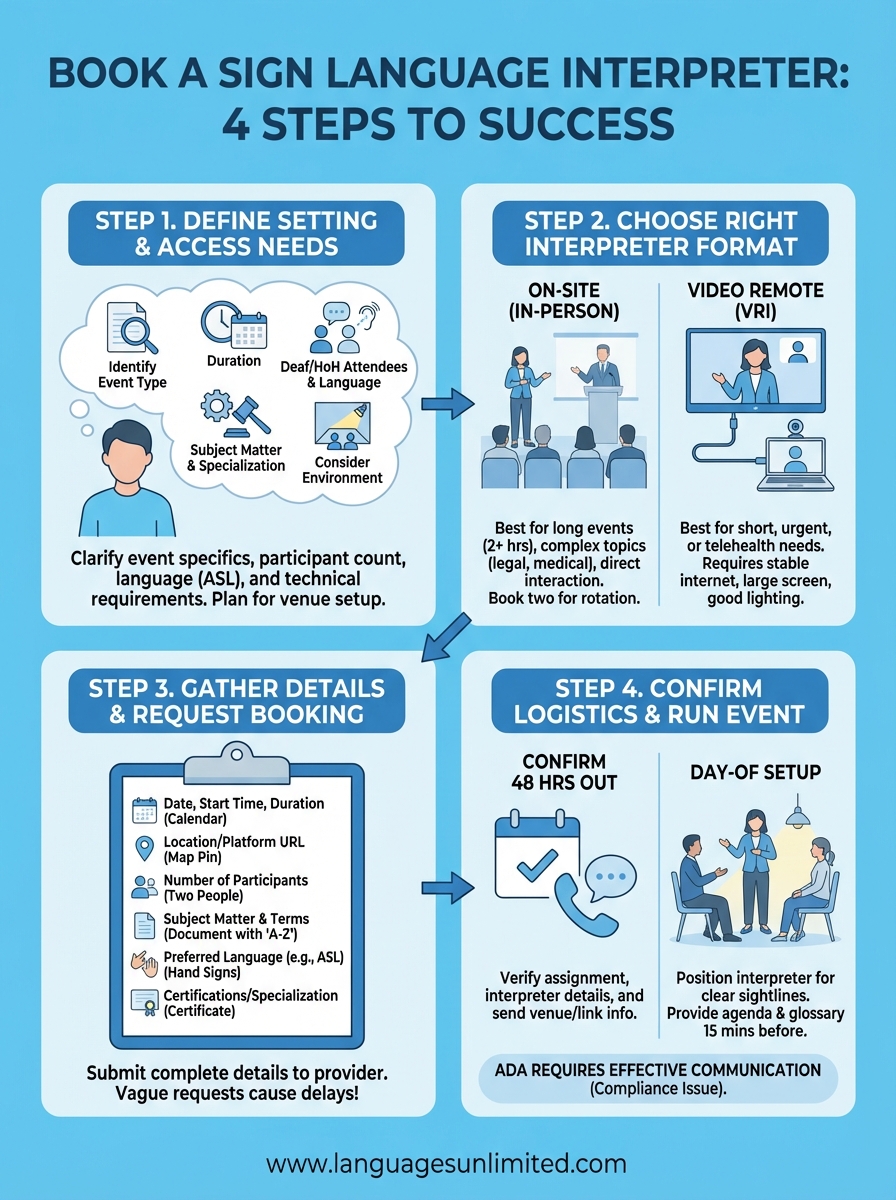
Step 1. Define the setting and access needs
Before you book a sign language interpreter, you need a clear picture of what the event requires. The setting, audience size, and specific access needs of your Deaf or hard-of-hearing participants shape every decision that follows, from which interpreter format you request to how far in advance you reach out.
Identify the event type and participant needs
Start by writing down the basics of your event. The more specific your details, the faster a provider can confirm the right match. Consider the following:
- Event type: Is this a staff meeting, a public conference, a medical appointment, or a legal proceeding?
- Duration: How many hours will the interpreter need to work?
- Number of Deaf/hard-of-hearing attendees: One participant versus a large audience changes the setup.
- Subject matter: Technical, legal, or medical content may require a specialist.
- Language preference: ASL is standard in the US, but some participants may use other sign systems.
Consider the environment
Your physical setup also determines what kind of interpretation works best. Large venues with poor sightlines may need platform interpreters with specific lighting, while smaller meeting rooms work fine with a single interpreter seated near the speaker. Virtual or hybrid events require a different setup entirely, which you will address in the next step.
Collecting this information before contacting a provider cuts booking time significantly and reduces the chance of a mismatch on the day of the event.
Step 2. Choose the right type of interpreter service
Once you have your event details mapped out, you need to decide which format of interpretation best fits your situation. The three main options are on-site, video remote interpreting (VRI), and telephonic. Each works best in different contexts, and choosing the wrong format can create access gaps even when a qualified interpreter is available.
On-site interpretation
On-site interpretation places a certified interpreter physically in the room with your participants. This format works best for legal hearings, medical appointments, and large events where visual clarity and direct interaction are critical. Use on-site interpretation when:
- The session runs longer than two hours (book two interpreters who rotate every 20-30 minutes)
- The subject matter is technical, legal, or medical
- The Deaf participant prefers direct, in-person communication
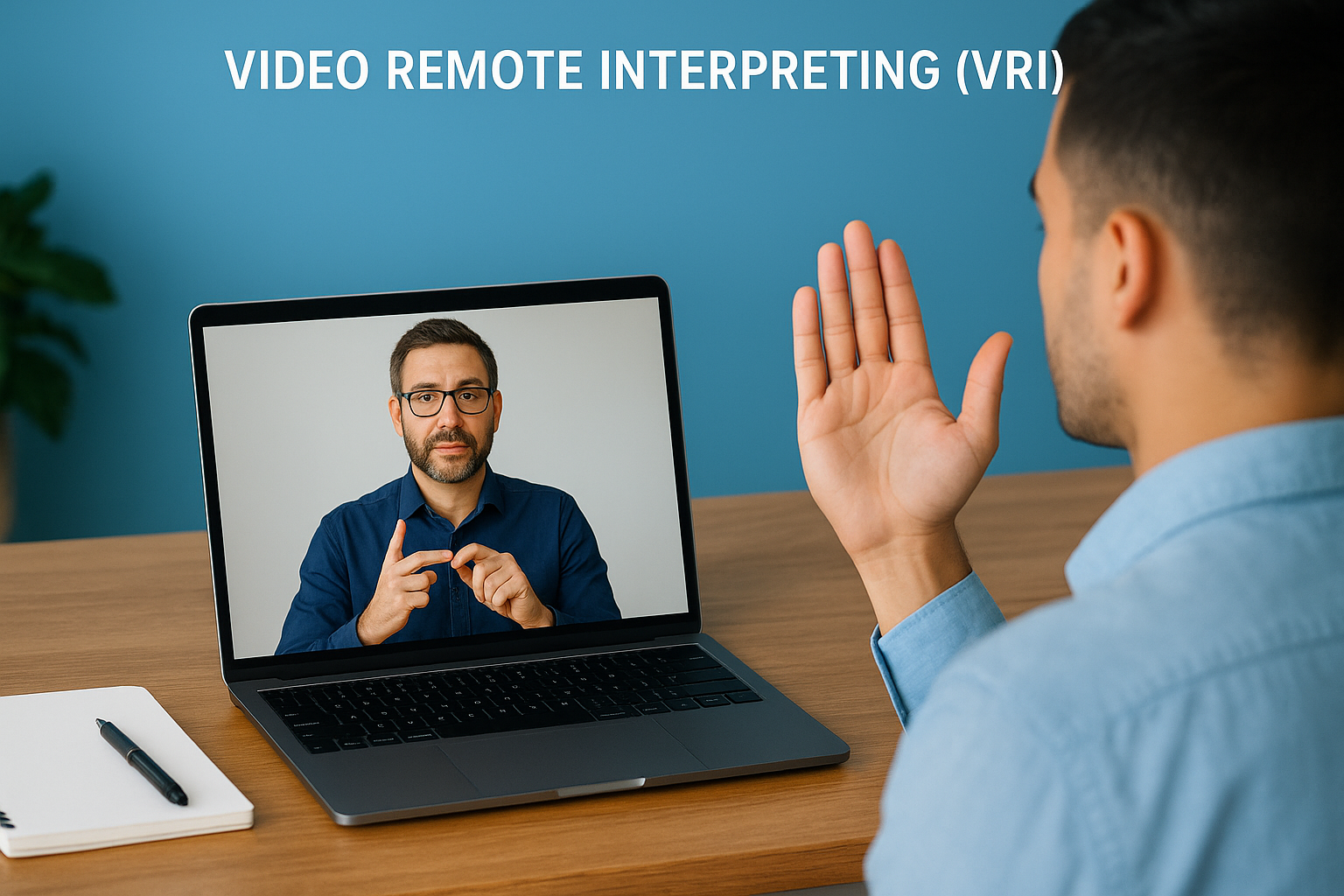
Video remote interpreting (VRI)
VRI connects you to a certified interpreter via a secure video call, which suits shorter appointments, telehealth visits, or urgent same-day needs. When you book a sign language interpreter through VRI, verify your technical setup before the session starts to avoid disruptions:
- Stable internet connection (10 Mbps minimum)
- Large screen positioned at eye level
- Good lighting with no backlighting behind the participant
VRI is not a substitute for on-site interpretation in lengthy or high-complexity settings.
Step 3. Gather details and request a booking
Once you have chosen your format, you need to compile all the information a provider needs to confirm your booking. Submitting complete details upfront speeds up the process and reduces back-and-forth, especially when you need to book a sign language interpreter on a tight timeline. Incomplete or vague requests are the most common reason bookings get delayed.
What to include in your booking request
Providers assign interpreters based on the specifics you submit. Missing information, such as subject matter or participant count, increases the chance of a mismatch. Pull together these details before reaching out:
- Event date, start time, and total duration
- Location address or video platform URL
- Number of Deaf or hard-of-hearing participants
- Subject matter and any technical terminology involved
- Preferred sign language (ASL, PSE, or other)
- Any certification requirements or interpreter specialization needed
Sample request template
Use this template when contacting a provider to make sure nothing gets left out:
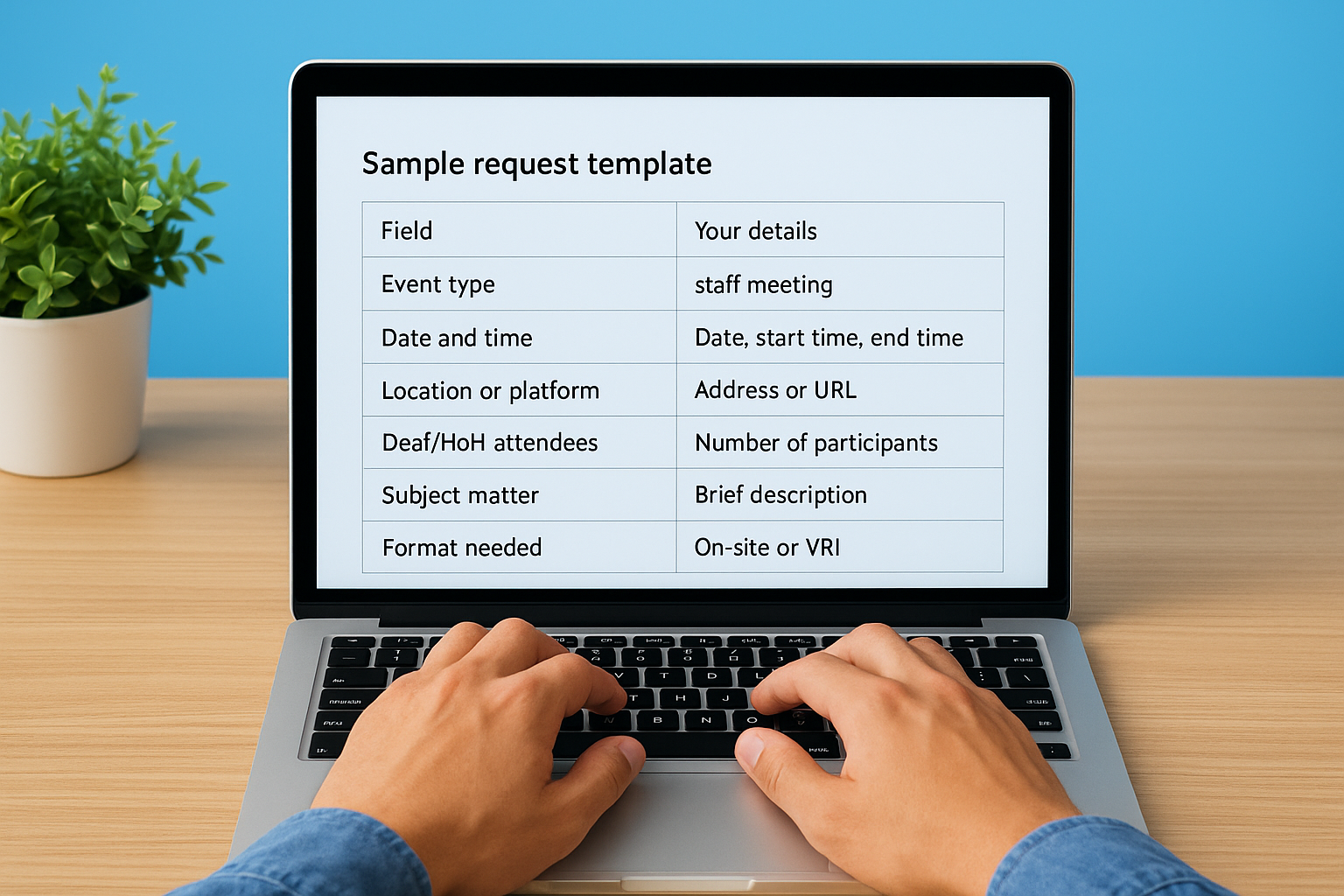
Providers confirm bookings faster when you give them the full picture in your first message.
| Field | Your details |
|---|---|
| Event type | e.g., staff meeting, medical appointment |
| Date and time | Date, start time, end time |
| Location or platform | Address or URL |
| Deaf/HoH attendees | Number of participants |
| Subject matter | Brief description |
| Format needed | On-site or VRI |
| Special requirements | Certifications, specialization, language |
Step 4. Confirm logistics and run the event smoothly
Once your booking is confirmed, your work isn’t done. Following up on logistics before the event prevents the most common day-of problems, from technical failures to interpreter positioning issues.
Confirm details 48 hours out
Reach out to your provider at least 48 hours before the event to verify the assignment is locked in. Confirm the interpreter’s name, arrival time, and contact number. If you book a sign language interpreter for an in-person event, share the venue address, parking information, and the name of your onsite contact. For virtual events, send the video platform link, any access codes, and test the connection in advance.
Set up the interpreter for success on the day
Position your interpreter where Deaf and hard-of-hearing participants can see both the speaker and the interpreter without shifting their gaze. Ensure the interpreter has good lighting, a clear sightline to the speaker, and any printed materials or slides ahead of time. Sharing an agenda or glossary of technical terms before the session helps the interpreter prepare and reduces errors during delivery.
Brief the interpreter on the agenda at least 15 minutes before the session starts.
Next steps
You now have everything you need to book a sign language interpreter with confidence. Define your event requirements first, choose the right format, submit complete booking details, and confirm logistics before the day arrives. Each step directly affects how well your Deaf and hard-of-hearing participants experience your event.
Waiting until the last minute is the biggest risk you can take. Most certified interpreters book up fast, especially for legal, medical, or large public events. Start your search at least two weeks out when possible, and always confirm your assignment 48 hours before the event to avoid day-of problems.
Languages Unlimited has placed qualified ASL and sign language interpreters across all 50 states since 1994. Whether you need on-site or VRI coverage, our team matches you to the right interpreter for your specific setting and subject matter. Contact our team to get your booking started today.