



Government agencies and federal contractors depend on personnel who’ve already been vetted and approved to handle classified information. Finding those people, and finding them quickly, is where security clearance staffing becomes critical. Without a reliable process for sourcing and placing cleared professionals, projects stall, contracts risk non-compliance, and sensitive operations lose momentum.
But staffing cleared positions involves more than matching resumes to job descriptions. It requires understanding clearance levels, adjudication timelines, polygraph requirements, and the specific demands of each agency or program. Add multilingual needs to the mix, something increasingly common in defense, intelligence, and diplomatic roles, and the hiring process grows even more complex. That’s exactly why organizations turn to staffing partners with deep roots in both government contracting and language services.
At Languages Unlimited, we provide cleared and non-cleared personnel for federal, state, and local government agencies, with a built-in advantage: access to bilingual and multilingual professionals across 200+ languages. This article breaks down what security clearance staffing actually means, how the process works from investigation to adjudication, and practical tips for hiring cleared talent more efficiently.
Why security clearance staffing matters
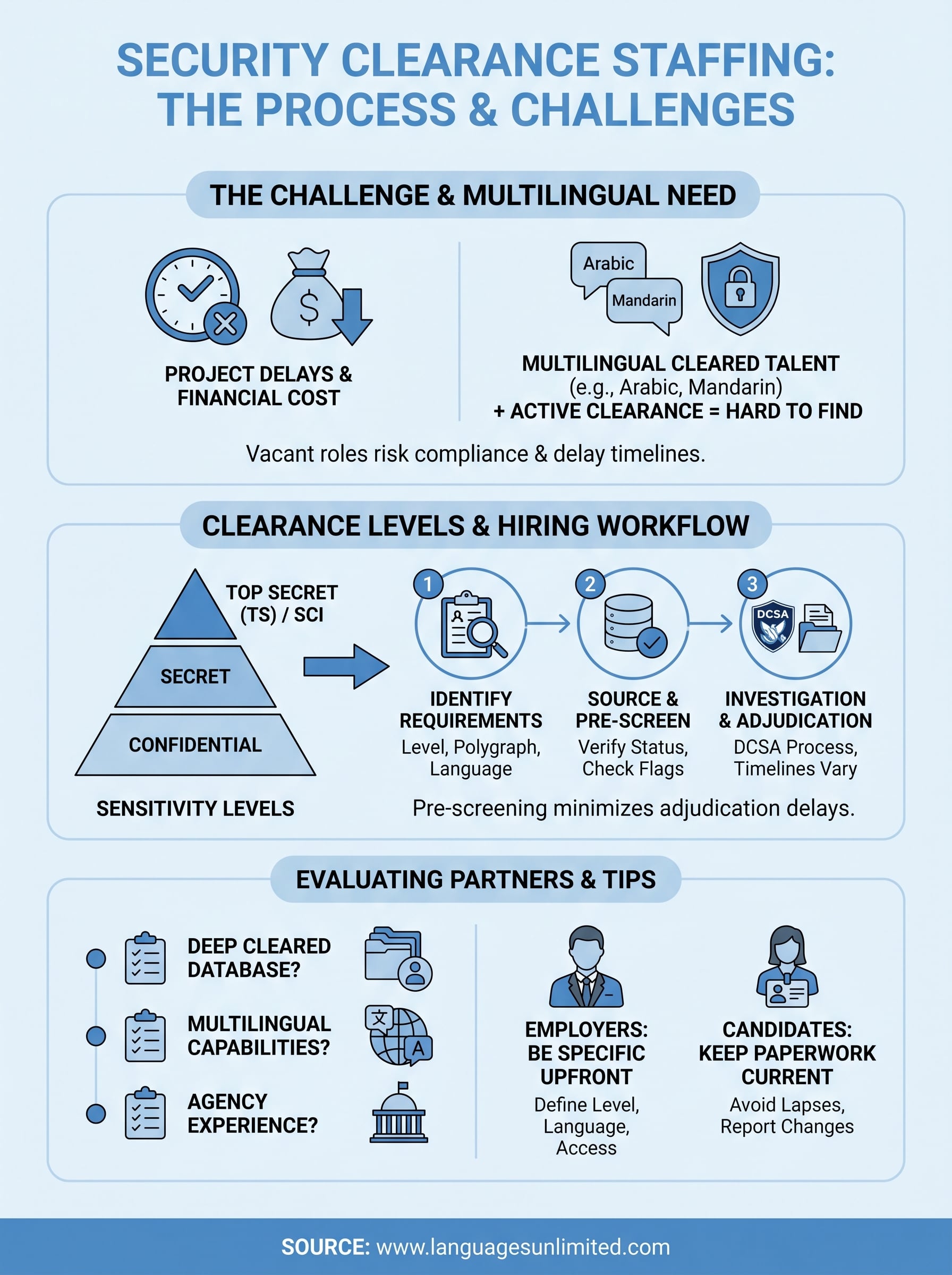
When a cleared position sits vacant, it doesn’t just slow down a project. It can delay contract delivery, put your agency’s compliance status at risk, and force uncleared staff to work around sensitive gaps they aren’t authorized to fill. The pool of candidates who already hold an active clearance is significantly smaller than the general workforce, which means competition for cleared talent is constant and often intense. Most organizations that rely on conventional hiring channels simply don’t have the reach to find these professionals at speed.
The average wait time for a new security clearance investigation can stretch from several months to over a year, depending on clearance level and agency backlog.
The cost of a vacant cleared role
Unfilled cleared roles carry direct financial consequences. Government contracts often include clauses tied to staffing levels, and falling short can result in penalties or scope reductions. Beyond the contract language, your team absorbs the operational strain of the gap, reassigning work, extending timelines, or leaving critical tasks undone until the right person is in place. Security clearance staffing solves this by giving you access to pre-vetted candidates who can step into roles faster, without waiting months for a full investigation to run its course.
When language skills are also required
Many federal programs, particularly in defense, intelligence, and diplomacy, require professionals who hold both a valid active clearance and fluency in a second language. Arabic, Mandarin, Farsi, Russian, and Spanish are among the most requested. Finding a candidate who checks both boxes is genuinely difficult through standard hiring channels. A staffing partner with a multilingual candidate database can identify those professionals far more quickly, because they already maintain relationships with bilingual cleared talent across a wide range of specializations.
Key clearance types and eligibility basics
Before you engage a security clearance staffing partner, you need to understand which clearance level your open roles actually require. Not all clearances are equal, and the requirements, investigation depth, and timelines vary significantly across levels.
The three main clearance levels
The federal government uses three primary clearance tiers, each tied to the sensitivity of information the role involves.
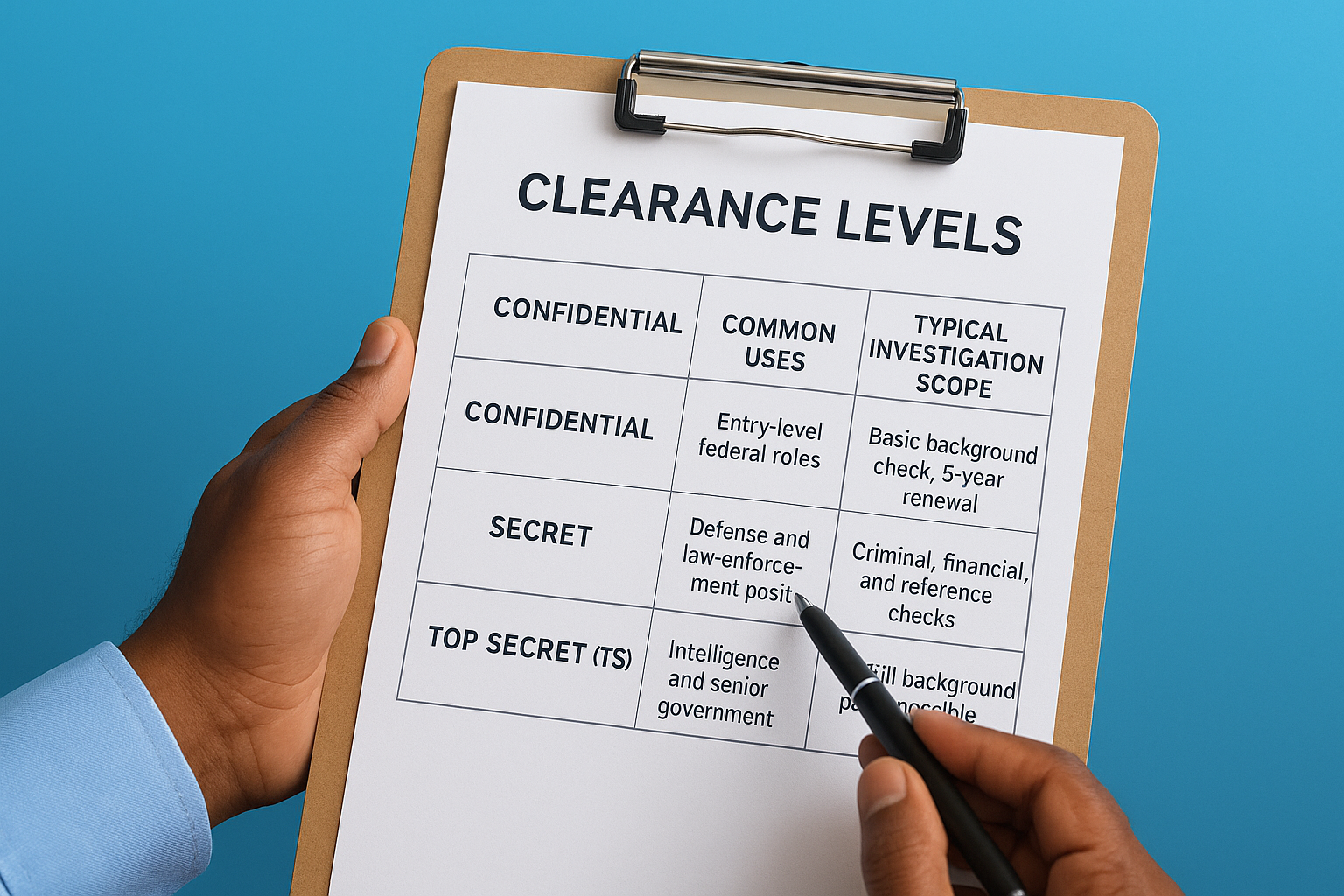
| Clearance Level | Common Uses | Typical Investigation Scope |
|---|---|---|
| Confidential | Entry-level federal roles | Basic background check, 5-year renewal |
| Secret | Defense and law enforcement positions | Criminal, financial, and reference checks |
| Top Secret (TS) | Intelligence and senior government roles | Full background investigation, possible polygraph |
Some positions also require a TS/SCI (Sensitive Compartmented Information) designation, which adds an additional layer of access restrictions beyond Top Secret.
Basic eligibility factors
Clearance eligibility comes down to a set of adjudicative guidelines the federal government applies consistently across agencies. Factors like foreign contacts, financial history, criminal record, and past drug use all carry weight in the review.
Even a minor financial issue or undisclosed foreign contact can delay or disqualify a candidate during adjudication.
Your staffing partner should screen candidates against these factors before submission, not after.
How the clearance hiring process works
Understanding the steps involved helps you set realistic expectations and avoid delays. Security clearance staffing moves through several distinct phases, and knowing where bottlenecks typically appear lets you plan ahead and protect your contract timelines.

Identify the position requirements
Your first step is defining exactly what the role needs. Clearance level, access type, and any polygraph requirements all need to be nailed down before you begin sourcing candidates. Skipping this step leads to wasted time screening people who simply don’t qualify.
Source and pre-screen candidates
A qualified staffing partner will pull from a database of currently cleared professionals rather than starting from scratch. Pre-screening should verify that the candidate’s clearance is active, appropriately scoped, and free of flags that could complicate adjudication.
An active clearance can lapse if the candidate has been out of cleared work for more than 24 months, so always confirm currency before moving forward.
Navigate investigation and adjudication
If a new or upgraded clearance is required, the investigation process runs through the Defense Counterintelligence and Security Agency (DCSA). Timelines vary by level and current workload, but submitting complete, accurate paperwork from the start significantly reduces back-and-forth delays and keeps your hiring timeline on track.
How to evaluate a cleared staffing provider
Not every staffing firm that claims cleared capabilities actually has the depth of candidate relationships or agency-specific experience to fill your roles at speed. Evaluating a provider before you commit saves you from a slow, frustrating process that costs you time on active contracts.
Check their cleared candidate database
A strong security clearance staffing partner maintains an existing pipeline of active candidates, not just a process for finding new ones. Ask directly how many cleared professionals they currently track, which clearance levels and specializations are represented, and how recently those records were verified.
A provider who can’t answer those questions quickly likely doesn’t have the database depth you need.
Confirm multilingual and specialized capabilities
If your roles require language-qualified cleared professionals, your provider needs a verified record of placing them. Ask for examples of past placements that combined clearance requirements with specific language or technical skill sets, and confirm they screen for cultural competency, not just language proficiency.
When vetting any provider, look for these core capabilities:
- Active clearance verification process
- Multilingual candidate coverage across key languages
- Experience with your specific agency or contract type
- Compliance-focused screening and onboarding support
Tips for employers and cleared candidates
Whether you’re hiring or job-seeking, security clearance staffing works best when both sides come prepared. A little upfront effort on either end cuts down on delays and improves the odds of a successful placement.
For employers: tighten your requirements upfront
Define your clearance level, access type, and any polygraph needs before you send a requisition to your staffing partner. Vague job requirements waste time on both sides and pull in candidates who don’t qualify. You should also confirm whether the role requires a language-qualified professional, since that combination narrows the candidate pool significantly and changes how your provider needs to search.
The more specific your requirements are at the start, the faster your staffing partner can deliver qualified candidates.
For cleared candidates: keep your paperwork current
Your clearance status is only as useful as its currency, so stay on top of renewal timelines and report any life changes that could affect your adjudication, such as foreign travel, new financial obligations, or changes in family contacts abroad. Gaps in cleared employment can trigger a new investigation, which costs time. Maintaining continuous cleared employment, even in a transitional or part-time capacity, protects your status and keeps you competitive in the cleared job market.
Next Steps
Security clearance staffing moves fast when you have the right partner, and it stalls when you don’t. The details covered here, from clearance tiers and adjudication basics to how you should evaluate providers, give you a solid foundation for making smarter hiring decisions. Whether you’re filling a single cleared role or building a multilingual cleared workforce across an agency program, the process works best when your staffing partner brings both government contracting experience and language capabilities to the table.
Languages Unlimited has supported federal, state, and local government agencies since 1994, placing cleared and non-cleared personnel across administrative, healthcare, social services, and public-facing roles. Our multilingual candidate database covers 200+ languages, which means we can fill roles that combine clearance requirements with specific language qualifications. If you’re ready to move on an open position or want to talk through your program requirements, reach out to our team and we’ll get started.