



Federal, state, and local agencies rely on a contract workforce for government operations more than ever before. From administrative support to healthcare roles to language-qualified professionals, contract workers fill critical gaps that agencies can’t always address through direct hiring alone. But working within this system, whether you’re a staffing provider or an organization seeking talent, means navigating a web of regulations, compliance requirements, and procurement processes that differ significantly from the private sector.
Understanding how government contract staffing works isn’t optional; it’s the difference between winning contracts and losing them, between staying compliant and facing costly penalties. Questions around eligibility, labor standards, security clearances, and contract vehicles like GSA Schedules all come into play. Getting any of these wrong can sideline even the most qualified providers.
At Languages Unlimited, we’ve operated as a GSA Contract Holder and government staffing partner since 1994, placing cleared and non-cleared personnel in federal and state roles across the country, including bilingual professionals in over 200 languages. This article breaks down how the contract workforce for government actually functions, what compliance looks like in practice, and how agencies and staffing firms can work together effectively.
What contract workforce for government means
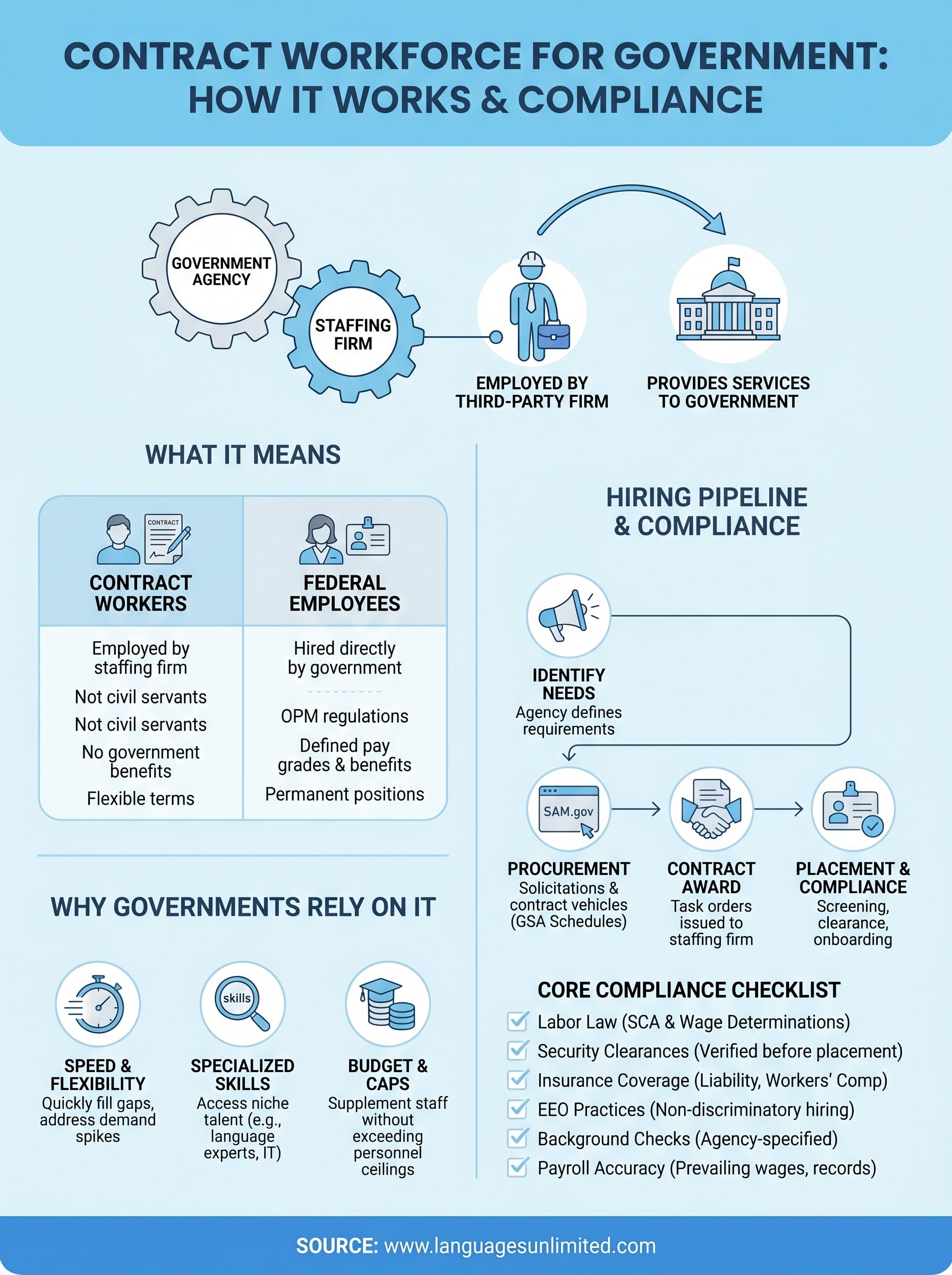
A contract workforce for government refers to workers who perform services for a government agency but are employed through a third-party staffing firm or as independent contractors rather than as direct government hires. These individuals are not civil servants. They don’t go through the standard federal or state hiring process, and they don’t receive government benefits. Instead, they work under the terms of a contract between the agency and a staffing provider or employer of record.
The difference between contract workers and federal employees
Federal employees are hired directly by the government and fall under Office of Personnel Management (OPM) regulations, with pay grades, benefits, and protections defined by law. Contract workers operate outside that structure. The agency pays the staffing firm, and the staffing firm employs the worker. This distinction matters because it shifts many HR, payroll, and compliance responsibilities to the contractor, not the agency.
Understanding this distinction protects both agencies and staffing firms from misclassification penalties and legal exposure.
Your staffing partner carries the obligation to follow applicable labor laws, maintain proper insurance, and ensure workers meet any clearance or credentialing requirements the contract specifies.
Types of roles that fall under government contracts
Contract workers appear across nearly every government function, from IT and logistics to public health and social services. Agencies frequently use contract staff for administrative roles, case management, translation and interpretation, healthcare support, and program coordination.
Language-qualified roles represent a significant and growing category, particularly in agencies serving diverse communities. Bilingual case workers, medical interpreters, and multilingual administrative staff are often placed through specialized staffing firms with expertise in this area, since general staffing agencies rarely carry the depth of language-qualified talent these positions demand.
Why governments rely on contract labor
Government agencies face a constant tension between fixed headcounts and fluctuating workloads. Direct hiring takes months, while expanding the contract workforce for government operations lets agencies bring qualified workers on quickly when programs launch, demand spikes, or emergency response situations arise.
Flexibility and specialized skills
Two factors drive most contracting decisions: speed and specialization. Civil service hiring involves lengthy approval chains, job postings, and background checks that can stretch across a budget cycle. Contract workers bypass much of that friction, giving agencies access to specialized talent like bilingual professionals, healthcare support staff, or technical experts without committing to permanent employment costs.
When demand drops or a program ends, agencies can reduce contract staff without the procedural complexity of cutting civil service positions.
Budget and workforce caps
Many agencies operate under strict personnel ceilings that cap how many direct employees they can carry. Contracting lets agencies supplement existing staff legally without exceeding those ceilings. If your organization works with government clients, understanding these cap structures helps you position contract staffing as a solution rather than a workaround, especially in public health, social services, and language access roles where community demand frequently outpaces fixed headcounts.
How the government contract hiring pipeline works
The process of placing a contract workforce for government roles follows a structured path that starts well before a worker ever shows up on-site. Agencies identify workforce gaps, then issue solicitations through procurement systems like SAM.gov, where qualified vendors can compete for the work. Understanding this pipeline helps staffing firms position themselves correctly and respond to opportunities before deadlines close.
Contract vehicles and procurement
Most government contracts flow through established contract vehicles that agencies use to streamline purchasing. These include GSA Schedules, Blanket Purchase Agreements (BPAs), and IDIQs (Indefinite Delivery, Indefinite Quantity contracts). Holding a GSA Schedule, for example, signals that your firm has already passed a baseline vetting process, which speeds up the agency’s acquisition timeline significantly.
Getting on a contract vehicle before an agency issues a specific task order gives you a real competitive advantage.
From award to placement
Once a contract is awarded, the staffing firm receives a task order outlining the specific roles, qualifications, and performance standards required. Your team then sources, screens, and presents candidates who meet those requirements. Clearance verification, credentialing checks, and onboarding must all happen before any worker begins, and the agency typically sets firm timelines for each step.

Compliance checklist for contract staffing
Running a contract workforce for government programs means compliance isn’t a one-time checkpoint. Agencies expect staffing firms to maintain documented records of every obligation met, from labor law adherence to worker eligibility verification, and they audit those records regularly.
A single compliance gap can trigger contract suspension or bar your firm from competing for future government work.
Core requirements to track before and during placement
Your firm must manage several compliance areas at once. Building a systematic review process is the only reliable way to stay current across active contracts.

- Labor law compliance: Follow the McNamara-O’Hara Service Contract Act and applicable wage determinations for each contract location
- Security clearances: Verify and document clearance levels before placement begins, not after
- Insurance coverage: Carry general liability, workers’ compensation, and any contract-specific coverage the agency requires
- Equal Employment Opportunity: Maintain hiring records that demonstrate non-discriminatory practices throughout the placement process
- Background checks: Complete agency-specified screenings before the worker’s first day on-site
- Payroll accuracy: Apply correct prevailing wages and document every pay period with supporting records
Reviewing these requirements at contract award, at each task order, and at regular intervals throughout performance keeps your team out of compliance trouble and positions you well for contract renewals.
Finding opportunities and choosing the right partner
Locating the right contracts for your contract workforce for government program starts with knowing where agencies post their requirements. The primary source is SAM.gov, the federal government’s official system where solicitations, contract awards, and vendor registrations are published.
Where to find government contract opportunities
Registering on SAM.gov is a mandatory first step for any firm pursuing federal work. Beyond the federal level, state and local procurement portals publish their own solicitations, so you’ll need to monitor multiple systems depending on the agencies you target. Setting up automated search alerts by NAICS code or keyword keeps you notified when relevant opportunities open.
Key places to search for government contracting opportunities:
- SAM.gov: Federal solicitations, awards, and vendor registration
- State procurement portals: Each state runs its own purchasing system
- Agency-specific sites: Some agencies post supplemental opportunities directly
What to look for in a staffing partner
Your staffing partner’s track record and compliance infrastructure matter more than their marketing. Look for firms that hold established contract vehicles like a GSA Schedule, carry the required insurance and clearance capabilities, and have documented experience placing workers in your sector.
A partner with access to language-qualified talent in 200-plus languages gives your agency a real advantage when serving multilingual communities.
Specialized industry knowledge and a proven placement process separate partners who deliver on day one from those who create compliance risk throughout the life of the contract.
Next steps
Building a contract workforce for government programs takes the right infrastructure, the right compliance processes, and the right staffing partner. This article has walked you through what government contract labor means, why agencies use it, how the hiring pipeline runs, and what compliance actually requires in practice. Every piece of that picture connects directly to whether your program succeeds or stalls.
Your next move depends on where you are in the process. If you’re an agency looking to fill language-qualified roles quickly, or a program manager evaluating staffing partners for an upcoming contract, the details covered here give you a solid foundation for those conversations. Choosing a partner with documented government experience, established contract vehicles, and access to bilingual talent makes the difference when timelines are tight and compliance is non-negotiable.
Languages Unlimited has supported government agencies with staffing and language services since 1994. Contact our team to discuss your specific staffing needs.