



Choosing between consecutive interpreting vs simultaneous interpreting can make or break a multilingual event. Pick the wrong method, and you’re looking at awkward pauses during a fast-moving conference, or an interpreter struggling to keep up in a one-on-one medical consultation. Both approaches serve the same core purpose (bridging a language gap), but they work in fundamentally different ways that affect timing, cost, equipment needs, and the overall experience for everyone in the room.
At Languages Unlimited, we’ve provided both consecutive and simultaneous interpreting services since 1994, staffing everything from federal court proceedings to hospital consultations to international conferences across all 50 states. With a network of over ten thousand interpreters covering 200+ languages, we’ve seen firsthand how the right interpreting mode transforms communication, and how the wrong one creates unnecessary friction. That hands-on experience is exactly what shaped this guide.
This article breaks down what each method actually involves, where each one works best, and how to decide which approach fits your specific situation. Whether you’re planning a large-scale multilingual conference or coordinating interpreter support for client-facing meetings, you’ll walk away with a clear framework for making that call with confidence.
What each interpreting mode means
Before you can compare consecutive interpreting vs simultaneous interpreting side by side, you need a clear picture of how each method actually works. The two modes look similar on paper (one person converting speech from one language to another), but the mechanics, timing, and skill sets involved are quite different. Understanding those mechanics helps you match the right approach to your event before you book anything.
Consecutive interpreting
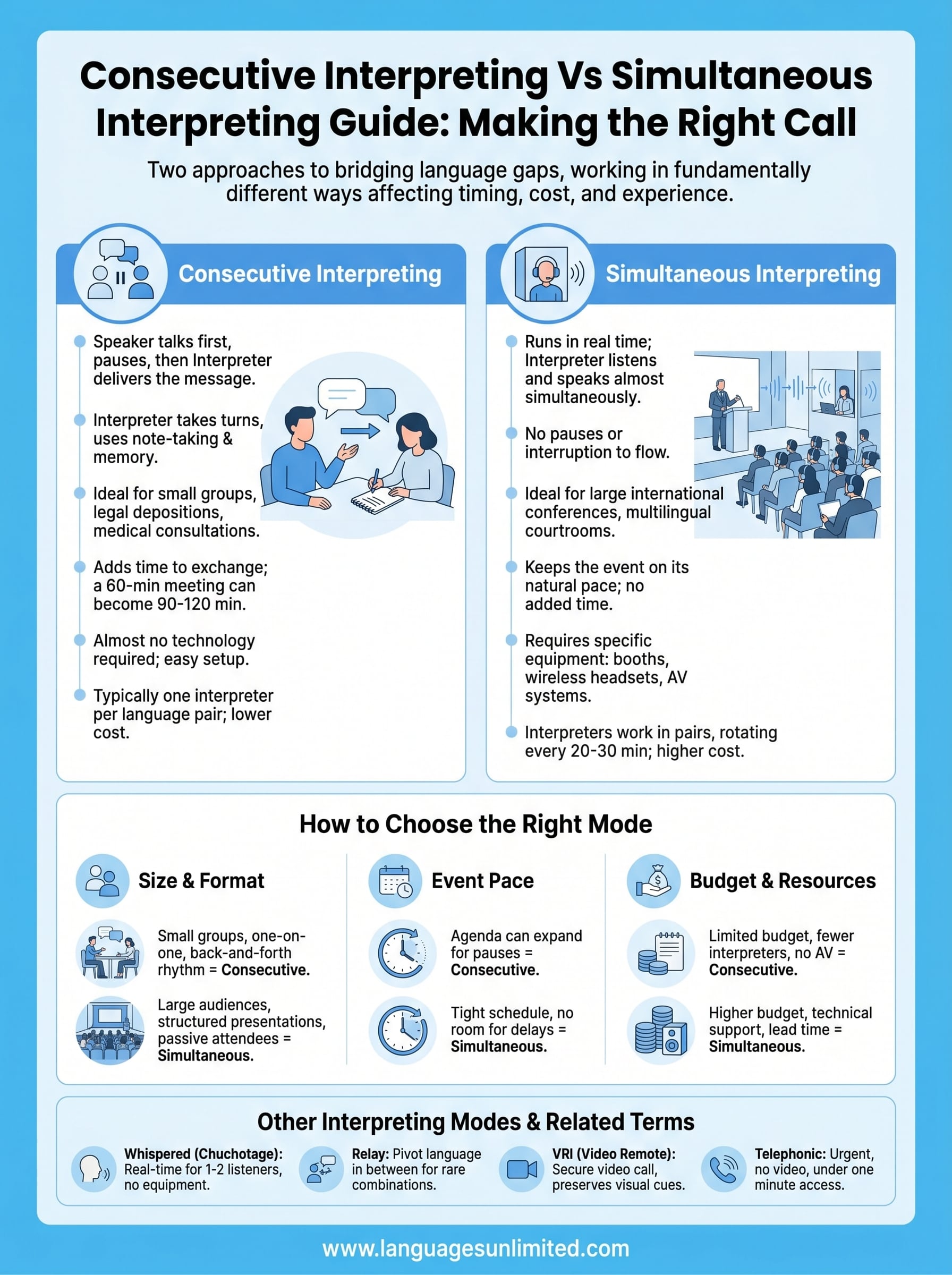
Consecutive interpreting is the method where the speaker talks first, pauses, and then the interpreter delivers the message in the target language. The speaker and interpreter take turns, with the interpreter typically waiting for a complete thought or a natural break before stepping in. During that pause, the interpreter uses a combination of note-taking and short-term memory to accurately reconstruct what was said. A well-trained consecutive interpreter doesn’t transcribe word-for-word; they capture the meaning, structure, and intent, then render it clearly in the other language.
This mode works at a conversational pace. In a medical consultation, for example, a doctor might explain a diagnosis in English, pause, and then the interpreter delivers that explanation to a Spanish-speaking patient. The exchange continues in back-and-forth segments. No specialized audio equipment is required for consecutive interpreting, which makes it easier to set up and more cost-effective for smaller or one-on-one settings. The tradeoff is that it roughly doubles the time needed to get through any given exchange.
Consecutive interpreting is the default choice for legal depositions, medical appointments, and small-group meetings where accuracy and natural flow matter more than speed.
Simultaneous interpreting
Simultaneous interpreting runs in real time. The interpreter listens to the speaker and delivers the translation almost at the same moment, with only a few seconds of lag. There is no pause, no turn-taking, and no interruption to the flow of the presentation. This is the method you see in action at the United Nations, large international conferences, and multilingual courtrooms with complex proceedings.
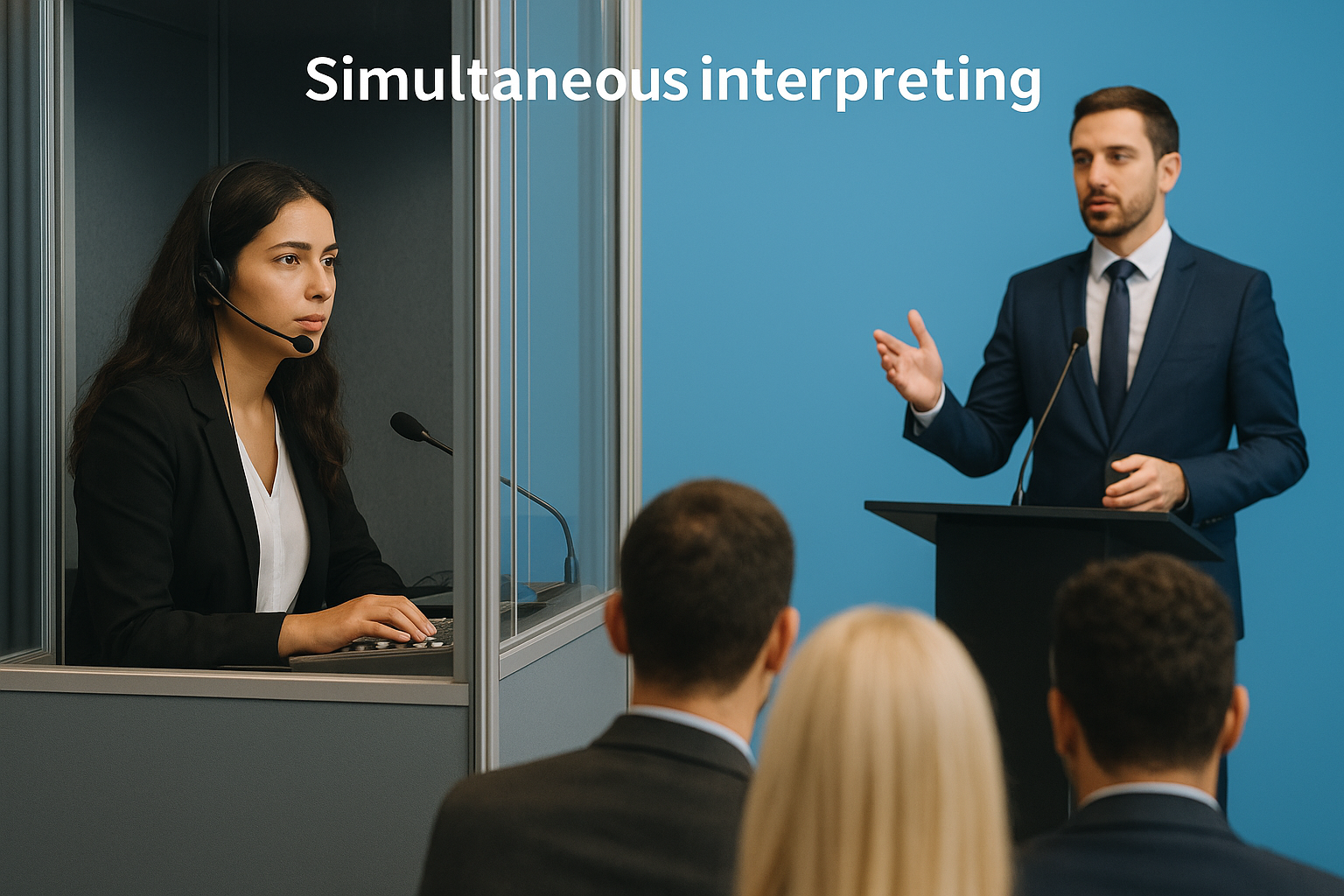
Because the cognitive demand is so high (the interpreter is actively listening, processing, and speaking at the same time), simultaneous interpreters almost always work in pairs, rotating every 20 to 30 minutes to prevent fatigue. This is not optional. Sustained simultaneous interpreting without rotation leads to accuracy drops, which in high-stakes settings can have serious consequences. The mode also requires specific equipment: soundproof interpreter booths, wireless receiver headsets for attendees, and audio distribution systems. For large events, that setup adds both logistical planning and cost, but it keeps the event running on schedule without any added time for translation.
Think of a multilingual product launch where hundreds of attendees need live translation in three languages simultaneously. Consecutive interpreting would make the event three times as long. Simultaneous interpreting handles all three languages at the same time, in separate audio channels, without adding a single minute to the schedule. That difference alone drives many event planners to choose simultaneous interpretation for anything with a large audience or a tight agenda.
Understanding both modes at this level puts you in a much stronger position to evaluate what your specific situation actually requires.
Key differences that affect outcomes
When you stack consecutive interpreting vs simultaneous interpreting side by side, five practical factors separate them: timing, equipment, cost, interpreter staffing, and setting suitability. Each one has a direct effect on how your event or appointment runs, so understanding where the two modes diverge helps you avoid costly surprises during planning.
Timing and event flow
Consecutive interpreting adds time to every exchange because the interpreter waits for the speaker to finish a thought before delivering the message. In practice, a 60-minute meeting can stretch to 90 or 120 minutes when consecutive interpretation is in use. That’s not a problem for a medical consultation or a legal deposition, but it creates a serious constraint for a packed conference agenda. Simultaneous interpreting removes that wait entirely, letting the event run at its natural pace while attendees receive the translation in real time through headsets. If you’re working with a tight schedule, that distinction alone often makes the decision for you.
If your agenda has no room to expand, simultaneous interpreting is the only mode that keeps the schedule intact.
Equipment and setup requirements
Consecutive interpreting needs almost no technology. An interpreter, a notepad, and a clear audio environment are all that’s required, which makes it easy to deploy in nearly any room or setting. Simultaneous interpreting requires a specific technical infrastructure: soundproof interpreter booths, wireless receiver headsets for attendees, and an audio distribution system connected through a professional AV setup. For large multilingual events, that equipment typically needs to be sourced, delivered, and tested in advance, which adds meaningful lead time and coordination to your logistics plan.
Cost and interpreter staffing
Consecutive interpreting typically involves one interpreter per language pair, making it the more cost-effective option for smaller meetings and appointments. Simultaneous interpreting requires at least two interpreters per language channel, rotating every 20 to 30 minutes to maintain accuracy under the cognitive load of real-time translation. Add equipment rental, technical support staff, and the higher rates that simultaneous interpreters command, and the total cost difference can be substantial. For large-scale events with multiple languages and hundreds of attendees, that investment is often justified, but you need to factor it into your budget early.
How to choose the right mode
Selecting the right approach comes down to three core variables: the size of your audience, the pace your event needs to maintain, and the resources you have available. When you’re comparing consecutive interpreting vs simultaneous interpreting for a specific situation, run through those three filters before booking anything. Most situations will point clearly to one mode once you apply them honestly, and forcing the wrong choice almost always creates avoidable friction for everyone involved.
Consider the size and format of your event
Small groups and one-on-one settings almost always call for consecutive interpreting. Legal depositions, medical appointments, immigration interviews, and client consultations work well in this format because the back-and-forth rhythm fits the natural structure of those interactions. The time added by turn-taking isn’t a drawback in these settings. It actually gives both parties a moment to absorb information before responding, which matters significantly in sensitive or high-stakes conversations.

If your event involves more than 20 attendees or a structured presentation agenda, simultaneous interpreting typically delivers a significantly better experience for everyone in the room.
Large conferences, diplomatic meetings, and multilingual training sessions benefit from simultaneous interpreting because the audience is largely passive and the agenda can’t expand to accommodate translation pauses. When multiple languages are in play at the same time, simultaneous interpreting handles all of them through separate audio channels without adding a single minute to the program. That efficiency is often what makes or breaks a packed event schedule.
Factor in your budget and timeline
Your available budget is a practical constraint that shapes this decision quickly. Consecutive interpreting is the lower-cost option in almost every scenario, requiring fewer interpreters and no AV equipment. If you’re working within a limited budget and your audience is small, consecutive interpreting is typically the more responsible choice without sacrificing quality.
Planning timeline matters just as much. Simultaneous interpreting requires sourcing interpreter pairs, coordinating equipment delivery and setup, and running technical checks before the event begins. That process takes meaningful lead time. If your event is within a week and involves a small group, consecutive interpreting is the faster, more straightforward path to getting qualified support in place. Build your decision around what your situation actually requires, not around what sounds more sophisticated on paper.
Other interpreting modes and related terms
When you focus on consecutive interpreting vs simultaneous interpreting, it’s easy to overlook the other modes that fill specific communication gaps. Whispered interpreting, relay interpreting, video remote interpreting, and telephonic interpreting each serve distinct situations, and knowing their differences helps you identify when one of those alternatives might be the better fit for your needs.
Whispered interpreting and relay interpreting
Whispered interpreting, also called chuchotage, is a simultaneous technique where the interpreter sits or stands beside one or two listeners and delivers the translation in a low voice in real time. No audio equipment is required, which makes it practical for small delegations attending a larger session where most attendees already share a common language. It works well for brief situations, but it becomes physically taxing for the interpreter over long sessions, so it’s not suited to extended events.
Relay interpreting applies when no single interpreter covers both the source and target language directly. One interpreter first translates the source language into a pivot language (often English or French), and a second interpreter picks up from that pivot language to deliver the final translation to the audience. International events involving rare language combinations rely on relay interpreting to close that gap. Because two interpreters work in sequence, the setup requires careful coordination to preserve accuracy across both steps.
Relay interpreting adds a layer of logistical complexity that’s worth accounting for in your timeline and interpreter briefing process.
Remote and telephonic interpreting
Video remote interpreting (VRI) connects a qualified interpreter to your session through a secure video call. Because the interpreter sees and hears all parties on screen, VRI preserves the visual communication cues that phone-only options miss. Healthcare providers, courts, and schools commonly use VRI to access qualified interpreters quickly without the cost or scheduling delay of on-site placement. It’s particularly valuable when you need language support at short notice.
Telephonic interpreting connects a qualified interpreter by phone with no video component. Languages Unlimited runs one of the leading telephonic interpreting platforms globally, placing a qualified interpreter on a call in under one minute across a wide range of languages. This mode suits urgent situations where video or on-site access isn’t available, and it operates around the clock with no advance scheduling required.
Planning checklist for your event or appointment
Pulling together the right language support requires more than choosing between consecutive interpreting vs simultaneous interpreting. Whether you’re organizing a multilingual conference or scheduling a medical appointment for a limited-English speaker, running through a structured checklist before you confirm anything saves you from avoidable gaps on the day itself. Use the two checklists below as a starting point, then adjust them to fit your specific situation.
Before you book an interpreter
Your preparation in the days leading up to the event determines how smoothly everything runs. Finalizing these details early gives your interpreter service provider the information they need to place the right professional for your specific language pair, setting, and subject matter.
The earlier you confirm your mode, language pair, and setting details, the more options your provider has for matching you with the right interpreter.
- Confirm the language pair and any regional dialect requirements (for example, Brazilian Portuguese vs. European Portuguese)
- Decide whether consecutive or simultaneous interpreting fits your audience size and schedule
- Check whether your venue can accommodate interpreter booths and AV equipment if you’re going simultaneous
- Verify whether you need certified interpreters for legal, medical, or government settings
- Share any subject-specific glossaries or briefing materials with your interpreter in advance
- Confirm the session length and whether interpreter rotation is needed for simultaneous assignments
- Establish a backup contact with your provider in case of last-minute changes
On the day of your session
Even a well-planned session can run into friction without a few final checks. Arriving early to test audio systems, confirm interpreter placement, and brief all parties on the format gives everyone a shared understanding of how the session will run before it starts.
- Run a sound check on all headsets and audio distribution equipment before attendees arrive
- Remind speakers to use clear, measured pacing and to pause at natural breaks if consecutive interpretation is in use
- Make sure attendees know how to use headsets and which audio channel carries their language
- Keep a contact number for your provider on hand in case you need to add a language or extend the session length
Next steps
You now have a clear framework for evaluating consecutive interpreting vs simultaneous interpreting across every variable that matters: timing, equipment, cost, audience size, and setting. That foundation also covers the supporting modes like VRI, telephonic, and relay interpreting so you can recognize when an alternative fits better than the two primary methods.
Knowing the right mode is only part of the process. The other part is working with qualified interpreters who can deliver accurate, professional language support in the specific setting you’re operating in, whether that’s a courtroom, a hospital, or a large multilingual conference. Languages Unlimited has been placing certified interpreters across all 50 states since 1994, with a network of over ten thousand language professionals covering 200+ languages.
When you’re ready to move forward, reach out to our team and we’ll help you identify the right interpreting solution for your event or appointment.