



When a non-English speaking individual takes the stand or provides testimony, a witness interpreter becomes essential to the legal process. This specialized role carries significant weight, accurate interpretation can determine case outcomes, affect witness credibility, and uphold constitutional rights to fair proceedings.
Legal professionals working with multilingual witnesses face unique challenges. From depositions to courtroom testimony, understanding how to effectively collaborate with interpreters, and knowing what standards to expect, directly impacts case quality. For interpreters themselves, the ethical obligations and legal requirements demand rigorous adherence to professional protocols.
At Languages Unlimited, we’ve provided legal interpretation services since 1994, supporting attorneys, courts, and government agencies across all 50 states. This guide breaks down the duties, ethical standards, and legal requirements that define professional witness interpretation, offering practical guidance for both legal teams and interpreters navigating these high-stakes situations.
What a witness interpreter does
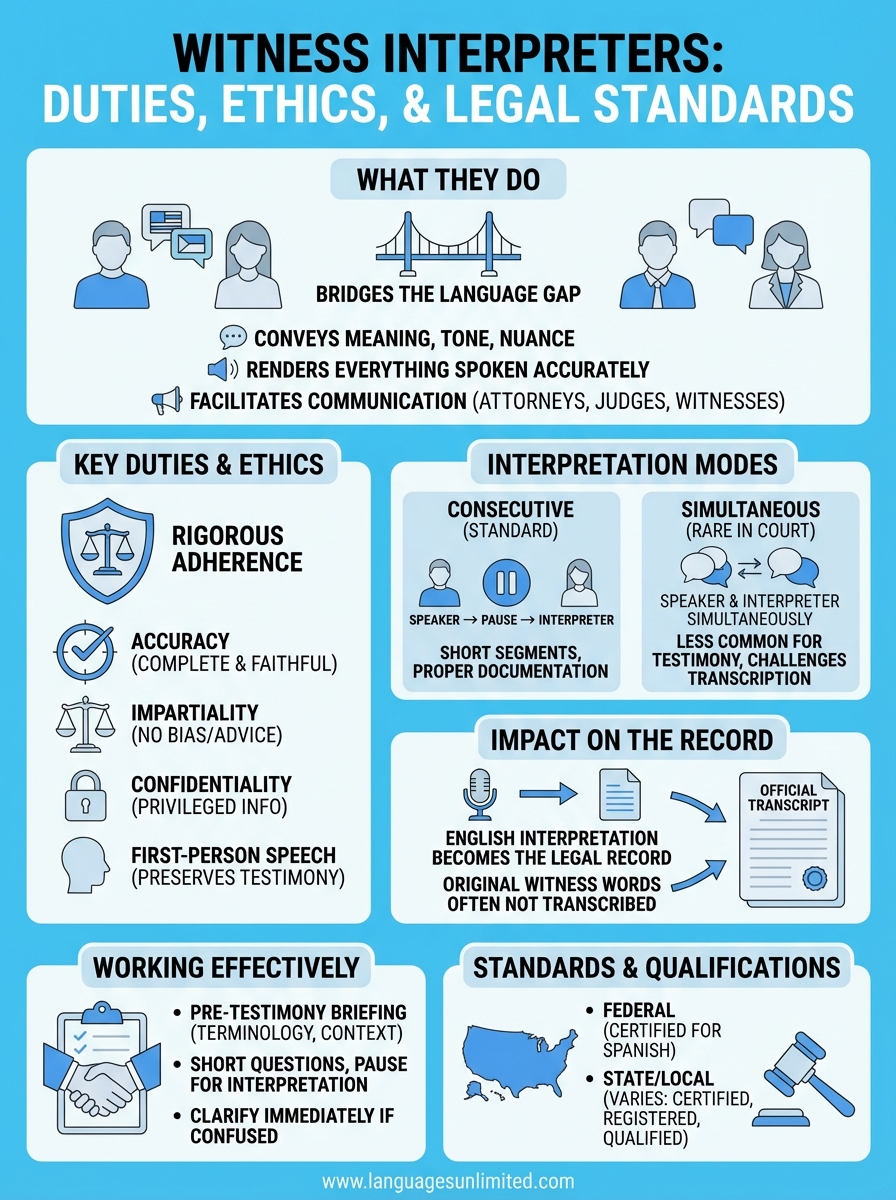
A witness interpreter bridges the language gap during depositions, trials, and other legal proceedings where testimony occurs. You’ll see them facilitating communication between attorneys, judges, and witnesses who don’t share a common language. Their primary responsibility extends beyond simple word-for-word translation, they must convey meaning, tone, and nuance while maintaining the integrity of every statement made under oath.
Core interpretation duties
The interpreter’s fundamental task involves rendering everything spoken into the target language with complete accuracy. When you pose questions to a witness, the interpreter converts your words into the witness’s language, then converts the response back into English. This two-way process continues throughout the entire testimony, requiring sustained concentration and linguistic precision. Every objection, question, answer, and procedural statement gets interpreted, ensuring the non-English speaker remains fully informed and can participate meaningfully in their own case.
Modes of interpretation in testimony
Legal settings typically employ consecutive interpretation, where the speaker pauses after a few sentences to allow the interpreter to render the message. You’ll notice this creates a rhythm in questioning, short segments followed by interpretation, which protects accuracy and allows for proper documentation in the official record. Simultaneous interpretation, where the interpreter speaks at the same time as the source speaker, rarely occurs in depositions or witness testimony because it prevents accurate transcription and verification of what was actually said versus interpreted.
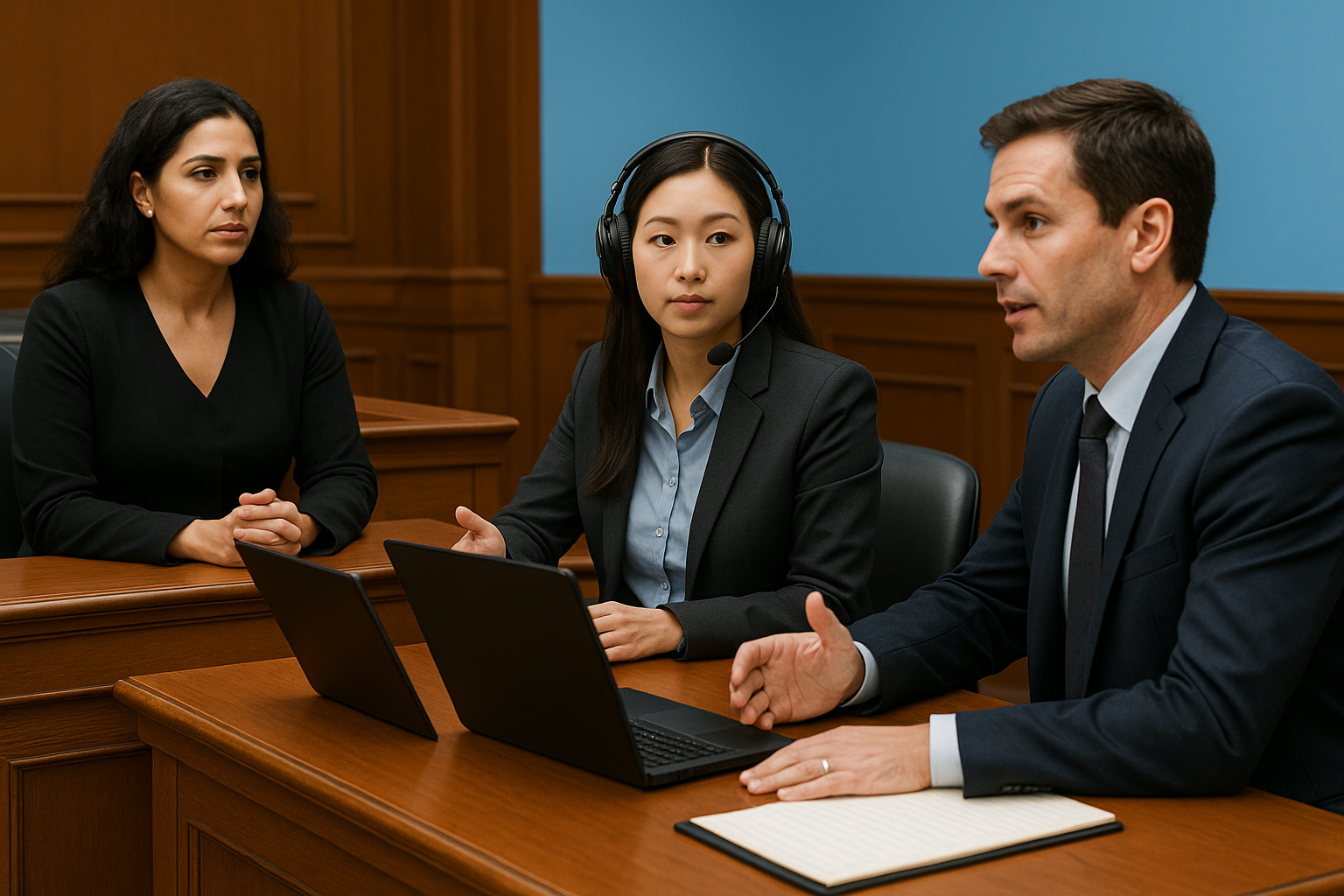
The mode of interpretation directly affects how quickly testimony proceeds and how accurately the court reporter can capture the record.
Pre-testimony preparation and terminology management
Before testimony begins, the interpreter reviews case-related documents and specialized terminology to ensure familiarity with technical language that may arise. If your case involves medical malpractice, immigration law, or financial fraud, the interpreter must understand industry-specific vocabulary in both languages. During this preparation phase, you can provide the interpreter with relevant documents, witness statements, or exhibits to help them anticipate terminology. This advance work prevents mid-testimony confusion and maintains the flow of questioning, though interpreters cannot discuss case strategy or substance with witnesses, only linguistic clarification of terms.
Why witness interpreting affects the record
The official court record serves as the permanent, authoritative account of what occurred during legal proceedings. When you work with a witness interpreter, their renditions become part of this record, creating unique documentation challenges that differ fundamentally from monolingual testimony. Court reporters transcribe only what they hear in English, meaning the interpreted version, not the witness’s original words, enters the official transcript.
How interpretation creates documentation gaps
Your court reporter cannot transcribe testimony in the source language because they typically don’t understand it. This creates a documentation structure where the English interpretation becomes the legal record, while the witness’s actual words exist only in audio or video recordings if captured at all. When you review transcripts later, you’re reading what the interpreter said, not a direct translation of the witness’s original statement. This separation introduces potential discrepancies if the interpreter made errors, missed nuances, or couldn’t convey culturally specific concepts that have no direct English equivalent.
The interpreted version becomes the legal truth for appeal purposes, making interpreter accuracy critical to case outcomes.
Protecting your record from interpretation errors
Appeals courts rely heavily on trial transcripts to evaluate claimed errors, and interpretation mistakes can compromise this review process. If a witness interpreter misunderstands a question or mistranslates a response, that error gets permanently embedded in the record unless you catch it immediately. You can request clarification during testimony when something seems inconsistent, and many attorneys now record proceedings in both languages to preserve the original testimony. This dual documentation protects against interpretation disputes later and provides verifiable evidence if questions arise about what the witness actually said versus what appears in the English transcript.
Legal standards and qualifications in the US
The United States lacks a unified national standard for witness interpreters, creating a patchwork of requirements that vary by jurisdiction. Federal courts operate under one set of rules while state courts maintain their own certification programs, and many local jurisdictions add additional requirements. You need to understand which standards apply to your specific proceeding to ensure your interpreter meets the necessary qualifications and that their work will withstand scrutiny on appeal.
Federal certification requirements
The Administrative Office of the U.S. Courts maintains a Federal Court Interpreter Certification Examination for Spanish interpreters, which covers consecutive interpretation, simultaneous interpretation, and sight translation. If you work in federal court and need a certified Spanish interpreter, your court will typically provide one from their roster of certified professionals. For other languages, federal courts use professionally qualified interpreters who pass background checks and demonstrate competence through testing or proven experience, though they won’t carry the certified designation. Your court clerk can confirm whether an interpreter holds federal certification or qualifies under the professionally qualified category.
Federal certification represents the highest interpreter credential in the U.S. legal system, but it currently exists only for Spanish.
State-specific licensing and court rules
State court requirements differ dramatically based on where you practice. California, for example, operates a comprehensive certification program for multiple languages, while other states may require only a basic skills test or accept interpreters who self-attest to their qualifications. Some states maintain registries of approved interpreters, others leave qualification decisions to individual judges. You should consult your state’s court website or rules of civil procedure to determine what credentials a witness interpreter must hold, and verify those qualifications before depositions or trial to avoid last-minute problems.
Ethics and common courtroom protocols
Professional interpreters operate under strict ethical codes that govern every aspect of their courtroom conduct. These standards protect the integrity of legal proceedings and ensure that your witness receives fair and accurate interpretation throughout testimony. Violations can result in interpreter disqualification, case mistrials, or successful appeals based on inadequate interpretation.
Professional codes that govern conduct
The National Association of Judiciary Interpreters and Translators (NAJIT) and similar organizations establish core ethical principles that witness interpreters must follow. Accuracy stands as the primary obligation, interpreters must render complete and faithful interpretations without adding, omitting, or altering meaning. Impartiality requires that interpreters avoid any conduct that suggests bias or preference for one party, they cannot offer legal advice, discuss case merits, or show sympathy toward witnesses they interpret for. Confidentiality demands that interpreters never disclose privileged information they hear during proceedings, treating all case details as protected communications.
Professional codes require interpreters to immediately disclose any conflict of interest, including personal relationships with parties or prior knowledge of case facts.
Standard courtroom procedures
You should expect your interpreter to position themselves near the witness but slightly offset to maintain clear sightlines between you, the judge, and the testifying party. Interpreters speak in the first person when rendering testimony, saying "I went to the store" rather than "He says he went to the store," which preserves the direct testimonial nature of statements. When technical terms arise that lack direct translation equivalents, qualified interpreters will briefly explain the concept rather than leave gaps in understanding. Before testimony begins, you can request a brief voir dire of the interpreter to establish their qualifications on the record and address any concerns about their ability to handle case-specific terminology.
How to work with a witness interpreter
Working effectively with a witness interpreter requires strategic preparation and clear communication protocols that differ from monolingual testimony. You control the pace of questioning, and your awareness of interpretation logistics directly affects how smoothly testimony proceeds and how accurately the record captures witness statements.
Preparation before testimony
Schedule a pre-testimony meeting with your witness interpreter at least a day before the proceeding begins. Provide them with relevant documents, exhibits, and any specialized terminology lists so they can familiarize themselves with case-specific language. You should also brief the interpreter on witness background, including their education level and regional dialect, which helps them calibrate their interpretation style appropriately. Discuss any anticipated challenges, such as technical medical terms or financial concepts, and confirm the interpreter understands your preferred questioning structure.
Interpreters who understand case context deliver more accurate interpretations because they anticipate terminology rather than encountering it cold.
During testimony best practices
Structure your questions in short, clear segments rather than long compound questions that strain interpretation accuracy. Pause after each question to allow complete interpretation before the witness begins answering, and wait for the full interpreted response before asking your next question. Avoid speaking while the interpreter works, as this forces them to choose between listening to new information or completing their current interpretation. If you notice hesitation or confusion, stop and request clarification immediately rather than continuing forward. You can also ask the interpreter to repeat the witness’s answer in the source language if something seems inconsistent with earlier testimony, which helps verify accuracy before it becomes part of the permanent record.
Next steps
Your success in legal proceedings involving non-English speakers depends on securing qualified witness interpreters who understand both linguistic requirements and courtroom protocols. Before your next deposition or trial, verify that your interpreter meets applicable federal or state certification standards, and schedule preparation time to review case-specific terminology. These proactive steps protect your record and ensure accurate testimony that withstands appellate scrutiny.
When you need professional witness interpreter services for depositions, trials, or other legal proceedings, working with an experienced language services provider streamlines the qualification and coordination process. Languages Unlimited has supported legal professionals across all 50 states since 1994, providing USCIS-approved and GSA-certified interpretation for courtrooms, law offices, and government agencies. Our network includes interpreters qualified in rare languages and specialized legal terminology, with availability for urgent scheduling needs.
Contact us today to discuss your upcoming case requirements and ensure you have the qualified interpretation support your witnesses and legal proceedings demand.