



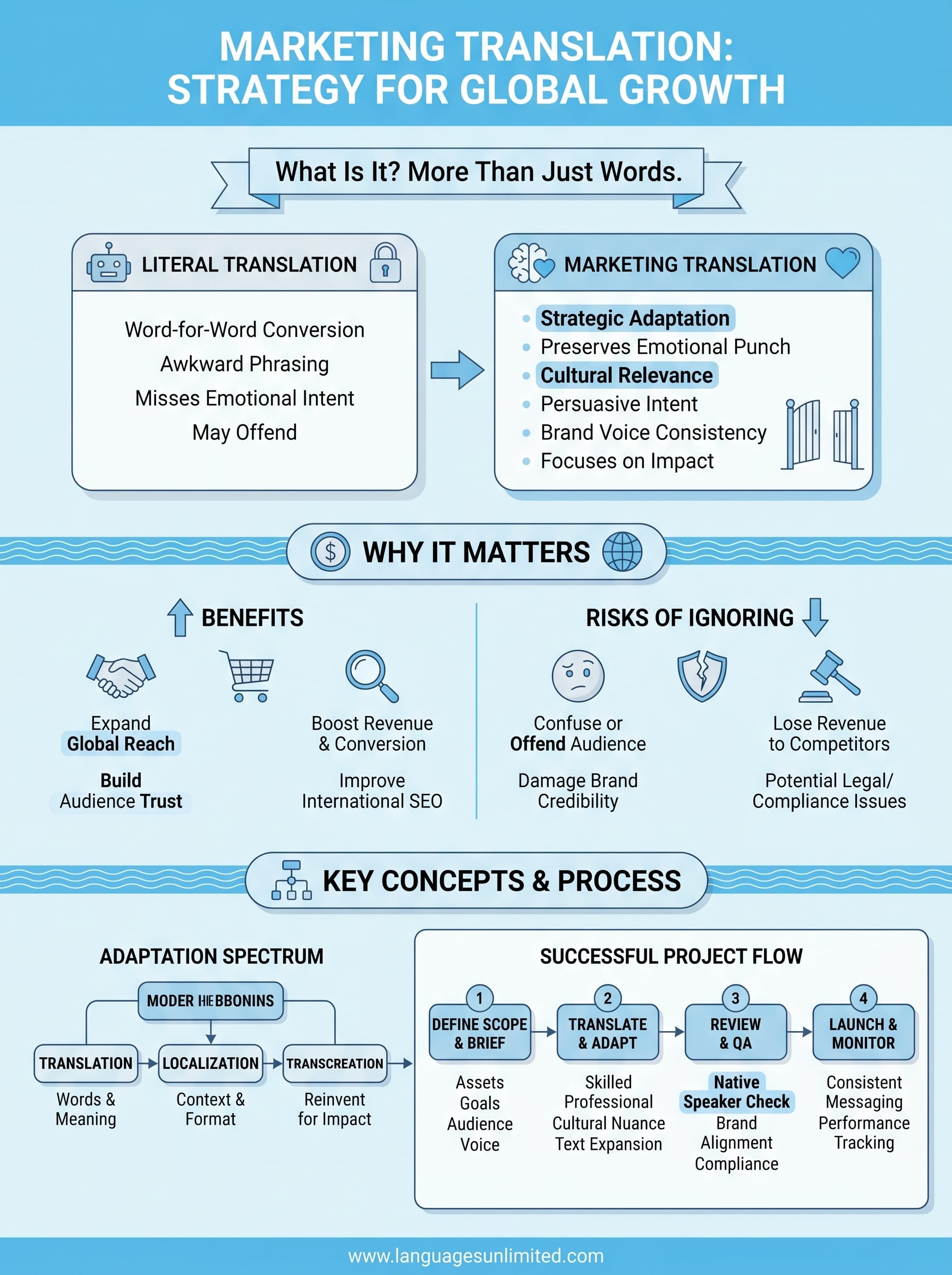
If you’ve ever run a slogan through a translator and watched it come back flat, awkward, or completely off-message, you already understand why what is marketing translation matters. It’s not the same as converting words from one language to another. Marketing translation requires a translator to preserve the emotional punch, cultural relevance, and persuasive intent behind your original content, something literal translation simply can’t deliver.
Your taglines, ad copy, product descriptions, and campaign messaging all carry tone, humor, and intent shaped by a specific culture. When you take that content into a new market without adapting it properly, you risk confusing your audience, or worse, offending them. Brands lose credibility and revenue every year because they treat marketing content like a technical document. The difference between a message that resonates and one that falls flat often comes down to how the translation was approached.
At Languages Unlimited, we’ve provided professional translation services since 1994, working with businesses, government agencies, and organizations across the United States through our network of over ten thousand language professionals. We understand that marketing content demands more than accuracy, it demands strategy. This article breaks down exactly what marketing translation is, how it differs from standard translation, and practical tips to help you localize your messaging for global audiences.
What marketing translation includes
Understanding what is marketing translation starts with knowing the scope of content it covers. Marketing translation goes well beyond ads and slogans. It applies to any content your brand uses to connect with, attract, or retain customers, and that content must carry the same impact in the target language as it does in the original. A skilled marketing translator does not just move words across a language barrier; they move your message, your voice, and your intent.
The types of content it covers
Marketing translation applies to a wide range of materials. If the content is designed to persuade, inform, or engage a customer, it falls within this category. That includes everything from short-form assets like social media posts, paid ads, and email subject lines to long-form content like landing pages, white papers, brochures, and product catalogs. Video scripts, press releases, packaging copy, and even metadata used in search campaigns all require marketing-level translation, not a word-for-word conversion.
The scope of marketing content that needs translation is often broader than companies initially expect, which is why project planning before you start saves you significant time and rework later.
Here is a breakdown of the most common content types that fall under marketing translation:
- Advertising copy: digital ads, print campaigns, billboards, and paid social content
- Website and landing page content: homepages, product pages, and campaign-specific pages
- Email marketing: newsletters, promotional sequences, and transactional messages
- Social media content: captions, bio copy, and sponsored posts
- Brand guidelines and messaging frameworks: taglines, mission statements, and value propositions
- Video and audio scripts: commercials, explainer videos, and podcast transcripts
- Packaging and labeling: product descriptions, instructions, and regulatory disclosures
- Sales collateral: brochures, pitch decks, and case studies
The elements a translator must adapt
A marketing translator works with more than the literal meaning of a sentence. Tone, rhythm, and cultural references all shape whether your content lands with the intended audience or falls short. For example, a joke built around an idiom familiar to a US audience may be meaningless, or even offensive, to a German-speaking audience. The translator needs to recognize that problem and find an equivalent that creates the same emotional response without the same words.
Beyond cultural references, brand voice and style require consistent attention throughout every translated asset. If your original content reads as bold and confident, the translated version needs to carry that same energy. That means the translator must understand your brand guidelines, your campaign goals, and your audience before they begin. Marketing translation is a collaborative process between your team and the language professional, not a task you hand off and collect at the end.
Formatting also plays a role that many teams overlook. Text expansion is a practical challenge: languages like German or Spanish often require significantly more characters to express the same idea as English. This directly affects your ad character limits, your page layout, and your packaging design. A good marketing translator accounts for this from the start and works within your creative constraints rather than forcing you to redesign assets after the fact.
Why marketing translation matters
When you ask what is marketing translation, you’re really asking how to grow your business beyond a single language market. The stakes are high: global consumers consistently prefer to buy in their own language, and most will abandon a purchase if the content feels foreign or mistranslated. Treating marketing translation as optional is not a neutral decision; it’s a decision to leave revenue on the table and hand an advantage to competitors who do invest in it.
Research from CSA Research found that 76% of online shoppers prefer to buy products with information in their native language, and 40% will never buy from websites in other languages.
It expands your reach into new markets
Entering a new language market requires more than translating your homepage and calling it done. Every touchpoint in the customer journey, from the first ad they see to the confirmation email after purchase, needs to speak to that audience in a way that feels natural and relevant. When your content reads as native, trust builds faster, and trust is what drives conversion in any market.
Your translated marketing content also feeds your international SEO strategy. Search engines index the language and terminology your audience actually uses, not a literal translation of your English keywords. A properly translated and localized campaign gives you a real chance to appear in search results when buyers in that market are actively looking for what you offer.
It protects your brand from costly mistakes
Mistranslated marketing content causes real damage: confusion, public embarrassment, and in regulated industries, potential legal exposure. Brands have launched campaigns that carried unintended meanings in the target language, generating negative press and requiring expensive corrections. These are not rare edge cases; they happen when companies rush translation or rely on tools that cannot interpret cultural context or audience expectations.
Beyond the immediate fallout, a poorly translated campaign signals to local audiences that you do not understand them. That perception is difficult to reverse once it takes hold. Investing in quality marketing translation from the start costs far less than repairing brand reputation or rebuilding audience trust after a visible and public mistake.
Marketing translation vs localization and transcreation
Once you understand what is marketing translation, the next step is separating it from two closely related concepts that often get used interchangeably: localization and transcreation. All three serve global marketing, but they operate at different levels of adaptation and creative involvement. Knowing which one you need prevents you from under-investing in a campaign that requires a full creative overhaul, or over-engineering a simple asset that just needs accurate, culturally aware translation.

Where localization fits in
Localization extends translation by adapting the surrounding context of your content, not just the words. That includes date formats, currency symbols, units of measurement, color associations, images, and even the way your interface or layout is organized. A marketing translator focuses on language and cultural tone; a localization specialist focuses on making the entire product or experience feel native to the target market. In practice, most successful marketing campaigns require both: you translate and culturally adapt the copy, then localize the broader assets around it.
Localization is not a replacement for translation; it is the layer that makes a translated product feel like it was built for that market from day one.
What transcreation means
Transcreation goes further than both translation and localization. It gives the language professional creative freedom to reimagine the content entirely, keeping only the intended emotional response and strategic goal rather than the original wording. Transcreation is most common in advertising taglines, brand slogans, and high-stakes campaign concepts where a literal or even culturally adapted translation would still miss the mark because the original relies too heavily on wordplay, humor, or cultural references that simply do not transfer.
The difference comes down to how much creative latitude you give the translator. Standard marketing translation asks the professional to preserve your voice while adapting for culture. Transcreation asks them to reinvent the message so it achieves the same impact using completely different language and sometimes a different concept altogether. For most content types, marketing translation delivers what you need. For your core brand campaign or a globally launched slogan, transcreation is often the stronger investment.
How to run a marketing translation project
Running a marketing translation project well comes down to preparation and communication. When you understand what is marketing translation and what it demands from a language professional, you can set up your project so the translator has everything they need to deliver content that actually performs in the target market. Most translation problems trace back to unclear briefs, missing context, or no review process rather than the translator’s skill.
Define your scope and brief your translator
Before any translation begins, you need to map out every content asset that requires translation and prioritize it by launch date or campaign phase. This prevents last-minute rushes that force quality shortcuts and result in weaker output. Once you have your asset list, write a translator brief that includes your brand voice guidelines, target audience description, campaign goals, and any terminology that must stay consistent across all materials. The more context you provide upfront, the fewer revision rounds you will need later.
Your brief should also specify character limits for ad copy, layout constraints for print or packaging, and any regulatory requirements for your industry. A translator working without these details may deliver linguistically accurate content that still breaks your design or fails a compliance review, costing you time you did not budget for.
Treating your translator as a creative partner rather than a vendor produces stronger final output, because they can flag potential cultural issues before those issues become expensive corrections.
Build in review and quality control steps
Two separate review stages give your marketing translation project the best chance of success. The first review should come from a native speaker of the target language who also understands your industry, checking for accuracy, tone, and any terms that feel unnatural to local audiences. The second review should involve someone from your marketing team who can evaluate whether the translated content aligns with your campaign strategy and brand standards.
Building these reviews into your project timeline, rather than treating them as optional steps you add at the end, keeps you from missing launch dates while still catching problems. You should also create a translation memory or approved glossary for your brand terms so future campaigns stay consistent across languages without starting from scratch each time. That investment in process compounds in value across every subsequent project you run.
Examples of marketing translation done right and wrong
Looking at real-world cases helps clarify what is marketing translation in practice and shows what separates a successful campaign from a damaging one. The gap between getting it right and getting it wrong often comes down to cultural awareness and preparation, not the budget or the brand’s global reach.

When marketing translation works
KFC’s entry into the Chinese market is a well-known example of adaptation done right. Their "Finger Lickin’ Good" slogan required significant reworking because a literal translation carried connotations that did not appeal to Chinese audiences. The team worked with local language professionals to find phrasing that kept the indulgent, satisfying tone while feeling entirely natural to native speakers. The result helped KFC build one of its most successful international markets.
McDonald’s handles menu translations and regional campaigns by investing in local marketing teams and professional translation review, ensuring their messaging reflects the food culture of each country rather than simply converting their English ads. Campaigns that acknowledge local food preferences, cultural events, and regional humor consistently outperform efforts that treat the target market as a copy of the home market.
When brands give their translators full context, including campaign goals, audience details, and brand voice standards, the output earns real trust with local audiences.
When marketing translation fails
Pepsi’s expansion into Southeast Asia produced a well-documented failure. Their "Come Alive with the Pepsi Generation" campaign translated into Chinese in a way that communicated something closer to bringing ancestors back from the dead. The linguistic error reached audiences before anyone caught it, and the brand took a public credibility hit in a market it was actively trying to grow.
A similar issue hit a major US automotive brand that launched a vehicle name in Spanish-speaking markets without checking whether the name carried any unintended meaning in local slang. It did, and the association undercut the premium positioning the brand was working to establish. Both examples share the same root cause: no native speaker review and no cultural vetting before the content went live. These failures were preventable with a proper translation workflow and a qualified reviewer involved before launch, which is exactly the kind of process worth building before you take your next campaign into a new market.
Quality, compliance, and brand consistency checks
Once your translated marketing content comes back from the language professional, the work is not finished. A structured quality review protects everything you invested in the translation itself and ensures the final output actually performs in the target market. Part of understanding what is marketing translation is recognizing that quality control is built into the process, not added at the end as an afterthought.
Running a final quality check
Your final quality check should cover three distinct dimensions: linguistic accuracy, cultural appropriateness, and regulatory compliance. Linguistic accuracy confirms the translated content matches the intent and tone of the original without awkward phrasing or terminology that native speakers would find unnatural. Cultural appropriateness verifies that no references, images, or expressions landed in a way that conflicts with local values or norms. Regulatory compliance is especially critical in healthcare, legal, and financial industries, where specific terms must meet government or industry standards in the target country.
Skipping even one of these three dimensions creates a gap that audiences or regulators will find before you do.
Use a native speaker reviewer who works in your industry to run the linguistic and cultural checks. This person should not be the same translator who produced the content, because a fresh set of eyes catches errors and inconsistencies the original translator may overlook. For regulated industries, add a legal or compliance review as a separate step after the language review clears.
Keeping brand language consistent across markets
Brand consistency across translated materials depends on two practical tools: a translation memory and an approved glossary. A translation memory stores previously approved translations of recurring phrases, headlines, and brand statements so future projects reuse those approved choices rather than creating new variations each time. An approved glossary locks in how your brand name, product terms, and core messaging translate into each target language, preventing different translators from producing different versions of the same term across campaigns.
Both tools reduce your review time on future projects and give every translator you work with a foundation to build from. When your brand voice stays consistent across languages, audiences in every market experience the same level of professionalism and trust, which is exactly what strong marketing translation is designed to deliver.
Next steps
Now that you understand what is marketing translation and what separates a campaign that resonates from one that falls flat, the next move is putting that knowledge into action. Every piece of marketing content you take into a new language market carries your brand’s credibility with it. The approach you take to translation determines whether local audiences trust what they read or scroll past it without a second thought.
Start by auditing the marketing assets you plan to localize and identifying which ones carry the highest risk if the translation misses the cultural mark. Then build your review process before you need it, not after a campaign goes live. Working with experienced language professionals who understand both your industry and your target audience makes that process significantly more reliable. If you are ready to move forward, contact the Languages Unlimited team to discuss your next marketing translation project.