



If you’re preparing an immigration application, chances are USCIS will ask you to submit an English translation of your foreign birth certificate. The problem? Most applicants have never seen a USCIS birth certificate translation sample and have no idea what format, language, or certification statement the agency actually expects. Submit it wrong, and you risk delays, or a Request for Evidence (RFE) that sets your case back weeks.
This guide breaks that down. You’ll find a clear template you can reference, the exact certification wording USCIS requires, and practical tips to make sure your translation meets their standards the first time. At Languages Unlimited, we’ve handled USCIS-approved certified translations since 1994 for individuals and immigration attorneys across all 50 states, so the guidance here comes directly from that experience.
Whether you’re translating the document yourself or deciding to work with a professional, this article gives you everything you need to get it right and keep your application moving forward.
What USCIS expects in a birth certificate translation
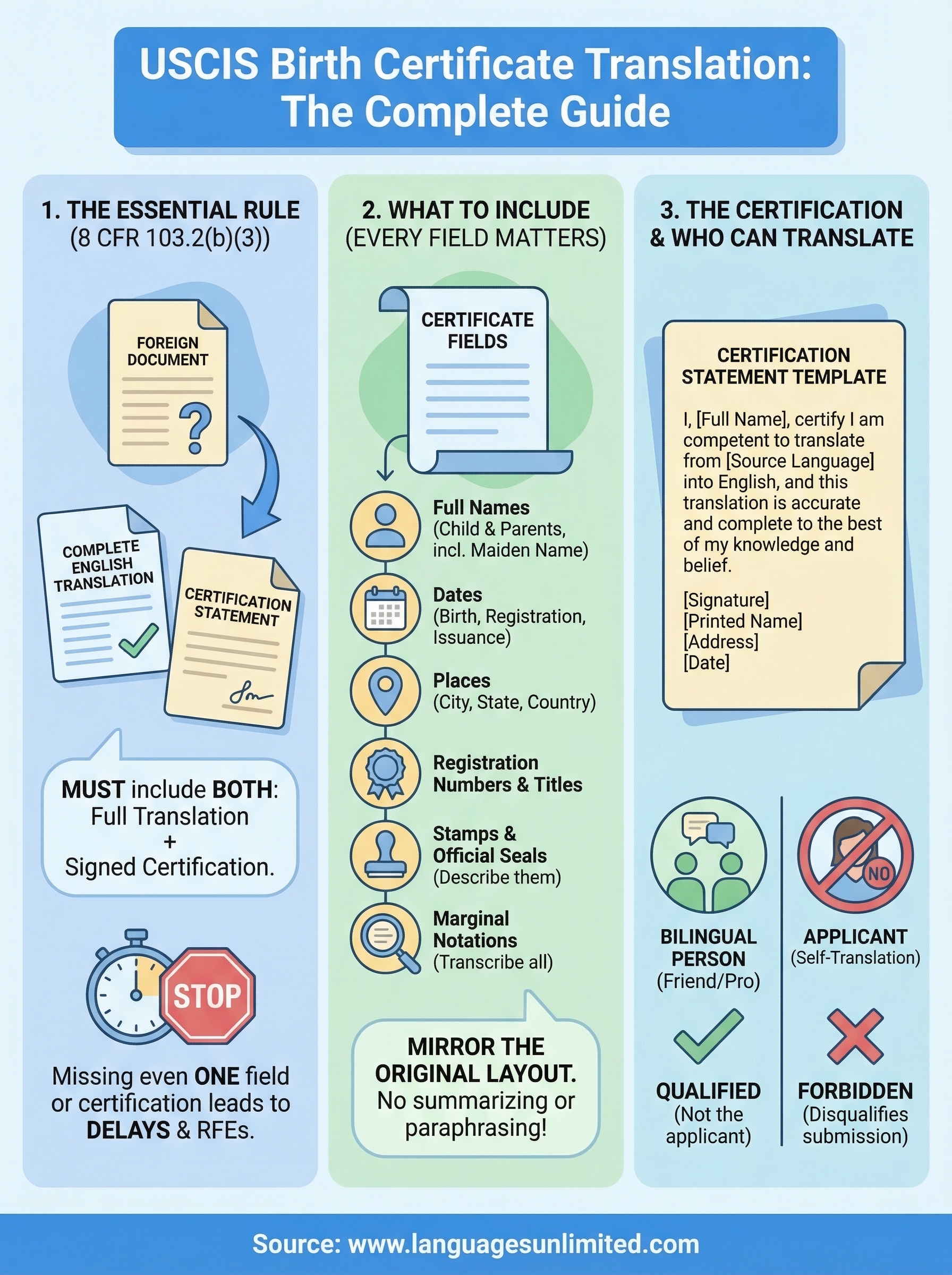
USCIS doesn’t accept a rough or partial translation. Under 8 CFR 103.2(b)(3), every foreign-language document you submit must include a complete English translation along with a written certification from the translator confirming their competence and the translation’s accuracy. This rule applies to every birth certificate you attach to your application, whether it supports a green card, naturalization, or a family-based petition.
Missing even one field from the original document can result in a Request for Evidence that sets your case back by weeks or more.
Every field must appear in the translation
The translator must carry over every piece of information visible on the original birth certificate. That includes the document title, registration numbers, names of officials, stamps, seals, and any marginal notations. When you review a USCIS birth certificate translation sample, you’ll notice it mirrors the original layout field by field, rather than summarizing the information in paragraph form.
Here’s a checklist of what USCIS expects to see translated:
- Full name of the person named on the certificate
- Date and place of birth (city, state or province, country)
- Names of both parents, including mother’s maiden name
- Date the certificate was issued or registered
- Name and title of the issuing official or civil registrar
- Any stamps, seals, or marginal notations present on the original
The translator must certify their own competence
USCIS does not require a notary or a credentialed agency to validate your translation. What they do require is a signed certification statement from whoever completed the work, confirming that the person is competent in both languages and that the translation is accurate and complete to the best of their knowledge. A professional translator can provide this, but so can a bilingual individual, as long as that person is not the applicant themselves.
Your translator also needs to include their full name, address, and the date the certification was signed. Leave any of those out, and USCIS may treat the translation as incomplete.
A clean USCIS birth certificate translation sample
Seeing a real example makes the requirements click immediately. The sample below shows how a translated birth certificate should look when formatted correctly. Each field from the original document maps directly to a labeled line in English, and nothing is skipped or paraphrased.
Sample translation layout
Use this format as your reference when building your own translation. Replace the bracketed placeholders with the actual information from the birth certificate you are translating.
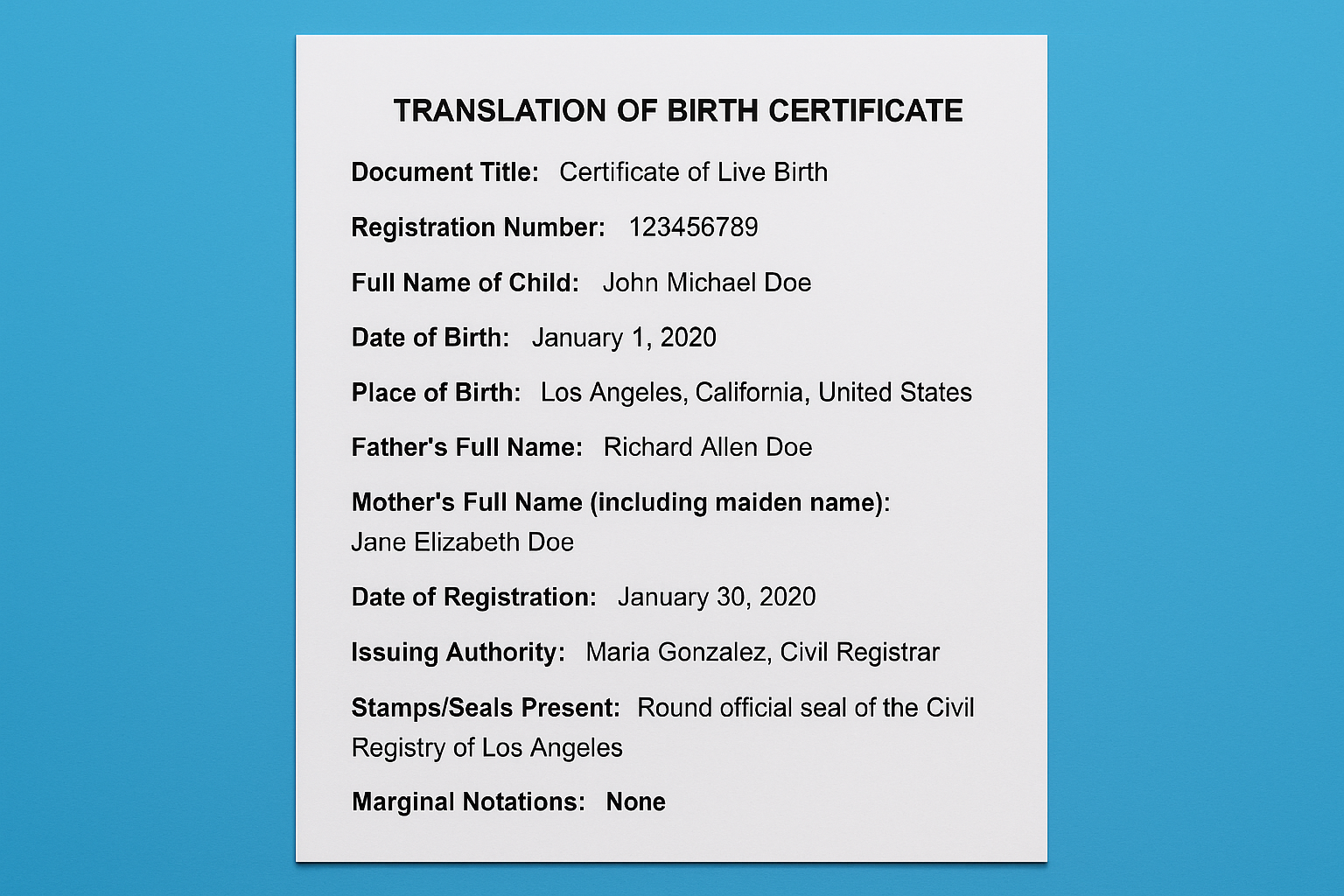
TRANSLATION OF BIRTH CERTIFICATE

Document Title: [e.g., Certificate of Live Birth]
Registration Number: [Number as shown on original]

Full Name of Child: [First, Middle, Last]
Date of Birth: [Month Day, Year]
Place of Birth: [City, State/Province, Country]

Father's Full Name: [First, Middle, Last]
Mother's Full Name (including maiden name): [First, Middle, Last]

Date of Registration: [Month Day, Year]
Issuing Authority: [Name and Title of Official or Civil Registrar]

Stamps/Seals Present: [Describe any stamps or seals visible on the original]
Marginal Notations: [Transcribe any handwritten or printed notes in the margins]
This layout is the backbone of any solid USCIS birth certificate translation sample. If your document includes fields not listed above, add them rather than leaving anything out.
How to handle stamps and seals
Stamps and official seals must appear in your translation, even if they repeat information already covered in the main fields. Write a brief description such as "Round official seal of the Civil Registry of [City], [Country]" so USCIS can confirm every element of the original is accounted for.
Certification statement USCIS accepts
The certification statement is the part of your translation that makes it legally valid for USCIS. Without it, even a perfectly formatted USCIS birth certificate translation sample is incomplete and will likely be rejected. Every translation you submit needs a signed statement attached directly after the translated content.
The required wording
USCIS doesn’t specify exact wording, but the statement must confirm two things: the translator’s competence in both languages and the accuracy of the translation. Use this template as your baseline:
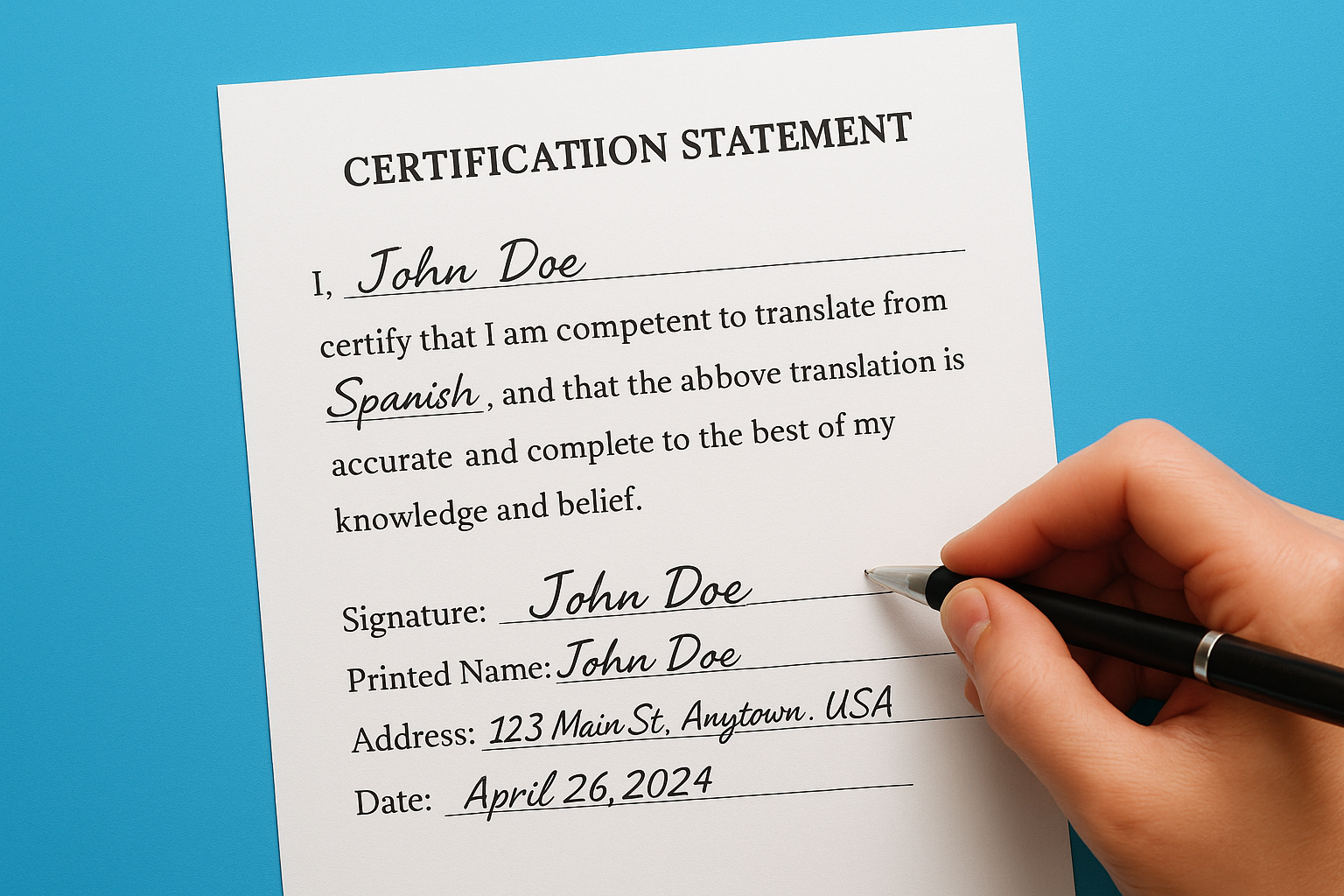
I, [Full Name], certify that I am competent to translate from
[Source Language] into English, and that the above translation
is accurate and complete to the best of my knowledge and belief.

Signature: ___________________
Printed Name: [Full Name]
Address: [Street, City, State, ZIP]
Date: [Month Day, Year]
If you leave out your address or the date, USCIS may flag the translation as deficient and issue an RFE.
What disqualifies you as a translator
You cannot translate your own documents for a USCIS application. The rules are clear: the applicant must use someone else, whether that’s a bilingual friend, a family member, or a professional translation service.
The translator does not need to hold a specific credential or notary stamp, but they must honestly certify their competency in both languages. Even a bilingual neighbor qualifies, as long as they are not the applicant named on the birth certificate.
How to translate your birth certificate step by step
Following a clear process keeps you from missing anything that would flag your submission. Before you start, make sure you have the original birth certificate in hand along with a high-quality scan or photocopy so you can reference every field, stamp, and notation while you write the translation.
Work through the document field by field
Start at the top of the certificate and move straight through to the bottom. Translate every field in order, including the document title, registration numbers, parent names, official titles, and any marginal notes. Use the sample layout from the previous section as your guide so nothing gets left out.
Skipping a single field, even a registration number, is one of the most common reasons a USCIS birth certificate translation sample gets flagged as incomplete.
Handle stamps and unfamiliar text
When you reach a stamp or seal, write a short description in brackets, such as "[Round stamp: Civil Registry Office, Guadalajara, Mexico]." If a word or phrase is illegible or unclear, write "[illegible]" rather than guessing. USCIS reviewers expect transparency over invention.
Attach the certification and review
Once the translation is complete, attach your signed certification statement directly below the last translated line. Read through the full document one more time against the original to confirm every element matches before you submit.
Common issues that trigger RFEs
Even a well-intentioned submission can draw a Request for Evidence if small details are off. Knowing where applicants most often go wrong lets you fix those problems before they become your problem.
Missing or incomplete fields
Reviewers compare your translation line by line against the original birth certificate. If a field appears on the original but not in your translation, USCIS treats the translation as incomplete and sends an RFE. The most frequently skipped fields are registration numbers, mother’s maiden name, and official titles.
Watch for these common omissions:
- Registration or certificate number printed at the top or bottom of the document
- Issuing official’s title (not just their name)
- Stamps or seals that contain location or date information
- Handwritten marginal notations added after the original issuance
A complete uscis birth certificate translation sample accounts for every stamp, seal, and notation, even when that information seems redundant.
Certification problems
The certification statement is where many submissions fall short. Translators forget to include their full address, leave off the date, or write a vague statement that does not explicitly confirm competence in both languages. USCIS needs all three elements: name, address, and date, paired with a direct statement of accuracy.
Another common error is when the applicant translates their own document. USCIS does not accept self-translations under any circumstances, so flag that issue early and arrange for a qualified third party before you finalize your submission.
Next steps
You now have everything you need to put together a clean, complete submission. Use the USCIS birth certificate translation sample in this guide as your reference, fill in every field from the original document, attach the signed certification statement, and review the whole package carefully against the checklist before it goes into your application envelope.
If anything on your birth certificate is difficult to read, written in a language with a non-Latin script, or involves a format that differs significantly from standard civil records, working with a professional certified translator reduces your risk considerably. Languages Unlimited has provided USCIS-approved certified translations since 1994, covering documents in hundreds of languages for applicants, families, and immigration attorneys across all 50 states.
Ready to move forward? Contact Languages Unlimited and let our team handle your certified translation with the accuracy and speed your application requires.