



Your immigration application sits on your desk. Everything looks ready except one thing: your birth certificate is in Spanish, Arabic, Mandarin, or another language USCIS can’t read. You know you need a translation, but the rules feel murky. Does it need to be notarized? Can a bilingual friend help? What makes a translation "certified"? Get it wrong and your application comes back with a Request for Evidence, pushing your timeline back by months.
USCIS requires a complete, accurate English translation of your birth certificate, accompanied by a signed certification statement from a qualified translator. The translator can’t be you, and the document doesn’t need notarization, but it must include specific language confirming accuracy and competence. Most applicants use professional services to avoid delays and rejections.
This guide walks you through the exact requirements USCIS expects, how to find a translator who won’t cause problems with your application, what the process looks like from start to finish, and what you should expect to pay. You’ll also learn the most common mistakes that trigger Requests for Evidence and how to sidestep them completely.
What USCIS requires for translations
USCIS demands complete accuracy and specific formatting when you translate birth certificate for USCIS applications. Your translation must cover every word on the original document, including stamps, seals, handwritten notes, and official signatures. Missing even a small notation can trigger a Request for Evidence that delays your case by months.
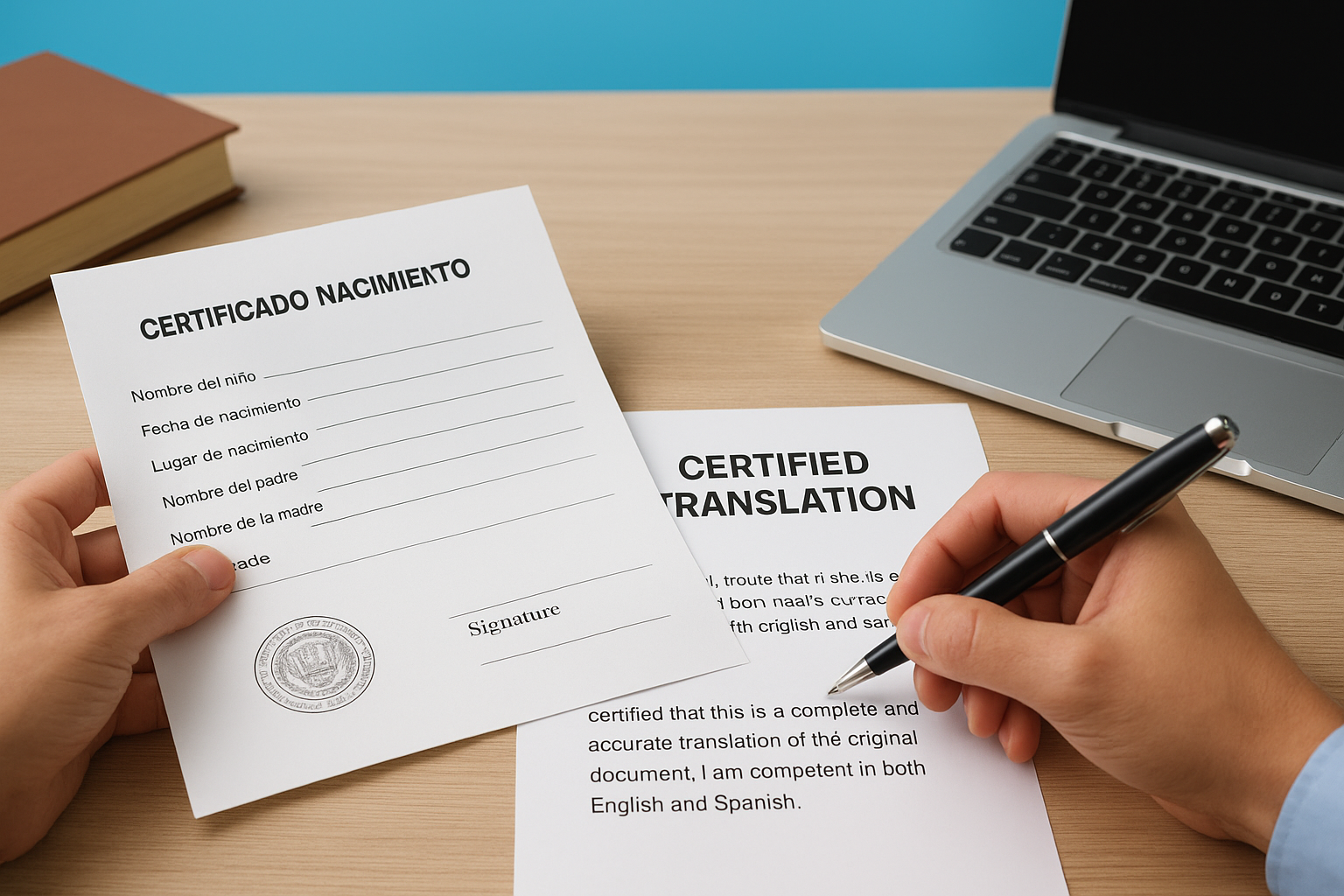
The certification statement
Every translated birth certificate must include a signed certification statement from your translator. This statement proves the translation meets USCIS standards and includes specific language about accuracy and competence. Your certification must contain:
- The translator’s full name and contact information
- A statement declaring the translation is complete and accurate
- Confirmation that the translator is competent in both English and the source language
- The translator’s signature (handwritten or electronic, not DocuSign)
- The date of certification
"Any document containing foreign language submitted to USCIS shall be accompanied by a full English language translation which the translator has certified as complete and accurate." (USCIS Policy Manual)
Your certification doesn’t need notarization. USCIS accepts the translator’s statement alone as proof of accuracy, though some state agencies require additional notarization steps for their own purposes.
Who qualifies as a translator
You cannot translate your own birth certificate. USCIS prohibits self-translation to prevent bias and ensure impartiality. Close family members typically don’t qualify either, though USCIS doesn’t explicitly ban them.
Any competent bilingual person can serve as your translator if they’re not you or directly involved in your application. Professional translation services remain the safest choice because they understand USCIS formatting requirements, handle technical terminology correctly, and reduce rejection risk. Friends or colleagues can translate your document if they’re truly fluent in both languages and willing to sign the certification statement, but small formatting errors or missed details often cause problems with informal translations.
Step 1. Confirm you need a translation
Not every birth certificate requires translation. USCIS only requires English translations for documents that aren’t already in English, so you need to verify your document’s language before spending money on translation services. Some countries issue bilingual certificates that include English alongside the native language, while others print documents entirely in their local language.
Check for English text
Examine your birth certificate carefully. Look for any English text on the document, not just your name or basic information. Some countries like Canada, India, and the Philippines frequently issue bilingual certificates with complete English sections. If your entire birth certificate appears in English with all fields labeled and filled in English, you don’t need to translate birth certificate for USCIS purposes.
Multilingual documents require special attention. Even if portions appear in English, USCIS often issues Requests for Evidence when documents mix languages. A certificate with headers in English but details in another language still needs complete translation. The safest approach treats any non-English text as requiring full translation, regardless of how much English appears.
Verify your country’s document standards
Different countries issue different certificate formats. Check the U.S. Department of State’s reciprocity schedule for your country to understand which document version USCIS accepts. Mexico issues both short-form and long-form birth certificates, but only the long-form version meets USCIS requirements. Your document must match the accepted format before translation begins, or you’ll waste time and money translating the wrong certificate.
Step 2. Choose a qualified birth certificate translator
You have three main options when you need to translate birth certificate for USCIS applications: professional translation companies, individual certified translators, or competent bilingual contacts who aren’t you. Your choice directly affects your application’s success rate, so understanding the differences between these options matters more than finding the cheapest price. Professional services cost more upfront but reduce rejection risk significantly because they understand USCIS formatting requirements and include proper certification automatically.

Professional translation services vs. informal translators
Professional translation companies specialize in immigration documents and typically deliver USCIS-compliant translations with certification statements included. They charge $25 to $60 per page depending on language pair and turnaround time, and most complete translations within 24 to 48 hours. These services employ translators experienced with birth certificate formats from specific countries, which matters when your document includes regional terminology or unusual formatting.
Informal translators like bilingual friends or colleagues can legally translate your birth certificate if they’re competent in both languages and willing to sign a certification statement. This option costs nothing but carries higher rejection risk because most people lack experience with USCIS requirements. Small formatting errors, missing stamps, or incorrect date formats often trigger Requests for Evidence even when the translation itself is accurate.
Questions to ask before hiring
Contact potential translators and request specific information before committing. Ask whether they’ve translated birth certificates from your specific country because formats vary significantly between nations and regions. Mexico’s "acta de nacimiento," Brazil’s "certidão de nascimento," and China’s birth certificates all require different handling approaches.
Verify the translator provides a signed certification statement that includes all required elements USCIS expects. Request a sample certification to review before you pay, confirming it contains the translator’s name, contact information, competence statement, accuracy declaration, signature, and date. Your translator should explain their experience level with USCIS applications without hesitation.
Red flags to avoid
Reject any translator who claims notarization is required for USCIS applications, as this reveals they don’t understand current USCIS policies. Skip services that promise "government certification" or "official translator status" because USCIS doesn’t recognize these credentials. Watch for translators who won’t provide samples of their certification statements or refuse to answer questions about their experience with immigration documents.
Professional translators understand that USCIS accepts competent translations from any qualified person, so they focus on accuracy and proper certification formatting rather than claiming special credentials.
Price alone shouldn’t drive your decision. Services charging under $15 per page often deliver template translations that miss document-specific details like regional stamps or handwritten notes, while premium services above $75 per page typically include unnecessary extras like notarization that USCIS doesn’t require.
Step 3. Prepare, review, and submit your documents
Your translator needs clear, legible copies to produce an accurate translation. Start by scanning or photographing your birth certificate at high resolution (at least 300 DPI for scans, well-lit and focused for photos) to ensure every detail remains visible. Poor image quality leads to missed stamps, unclear dates, or illegible signatures that force you to resubmit later.
Gather your original documents
Collect the long-form version of your birth certificate that shows complete details including your parents’ names, birth location, and registration information. Short-form or abstract certificates don’t meet USCIS requirements even when translated correctly. Check that your document includes visible official stamps, seals, and signatures because your translator must account for these elements in the final translation.
Save your document as a PDF or high-quality JPEG file before sending it to your translator. Avoid taking photos in dim lighting or at angles that distort text. Your translator can’t accurately translate birth certificate for USCIS applications when portions of the document appear blurry or cut off.
Submit your document with clear instructions
Professional translation services typically request specific information when you upload your document. Provide your full name as it appears on the certificate, your contact details, the source language, and your deadline to avoid confusion or delays. Most services offer online portals where you upload documents, select languages, and receive quotes instantly.
Include any special instructions about your document. Tell your translator about handwritten sections, faded stamps, or unusual regional terms that might require extra attention. This guidance helps them produce a complete translation that USCIS accepts without questions.
Review the completed translation
Compare the translation against your original document line by line when you receive the final version. Verify that dates appear in month/day/year format (the U.S. standard), names match exactly across both documents, and the certification statement includes all required elements. Check that stamps and seals are noted in the translation even though they can’t be recreated.
Your translated birth certificate must mirror the original document’s content completely, including details that seem minor like registration numbers or issuing authority names.
Request corrections immediately if you spot errors because most services fix mistakes at no charge. Wait until you’ve confirmed accuracy before submitting anything to USCIS, as fixing errors after submission costs significantly more time and money.
Cost, timing, and common mistakes
Professional translation services charge between $25 and $60 per page when you translate birth certificate for USCIS applications, with most birth certificates requiring only one page of translation. Your final cost depends on your document’s source language, complexity, and how quickly you need the finished translation. Rush services that deliver within 24 hours typically add $10 to $20 to standard pricing, while standard turnaround runs 24 to 48 hours for most language pairs.
What to expect for cost and turnaround
Common languages like Spanish, French, or Mandarin cost less because translators who handle these languages are more available. Rare languages like Amharic, Khmer, or regional dialects can push prices above $75 per page due to limited translator availability. Your document’s condition also affects pricing because faded text, handwritten sections, or damaged certificates require extra time to interpret accurately.
Most services complete standard translations within two business days, though you can request same-day or next-day service when deadlines press. Account for weekends and holidays in your timeline because translation companies typically pause operations during these periods. Order your translation at least one week before you need to submit your USCIS application to avoid paying rush fees or missing filing deadlines.
Common mistakes that cause rejections
Small errors trigger expensive delays when USCIS reviews your application. Watch for these frequent problems that lead to Requests for Evidence:
- Missing certification statements or incomplete translator contact information
- Date format errors showing day/month/year instead of the required month/day/year format
- Untranslated stamps, seals, or handwritten notes that appear on the original certificate
- Name spelling inconsistencies between your birth certificate and other application documents
- Wrong certificate version when countries issue both short-form and long-form documents
- Self-translated documents submitted by applicants trying to save money
- Digital signatures from services like DocuSign instead of handwritten or standard electronic signatures
Fixing rejected translations costs more than getting them right initially because you pay for both the corrected translation and additional filing fees if you miss deadlines.
Review your translated document carefully before submission to catch formatting errors, missing elements, or unclear sections that might raise questions during USCIS review.
Key takeaways and how to start
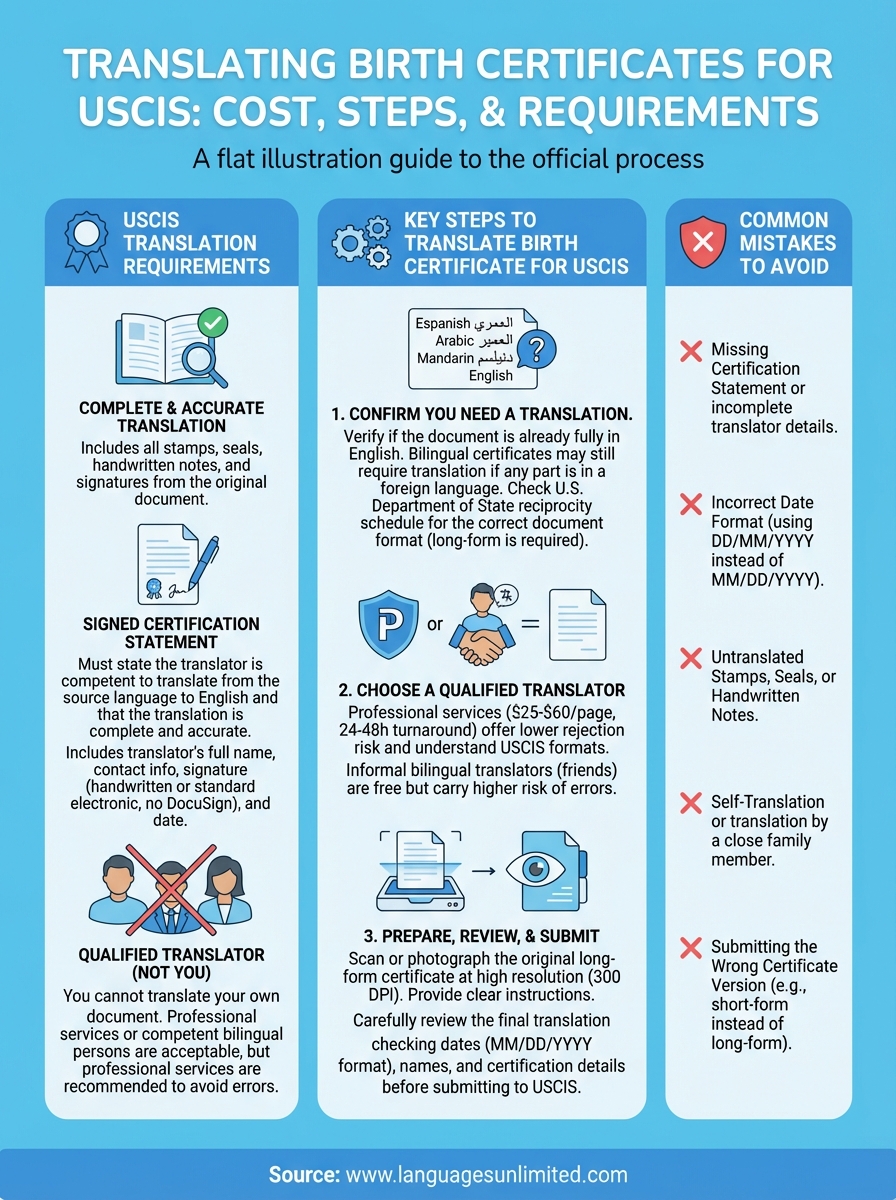
USCIS requires complete, accurate translations of your birth certificate with a signed certification statement from a qualified translator who isn’t you. Your translation must include every detail from the original document, maintain month/day/year date formatting, and come with proper certification that lists the translator’s name, contact information, competence statement, and signature. Professional services cost $25 to $60 per page and deliver within 24 to 48 hours, significantly reducing rejection risk compared to informal translations.
Start by confirming your birth certificate matches the format USCIS accepts for your country, then scan or photograph it at high resolution. Review your translated document carefully before submitting to catch formatting errors or missing elements that trigger Requests for Evidence. Contact Languages Unlimited to translate birth certificate for USCIS applications with certified translations that meet all requirements and protect your application timeline.