



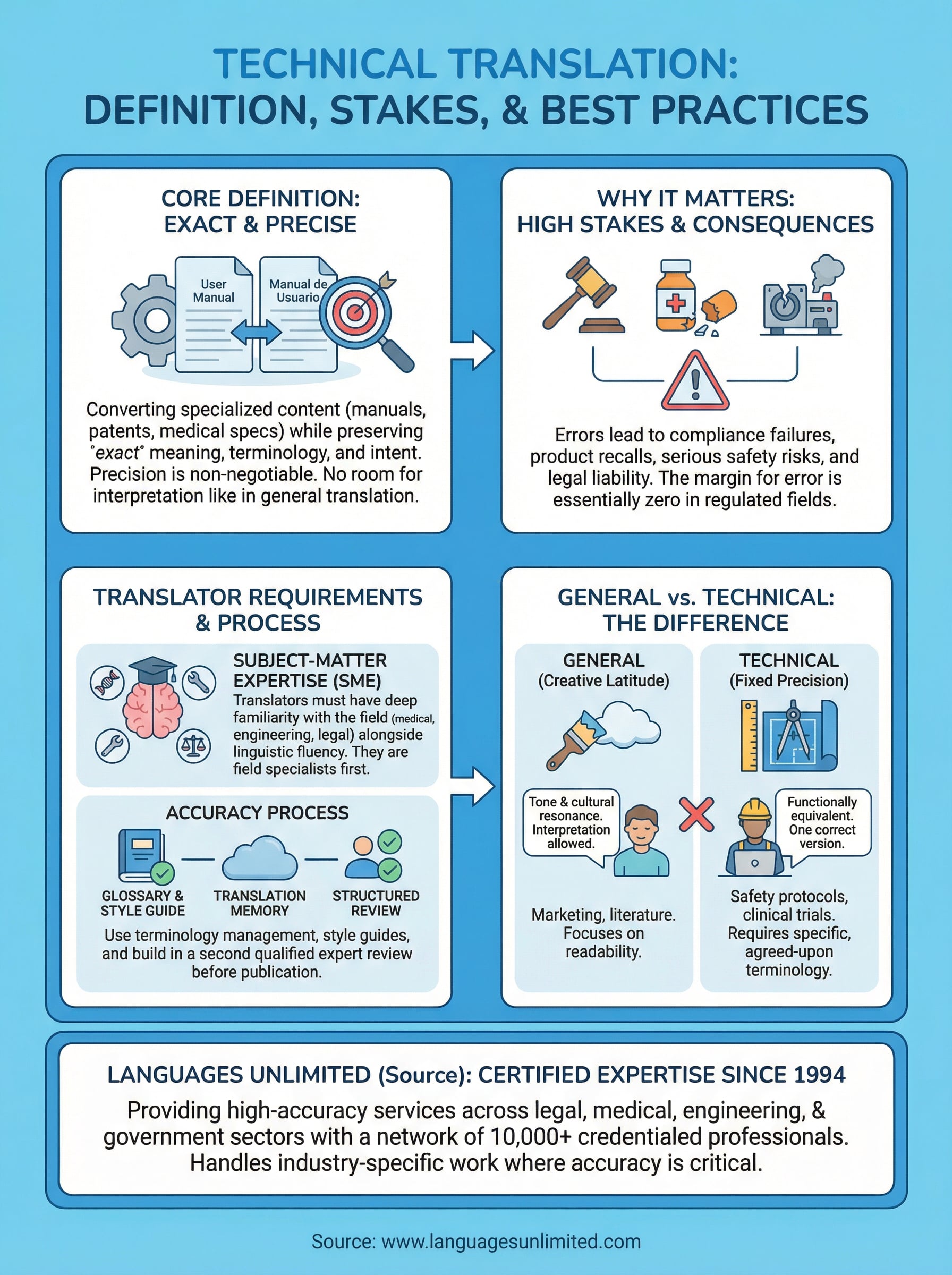
If you’ve ever searched for a technical translation definition, you’ve probably noticed that answers range from vague to overly academic. Here’s the straightforward version: technical translation is the process of converting specialized content, think user manuals, patents, medical device instructions, engineering specs, from one language to another while preserving exact meaning, terminology, and intent.
That "exact" part is what separates technical translation from general translation. A menu or a blog post gives translators room to interpret. A pharmaceutical label or a legal patent does not. One wrong term can trigger compliance failures, product recalls, or safety risks. The stakes are high, and the margin for error is essentially zero. That’s why technical translation demands subject-matter expertise on top of linguistic fluency, translators need to know the field as well as they know the language.
At Languages Unlimited, we’ve provided certified translation services since 1994 across legal, medical, engineering, and government sectors. With a network of over ten thousand language professionals and credentials including ATA membership, USCIS approval, and a GSA contract, we handle the kind of high-accuracy, industry-specific work that technical translation requires.
This article breaks down what technical translation actually means, walks through real examples of the documents involved, explains why it matters across specialized industries, and clarifies how it differs from general translation. Whether you’re evaluating providers or trying to understand the process, you’ll leave with a clear, practical understanding of the subject.
What technical translation means
Technical translation is the process of converting specialized, field-specific content from one language into another. Unlike general translation, it deals with documents that carry precise terminology tied to a particular industry or discipline, whether that’s medicine, engineering, law, software, or manufacturing. When you look for a technical translation definition, the core idea is always the same: the translator must reproduce the exact meaning of the source content in the target language, without any loss of technical accuracy.
The "technical" in the name refers not just to the subject matter but to the level of precision required. Every term in a technical document has a specific, agreed-upon meaning within its field. Change "dosage" to "amount" in a pharmaceutical instruction, and you’ve introduced ambiguity that could harm a patient. Swap one engineering term for a near-synonym, and you may invalidate a safety specification. Precision is not optional in this work; it is the entire point.
Technical translation requires the translator to understand the subject matter at a professional level, not just the words on the page.
The role of specialized knowledge
Technical translators are not generalists. To do this work accurately, a translator needs deep familiarity with the field they’re working in. A medical translator needs to understand anatomy, pharmacology, and clinical procedures. A legal translator must know how legal systems differ between countries and how specific terms function within each one. Subject-matter expertise is what allows a technical translator to choose the right term when two words look equivalent in a dictionary but carry very different meanings in practice.
Many technical translators hold professional credentials or degrees in the fields they cover. You often find translators with backgrounds in engineering, medicine, or law who then train in translation, rather than linguists who pick up technical vocabulary on the job. Industry knowledge and language fluency must work together, and the absence of either one introduces real risk into every document they touch.
Accuracy as the core standard
When you commission a technical translation, you’re not asking for a readable paraphrase. You’re asking for a functionally equivalent document in another language. That means the translated version must work the same way the original does: a user manual should guide the reader through the correct steps, a safety data sheet should communicate the correct hazards, and a patent filing should protect the same invention in the target jurisdiction.
Accuracy in technical translation also means consistency throughout a document. The same term must be translated the same way every time it appears. Inconsistency creates confusion, especially in long documents like technical specifications or clinical trial reports where the same concept may appear dozens of times. Professional translators working in this field use terminology management practices to maintain that consistency, ensuring the final document reads as a coherent, unified text rather than a collection of slightly different word choices.
Examples and common use cases
Technical translation covers a wide range of document types across different industries. Understanding what falls under this category helps clarify why the technical translation definition always emphasizes precision and subject-matter expertise. The documents involved aren’t just complex in language; they carry legal, clinical, or operational weight that makes accuracy non-negotiable for the organizations and individuals relying on them.

Legal and regulatory documents
Legal translation is one of the most common forms of technical translation. Documents like contracts, patents, court filings, and compliance reports require translators who understand both the source and target legal systems. A patent translated incorrectly can fail to protect an invention in the target jurisdiction, and a mistranslated contract clause can expose your business to serious liability.
Regulatory documents also fall into this category, including FDA submissions, CE marking documentation, and import/export compliance filings. Any document that must satisfy a governing body in another language needs a translator who understands what that body requires and how specific terms function within its framework.
Medical and scientific content
Medical translation covers everything from clinical trial protocols and informed consent forms to medical device instructions and pharmaceutical labeling. These documents directly affect patient safety, which is why accuracy requirements are especially strict in this field.
A single mistranslated dosage instruction on a pharmaceutical label can put patients at serious risk, regardless of how fluent the translator is in both languages.
Scientific research papers and lab reports also require technical translation when they cross language borders. Researchers publishing internationally need their methodology and findings reproduced exactly, so peer reviewers in other countries evaluate the same work rather than a reinterpretation of it.
Engineering and technology
Technical manuals, product specifications, and software documentation represent another large category. When you enter a new market, your installation guides, safety warnings, and maintenance instructions must be translated accurately for local users and inspectors to follow correctly.
Software localization sits within this space as well. User interfaces, error messages, and help documentation all require translation that preserves functional meaning. Getting a single system prompt wrong causes users to take the wrong action inside an application, which creates real operational problems.
Why technical translation matters
When you work with specialized content, the quality of translation directly determines whether your document, product, or service functions correctly in another market. A technical translation definition always circles back to precision, and that precision exists for a clear reason: the industries that rely on it carry consequences that general content simply does not.
Compliance and legal exposure
Regulatory environments differ by country, and any document you submit to a government body, certifying agency, or court must meet that jurisdiction’s specific requirements. A mistranslated term in a compliance filing can delay approvals, trigger rejections, or expose your organization to significant fines. Companies entering new markets with medical devices, pharmaceuticals, or industrial equipment face mandatory regulatory documentation in the local language, and those documents must be accurate enough to satisfy official reviewers.
Contracts and patents create another layer of legal risk. A poorly translated contract clause can shift liability in ways the original parties never intended. A patent that fails to reproduce the exact scope of an invention in the target language can leave your intellectual property unprotected in that market, which is a costly outcome to reverse.
Submitting an inaccurate compliance document does not just slow your project down; it signals to regulators that your organization lacks the rigor to operate in their market.
Safety in high-stakes industries
In medical and engineering contexts, inaccurate translation carries direct physical risk. A user manual that guides a technician through the wrong procedure sequence can cause equipment failure or injury. A pharmaceutical label that communicates dosage or contraindications incorrectly puts patients at immediate risk. These are not rare scenarios; they represent the core reason why accuracy standards in this field are non-negotiable.
Healthcare organizations, manufacturers, and government contractors operate in environments where a single document error can trigger audits, product recalls, or litigation. The cost of fixing a bad translation in these fields almost always exceeds the cost of hiring a qualified technical translator from the start.
Market access and credibility
When you expand into a new market, your technical documentation is often the first point of contact between your product and the end user. Manuals and safety sheets that read as inconsistent or imprecise erode trust before your product gets a fair evaluation. Accurate technical translation signals operational competence, and in competitive markets, that signal carries real commercial weight.
How to translate technical documents accurately
Translating technical documents accurately starts with choosing the right translator, not just any bilingual professional. Anyone familiar with the technical translation definition understands that subject-matter expertise is central to the work, which means your translator needs relevant field knowledge alongside linguistic skill. A translator who covers medical content one week and software manuals the next is a generalist, and generalists introduce risk into specialized documents. Fluency alone is not a sufficient qualification when the content you’re translating carries legal, clinical, or operational consequences.
Work with qualified subject-matter experts
Match your document type to a translator with direct experience in that field. Legal patents require someone familiar with intellectual property law in both jurisdictions. Medical device instructions need a translator who understands clinical terminology and regulatory language. When you review candidates, ask for samples of comparable work and check for professional credentials like subject-matter degrees or industry certifications. Credentials matter here because they give you an independent signal of competence beyond a language test alone.
Matching the translator’s background to your document type is the single most important decision you make in the entire process.
Use terminology management and style guides
Technical translation produces better results when you provide glossaries, style guides, and reference materials from the start. If your organization uses specific terms for products, processes, or systems, document those terms and share them with your translator before work begins. This prevents the kind of inconsistency where the same component gets three different names across a single manual. Translation memory tools support this process by storing approved term pairs and flagging deviations, which keeps large documents consistent throughout even when multiple translators work on the same project.
Build in a review process
No translation should go straight from the translator to publication without a structured review step. Ideally, a second qualified reviewer, preferably a subject-matter expert in the target language, checks the translation against the source document for accuracy, completeness, and terminology consistency. This step is especially important for documents that carry regulatory or safety implications.
A review process catches errors before they reach end users, auditors, or regulators, and it protects your organization from the downstream costs of corrections after the fact. Building review time into your project timeline from the beginning makes this step routine rather than an afterthought you scramble to fit in before a deadline.
How technical translation differs from general translation
General translation and technical translation both convert content between languages, but they operate under fundamentally different rules. Understanding this difference is important when you’re choosing a service, because the type of content you’re translating determines what skills and standards the work requires. The core of any technical translation definition is precision, and that precision sets it apart from most translation work in practical, measurable ways.
The tolerance for interpretation
General translation, covering materials like marketing copy, literature, or casual communication, allows the translator meaningful creative latitude. The goal is to capture tone, intent, and cultural resonance, and two translators working on the same paragraph might produce very different results, both of which could be considered correct. Technical translation removes that latitude almost entirely.
When you translate a safety procedure or a clinical protocol, there is one correct version, not a range of acceptable interpretations.
Technical documents use field-specific terminology that has a fixed meaning within its industry. The translator’s job is to find the precise equivalent in the target language, not the most readable or natural-sounding one. This requirement for terminological exactness is what makes technical translation a distinct discipline rather than just a harder version of general translation.
The qualifications required
General translators need strong bilingual ability and a feel for tone and style. Technical translators need all of that plus verified expertise in the subject matter they’re covering. A skilled literary translator cannot step into a pharmaceutical project and produce reliable output without clinical knowledge, regardless of language proficiency.
This means you should evaluate technical translators differently than you would evaluate general translators. Credentials, relevant work history, and demonstrated field knowledge matter in a way they simply do not for non-technical content. Providers who specialize in technical translation maintain rosters of translators with subject-matter backgrounds precisely because the work demands it.
The consequences of errors
Errors in general translation might produce awkward phrasing or a message that misses its audience. Errors in technical translation can expose your organization to legal liability, cause regulatory rejections, or create direct safety risks for end users. The consequences scale with the stakes of the document, and technical documents almost always carry significant stakes.
Your choice of translator should reflect that difference. Matching the risk level of your content to the qualifications of your translator is not optional; it is the baseline standard for responsible project management.
What to do next
Now that you have a working technical translation definition and understand how this discipline differs from general translation, you can apply that knowledge to your next project. The translator you choose and the accuracy standards you hold them to will determine whether your documents function correctly in another language or introduce risks you didn’t anticipate. Getting this decision right from the start costs far less than correcting a flawed translation after submission.
If you need technical translation for legal, medical, engineering, or government content, Languages Unlimited has delivered certified, specialized language services since 1994. Our network of over ten thousand translators covers more than 200 languages, with subject-matter expertise across the industries where accuracy is non-negotiable. Regulatory filings, patents, clinical materials, and technical manuals all require a provider with verified credentials and a structured review process in place.
Contact our team to discuss your project and match the right expertise to your content.