



Your brand voice took years to build. Your tagline lands perfectly in English. Your campaigns convert. But the moment you push that same content into another language without a clear strategy, everything can fall apart. Knowing how to translate marketing materials isn’t just about swapping words between languages, it’s about preserving the intent, emotion, and persuasion behind every sentence while making it feel native to a completely different audience.
A mistranslated slogan can confuse potential customers. A culturally tone-deaf campaign can alienate an entire market. And a rigid, word-for-word translation almost always strips the original message of its power. The difference between translation and localization matters here, and understanding that distinction is what separates brands that succeed internationally from those that stumble at the border.
At Languages Unlimited, we’ve spent over three decades helping businesses, government agencies, and organizations communicate across 200+ languages, including translating high-stakes marketing content where accuracy and cultural relevance are non-negotiable. This guide walks you through the process, best practices, and strategic decisions involved in translating marketing materials that actually resonate with global audiences.
What marketing translation requires
Marketing translation is fundamentally different from translating a legal contract or a technical manual. When you translate a contract, accuracy and literal precision are the top priorities. When you translate a brochure, a landing page, or an ad campaign, meaning, tone, and emotional resonance matter just as much as correctness. The goal isn’t a faithful word-for-word rendering; it’s a version of your content that makes a target audience feel the same way your original content makes your home audience feel.
Translation vs. localization: what the difference means for your brand
Many marketers treat translation and localization as the same thing, but they are not. Translation is the process of converting text from one language to another while preserving its meaning. Localization goes further by adapting that content to fit the cultural context, local idioms, visual preferences, date formats, currency, and even humor of a specific region or market.
Localization is not an upgrade to translation; it is a completely different standard of work that your marketing content demands if you want to compete in a new market.
When you learn how to translate marketing materials properly, you quickly realize that a direct translation of a slogan that works in American English might land as awkward, confusing, or even offensive in Portuguese or Mandarin. Localization means rebuilding the message around the same intent, not just converting the words.
What marketing content actually needs localization
Not every asset needs the same level of adaptation. Some content carries heavy cultural weight and requires full localization. Other content, like technical specifications or product dimensions, needs accurate translation with minimal cultural adjustment. Understanding this distinction helps you allocate budget and time efficiently across your marketing materials.

Here is how common marketing assets typically break down:
| Content Type | Level of Adaptation Needed |
|---|---|
| Taglines and slogans | Full localization |
| Social media copy | Full localization |
| Website landing pages | Full localization |
| Email campaigns | High localization |
| Brochures and print ads | High localization |
| Product descriptions | Moderate localization |
| Legal disclaimers | Accurate translation, minimal adaptation |
| Technical specifications | Accurate translation, minimal adaptation |
Your core brand voice should stay consistent across every market, but the specific words, references, and cultural touchpoints you use to express that voice must shift depending on your audience. That distinction is exactly what separates a successful global campaign from one that quietly underperforms in every new region you enter.
Step 1. Plan your audience, regions, and goals
Before you translate a single word, you need a clear picture of who you’re targeting and what you want them to do. Skipping this step is the most common reason marketing localization fails. A campaign built for a broad "Spanish-speaking audience" will not connect with a buyer in Mexico City the same way it connects with one in Madrid, and those differences in dialect, culture, and buying behavior affect every translation decision you make downstream.
Define your target markets precisely
Start by narrowing down which specific regions or countries you are entering, not just which language you need. Spanish covers over 20 distinct national markets, each with vocabulary, idioms, and cultural references that differ significantly. Your first decision when learning how to translate marketing materials should always be: which version of this language, for which people, in which market?
Getting specific about your regional target upfront saves you from costly revisions later and forces your translation team to make the right local choices from the start.
Set measurable goals for each market
Your localization goals should be as specific as your marketing goals. Use this planning template before briefing any translator or agency:
| Question | What to Define |
|---|---|
| Who is the target audience? | Age, profession, language variant, region |
| What is the primary conversion goal? | Sign-up, purchase, inquiry, awareness |
| What tone does this market expect? | Formal, casual, technical, conversational |
| What cultural references should be avoided? | Religious, political, idiomatic content |
| What is the deadline and launch market? | Country, date, channel |
Filling out this table for each target market before translation begins keeps your team aligned and gives translators the context they need to make smart, culturally informed localization decisions rather than guessing.
Step 2. Prepare source content that translates cleanly
The quality of your translation output depends directly on the quality of your source content. If your original copy is full of idioms, cultural references, ambiguous pronouns, or overly complex sentence structures, you force your translator to make judgment calls that increase the risk of errors. Before you send anything to a translator, you need to make your source content as clear and translation-ready as possible.
Write for translatability from the start
When you know how to translate marketing materials effectively, you understand that the work starts in your own language. Write in short, direct sentences. Avoid phrasal verbs where a single verb works, for example, use "increase" instead of "ramp up." Cut idioms entirely unless you plan to fully replace them during localization.
The cleaner your source copy, the faster and more accurately a translator can work, and that directly reduces your cost and revision cycles.
Use this checklist before sending any content for translation:
- Replace all idioms and slang with plain, direct language
- Use consistent terminology throughout (pick one word for each concept and stick to it)
- Avoid cultural references that are specific to one country or region
- Write numbers, dates, and units in a neutral format that can be localized easily
- Keep sentences under 25 words wherever possible
Audit your existing content before sending it out
Run your source materials through a content audit before they go to any translator. Review each asset for ambiguous pronouns, passive constructions, and double meanings that could confuse a translator or produce inaccurate output. A single unclear sentence in your source document can create errors that ripple across every language version you produce.
Flag any visual elements that contain embedded text, such as graphics, buttons, or infographics, because those require separate handling and often get missed in standard translation workflows.
Step 3. Choose the right workflow and resources
Once your source content is clean and your target markets are defined, you need to decide who handles your translation and how the work moves through your organization. This decision shapes your speed, quality, and budget for every campaign you launch. When thinking about how to translate marketing materials at scale, the right workflow removes bottlenecks and keeps your brand consistent across every market you enter.
Pick the right type of translator for the job
Not every translation resource fits every marketing need. Freelance translators work well for smaller projects with simple content and flexible timelines. Professional language service providers are better suited for high-stakes campaigns, multiple language pairs, and content that requires cultural expertise alongside linguistic accuracy.
Use this comparison to match your project to the right resource:
| Project Type | Best Resource |
|---|---|
| Single-language, low-risk content | Freelance translator |
| Multi-language marketing campaigns | Language service provider |
| Legal disclaimers within marketing assets | Certified translator |
| Ongoing localization at volume | Managed service with a dedicated team |
Choosing the wrong resource type for your project is one of the fastest ways to produce inconsistent brand messaging across markets.
Build a repeatable translation workflow
A repeatable workflow prevents your team from restarting from scratch every time you launch a new campaign in a new market. Map out each handoff point, from source content approval to translation, cultural review, and final sign-off, before any work begins.
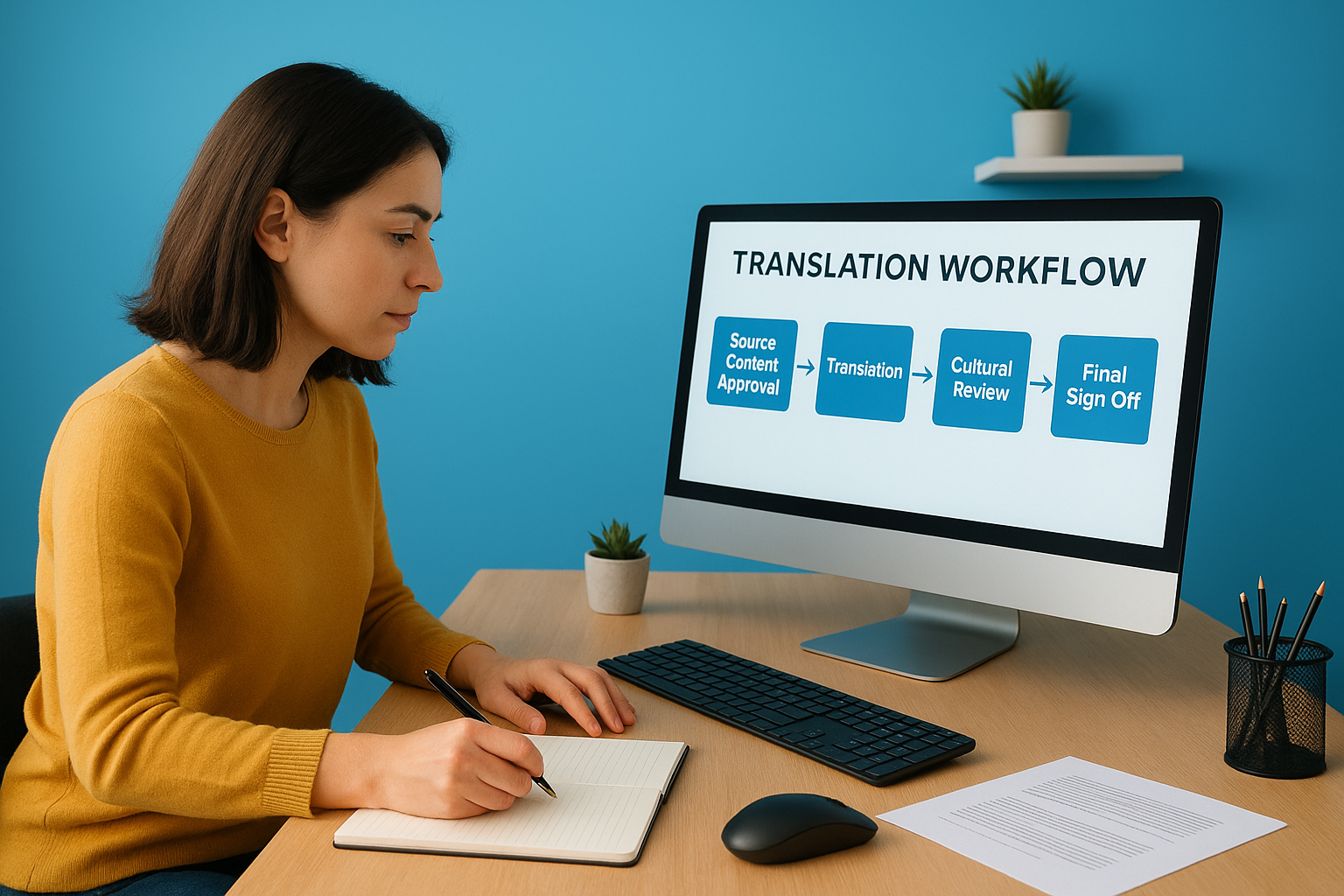
Your workflow should also include a translation memory, which is a saved database of approved translated phrases, alongside a style guide specific to each target language. Both tools cut revision time and protect your brand voice across every asset you produce.
Step 4. Localize, publish, and quality-check everything
Translation delivers the words. Localization and quality control determine whether those words actually work. When you understand how to translate marketing materials at a professional level, you know that the review stage is not optional, it is the point where errors get caught before they reach your audience and damage your brand in a market you worked hard to enter.
Run a cultural and linguistic review
Every piece of translated marketing content needs a native-speaking reviewer who was not involved in the original translation. This reviewer looks beyond grammar and checks whether the tone, humor, and cultural references land correctly for the target audience. A translator converts the text; a cultural reviewer confirms it feels right to someone who actually lives in that market.
A single culturally tone-deaf phrase can undo months of brand-building in a new region faster than any competitor can.
Assign your cultural reviewer a specific brief that includes your brand voice guidelines and a list of phrases or references flagged during the source content audit. This gives them clear criteria and keeps feedback structured rather than subjective.
Set up a pre-launch quality checklist
Before any localized asset goes live, run it through a standardized checklist that covers both linguistic and technical elements. Missing one item, like a button that still reads in English on a French landing page, creates a broken experience that undermines trust immediately.
Use this checklist for every asset before publishing:
- Confirm all in-image text has been translated and replaced
- Verify date formats, currency symbols, and units match the target region
- Test all links and calls-to-action in the localized version
- Check character counts for headlines, meta descriptions, and ad copy
- Get final sign-off from a native speaker before the asset goes live
Wrap-up and what to do next
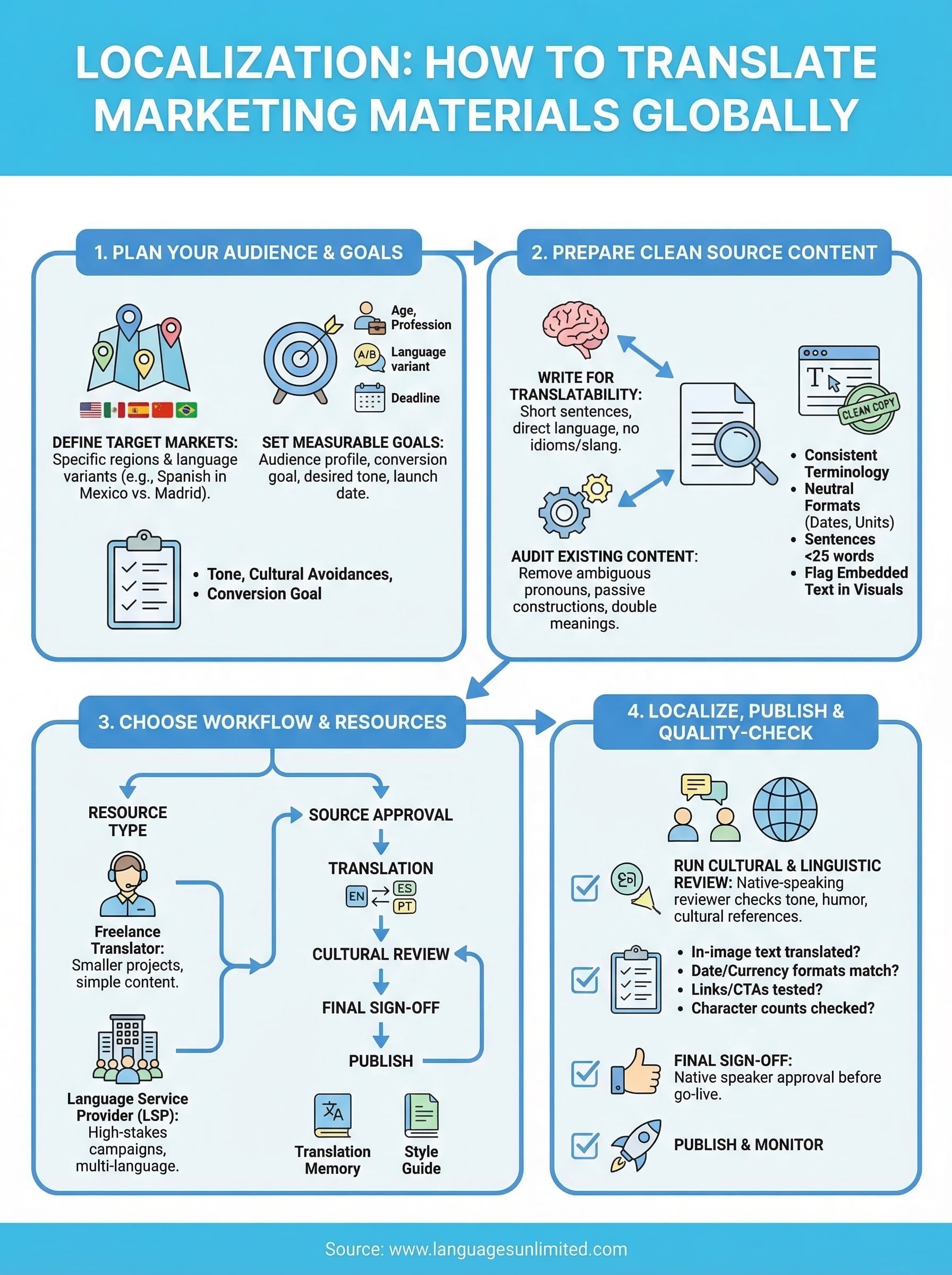
Knowing how to translate marketing materials comes down to four steps: planning your target markets before translation starts, preparing clean source content, choosing the right resources, and running a structured quality review before anything goes live. Skip any one of those steps and you raise the risk of publishing content that confuses or alienates the exact audience you worked to reach.
The brands that succeed in global markets treat localization as a core part of campaign planning, not something they handle once the English version is already approved. That shift in approach is what separates campaigns that convert in new markets from ones that quietly underperform across every region they enter.
If you’re ready to move forward with a localization project, the team at Languages Unlimited works with organizations across every industry and 200+ language pairs. Contact us today to discuss your marketing translation needs and get a quote.