



If you’re preparing an immigration application, knowing how to translate a birth certificate for USCIS is one of the first hurdles you’ll face. USCIS requires that every foreign-language document submitted with a petition or application include a complete English translation, and birth certificates are among the most commonly requested records.
Getting it wrong can mean delays, requests for evidence, or even a denied application. The translation must be accurate, complete, and accompanied by a signed certification statement confirming the translator’s competence. These aren’t suggestions, they’re strict USCIS requirements that apply to every applicant, regardless of the language involved.
At Languages Unlimited, we’ve handled certified birth certificate translations for USCIS since 1994. As a USCIS-approved translation provider and official member of the American Translators Association, we work with a network of over ten thousand linguists covering hundreds of languages and dialects, including less common ones that many other providers can’t support.
This guide walks you through the exact requirements, the step-by-step process, common mistakes to avoid, and how to make sure your translated birth certificate meets USCIS standards the first time you submit it.
USCIS rules your translation must meet
USCIS outlines its translation requirements in 8 CFR 103.2(b)(3), which applies to every foreign-language document included in an immigration filing. The rule requires that any non-English document be accompanied by a full English translation certified as complete and accurate. There are no exceptions based on the language, the issuing country, or the age of the document.
USCIS can reject or return documents that include partial translations or translations missing a signed certification statement, which can delay your entire application by weeks or months.
The certification statement requirement
The certification statement is the element that makes a translation USCIS-compliant. Your translator must sign a written declaration confirming two things: that they are competent to translate from the source language into English, and that the translation is accurate and complete to the best of their knowledge. USCIS does not require a licensed professional or a notary public, but the statement must be written, signed, and dated by the translator personally.
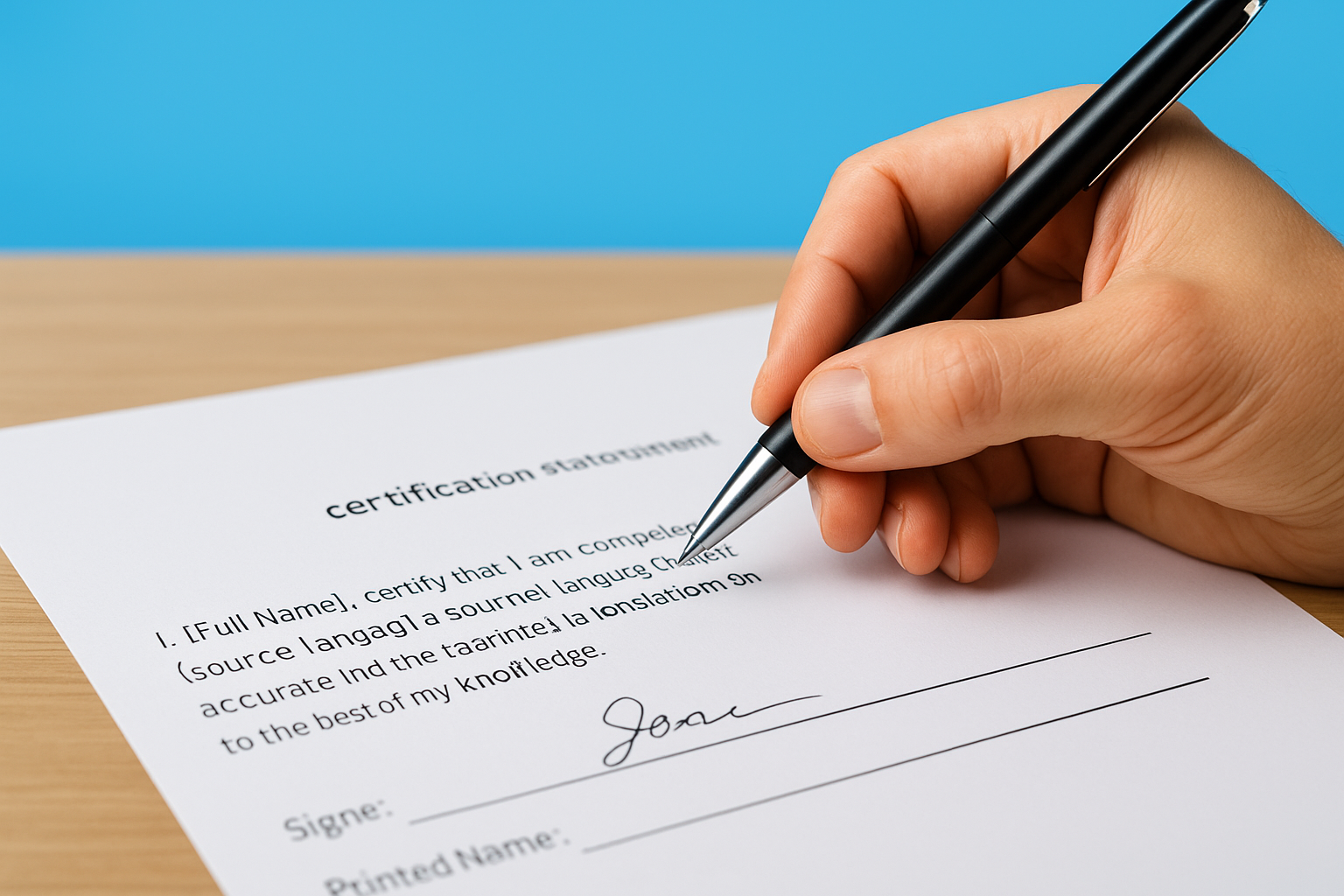
Below is a standard certification statement template that meets USCIS requirements:
I, [Full Name], certify that I am competent to translate from
[source language] into English and that the translation of
[document name] is accurate and complete to the best of my knowledge.

Signed: _______________________
Date:   _______________________
Printed Name: _________________
What the translation must cover
When you research how to translate a birth certificate for USCIS, one common error is assuming only the main body text matters. USCIS requires your translation to reflect every element on the original document, including headers, footers, official stamps, seals, handwritten annotations, and any corrections noted on the certificate. Missing even a marginal stamp or notation can trigger a Request for Evidence (RFE).
Your translated birth certificate must also mirror the structure of the original as closely as possible. If fields on the original are blank, your translation should mark those fields as blank rather than skipping them entirely. If the document carries a registrar’s seal or embossed stamp, your translation should note its presence and location. This level of detail tells USCIS that the translation is faithful and complete, not a partial summary of the content.
Step 1. Get the right birth certificate version
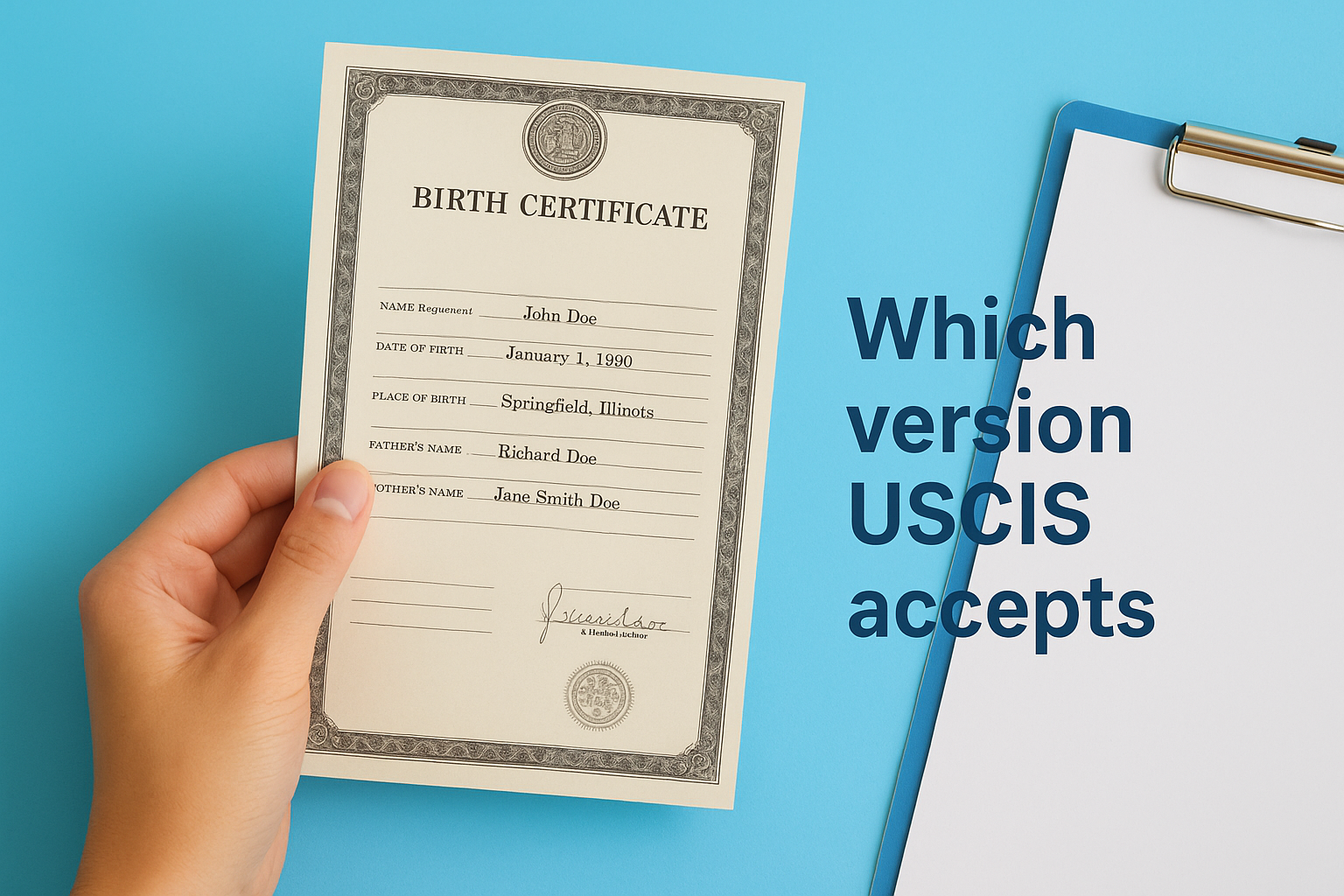
Before you focus on translation, you need to confirm that you have the correct version of your birth certificate in hand. Many countries issue multiple types, and USCIS almost always requires the long-form or full-extract version rather than a short-form summary. A short-form certificate typically shows only the registrant’s name, date, and place of birth, while a long-form version includes parents’ names, the attending official’s signature, and the registrar’s seal.
Which version USCIS accepts
USCIS expects the most complete and official version of the birth certificate available in your country of birth. That usually means the document issued directly by the civil registry or the equivalent government body. In countries that use multi-page birth record extracts, you need all pages, not just the first one. The table below shows what different versions typically contain:
| Version | Typical contents | Accepted by USCIS |
|---|---|---|
| Short-form / abstract | Name, DOB, place of birth | Rarely, only if no other exists |
| Long-form / full extract | All fields, parents, official seals | Yes |
| Apostille-certified copy | Long-form with authentication | Yes |
If your country only issues a short-form certificate, include a letter from the issuing authority confirming no long-form version exists.
What to do if your document is old or damaged
If your original birth certificate is worn, faded, or handwritten in a way that is hard to read, request a certified reprint from the issuing authority before you send anything to a translator. A translator cannot produce an accurate, USCIS-compliant translation from a document they cannot fully read.
Learning how to translate a birth certificate for USCIS correctly starts with giving your translator a clean, complete source document. You should also confirm that the document carries an official seal or signature from the issuing authority, because USCIS will expect your translator to note those elements in the final translation.
Step 2. Prepare a clear copy and translation notes
Once you have the correct birth certificate version, your next task is to prepare it for the translator in a way that supports an accurate, USCIS-compliant result. A clean, legible copy is not optional. Poor-quality scans are one of the most common causes of translation errors, and errors lead directly to Requests for Evidence that slow your entire application down.
Make a high-quality scan or photocopy
Your translator needs to see every detail on the document, including faint stamps, handwritten dates, and marginal notations. Scan the document at a minimum of 300 DPI in full color, and confirm that the entire page is visible with no cropped edges. If you only have a physical copy, photograph it under strong, even lighting to reduce shadows.
Before you send anything to a translator, review the copy against this checklist:
- All four edges of the document are fully visible
- Stamps and seals are legible, not washed out or overexposed
- Handwritten entries are clear and readable
- No page is missing if the certificate spans multiple pages
- The file resolution is at least 300 DPI
Write out your translation notes
When researching how to translate a birth certificate for USCIS, many applicants skip the step of sending context notes alongside the document. These notes help your translator handle ambiguous entries, such as names with multiple accepted spellings or dates written in non-standard formats.
Prepare a brief note document to send with your scan that includes:
- The country and region where the certificate was issued
- Any known alternate spellings of names appearing on the document
- The date format used on the certificate (for example, DD/MM/YYYY versus YYYY/MM/DD)
- Any fields you know are intentionally blank
Giving your translator this context upfront reduces revision cycles and helps produce a translation that clears USCIS review on the first submission.
Step 3. Choose a qualified translator and certify it
Choosing the right translator is where many applicants make costly mistakes. USCIS does not require a certified or licensed translator, but the person you select must be genuinely competent in both the source language and English. That means they understand not just vocabulary but also the formatting conventions and legal terminology common to civil registry documents in the issuing country.
What makes a translator qualified for USCIS work
Your translator does not need a formal credential, but they do need demonstrated fluency in the source language and a clear understanding of official document structure. Avoid using family members or bilingual friends, even if they speak the language fluently. Errors made by unqualified translators most often appear in names, dates, and place fields, which are exactly the fields USCIS scrutinizes most closely.
Look for a translator who meets all of the following criteria:
- Native or near-native fluency in the source language
- Experience translating government-issued civil documents
- Familiarity with USCIS certification requirements
- Willingness to sign a written certification statement
How to create a proper certification statement
When you research how to translate a birth certificate for USCIS, the certification statement is the step most people underestimate. Your translator must attach a signed, dated declaration to the completed translation. The statement does not need to be notarized, but it must be specific to the document translated.
Use the template below exactly, filling in the correct details for each submission.
I, [Full Name], certify that I am fluent in [source language]
and English, and that the attached translation of [document name],
issued by [issuing authority], is accurate and complete to the
best of my knowledge.

Signed: _______________________
Date:   _______________________
Printed Name: _________________
Contact Information: ___________
Step 4. Quality-check the translation and submit to USCIS
Before you send anything to USCIS, review the completed translation side by side with the original document. This step catches errors before they become Requests for Evidence, which can set your case back by months. Even a single transposed digit in a birth date or a misspelled name can create a discrepancy that USCIS flags during adjudication.
Review the translation against the original
Go through the translation field by field rather than reading it as a continuous block of text. Check that every stamp, seal, and handwritten notation is accounted for in the translated version. Use the checklist below to confirm your translation covers everything USCIS will expect when reviewing how to translate a birth certificate for USCIS correctly:
- Full name of the registrant matches the original exactly
- Date of birth reflects the correct day, month, and year
- Place of birth includes city, region, and country as shown on the original
- Parents’ names are complete and spelled as they appear on the source document
- All official stamps, seals, and signatures are noted with their position on the document
- Blank fields are marked as blank, not omitted
- The certification statement is signed, dated, and attached
A mismatch between the translated name and the name on your passport or other USCIS filing documents is one of the most common reasons USCIS issues an RFE on birth certificate submissions.
Assemble your submission package
Once the translation passes your review, compile your complete submission package before filing. Your package should include the original foreign-language birth certificate, the full English translation, and the signed certification statement from the translator. Place the certification statement as the first page of the translated document so the USCIS officer can locate it immediately. Keep a copy of the entire package for your own records before you mail or upload anything.
Next steps
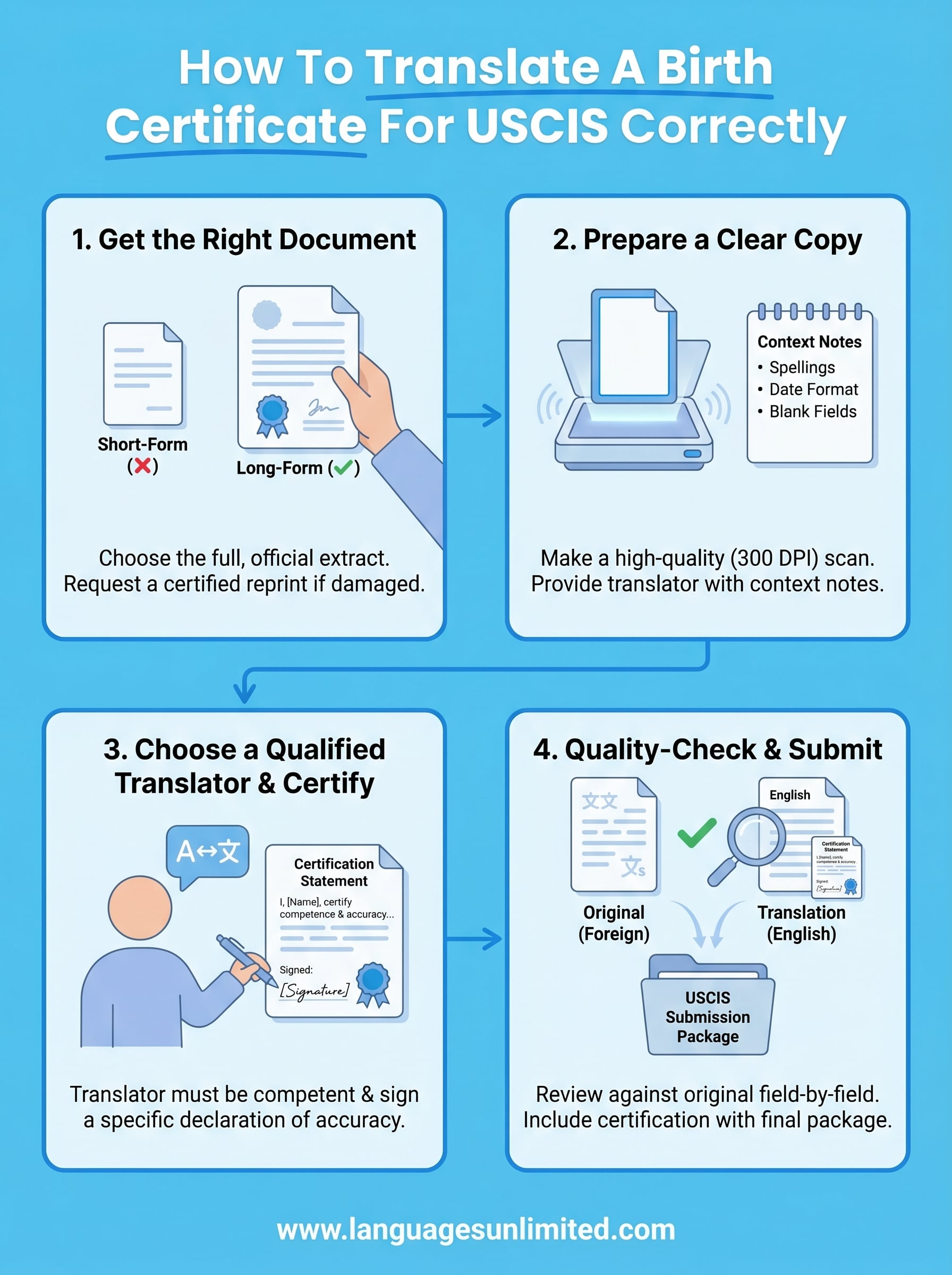
You now have everything you need to understand how to translate a birth certificate for USCIS correctly. To recap: confirm you have the long-form certificate, prepare a clean copy with context notes, select a qualified translator who will sign a proper certification statement, and review the final translation field by field before you submit your package.
The most common mistakes come down to incomplete translations and missing or vague certification statements. Both are avoidable if you follow the steps in this guide and work with a translator who understands USCIS requirements specifically.
If you want to remove the guesswork entirely, Languages Unlimited has provided USCIS-compliant certified translations since 1994. Our network covers over 200 languages, and every translation comes with a signed certification statement that meets the federal standard. Request your certified birth certificate translation and get your application moving without delays.