



If you’re preparing an immigration application, you’ve probably already gathered a stack of foreign-language documents, birth certificates, marriage licenses, academic records, and more. But before USCIS will review any of them, you need to know how to translate documents for USCIS the right way. Submit a translation that doesn’t meet their requirements, and you risk delays, requests for evidence, or even a denial of your application.
The good news is that USCIS translation rules aren’t as complicated as they might seem. You don’t necessarily need a professional translator, but you do need to follow a specific process and include a signed certification statement with every translated document. Understanding exactly what qualifies as a "certified translation" and who can (and can’t) provide one is where most applicants get tripped up. At Languages Unlimited, we’ve handled USCIS-approved translations since 1994 and have seen firsthand how small errors in this process create big problems.
This guide breaks down everything you need to know: USCIS translation requirements, the exact certification language your documents need, whether a friend or family member can translate for you, and when it makes sense to hire a professional. By the end, you’ll have a clear path forward, no guesswork, no wasted time.
USCIS translation rules and what certified means
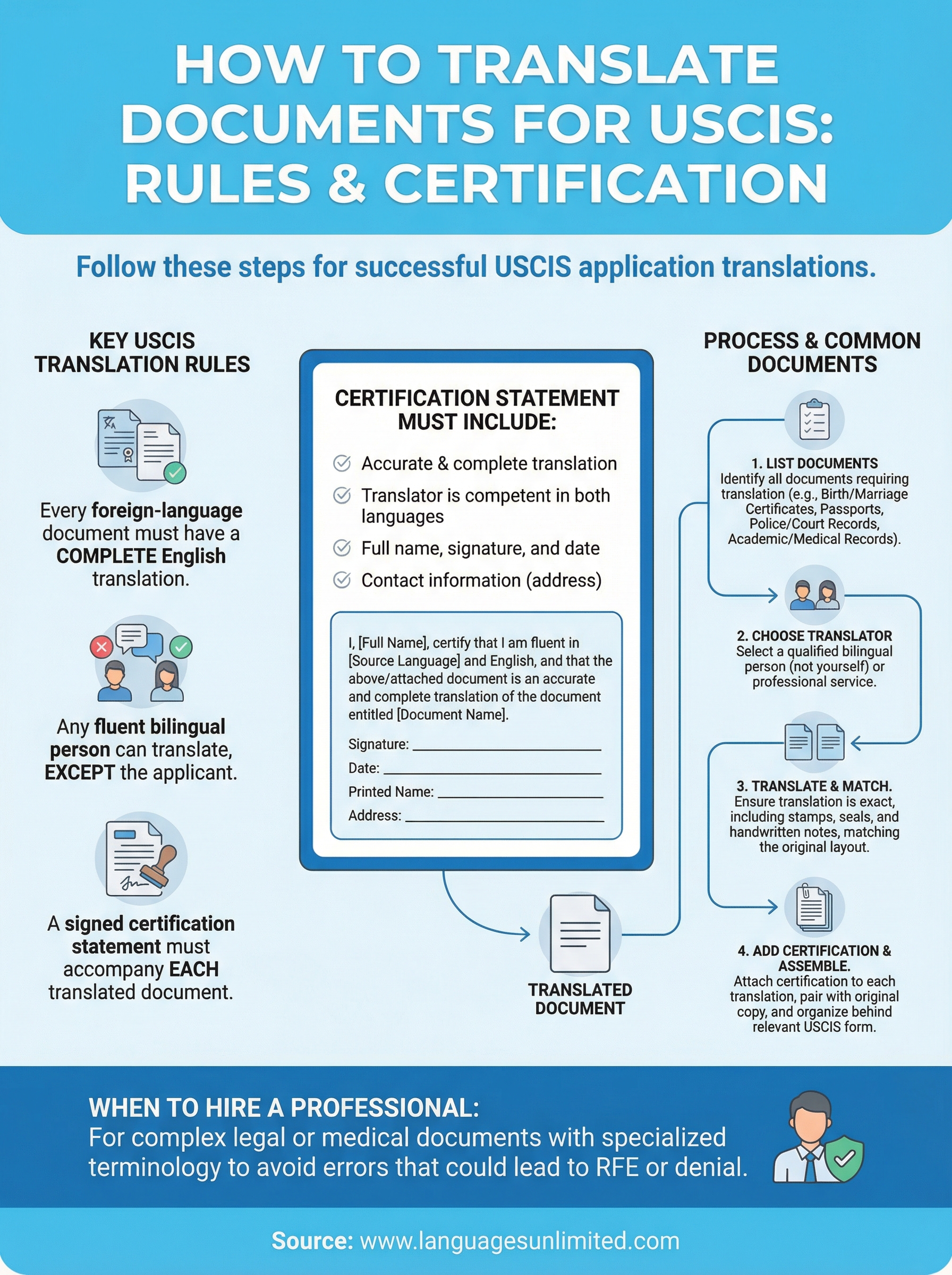
USCIS requires that every foreign-language document you submit come with a complete English translation. The rule comes from 8 CFR 103.2(b)(3), which states that any document not in English must be accompanied by a full English translation that the translator has certified as complete and accurate, along with a statement that the translator is competent to translate from that language into English. That is the entire federal requirement, and understanding it correctly keeps your application moving.
What the USCIS regulation actually says
The regulation does not require you to hire a professional translation agency, a notary, or a credentialed linguist. Any person who is fluent in both the source language and English can translate your documents, with one firm exception: you cannot translate your own documents. Anyone else who qualifies as competent must complete and sign a certification statement that confirms their fluency and the accuracy of the work they produced. This is where most applicants either get it right or create a problem for their entire application.
USCIS defines a "certified translation" by the certification statement attached to it, not by the professional credentials of the person who did the translating.
What the certification statement must include
When you work through how to translate documents for USCIS, the certification statement is the detail most people miss or underestimate. Every translated document in your packet needs its own individual certification statement from the translator. The statement must cover four things: the translation is accurate and complete, the translator is competent in both languages, and the translator’s full name, signature, date, and contact information are present. Below is the standard language that USCIS accepts:
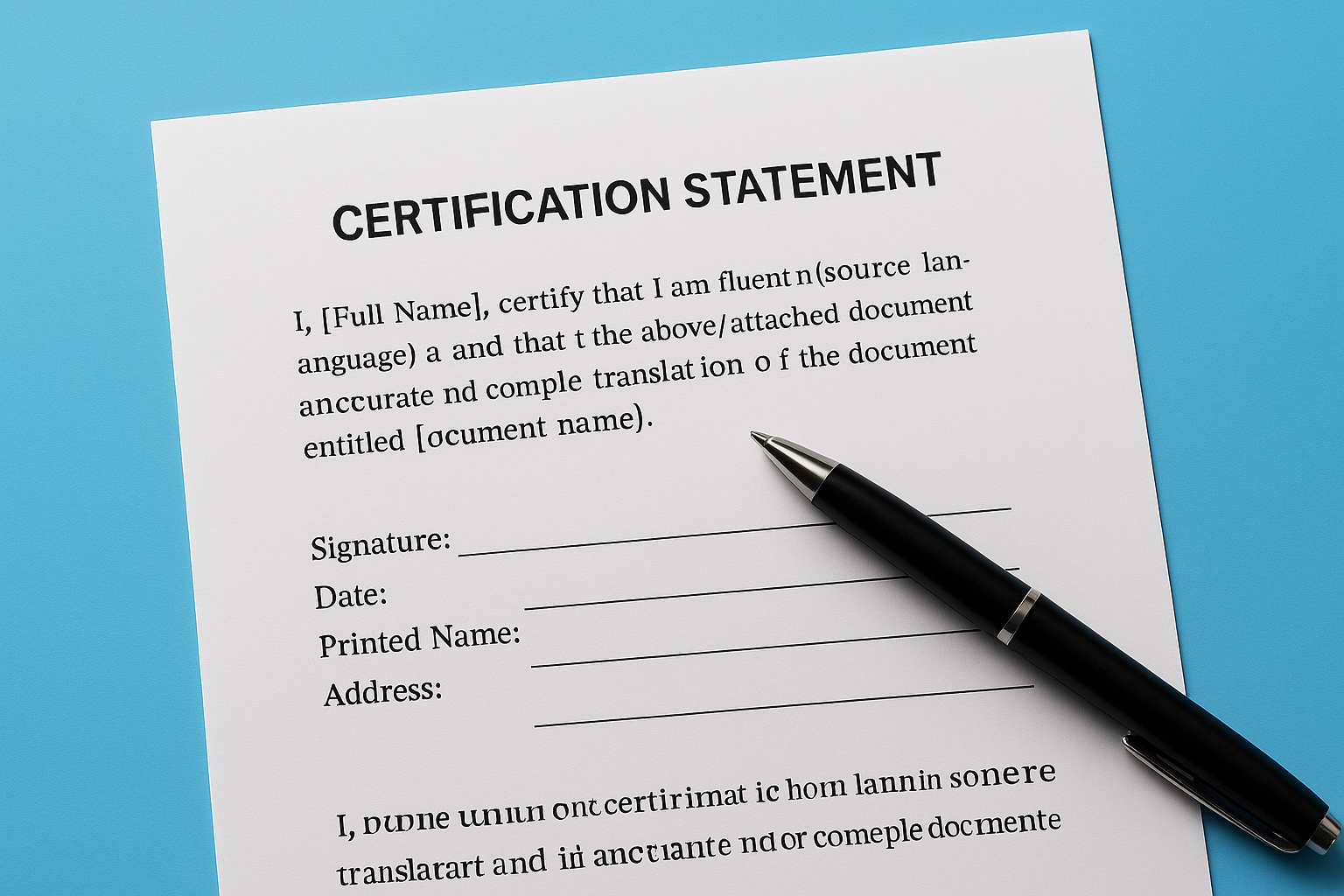
"I, [Full Name], certify that I am fluent in [source language] and English, and that the above/attached document is an accurate and complete translation of the document entitled [document name].
Signature: __________ Date: __________ Printed Name: __________ Address: __________"
This statement must appear on each translated document separately, not once per packet. Missing it on a single document is enough to generate a Request for Evidence (RFE) and delay your case.
Step 1. List documents USCIS needs in English
Before you translate anything, pull together every foreign-language document your USCIS application requires. Different form types, such as I-485, I-130, or N-400, call for different supporting documents, so check the specific instructions for your form on the USCIS website before you start. Skipping this step means you might miss a document and face a Request for Evidence later, which adds weeks or months to your case.
Building your full document list before you start translating prevents costly gaps that slow down your application.
Common documents that require translation
Most applicants need translations for a predictable set of documents, and knowing that list upfront makes the whole process easier to manage. Below are the most common ones USCIS requests across multiple application types:
- Birth certificates (for you and any family members named in the petition)
- Marriage certificates or divorce decrees
- Passports or national identity cards containing foreign-language text
- Police clearance certificates from every country where you have lived
- Court records or criminal dispositions, if applicable to your case
- Academic transcripts or diplomas
- Medical records, when your specific form requires them
Your checklist will look different depending on your case type. Go through your form instructions line by line and flag every document written in a language other than English. That list defines your translation workload, and having it complete before you start means no surprises at the end.
Step 2. Choose who will translate your documents
Once you have your document list, your next decision is who will do the translating. USCIS gives you more flexibility here than most applicants expect, but the choice still matters because the wrong translator can force you to redo work you’ve already completed.
Who qualifies as a translator
Any bilingual person who is not you can translate your USCIS documents, including a bilingual friend, a colleague, a community member, or a professional agency. When you’re working through how to translate documents for USCIS, the key requirement is that the translator must be competent in both languages and willing to sign the certification statement with their full name and contact information.
You cannot translate your own documents, even if you are fully fluent in both languages.
Rule out the following people immediately:
- You (the applicant)
- Anyone who cannot read the source language fluently
- Anyone who refuses to sign the certification statement
When to hire a professional
Complex documents like police clearance certificates, court records, and medical records contain specialized terminology that is easy to mistranslate without subject-matter knowledge. One wrong word in a legal or medical document can change its meaning in ways that create problems during adjudication. For documents like these, working with a professional translation service gives you the strongest protection against errors and ensures your certification statement meets USCIS standards.
Step 3. Translate everything and match the original
The actual translation work requires close attention to detail. When you work through how to translate documents for USCIS, your goal is to produce an English version that mirrors the original document completely and exactly, including every field, stamp, seal description, and notation. USCIS reviewers compare your translation against the original, so anything you leave out or alter raises questions.
A translation that skips stamps, seals, or handwritten notations is incomplete by USCIS standards and can trigger a Request for Evidence.
What to include in every translation
Every visible element on the source document needs to appear in your translation. That includes printed text, handwritten entries, official stamps, seal descriptions, and notations that say things like "void" or "for official use only." Translate each field label and its corresponding value, and note anything illegible by writing "[illegible]" in brackets at the relevant spot.
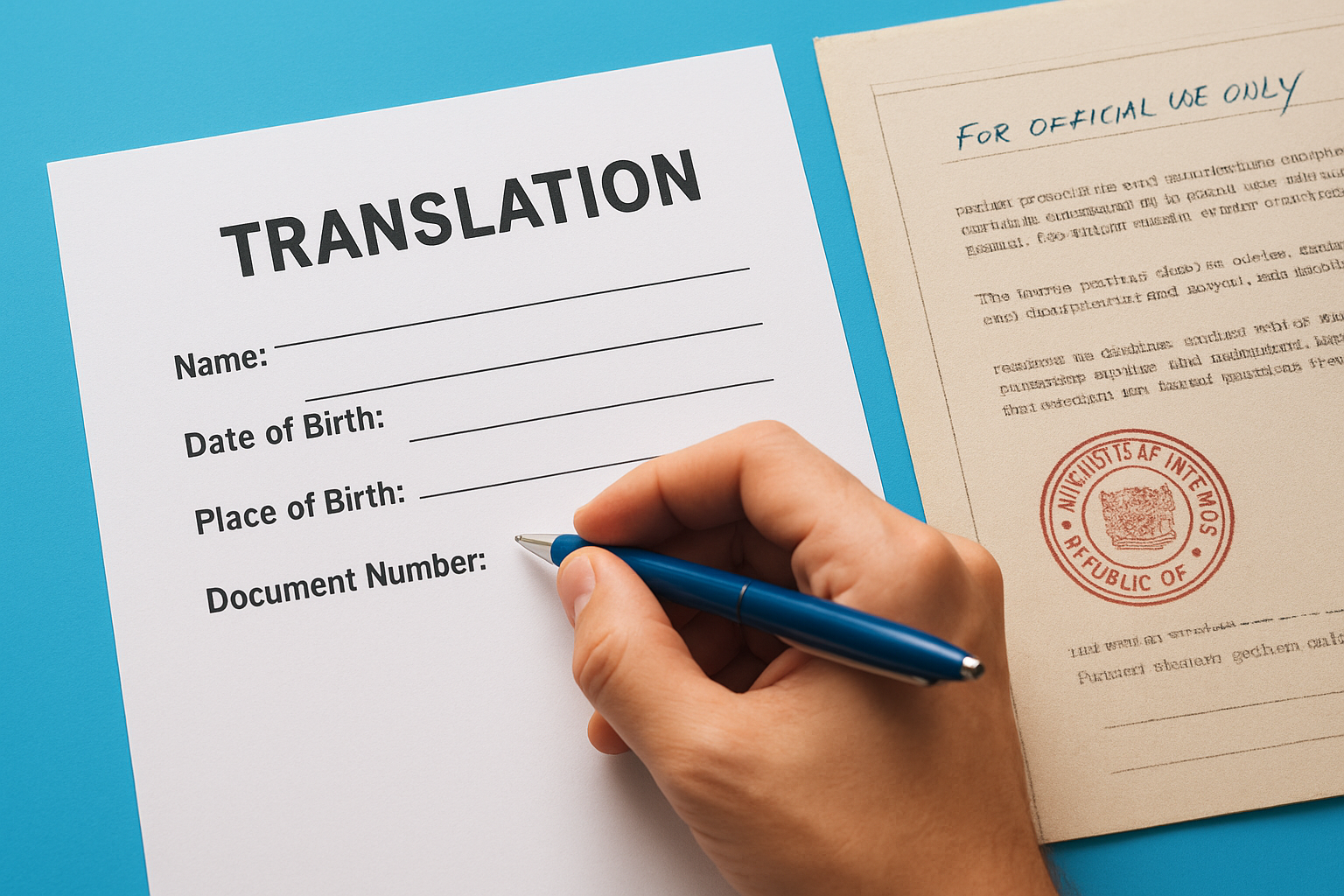
Use this checklist as your reference before marking any document complete:
- Field labels and their values (name, date of birth, place of birth, etc.)
- Official stamps and seals (describe them, for example: "[Official stamp: Ministry of Interior, Republic of X]")
- Handwritten annotations or signatures
- Document numbers, issue dates, and expiration dates
- Any watermarks or background text that carries meaning
How to format the translation
Structure your translated document so it follows the same layout as the original, matching section order as closely as possible. Label each section clearly so the USCIS officer reviewing your file can cross-reference both documents without confusion. A clean, parallel format signals that your translation is thorough and professional.
Step 4. Add the certification and assemble your packet
Once your translation is complete, you need to attach a certification statement to each translated document individually. This is the final step in how to translate documents for USCIS, and getting the assembly right means your packet arrives in a format that a USCIS officer can review quickly and without confusion.
Write the certification on the translation itself
Place the certification statement at the bottom of your translated document, not on a separate page, whenever possible. If the translation runs long, add the certification on the final page and make sure the translator’s signature, full name, date, and address appear clearly. Use the exact template below:
"I, [Full Name], certify that I am fluent in [source language] and English, and that the above/attached document is an accurate and complete translation of the document entitled [document name].
Signature: __________ Date: __________ Printed Name: __________ Address: __________"
Every translated document in your packet needs its own separate certification statement, not one statement covering the entire set.
Assemble each document pair
Keep the original foreign-language document and its certified English translation together as one paired unit. Clip or staple each pair separately before placing it into your application packet. Then arrange all your document pairs behind the correct form or cover sheet that your specific application requires. Never mix translated pages from different documents into the same stack, as this forces reviewers to sort through your materials and adds unnecessary delay to your case.
Next steps
Now you have a clear picture of how to translate documents for USCIS, from building your complete document list to pairing certified translations with originals in your final packet. Every step matters, and the certification statement is the detail that ties it all together. Follow the process in this guide and you significantly reduce your risk of receiving a Request for Evidence that stalls your application for weeks.
Most applicants handle straightforward documents like birth certificates on their own without any problems. Legal records, court documents, and medical files are a different story. These require precise terminology that a bilingual friend may not have, and a single mistranslation can change how a USCIS officer interprets your case.
Your application is too important to risk on a translation error. Contact the Languages Unlimited team for USCIS-approved certified translations that meet every federal requirement and keep your case moving forward.