



You want to work as a professional interpreter in the justice system, but the path to becoming a court certified interpreter seems unclear. Each state has different requirements, multiple exams, and confusing registration processes. Without a clear roadmap, you might waste time pursuing the wrong credentials or miss critical steps that could delay your career by months or even years.
Court interpreter certification requires passing rigorous written and oral exams that test your language skills and legal terminology knowledge. Most states follow a similar framework established by the National Center for State Courts, though specific requirements vary. You’ll need to demonstrate bilingual fluency, complete mandatory training, and meet strict ethical standards before you can interpret in courtrooms.
This guide walks you through every step needed to become a certified court interpreter, from meeting the prerequisites to passing both certification exams and completing your state registration. You’ll learn what each exam tests, how to prepare effectively, and what documentation you need to finalize your credentials. Whether you’re starting from scratch or already working as a community interpreter, you’ll find the exact pathway to launch your court interpreting career.
Prerequisites for aspiring court interpreters
Before you start the certification process, you need to meet several fundamental requirements that establish your readiness for court interpreting work. State courts set specific baseline qualifications to ensure interpreters possess the necessary language skills, education, and ethical standards. Understanding these prerequisites saves you time and helps you identify any gaps you need to address before applying for certification.
Language proficiency requirements
You must demonstrate native or near-native fluency in both English and your target language. Most certification programs require you to have lived, worked, or studied extensively in countries where both languages are spoken. This immersion experience ensures you understand cultural nuances, regional dialects, and formal versus informal registers that appear in legal proceedings.
Bilingual proficiency alone doesn’t guarantee success in court interpreting. You need specialized vocabulary knowledge in legal, medical, and technical terminology for both languages. Courts expect you to interpret complex testimony about forensic evidence, financial crimes, and medical conditions without hesitation or error.
"Court interpreters must possess the linguistic competence to accurately convey statements between languages while preserving the speaker’s tone, register, and intended meaning."
Many aspiring interpreters underestimate the language assessment standards used in certification exams. Testing agencies evaluate your ability to handle rapid speech, multiple speakers, and emotionally charged testimony. Practice interpreting news broadcasts, legal podcasts, and documentary content in both languages to build the stamina and accuracy courts demand.
Educational background expectations
Most states require you to hold at least a high school diploma or GED equivalent to apply for court interpreter certification. Bachelor’s degree holders often have an advantage because they’ve developed research skills, critical thinking abilities, and exposure to academic terminology that appears in expert witness testimony.
Formal education in translation, interpretation, or linguistics strengthens your application significantly. Universities and community colleges offer certificate programs specifically designed for court interpreters. These programs cover legal systems, courtroom procedures, interpreting techniques, and professional ethics.
You don’t need a law degree to understand how to become a court certified interpreter, but you must study legal terminology and court procedures independently if you lack formal training. Self-directed learners can access online resources, legal dictionaries, and courtroom observation opportunities to build this knowledge base.
Professional experience considerations
Previous interpreting experience helps you understand the demands of the profession before investing in certification. You can start by volunteering at community organizations, medical clinics, or local government offices that serve non-English speakers. This practical work exposes you to the stress, concentration, and ethical dilemmas interpreters face daily.
Courts value interpreters who demonstrate professional conduct and reliability. You need a clean background check since you’ll handle sensitive information and interact with vulnerable populations. Criminal convictions, especially those involving dishonesty or violence, typically disqualify candidates from certification.
Your age and citizenship status affect your eligibility in some jurisdictions. Most states require you to be at least 18 years old and legally authorized to work in the United States. Check your state court system’s specific requirements before starting the application process, as these prerequisites vary by location.
Step 1. Complete mandatory orientation training
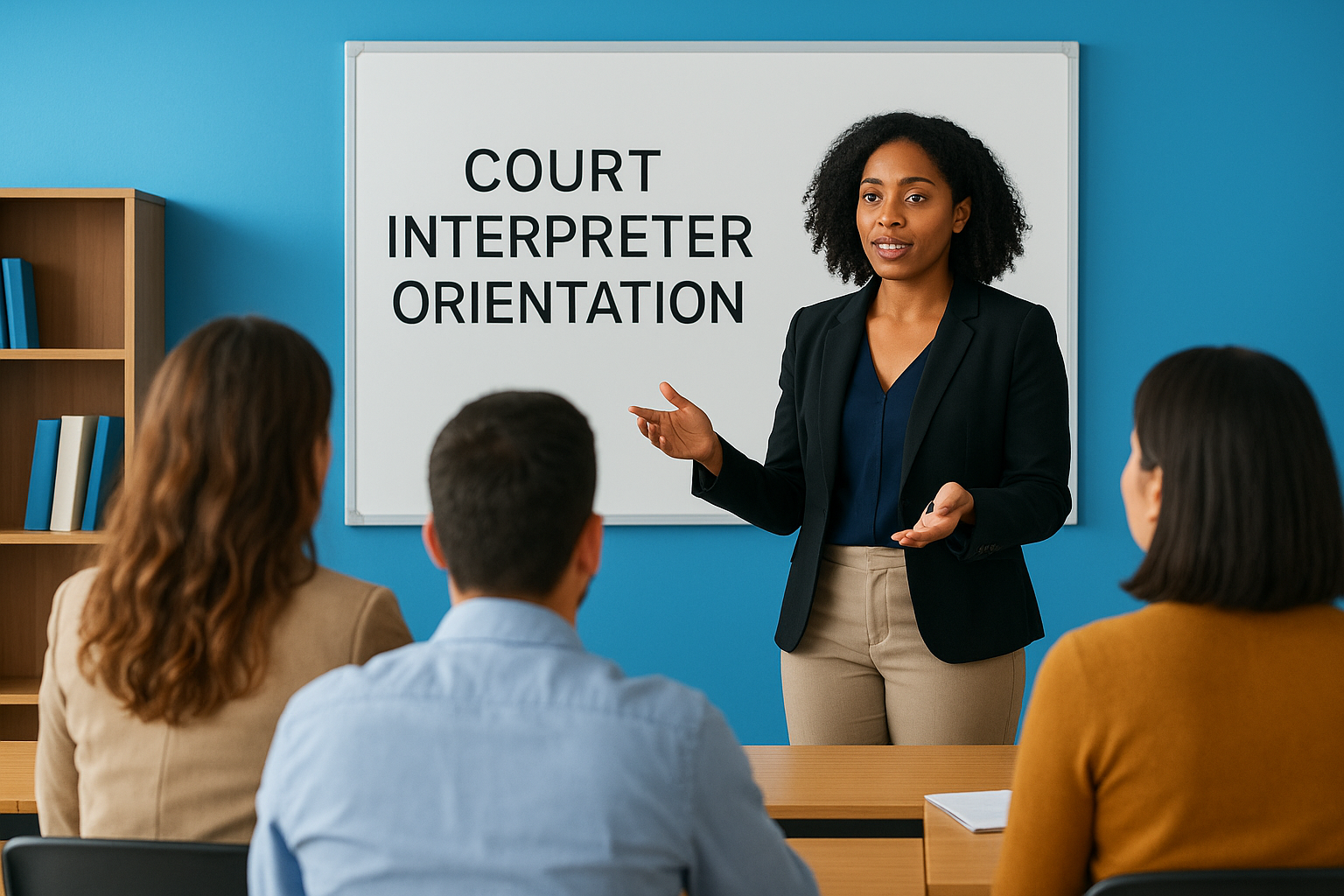
Your first official step toward learning how to become a court certified interpreter starts with mandatory orientation training. Most state courts require you to complete this foundational program before you can register for certification exams. The training introduces you to courtroom procedures, interpreter ethics, and the standards that govern your professional conduct in legal settings.
Finding approved training programs
You need to locate state-approved orientation courses that meet your jurisdiction’s specific requirements. Visit your state court system’s website and navigate to the interpreter services or certification section, where you’ll find a list of authorized training providers. Some states offer online programs, while others require in-person attendance at workshops held at courthouses or legal education centers.
Training programs typically cost between $150 and $500, depending on the format and duration. Online courses provide flexibility for working professionals, allowing you to complete modules on your own schedule. However, in-person workshops often include valuable networking opportunities and direct interaction with experienced court interpreters who share practical insights.
Key topics covered in orientation
Orientation training addresses the fundamental concepts every court interpreter must understand before entering the profession. You’ll study the code of professional responsibility, which outlines your obligations to maintain impartiality, confidentiality, and accuracy. Instructors explain how these ethical principles apply in real courtroom situations where attorneys, judges, or witnesses might pressure you to deviate from proper protocol.
Programs cover essential courtroom terminology and procedures across different legal proceedings:
- Criminal arraignments, hearings, and trials
- Civil litigation and small claims court
- Family law matters including custody and divorce
- Immigration proceedings and deportation hearings
- Appeals and post-conviction proceedings
"Court interpreters serve as linguistic bridges that ensure equal access to justice, making ethical conduct and professional standards non-negotiable aspects of the profession."
Completing your training requirements
Certificate of completion serves as proof you’ve finished the mandatory orientation. Keep this document in a secure location because you’ll need to submit it when you apply for certification exams. Most training providers issue certificates within two weeks of course completion, either by mail or through downloadable PDF files.
Document your training completion date and provider information immediately. Some states require you to take certification exams within a specific timeframe after finishing orientation, so tracking these deadlines prevents delays in your certification timeline.
Step 2. Pass the written certification exam
The written exam tests your understanding of court procedures, interpreter ethics, and basic legal terminology in both English and your target language. This multiple-choice assessment serves as the first screening mechanism to ensure you possess fundamental knowledge before advancing to the more challenging oral performance test. You’ll need to demonstrate your comprehension of courtroom protocols and professional standards that govern interpreter conduct.
Understanding the exam format
The test contains 100 to 150 multiple-choice questions that you must complete within a designated time limit, typically two to three hours. Questions cover several core areas that directly relate to your future work in courtrooms:
- Code of professional conduct and ethical scenarios
- Court structure and legal procedures
- Terminology for criminal, civil, and family law
- Roles and responsibilities of court personnel
- Cultural competency and language access rights
Your score must reach the minimum passing threshold set by your state, usually between 70% and 80%. States release results within four to six weeks after your test date, either through mail or online portals.
Registering for the written test
You register for the written exam through your state court system’s interpreter certification office after completing mandatory orientation training. Visit the official website and locate the exam registration portal, where you’ll create an account and submit your application form along with required fees, typically ranging from $50 to $150.
Most states schedule written exams quarterly at designated testing centers or courthouses across the jurisdiction. Select your preferred test date and location during registration, keeping in mind that popular sites fill quickly. You’ll receive a confirmation email with your test location, date, and time within two weeks of registration.
Preparing for exam day
Study materials provided by your state’s certification program include practice tests, glossaries, and court procedure manuals. Download these resources from the official website and create a study schedule that allows you to review all content at least twice before your exam date.
"Successful candidates typically spend 40 to 60 hours studying legal terminology, courtroom procedures, and ethical scenarios before taking the written certification exam."
Bring your government-issued photo identification and confirmation letter to the testing center. Arrive 30 minutes early to complete check-in procedures and familiarize yourself with the facility. Testing administrators prohibit electronic devices, reference materials, and personal belongings in the exam room.
Step 3. Pass the oral performance exam
The oral performance exam represents the most challenging component of learning how to become a court certified interpreter. This practical assessment evaluates your ability to interpret accurately and fluently in real-time courtroom scenarios. You’ll perform three distinct interpreting modes that court interpreters use daily: sight translation, consecutive interpretation, and simultaneous interpretation. Examiners score your accuracy, fluency, voice quality, and adherence to ethical standards throughout the entire test.
Understanding the three-part oral test
Each section of the oral exam tests a different skill set critical to courtroom interpreting. You receive recorded audio prompts or written documents that simulate actual court proceedings, and your responses get recorded for evaluation by certified raters. The entire exam lasts approximately 90 minutes, though individual section times vary.
The exam includes these components:
- Sight translation of legal documents (10-15 minutes)
- Consecutive interpretation of witness testimony (30-40 minutes)
- Simultaneous interpretation of court proceedings (30-40 minutes)
Demonstrating sight translation skills
Sight translation requires you to read a written document in one language and immediately render it orally in the other language. Examiners provide legal documents like court orders, pleadings, or consent forms that you must interpret without preparation time. You need to convey the meaning accurately while maintaining appropriate tone and legal terminology.
Practice sight translation by reading legal documents aloud in your target language daily. Start with simpler forms and progress to complex contracts or court opinions as your skills improve.
Mastering consecutive interpretation
Consecutive interpretation involves listening to a speaker complete a thought or segment, then interpreting that content into the target language. You interpret witness testimony, attorney questions, and judicial instructions in segments ranging from a few sentences to several minutes. Note-taking skills become essential for retaining details from longer segments.
"Consecutive interpreters must develop memory techniques and note-taking systems that capture both factual content and emotional nuance without distorting the speaker’s message."
Record yourself interpreting news interviews or podcast segments to build your consecutive skills. Review your recordings to identify accuracy errors, hesitations, or omissions that would lower your exam score.
Executing simultaneous interpretation
Simultaneous interpretation demands that you listen and speak at the same time, rendering speech into the target language with only a few seconds delay. This mode tests your mental stamina and ability to process complex legal arguments while maintaining accuracy. You interpret opening statements, closing arguments, and judicial rulings without pausing the speaker.

Practice simultaneous interpretation by shadowing news broadcasts and gradually reducing your lag time. Build your endurance to interpret continuously for 20 to 30 minutes without breaks.
Step 4. Finalize registration and licensure
After passing both exams, you must complete the final administrative steps to receive your official court interpreter credentials. This registration process involves submitting documentation, paying fees, and taking an oath of office. Your certification remains inactive until you complete these requirements, so prioritize this paperwork immediately after receiving your passing exam scores.
Submitting certification documentation
Gather all required documents and submit them to your state court interpreter certification office within the specified deadline, typically 30 to 90 days after passing your oral exam. You’ll need to provide original or certified copies of specific materials that verify your identity, background, and exam completion.
Your documentation package includes:
- Completed registration application form
- Copy of your government-issued photo identification
- Proof of orientation training completion
- Written and oral exam score reports
- Background check results (fingerprint clearance)
- Two professional reference letters
- Passport-sized photographs (usually two)
- Registration fee payment (typically $100 to $300)
Mail your complete package via certified mail or deliver it in person to ensure proper receipt. Keep photocopies of all submitted documents for your records, as processing times range from four to eight weeks depending on your state’s administrative workload.
Completing your official registration
Your state court administrator schedules you for an oath of office ceremony after approving your registration materials. This ceremony formalizes your commitment to uphold professional standards and ethical obligations as a court interpreter. You receive your official interpreter identification card and certificate at this ceremony, which authorizes you to accept court assignments.
"The oath of office binds court interpreters to maintain impartiality, confidentiality, and accuracy in all proceedings, creating a legal obligation that extends beyond ethical guidelines."
Sign the interpreter registry and create your profile in the court assignment system. Update your contact information, language pairs, geographic availability, and any specialized areas of expertise to help courts match you with appropriate cases.
Maintaining your interpreter credentials
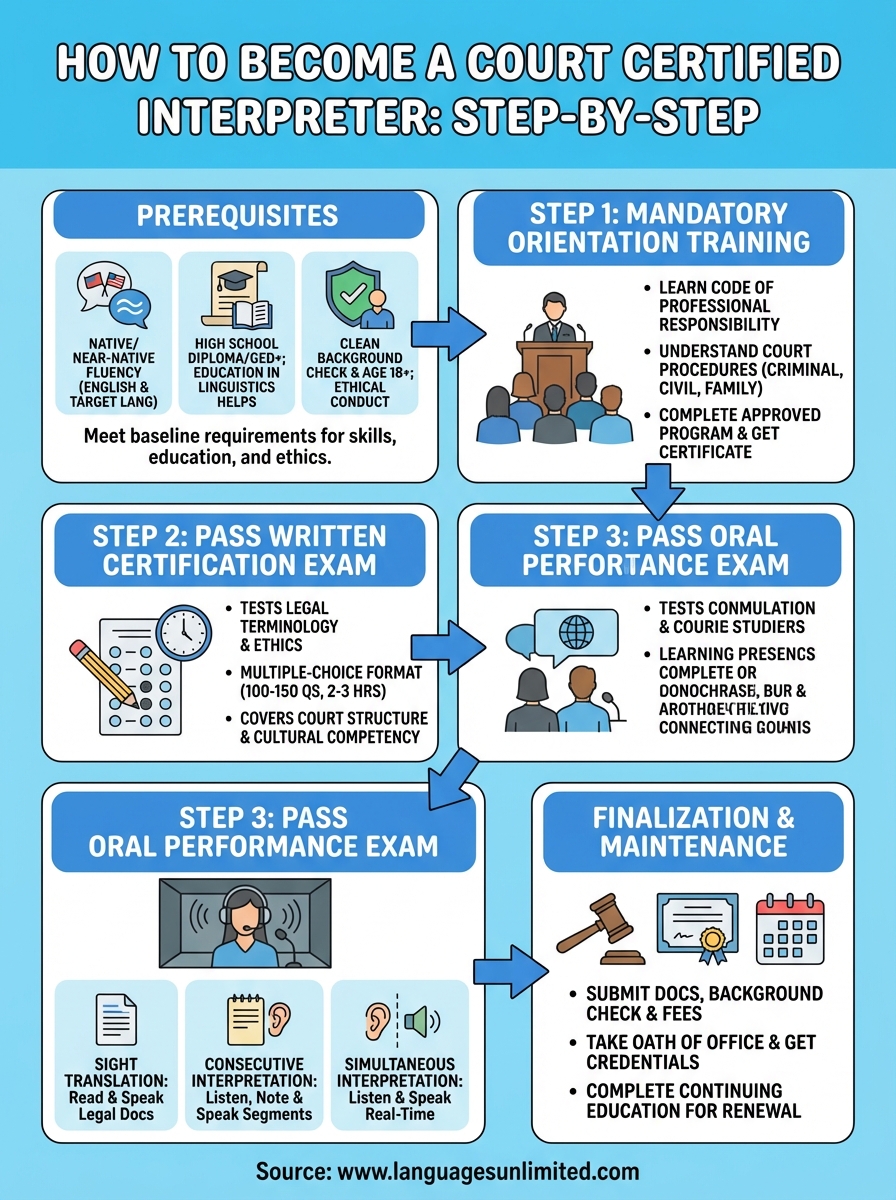
Renewal requirements for learning how to become a court certified interpreter extend beyond initial certification. You must complete continuing education units (typically 18 to 30 hours every two years) covering legal updates, interpreting techniques, and ethical scenarios. Track your professional development hours carefully and submit renewal applications before your credential expiration date to avoid lapses in certification status.
Start your court interpreting career
You’ve learned every step required for how to become a court certified interpreter, from meeting prerequisites through passing both certification exams and completing your official registration. Your next action involves applying this knowledge by scheduling your orientation training and creating a detailed study timeline that aligns with your state’s exam dates. Set specific deadlines for each milestone to maintain momentum and avoid unnecessary delays that could postpone your career launch by months or years.
Professional court interpreting offers stable career opportunities with competitive compensation and meaningful work that ensures equal access to justice for non-English speakers in legal proceedings. If your organization needs certified interpretation services for legal proceedings, depositions, or court-related matters while you complete your certification journey, contact Languages Unlimited for experienced court interpreters who can handle your immediate needs across all languages and legal settings nationwide.