



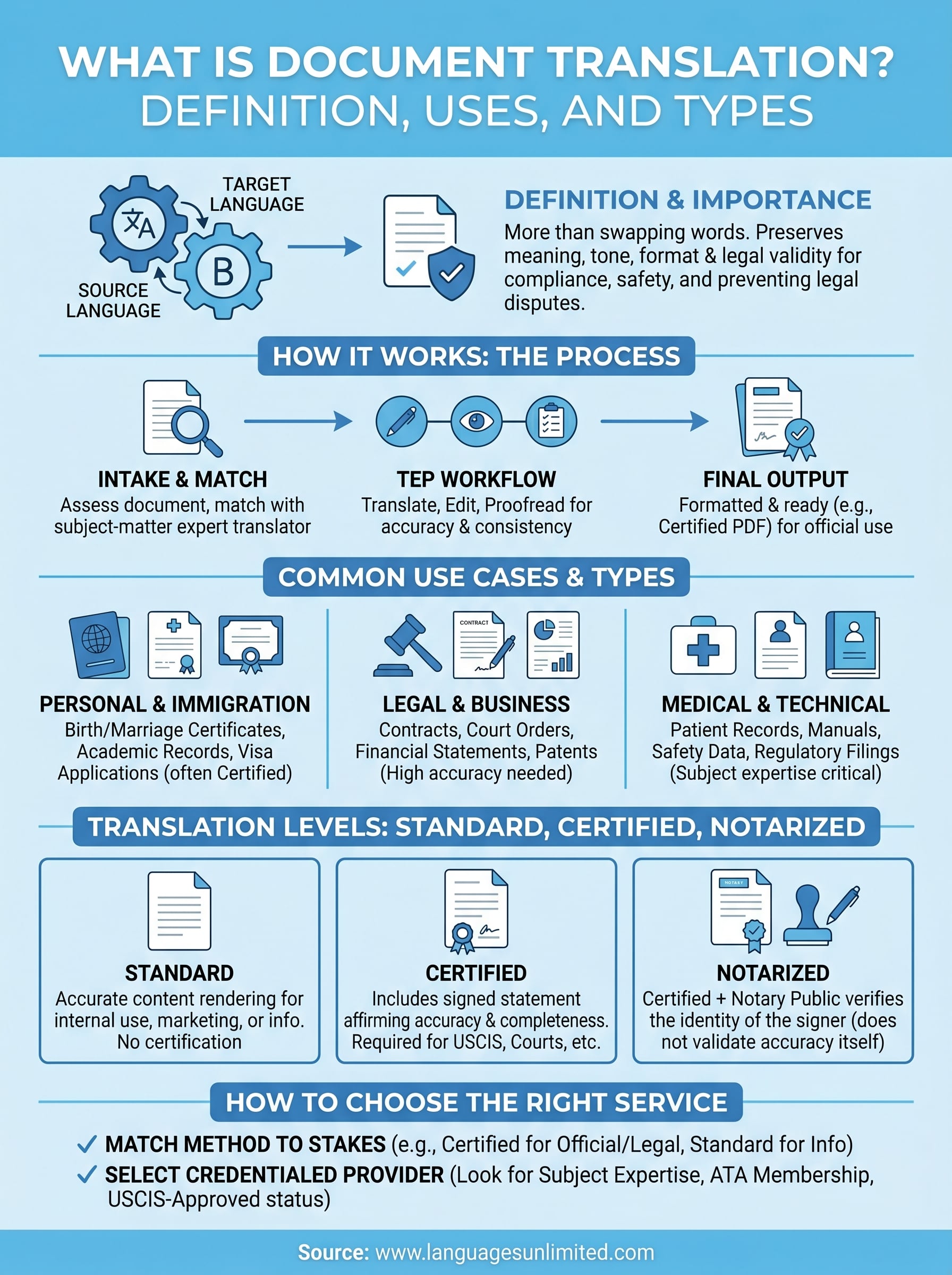
If you’ve ever needed to convert a contract, birth certificate, or medical record into another language, you’ve probably asked yourself: what is document translation, and how does it actually work? The answer goes beyond swapping words between languages. It involves preserving meaning, formatting, tone, and, in many cases, legal validity across every page.
Document translation plays a critical role in immigration applications, international business deals, healthcare communications, court proceedings, and academic admissions. Some situations call for a simple, accurate rendering of a text, while others require certified or notarized translations that meet strict regulatory standards. Knowing the difference, and choosing the right approach, can save you significant time, cost, and legal headaches.
At Languages Unlimited, we’ve provided professional document translation services since 1994, working with legal firms, healthcare providers, government agencies, and individuals across all 50 states. As an ATA member and USCIS-approved provider, we handle everything from certified immigration documents to large-scale multilingual projects. This article breaks down exactly what document translation is, when you need it, the types available, and how to choose the right service for your situation.
Why document translation matters
Understanding what is document translation starts with recognizing how often accurate, language-specific communication directly affects real outcomes. Whether you’re submitting immigration paperwork, signing a cross-border contract, or receiving medical care in a country where you don’t speak the primary language, a mistranslated document can delay processes, trigger legal disputes, or put lives at risk. Document translation isn’t just a convenience for multilingual environments; it’s a practical necessity across dozens of regulated industries and everyday personal situations alike.
Legal and compliance requirements
Legal systems around the world operate in their own official languages, and courts, government agencies, and regulatory bodies will not accept foreign-language documents without proper translation. If you’re applying for a U.S. visa, petitioning for citizenship, or handling an international legal dispute, every document you submit needs to be accurately translated and, in many cases, certified. The U.S. Citizenship and Immigration Services (USCIS) requires that all foreign-language documents include a full English translation along with a signed certification confirming its accuracy and completeness.
Submitting an incomplete or inaccurate translation to a government agency can result in application rejection, costly processing delays, or legal liability that takes months to resolve.
Contracts, court orders, patents, and regulatory filings all fall into this category. Working with a qualified translation provider protects you from compliance failures that could otherwise derail timelines and expose your organization to unnecessary legal risk.
Healthcare and patient safety
Medical settings present some of the highest stakes for accurate document translation. A mistranslated dosage instruction, a misread allergy notation, or an incorrectly rendered diagnosis can directly harm a patient. Hospitals, clinics, and public health organizations that serve multilingual populations need translated medical records, informed consent forms, discharge instructions, and insurance documents to function both safely and legally. The consequences of getting this wrong go far beyond administrative inconvenience.
Federal regulations under Title VI of the Civil Rights Act require healthcare providers that receive federal funding to provide meaningful access to language services for patients with limited English proficiency. Accurate document translation is a core part of meeting that legal obligation. If your organization works with diverse patient populations, translation quality isn’t optional; it’s a compliance baseline.
Business and international operations
When your business crosses borders, every piece of documentation follows. That includes employee contracts, product manuals, financial statements, marketing materials, and regulatory submissions. Companies that expand into new markets often underestimate how much a translation gap can cost them in time, money, and credibility. A poorly translated product specification, for example, can create liability issues in a foreign market or undermine the trust of the customers you’re trying to reach.
Global organizations working with international partners or multicultural workforces depend on consistent, high-quality translation to maintain operational clarity and professional credibility. Even internal documents, like HR policies or compliance training materials, need accurate translation to ensure every employee understands their responsibilities regardless of the language they speak.
How document translation works
Once you understand what is document translation and why it matters, knowing the actual workflow helps you set realistic expectations and avoid common mistakes. Professional document translation is not a single conversion step. It runs through multiple sequential stages, from initial intake to final formatting, and each stage serves a specific quality and compliance purpose.
Document intake and translator matching
When you submit a document to a professional provider, the first thing they do is assess the language pair, subject matter, document type, and total length to identify the right translator for the job. A patient intake form and a patent filing both require translation, but they demand completely different expertise. This initial matching step is one of the most important parts of the process because subject-matter fluency matters as much as linguistic fluency in technical, legal, and medical content.
Your provider also reviews any formatting, certification, or institutional requirements at this intake stage. If the document is heading to a government agency, a court, or a hospital credentialing office, the provider needs to know that upfront so the final output meets the receiving institution’s exact standards, not just a general translation quality baseline.
Assigning a document to a subject-matter specialist rather than a generalist translator is often the difference between a clean first submission and an expensive revision cycle.
From first draft to final delivery
The assigned translator works through the source text systematically, preserving meaning, tone, terminology, and document structure in the target language. Once the first draft is complete, a second qualified linguist reviews it for accuracy, consistency, and alignment with the relevant technical vocabulary. Most professional providers follow a TEP workflow (translation, editing, and proofreading), which catches errors that even experienced translators can introduce in dense or highly specialized material.
After review, the provider formats the translated document to match the original layout as closely as possible, preserving field labels, section numbers, and page references where accuracy matters for official use. Certified translations include a signed statement of accuracy before delivery. Your final file is then sent in the format your institution or agency requires, whether PDF, Word, or printed hard copy.
Common document types and use cases
Knowing what is document translation in theory is useful, but understanding which specific documents most often require translation gives you a clearer picture of when professional services apply to your situation. The range is broad, spanning personal paperwork, regulated industry records, and complex technical materials, and each category carries its own accuracy requirements and formatting expectations.
Personal and immigration documents
Immigration is one of the most common reasons individuals seek professional document translation. Birth certificates, marriage and divorce certificates, adoption records, academic diplomas, and police clearance letters all need to be translated accurately and completely before USCIS or foreign immigration authorities will process them. These documents often contain dates, official seals, and government-issued identifiers that must be rendered precisely to avoid rejection.
A single formatting error or omitted field on a translated immigration document can delay your application by weeks or trigger a request for evidence, which stalls your case further.
Your academic transcripts and diplomas also fall into this category when you’re applying to foreign universities or seeking professional license recognition in a new country. These documents follow standardized formats that vary by institution and country, so your translator needs to understand both the source structure and the target country’s expectations.
Legal and business documents
Legal professionals regularly deal with contracts, court transcripts, affidavits, power of attorney documents, and intellectual property filings that require translation for cross-border proceedings or international business transactions. Each of these document types uses precise, jurisdiction-specific language where a single mistranslated term can change the legal meaning of an entire clause.
Business translation extends further into financial statements, compliance reports, employee handbooks, and merger agreements. If your company operates in multiple countries or works with international partners, every document your team relies on to make operational decisions needs to accurately reflect the original content.
Medical and technical documents
Healthcare organizations translate patient records, clinical trial documentation, informed consent forms, and discharge summaries to meet both regulatory requirements and patient safety standards. Technical fields like engineering, manufacturing, and software development require translation of user manuals, safety data sheets, product specifications, and regulatory submissions that are dense with industry-specific terminology and zero tolerance for ambiguity.
Certified vs notarized vs standard translations
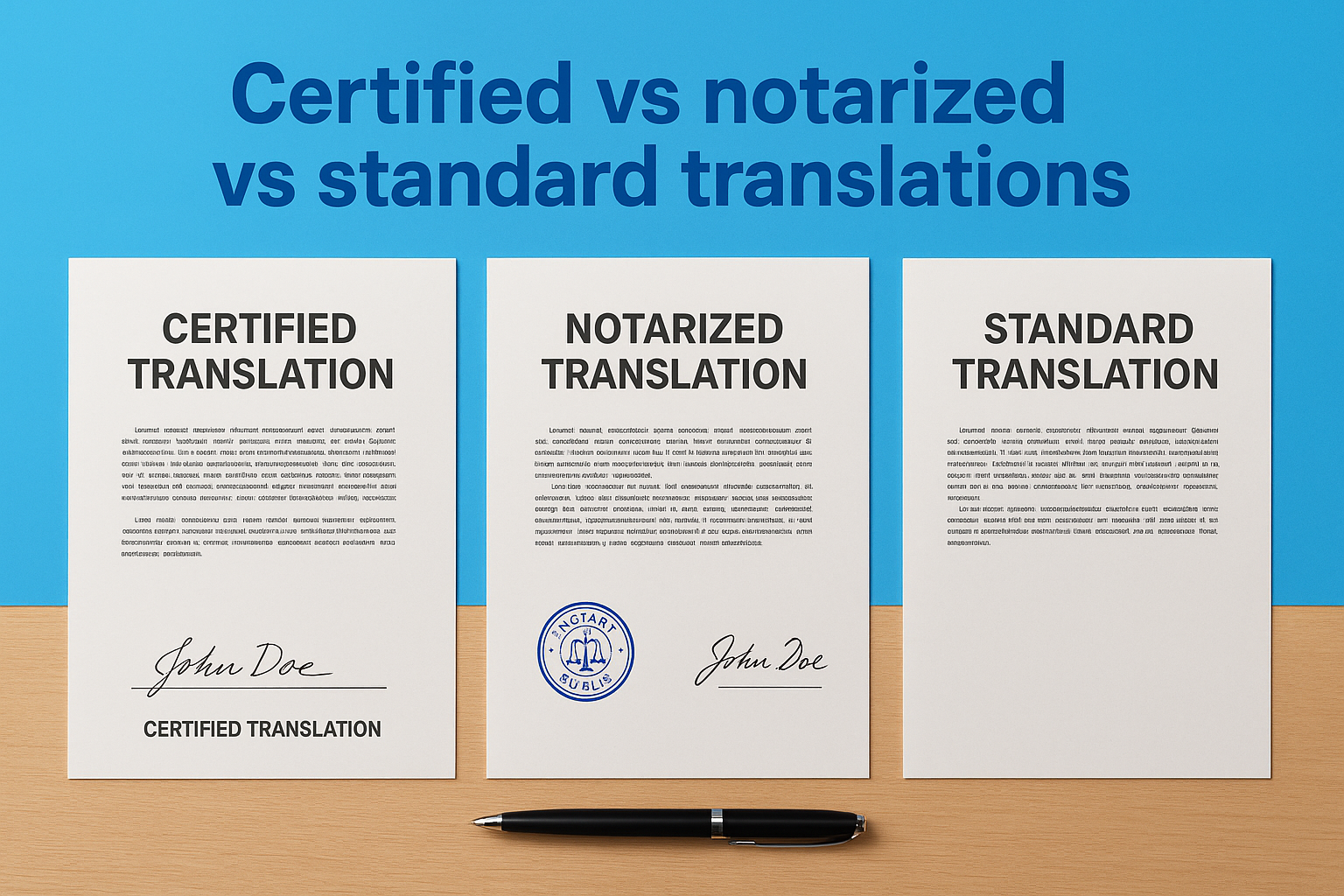
One of the most common points of confusion when people first ask what is document translation is understanding the difference between standard, certified, and notarized translations. These are not interchangeable terms. Each one describes a different level of official recognition, and submitting the wrong type to a government agency, court, or academic institution can result in outright rejection.
Standard translations
Standard translation covers the accurate rendering of content from one language into another without any formal certification attached. This type of work is appropriate for internal business communications, marketing materials, website content, and any document where institutional acceptance is not required. Your translated employee newsletter or product description does not need a certification statement; it just needs to be accurate and well-written.
Standard translation is generally faster and less expensive than certified work, but it carries no legal standing on its own. If you submit a standard translation to USCIS or a court, the receiving institution will likely reject it and request a proper certified version.
Certified translations
A certified translation includes a signed statement from the translator or translation agency affirming that the translation is complete and accurate to the best of their knowledge. USCIS requires this format for all foreign-language documents submitted with immigration applications, and many courts and academic institutions follow the same requirement.
The certification statement itself is what gives the document legal standing, not the translator’s credentials alone, so the format and wording of that statement must meet the receiving institution’s specific requirements.
The translator or agency representative signs and dates the certification, often including their contact information and a statement of competency. Languages Unlimited provides USCIS-approved certified translations that meet these standards directly.
Notarized translations
Notarization adds another layer on top of certification. A notary public witnesses and stamps the translator’s signature, verifying that the person who signed the certification is who they claim to be. Notarization does not validate the translation’s accuracy; it only authenticates the identity of the signer. Some courts, foreign consulates, and government bodies require this added step, so confirm with the receiving institution before ordering.
How to choose a method and provider
Once you understand what is document translation and which type fits your situation, the next decision is how to get it done. Your choice of method and provider will directly affect accuracy, turnaround time, and whether the final document gets accepted by the institution receiving it. Getting this decision right upfront saves you from costly revisions or outright rejection later.
Match the method to the stakes
Not every document needs the same level of service. For internal communications, marketing copy, or informational content, a professional translation without certification is usually sufficient. For legal filings, immigration applications, medical records, or academic submissions, you need a certified translation from a qualified provider. Attempting to cut costs by using machine translation or unqualified freelancers on high-stakes documents is a risk that regularly backfires when agencies reject submissions and require you to start the process over.
Matching the method to the actual requirements of the receiving institution is the most reliable way to avoid delays, rejections, and unnecessary cost.
Evaluate the provider carefully
When selecting a translation provider, look for demonstrated subject-matter expertise in the field relevant to your documents. A provider that handles legal contracts daily brings a different level of accuracy to those documents than a generalist who covers any topic. Check whether the provider holds recognized credentials, such as membership in the American Translators Association or USCIS approval status, both of which signal accountability to professional standards.
You should also ask about the quality review process the provider follows. Providers that use a TEP workflow (translation, editing, and proofreading) catch terminology inconsistencies and formatting errors before delivery, which protects you from submitting a document with avoidable mistakes. Languages Unlimited has operated as an ATA member and USCIS-approved translation provider since 1994, covering over 200 languages with a network of more than ten thousand professionals across legal, medical, government, and business sectors. Whether you need a single certified birth certificate or a large-scale multilingual project, working with an experienced, credentialed provider removes the guesswork from what is often a compliance-critical process.
Final takeaways
Understanding what is document translation goes well beyond knowing that it converts text from one language to another. It means recognizing that accuracy, certification type, and provider credentials all determine whether your translated document gets accepted or rejected by the institution that receives it. Personal documents, legal filings, medical records, and business materials each carry different requirements, and choosing the wrong approach costs you time and money you didn’t need to spend.
Your next step is straightforward. Match your document type to the correct translation format, confirm the requirements of the receiving institution, and work with a provider that has verifiable credentials and a structured quality review process. If you have specific documents you need translated, or you’re not sure which service level applies to your situation, reach out to our team at Languages Unlimited and we’ll help you identify the right solution and get your project moving.