



If you’ve ever wondered what is i18n and l10n, you’re not alone. These shorthand terms, numeronyms, technically, show up constantly in software development, product management, and global content strategy. They stand for internationalization and localization, two processes that determine whether a product or piece of content actually works for people in different languages, regions, and cultures.
Here’s the short version: i18n prepares your product to support multiple languages, while l10n adapts it for a specific audience. They’re closely related but do very different things. Confusing one for the other, or skipping either step, leads to costly rework and a poor experience for your end users.
At Languages Unlimited, we’ve provided professional translation, interpretation, and localization services since 1994, working with over ten thousand language professionals across more than 200 languages. We see firsthand how i18n and l10n shape real-world outcomes for businesses, government agencies, and healthcare organizations trying to communicate across language barriers.
This article breaks down both terms in plain language, what they mean, how they differ, and where they overlap, with practical examples so you can apply these concepts to your own projects.
What i18n and l10n mean
The two terms come from a naming shortcut called a numeronym, where a number replaces the letters between the first and last letter of a word. Internationalization has 18 letters between the "i" and the "n," giving you i18n. Localization has 10 letters between the "l" and the "n," giving you l10n. Once you know that, the abbreviations make sense immediately, and you will not need to look them up again every time you encounter them in a technical document or a project brief.
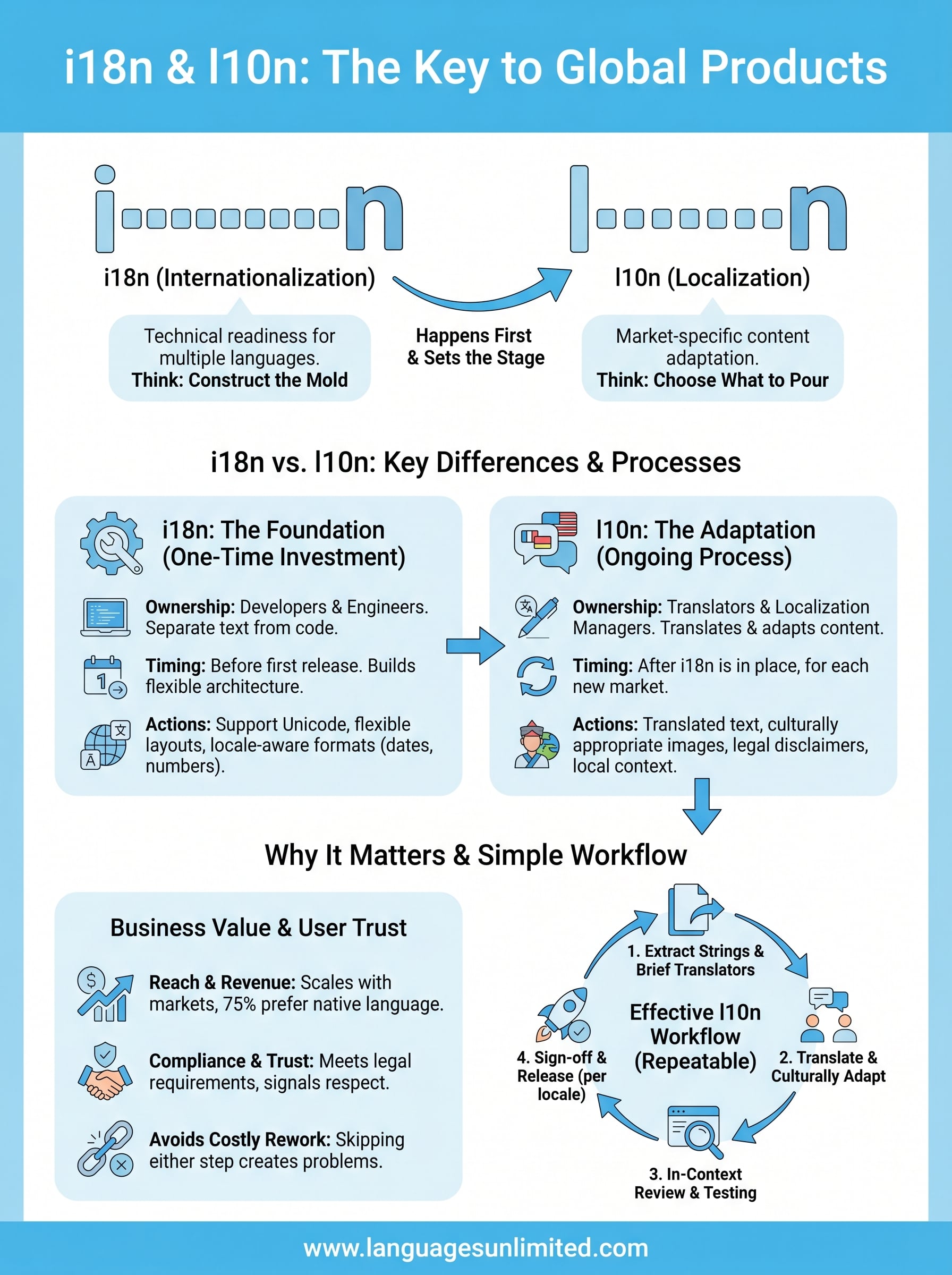
Understanding what is i18n and l10n comes down to recognizing that the two processes work together but serve distinct purposes at different stages of a product’s development. i18n happens first and sets up the technical foundation so your product can support multiple languages. l10n follows, taking that foundation and filling it with content tailored for a specific locale. Think of i18n as constructing the mold and l10n as choosing what to pour into it depending on the audience you are serving.
What i18n means
Internationalization is the process of designing and engineering a product so it can be adapted to different languages and regions without requiring changes to the underlying code. When a development team builds with i18n in mind, they separate translatable text strings from the source code, build in support for character encodings like Unicode, and account for things like right-to-left text direction, flexible layouts that expand when translated content is longer, date and time formats, and locale-specific number formatting.
i18n is not about translating anything yet. It’s about making your product technically ready to be translated without breaking.
A well-internationalized product lets you add a new language by swapping in a new resource file rather than rewriting your application. Practical examples include handling plural forms correctly across languages (Russian uses more plural forms than English does), rendering scripts like Arabic or Chinese without layout failures, and displaying currency symbols and decimal separators that match regional conventions rather than defaulting to a single format everywhere.
What l10n means
Localization is the process of adapting content, design, and functionality for a specific market or locale. Where i18n handles the technical groundwork, l10n fills in the actual translated text, culturally appropriate images, legal disclaimers, date formats, and any other element that needs to match local expectations, standards, or regulations.
Beyond simple word-for-word translation, l10n asks you to consider cultural context and local norms, including regional spelling differences between American and British English, idioms that do not transfer directly between languages, and even color associations that carry different meanings across cultures. A properly localized product does not just speak the right language; it feels like it was built specifically for that audience rather than adapted as an afterthought.
i18n vs l10n: key differences
When you understand what is i18n and l10n at a practical level, the differences become easier to act on. i18n is a one-time engineering investment you make early in a product’s life cycle, while l10n is an ongoing process you repeat each time you enter a new market. Getting that sequencing right saves your team significant rework and prevents costly structural fixes later.
A side-by-side comparison makes these distinctions clear:
| Factor | i18n | l10n |
|---|---|---|
| When it happens | Before the first release | After i18n is in place |
| Who leads it | Developers and engineers | Translators and localization managers |
| Goal | Technical readiness | Market-specific adaptation |
| Output | Flexible, language-neutral architecture | Translated, culturally adapted content |
| Repeatable? | Typically done once | Done for each new locale |
Scope and timing
i18n operates at the code level, focusing on structure and architecture before any content gets written. Your engineering team builds systems that handle multiple character sets, flexible UI layouts, and locale-aware number or date formatting. l10n operates at the content level, filling that structure with translated text, adapted visuals, and any market-specific legal or regulatory requirements your target region demands.
The simplest way to think about it: i18n builds the stage, and l10n writes the script for each new audience.
Who owns each process
Developers own i18n, and localization specialists, translators, and in-market reviewers own l10n. That split matters because blurring those responsibilities creates problems. If your engineers are making translation decisions, or your translators are trying to resolve technical encoding issues, both groups are working outside their core expertise and slowing the project down.
Your localization manager serves as the link between the two, confirming that the technical infrastructure actually supports the specific formatting, script, and cultural requirements of each target locale before translation work begins.
Why i18n and l10n matter
Understanding what is i18n and l10n is one thing; knowing why both processes deserve investment is what drives better decisions. If you build software or manage content that reaches people in more than one country, skipping either step creates real problems that compound over time. Products that were never internationalized require full architectural rewrites before they can be localized, and poorly localized content damages trust with the audiences you are trying to reach.
The business case for going global
Reaching new markets is not just a growth opportunity; it is increasingly a baseline expectation for any product that competes internationally. Research from Common Sense Advisory found that 75% of consumers prefer to buy products in their native language, and 60% rarely or never purchase from English-only websites. If your product only works in one language, you are cutting off a large portion of your potential user base before they experience any of your value.
Localization is not a nice-to-have feature for global products; it is the mechanism that turns availability into actual adoption.
Your revenue potential scales directly with how many markets your product serves effectively. Companies that invest in i18n early avoid the expensive process of retrofitting language support after launch, when your codebase is already large and difficult to restructure without breaking things.
Compliance and user trust
Legal and regulatory requirements in many markets make localization mandatory, not optional. Healthcare organizations in the United States must meet language access standards under federal law, and government agencies must satisfy language equity mandates tied to funding and public service obligations. For these audiences, missing localization requirements carries legal and financial consequences.
Beyond compliance, localization signals respect for your audience. When users encounter content that reflects their language, regional formats, and cultural context, they engage more, convert at higher rates, and return more often.
How to implement i18n in software
Once you understand what is i18n and l10n conceptually, the next step is putting i18n into practice. Implementing internationalization well means making deliberate architectural decisions early, before your codebase grows too large to restructure cleanly. The core principle is straightforward: keep all user-facing text and locale-specific data separate from your application logic so you can swap it out without touching the underlying code.
Structure your codebase for multiple locales
Your first move is to externalize every string your application displays to users into resource files. Instead of hardcoding text like "Submit" or "Invalid email address" directly into your code, you store those strings in locale-specific files, one per language, and your application pulls from the correct file based on the user’s locale setting. Most major development frameworks support this pattern natively. Microsoft’s .NET globalization documentation and similar platform guides walk you through the specific implementation for your stack.
Getting your string externalization right from the start is the single most impactful i18n decision your team will make.
Unicode (UTF-8) encoding must be your default across every layer of your stack, including your database, API responses, and front-end rendering. Without it, certain scripts, like Arabic, Chinese, or Thai, will not display correctly regardless of how well your translation files are structured.
Account for layout and formatting variation
Translated text rarely takes up the same amount of space as the original. German strings, for example, often run 30 to 40 percent longer than their English equivalents, so your UI needs flexible layouts that expand without breaking your design. Build your components to handle variable text length from the start rather than fixing overflow issues locale by locale later.

Date, time, number, and currency formats all vary by region, and your application should resolve these dynamically from the user’s locale rather than applying a single global format. Libraries like the Unicode Common Locale Data Repository (CLDR) provide standardized locale data that most modern frameworks already use under the hood.
How to run an effective l10n workflow
Once your i18n foundation is in place, you can start running localization for each target market. A solid l10n workflow reduces back-and-forth, keeps quality consistent across languages, and lets you scale to new locales without rebuilding your process from scratch each time. Knowing what is i18n and l10n in practice means treating localization as a structured, repeatable operation rather than a one-off translation task.
Build a repeatable process
Your workflow should follow a clear sequence so every locale receives the same level of care. Start by exporting your externalized string files from the i18n layer your engineers set up, then pass those files to your localization team with context about where each string appears in the product. Missing context is one of the most common reasons translations come back with errors.
A reliable l10n workflow typically covers these stages:
- String extraction from your resource files
- Briefing translators with UI screenshots or descriptions for context
- Translation and cultural adaptation by native-language professionals
- In-context review by a second linguist familiar with the target market
- Linguistic and functional testing inside the actual product or interface
- Sign-off and release per locale
Skipping the in-context review step is where most localization quality problems originate, so treat it as mandatory rather than optional.
Work with professional translators and reviewers
Machine translation can generate a rough draft quickly, but professional human translators catch cultural nuance, legal terminology, and register that automated systems miss. For regulated industries like healthcare or government services, accuracy is a compliance requirement, not just a quality preference. Pair every translator with a native-language reviewer who understands the target market, and you build a quality check directly into your workflow rather than discovering errors after release.
Track glossaries and translation memories for each language so your terminology stays consistent across product updates, marketing content, and support documentation over time.
A simple way to remember it
The clearest way to keep what is i18n and l10n straight is this: i18n is the work your engineers do before translation begins, and l10n is the work your translators do to reach a specific audience. One builds the system; the other serves the people using it. If you skip i18n, your localization team hits structural walls they cannot work around. If you skip l10n, your internationalized product sits ready but never actually connects with anyone in their own language.
Both processes are deliberate investments that pay off in wider reach, stronger user trust, and fewer costly rewrites down the line. The sequence matters, the ownership is clear, and the outcome is a product that genuinely works for the audiences you are building it for. When you are ready to move from concept to execution, reach out to Languages Unlimited and let our team support your next localization project.