



Federal, state, and local agencies depend on skilled administrative professionals to keep operations running, but finding qualified candidates who meet strict compliance requirements is rarely straightforward. Government administrative staffing solves that problem by connecting agencies with vetted personnel through specialized recruitment firms that understand public-sector hiring standards, security clearance protocols, and the unique demands of government work.
Whether an agency needs temporary support during a seasonal surge or long-term placements for ongoing programs, the right staffing partner makes all the difference. At Languages Unlimited, we’ve supported government agencies across the United States since 1994, placing cleared and non-cleared administrative professionals in roles that range from program support to public-facing positions, many of which require bilingual or multilingual capabilities in over 200 languages.
This article breaks down what government administrative staffing actually means, how it works, and why agencies rely on it. You’ll learn about the key benefits of partnering with a specialized staffing provider, the types of roles typically filled, and what to look for when choosing a firm that can meet your agency’s compliance and workforce needs.
What government administrative staffing includes
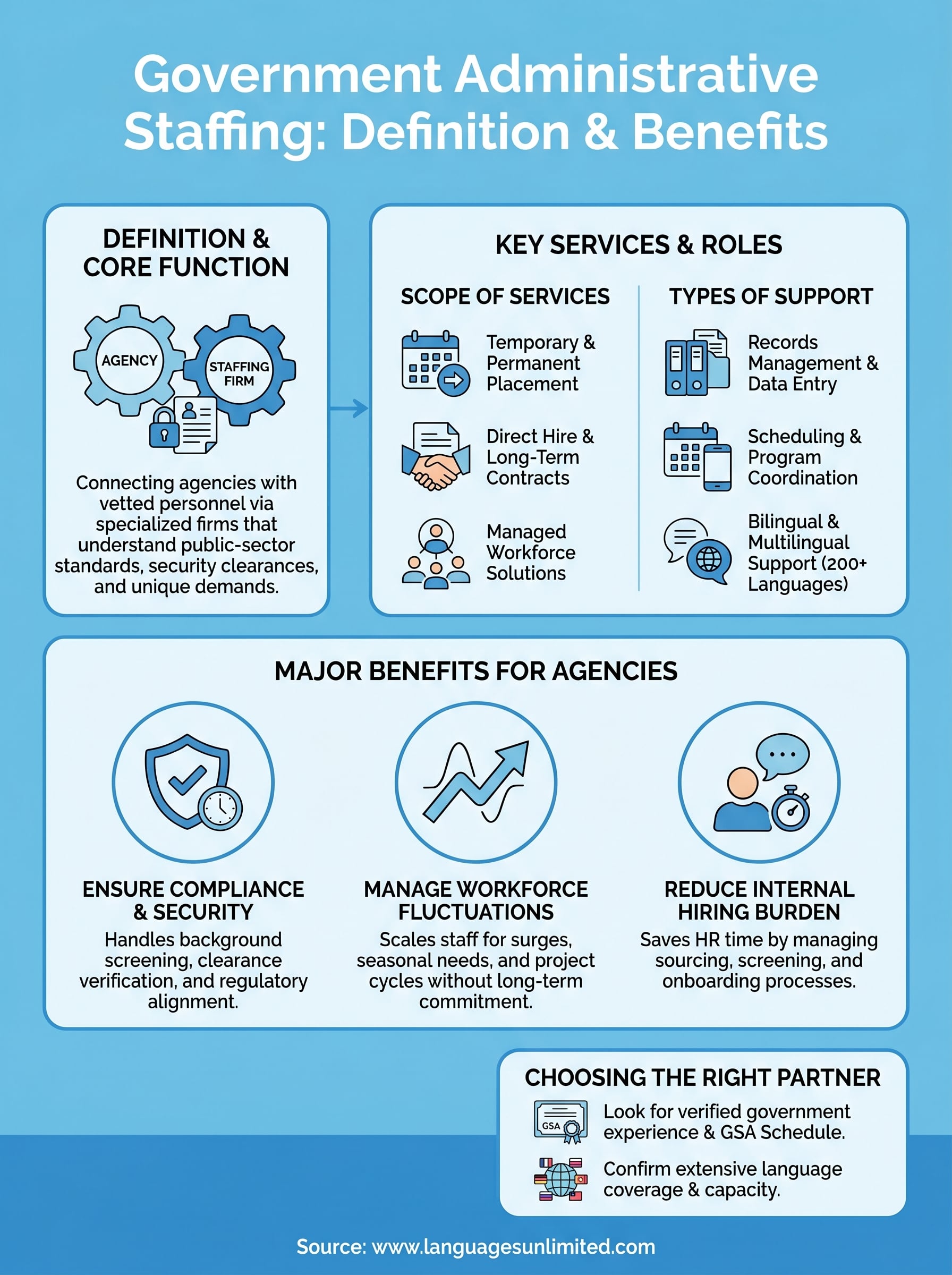
Government administrative staffing covers a broad range of personnel placement and workforce management services designed specifically for public-sector environments. Unlike general commercial staffing, it accounts for the additional layers of compliance, clearance requirements, and qualification standards that government agencies must satisfy before placing someone in even a basic administrative role. A specialized staffing firm handles sourcing, screening, and vetting so your agency can direct its energy toward its core mission rather than the hiring process. That distinction matters because a misplaced hire in a public-sector setting carries real regulatory and operational consequences.
Scope of services
Government administrative staffing firms typically provide both temporary and permanent placement options, depending on your agency’s timeline and operational budget. Temporary placements work well for short-term projects, fiscal-year cycles, or high-volume processing periods, while direct hire and long-term contract placements suit ongoing program needs. Some providers also offer managed workforce solutions where they oversee an entire team of placed personnel, handling scheduling, compliance tracking, and performance oversight on your behalf.

The best staffing partners don’t just fill seats, they deliver candidates who already understand government workplace expectations and public-sector documentation standards.
Types of support covered
Beyond basic placement, a full-service government staffing provider supports your agency across multiple administrative functions, including program coordination, records management, data entry, scheduling, public communications, and general office operations. Many agencies also require bilingual or multilingual administrative staff to serve communities with limited English proficiency, which adds a qualification layer that most general staffing firms simply can’t meet at scale.
Candidate screening and vetting
Placing the right person in a government role requires more than reviewing a resume. Staffing firms with government sector expertise run thorough background checks, verify professional credentials, and confirm any required security clearances before presenting candidates to your agency. For roles involving sensitive data or direct public interaction, this pre-screening and vetting process reduces onboarding risk and keeps your agency aligned with applicable federal and state hiring regulations. Your agency should expect a staffing partner to document every step of that process clearly and transparently.
Why agencies use administrative staffing
Government agencies face hiring pressures that commercial organizations rarely encounter. Budget constraints, rigid hiring timelines, and strict compliance requirements make it difficult to staff up quickly when workloads shift. Government administrative staffing fills that gap by giving agencies access to pre-vetted, qualified professionals without the time and cost of a full internal recruitment cycle.
Agencies that rely on specialized staffing partners consistently reduce time-to-hire while staying aligned with their regulatory hiring frameworks.
Managing workforce fluctuations
Federal and state agencies often experience predictable surges in workload, such as tax season processing, census operations, or end-of-fiscal-year administrative demands. Rather than overextending permanent staff or running costly overtime, agencies use contract placements to scale their workforce up or down based on actual operational need. This approach keeps your agency responsive without adding long-term payroll commitments, and it gives your leadership team more flexibility when program priorities shift unexpectedly.
Reducing internal hiring burden
Recruiting for government roles requires verifying credentials, running background checks, and confirming compliance with federal and state hiring standards. That process takes considerable time your HR team may not have during peak operational periods. A specialized staffing partner manages each step, from sourcing candidates to completing pre-employment screening, so your staff can stay focused on program delivery. When a placement doesn’t work out, your staffing firm can move quickly to find a qualified replacement without restarting the entire process from scratch. That reliability and speed directly protects your agency’s ability to serve the public without interruption.
Common roles and skill requirements
Government administrative staffing covers a wide range of positions, and knowing which roles your agency needs most helps you work more effectively with your staffing partner from day one. The qualifications for these roles go beyond comparable private-sector jobs because public accountability and documentation standards shape every part of the work.
Core administrative positions
Most agencies regularly seek candidates for roles such as program support specialists, records managers, office coordinators, and public-facing intake representatives. Bilingual or multilingual administrative staff are also in consistent demand, particularly at agencies that serve communities with limited English proficiency in languages such as Spanish, Mandarin, Arabic, or Vietnamese. Below are common position categories a qualified staffing partner can fill:
- Program coordination and administrative support
- Records and document management
- Data entry and case processing
- Scheduling and executive support
- Bilingual intake and public-facing roles
Agencies that define their role requirements clearly before engaging a staffing firm consistently receive better-matched candidates in less time.
Skills that set government candidates apart
Strong candidates for government roles typically bring proficiency in federal document management systems, familiarity with records retention policies, and experience working within structured approval processes. Attention to detail matters most in roles that involve processing applications, maintaining compliance records, or supporting audits. Your staffing partner should screen for these competencies directly, not just review general work history.
Candidates who already understand the pace and accountability standards of public-sector work reduce your agency’s onboarding time and help your team stay productive from the first day of placement.
Compliance, security, and accessibility
Government agencies operate under strict regulatory frameworks that affect every hiring decision, and your staffing partner needs to understand those frameworks in detail. A firm with real government sector experience will handle background investigations, clearance verification, and documentation requirements as standard practice, not as exceptions. Working with the wrong partner can expose your agency to compliance gaps that take months to resolve.
Security clearance and background screening
Placing personnel in government roles often requires security clearance verification at various levels, from basic public trust determinations to full suitability investigations depending on the sensitivity of the position. Your staffing firm should confirm which clearance level each role demands before sourcing begins, then present only candidates who already meet or can realistically obtain that standard. This step prevents delays and keeps your agency aligned with federal hiring compliance requirements.
Accessibility and multilingual support
Many government programs carry a legal obligation to serve the public in their preferred language, particularly under Title VI of the Civil Rights Act and Executive Order 13166, which requires agencies receiving federal funding to provide meaningful access for individuals with limited English proficiency. Government administrative staffing that includes bilingual and multilingual candidates directly supports that obligation. Your staffing partner should be able to place professionals fluent in the languages your community needs most, whether that’s Spanish, Arabic, or less commonly spoken languages.

Agencies that source multilingual administrative staff through a single specialized partner reduce coordination complexity and close service gaps faster.
How to choose a government staffing partner
Not every staffing firm is equipped to handle the specific demands of government administrative staffing. Before you commit to a partner, evaluate their track record with public-sector clients, their familiarity with federal compliance standards, and their ability to source multilingual candidates at scale. A firm that primarily serves commercial clients may lack the clearance processing experience and documentation rigor that government work requires.
Choosing a staffing partner with verified government experience from the start saves your agency from costly placement mistakes later.
Credentials and sector experience
Ask every firm you evaluate about their certifications and government contract history. Look for partners that hold a GSA Schedule contract, which signals the firm has already passed federal vendor vetting requirements. You should also confirm that the firm has experience placing personnel in roles similar to yours, whether that means cleared administrative support, bilingual public-facing staff, or program coordination specialists. References from other government clients carry more weight here than general testimonials.
Capacity and language coverage
Your agency’s staffing needs may extend beyond standard administrative roles, especially if you serve communities with limited English proficiency. A qualified partner should maintain a large, active candidate database that covers a wide range of languages and skill sets, so you are not waiting on sourcing when a time-sensitive placement comes up. Confirm that the firm can handle both temporary and long-term placements across multiple locations if your program operates in more than one region. That flexibility directly affects how quickly your agency can respond when workforce needs shift.
Final takeaways
Government administrative staffing gives your agency a practical way to fill qualified roles quickly, stay compliant with federal and state hiring standards, and serve diverse communities without stretching your internal HR team beyond its capacity. The right staffing partner handles background screening, clearance verification, and multilingual candidate sourcing so your agency can focus on program delivery rather than recruitment logistics.
When you evaluate potential partners, prioritize firms with verified government contract experience, a GSA Schedule contract, and the language coverage your community actually needs. Agencies that get these fundamentals right from the start spend less time correcting placement mistakes and more time delivering results.
If your agency needs administrative professionals who meet government compliance standards, including bilingual and multilingual staff across more than 200 languages, Languages Unlimited is ready to support you. Contact our team to discuss your workforce needs and get a staffing solution built around your agency’s requirements.