



Both medical interpreters and medical translators help patients and providers communicate across language barriers, but they do it in fundamentally different ways. If you’re weighing medical interpreter vs translator as a career path, or trying to figure out which service your organization actually needs, understanding the distinction matters more than you might think. Getting it wrong can affect patient safety, compliance, and the quality of care.
One works with the spoken word in real time. The other works with written documents, often behind the scenes. Their training, certifications, daily responsibilities, and earning potential all reflect that core difference. Yet the two roles are frequently confused, even by people who work in healthcare.
At Languages Unlimited, we’ve provided both medical interpretation and translation services since 1994, placing qualified language professionals in hospitals, clinics, and healthcare systems nationwide. That experience gives us a grounded perspective on what separates these two careers, and where they overlap. This article breaks down the roles, pay, certification requirements, and job outlook for each so you can make an informed decision.
Why the interpreter vs translator distinction matters
The difference between these two roles isn’t just technical vocabulary. When a hospital assigns the wrong type of language professional to a task, real problems follow. A medical interpreter handles live, spoken communication, such as a patient explaining symptoms or a physician delivering a diagnosis. A medical translator works with written material, such as discharge instructions, informed consent forms, or clinical trial documentation. Confusing the two means either the wrong person shows up for the job or the wrong type of content gets handled by someone without the right skill set for it.
The risk of mixing up roles in clinical settings
Healthcare organizations face serious legal and ethical obligations when serving patients with limited English proficiency. Under Title VI of the Civil Rights Act, federally funded healthcare providers must offer language access services at no cost to patients. Using an untrained bilingual staff member as an impromptu interpreter, or asking a document translator to handle live patient conversations, puts your organization out of compliance and puts patients at direct risk.
When a patient misunderstands a medication dosage or a care plan because of a language gap, the consequences can be irreversible.
Medical errors linked to communication failures remain a well-documented patient safety issue. The Joint Commission has identified language barriers as a contributing factor in a significant share of adverse events involving patients with limited English proficiency. Knowing which professional you need, and in which situation, is a foundational part of managing that risk and staying compliant with federal language access requirements.
How this distinction affects your hiring and procurement decisions
If you manage language services procurement or oversee clinical operations, the medical interpreter vs translator distinction directly shapes how you staff and source. Interpreters need real-time performance skills, composure under pressure, and the ability to convey emotional nuance in high-stakes conversations. Translators need strong medical writing ability, deep terminology knowledge, and the discipline to verify accuracy across complex documents.
Hiring the wrong profile for either role wastes budget and introduces quality gaps that are hard to catch after the fact. Getting clear on this distinction early lets you set accurate requirements, evaluate candidates properly, and build a language services program that actually protects your patients and your organization.
Medical interpreter role and core skills
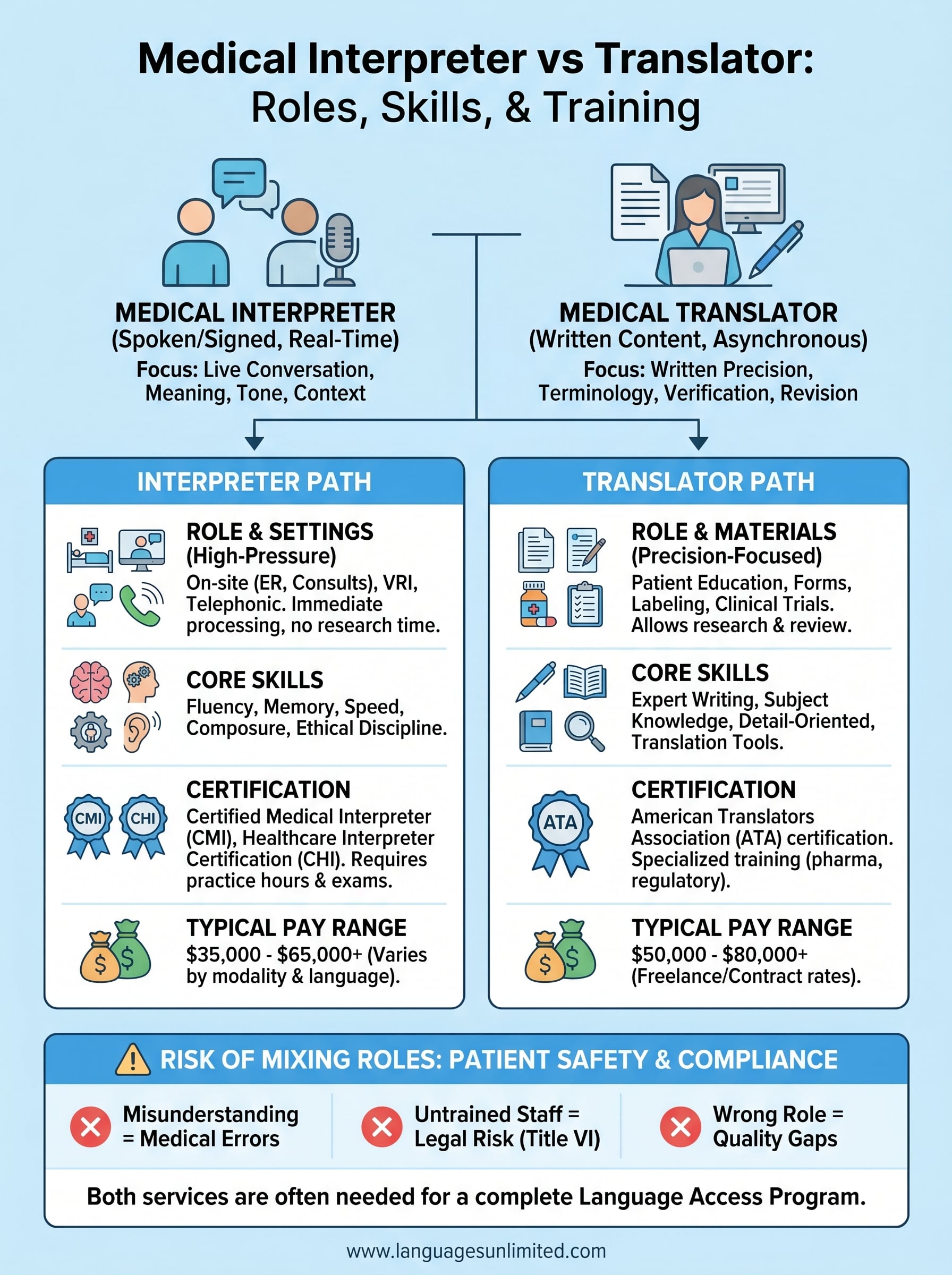
A medical interpreter works in spoken or signed language, converting what a patient, physician, or provider says in real time from one language to another. This is a live performance role. Whether you’re working on-site at a hospital, over the phone, or through a video remote interpreting platform, you handle the conversation as it happens with no opportunity to pause and research. The medical interpreter vs translator comparison starts here: interpreters operate in the moment, under pressure, in high-stakes clinical environments.

What interpreters do in practice
Medical interpreters work across a range of settings, including emergency rooms, surgical consultations, mental health evaluations, and patient intake. Their job is to convey not just words but meaning, tone, and emotional context accurately. A patient expressing fear or confusion needs that communicated precisely, not softened or summarized.
Accuracy in medical interpretation is not a preference. It is a patient safety standard.
Common settings where you’ll find medical interpreters include:
- On-site hospital and clinic appointments
- Video remote interpreting (VRI) sessions
- Telephonic interpretation for urgent or after-hours care
Core skills required
Strong interpreters bring professional-level fluency in both languages and deep medical terminology knowledge. You also need solid memory to manage consecutive mode and the processing speed that simultaneous mode demands.
Ethical discipline matters just as much as language ability. Professional interpreters follow strict codes of conduct that prohibit summarizing, editorializing, or inserting personal opinions. Composure during difficult conversations, such as delivering a serious diagnosis, separates a trained professional from a bilingual staff member filling a gap.
Medical translator role and core skills
A medical translator works exclusively with written content, converting documents from one language to another with a level of precision that clinical and legal review can withstand. Unlike the live performance demands of interpretation, translation work allows time for research, terminology verification, and revision. But that additional time comes with higher accuracy expectations. A translated informed consent form or discharge summary carries legal weight, and errors in that material can harm patients and expose your organization to liability.

What translators handle in practice
Medical translators work on a wide range of written clinical and administrative documents. Common assignments include:
- Patient education materials and discharge instructions
- Pharmaceutical labeling and drug information sheets
- Insurance authorization forms and medical records
- Regulatory submissions and clinical trial documentation
In the medical interpreter vs translator comparison, this is where translators stand apart: their work persists. A patient reads your translated discharge instructions days after leaving the hospital, without any professional present to clarify a mistake.
A single mistranslated dosage instruction in a patient handout can create a medical error that no follow-up call will catch in time.
Core skills required
Strong translators bring expert-level writing ability in the target language alongside deep subject matter knowledge in medicine, pharmacology, or both. You need to understand how clinical terminology maps across languages without producing false equivalents, and you need to spot the gaps where a direct translation would mislead rather than inform. Attention to detail, familiarity with translation memory tools, and the discipline to verify every specialized term are non-negotiable requirements in this role.
Training, certification, and pay in the US
The medical interpreter vs translator career paths diverge significantly when it comes to training requirements and earning potential. Neither role requires a single mandatory national license, but professional certifications are widely recognized by healthcare organizations and often required by employers.
Certification paths for interpreters and translators
For interpreters, two credentials carry the most weight in US healthcare settings. The Certified Medical Interpreter (CMI) credential, offered by the National Board of Certification for Medical Interpreters, and the Healthcare Interpreter Certification (CHI), offered by the Certification Commission for Healthcare Interpreters, are both well-respected and signal a serious commitment to the profession. Most programs require documented hours of practice alongside written and oral exams.
Holding a recognized certification significantly increases your chances of placement with hospitals, health systems, and language service providers.
Translators working in medical contexts benefit from American Translators Association (ATA) certification, which tests translation competency in specific language pairs. You can also pursue specialized medical translation training through university programs or continuing education courses focused on pharmaceutical, clinical, and regulatory content.
What you can expect to earn
Compensation varies based on setting, language pair, modality, and experience level. The table below gives you a general range based on US labor market data.
| Role | Typical Annual Pay Range |
|---|---|
| Medical Interpreter (on-site) | $40,000 to $65,000 |
| Medical Interpreter (remote/telephonic) | $35,000 to $55,000 |
| Medical Translator (freelance/contract) | $50,000 to $80,000+ |
Rare language pairs and specialized subject matter, such as oncology or clinical trials, command higher rates in both fields.
How to choose the right language service
The medical interpreter vs translator decision comes down to one core question: is the communication happening live and verbally, or does it exist as a written document? That single distinction determines which professional you need, how you should budget, and where the liability sits if something goes wrong.
When you need an interpreter
You need an interpreter any time a real-time spoken exchange is involved. Patient consultations, emergency triage conversations, mental health screenings, and discharge discussions all require a live professional who can handle the unpredictable flow of a clinical conversation with accuracy and composure.
If you’re relying on a bilingual staff member to cover these moments, you’re taking on legal and clinical risk that a qualified interpreter eliminates.
Your organization should also plan for multiple service modalities: on-site interpretation for scheduled appointments, video remote interpreting for specialist consultations, and telephonic interpretation for urgent or after-hours situations.
When you need a translator
Written clinical materials require a translator, full stop. If you’re producing patient education handouts, informed consent forms, discharge instructions, or pharmaceutical inserts, you need someone with the writing precision and deep terminology knowledge that translation work demands.
Many healthcare organizations need both services running at the same time. A patient may need an interpreter during their appointment and a translated care plan to take home afterward. Building both capabilities into your language access program from the start prevents costly gaps and keeps your organization compliant with federal language access requirements under Title VI.
Final takeaways
The medical interpreter vs translator distinction is not a matter of preference. It determines which professional you hire, which service you book, and how your organization manages risk and compliance across every patient interaction and written document.
Interpreters handle live spoken communication in real time, under pressure, with no room for error. Translators work with written clinical materials that carry legal weight long after the appointment ends. Both roles require specialized training, recognized certifications, and a deep command of medical terminology in two languages. Treating them as interchangeable creates real gaps in care and puts your organization at legal and clinical risk.
Your language access program needs both capabilities to function properly. Planning for on-site, remote, and telephonic interpretation alongside professional document translation keeps your organization compliant and your patients safe. To discuss which services fit your specific situation, contact the team at Languages Unlimited and get the right professionals in place.