



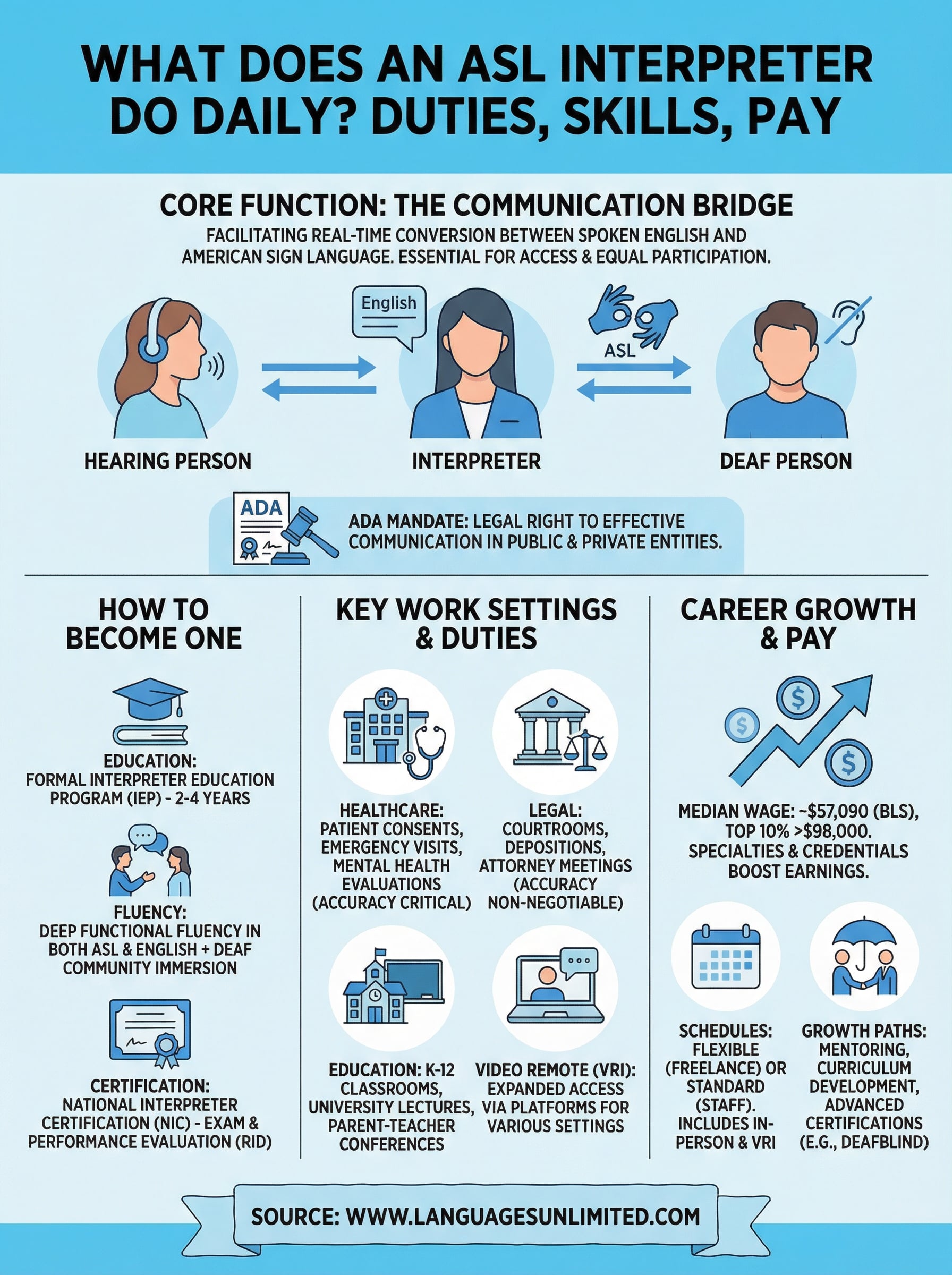
An ASL interpreter acts as the communication bridge between Deaf or hard-of-hearing individuals and hearing people, converting spoken English into American Sign Language, and vice versa, in real time. If you’ve ever wondered what does an ASL interpreter do on a daily basis, the answer goes far beyond simply knowing sign language. These professionals work in hospitals, courtrooms, classrooms, corporate meetings, and dozens of other settings where clear, accurate communication isn’t optional, it’s essential.
At Languages Unlimited, we’ve provided sign language interpretation services since 1994, connecting organizations across all 50 states with qualified ASL interpreters for on-site, video remote, and event-based assignments. That experience has given us a front-row seat to what this career actually looks like, the skills it demands, the environments interpreters work in, and the impact they have every single day.
This article breaks down the core duties, required qualifications, typical work settings, and pay expectations for ASL interpreters. Whether you’re exploring this as a career path or you’re a hiring manager trying to understand what to look for in a qualified interpreter, you’ll walk away with a practical, honest picture of the role. We’ll also cover how the profession is evolving and what sets experienced interpreters apart from the rest.
Why ASL interpreters matter for access
ASL interpreters do more than facilitate conversation. They give Deaf and hard-of-hearing individuals the ability to participate fully in situations where the stakes are often high: medical appointments, legal proceedings, job interviews, and school meetings. When you think about what does an ASL interpreter do at its core, the answer is that they remove a barrier that would otherwise shut millions of people out of essential services and opportunities.
The legal right to communication access
Federal law backs this up directly. The Americans with Disabilities Act (ADA) requires that public entities and private businesses provide effective communication for people who are Deaf or hard-of-hearing. That typically means providing a qualified sign language interpreter when one is needed. Hospitals, courts, schools, and government offices are among the organizations most frequently required to meet this obligation, and failing to do so can result in complaints, lawsuits, and significant civil liability.
When communication access fails, the consequences are not just inconvenient. In medical and legal environments, missing a single detail can change everything.
According to the National Institute on Deafness and Other Communication Disorders, approximately 15% of American adults report some degree of hearing loss, and a significant portion of the Deaf community relies on ASL as their primary language. That is a large population depending on qualified interpreters to access the same services most hearing people take for granted.
What happens without qualified interpretation
When a qualified interpreter is not available, organizations often resort to workarounds that create real risk. A family member stepping in as an informal interpreter in a hospital setting introduces problems with medical accuracy, emotional bias, and privacy. Children interpreting for their Deaf parents puts an unfair burden on them and almost always leads to incomplete or inaccurate communication that affects the entire interaction.
These gaps affect real outcomes. A patient who cannot fully understand their diagnosis may not follow a treatment plan correctly. A Deaf defendant without proper interpretation may not fully grasp the charges brought against them. Accurate, professional interpretation is a safeguard that protects people’s health, legal rights, and equal access to opportunity, not simply a courtesy that organizations can offer when convenient.
Professional ASL interpreters carry both the language skills and the ethical framework to handle these situations correctly. They are trained to maintain confidentiality and remain neutral, conveying meaning accurately even in emotionally charged or technically complex settings. That combination of skill and professional discipline is what separates a qualified interpreter from someone who simply knows some sign language.
How to become an ASL interpreter
Becoming an ASL interpreter takes more than learning signs from an app or a beginner’s course. You need deep, functional fluency in both ASL and English, along with formal training and, in most professional settings, nationally recognized certification. Understanding what does an ASL interpreter do at a professional level makes it clear why the entry bar is high: this is a role where a single error can change the outcome of a medical appointment or a legal proceeding.
Education and language fluency
Most working interpreters complete a formal interpreter education program (IEP), offered at community colleges and universities across the country. These programs typically run two to four years and combine classroom instruction with supervised field practice. Immersing yourself in the Deaf community throughout your training is not optional if you want to build genuine, functional fluency.
Common areas covered in IEP programs include:
- ASL linguistics and grammar structure
- Deaf culture and history
- Interpreting theory and professional ethics
- Supervised field practice with real-world assignments
Certification and professional credentials
The primary credential for ASL interpreters in the United States is the National Interpreter Certification (NIC), offered by the Registry of Interpreters for the Deaf (RID). Earning the NIC requires passing both a written knowledge exam and a performance evaluation where you demonstrate fluency, accuracy, and sound ethical judgment under realistic conditions.
Certification is the floor, not the ceiling. Employers in healthcare and legal settings expect interpreters who maintain current credentials and pursue ongoing professional development.
Some states layer their own licensure requirements on top of national certification. You’ll need to verify the specific rules in your state before accepting professional assignments, particularly in regulated environments like courts or hospitals.
What ASL interpreters do each day
A typical day for an ASL interpreter rarely looks the same twice. Assignments vary widely, and interpreters often move between settings, topics, and communication dynamics within a single week. Understanding what does an ASL interpreter do from a daily operations perspective means looking at three core phases: preparation, active interpretation, and post-assignment wrap-up.
Before the assignment begins
Preparation is not optional for working interpreters. Before any assignment, you review briefing materials, relevant terminology, and the context of the setting you’re entering. A medical interpreter might study diagnosis-related vocabulary ahead of a patient consultation, while a legal interpreter may review case documents beforehand. This pre-work directly affects accuracy and fluency during the live session.
Interpreters who skip preparation are more likely to make errors that have real consequences for the people depending on them.
Connecting with the requesting organization before the assignment is also standard practice. You confirm logistics, clarify any special requirements, and identify whether a team interpreter is needed based on the expected duration. Getting these details right before you walk in the door prevents problems during the session itself.
During live interpretation
Once the assignment begins, your focus is total. You process spoken English and render it in ASL simultaneously or consecutively, while also voicing what the Deaf participant signs for hearing people in the room. You track the pace, tone, and intent of every speaker, not just their literal words, because accurate interpretation depends on understanding what someone means, not only what they say.

Longer assignments require rotating with a team interpreter every 20 to 30 minutes to manage mental fatigue and protect accuracy. After the session ends, you may complete documentation or debrief with your team, especially after emotionally demanding or technically complex assignments.
Where ASL interpreters work
Work settings shape every aspect of an interpreter’s experience, from the vocabulary they need to master to the emotional demands they carry into each assignment. If you’re asking what does an ASL interpreter do across different environments, the short answer is that the role adapts to wherever communication needs to happen, and those locations are far more varied than most people expect.
Healthcare and legal settings
Hospitals and clinics are among the most common settings for ASL interpreters. Patient consultations, surgical consent conversations, mental health evaluations, and emergency room visits all require accurate interpretation where missing a word or phrase can directly affect someone’s health. Interpreters in these settings must handle sensitive medical terminology while staying composed during emotionally charged interactions.
Legal environments carry the same weight. In courtrooms, depositions, and attorney-client meetings, every interpreted word is part of the official record, and accuracy is non-negotiable.
Schools, corporations, and beyond
Educational settings represent another major employment area. Classrooms, parent-teacher conferences, and college lecture halls all rely on ASL interpreters to give Deaf and hard-of-hearing students equal access to instruction and campus life. K-12 schools and universities employ both staff interpreters and contract professionals depending on their caseload and budget.

Corporate environments are growing as employers prioritize workplace accessibility and inclusion. You might work in a conference room, on a video remote interpreting platform, or at a company-wide event. Government agencies, community organizations, religious institutions, and entertainment venues round out the list. Video remote interpreting (VRI) has expanded the geography of available work significantly, allowing interpreters to serve clients in locations that would otherwise have no local coverage, without leaving their home office.
Pay, schedules, and career growth
Pay and scheduling both vary depending on your work setting, credentials, and experience level. Understanding what does an ASL interpreter do in terms of career trajectory helps you see this as a long-term profession with real room to advance, not just an entry-level gig.
What ASL interpreters earn
According to the U.S. Bureau of Labor Statistics, the median annual wage for interpreters and translators was $57,090 as of recent data, with the top 10% earning over $98,000. ASL interpreters who hold RID certification and specialize in high-demand settings like legal or medical environments consistently land at the higher end of that range.
Specialty certifications in legal or healthcare interpreting can meaningfully increase your earning potential compared to general assignments.
Freelance interpreters often charge hourly or half-day rates, with many experienced professionals billing $50 to $100 or more per hour depending on the assignment complexity and their credentials.
Schedules and work arrangements
Your schedule depends heavily on whether you work staff or freelance. Staff interpreters at schools, hospitals, or government agencies typically follow a standard workweek. Freelancers build their own calendars, which offers flexibility but also means managing inconsistent income and gaps between assignments.
Video remote interpreting has made fully remote work a realistic option. Many interpreters now split their time between in-person assignments and VRI platform work, which broadens your client base without requiring additional travel.
Career growth paths
Experienced interpreters often move into mentoring, curriculum development, or program management roles within interpreter education programs or language services organizations. Others pursue advanced RID certifications or specialize further in fields like DeafBlind interpreting. Building a strong professional network within the Deaf community remains one of the most reliable ways to access higher-profile and higher-paying opportunities as your career progresses.
Conclusion
ASL interpreters carry serious responsibility every time they take an assignment. From understanding what does an ASL interpreter do across settings like hospitals and courtrooms to recognizing the career path, certifications, and pay involved, you now have a complete picture of this profession. Accurate, ethical interpretation is what makes equal access real for millions of Deaf and hard-of-hearing individuals across the country.
Your organization has a legal and practical obligation to provide qualified communication access when Deaf or hard-of-hearing individuals need to participate. Working with a credentialed, experienced interpreter rather than an untrained substitute protects everyone involved and leads to better outcomes. Languages Unlimited has been placing certified ASL interpreters nationwide since 1994, and our team is ready to match you with the right professional for your specific situation. Contact us to discuss your sign language interpretation needs and get the right coverage in place.