



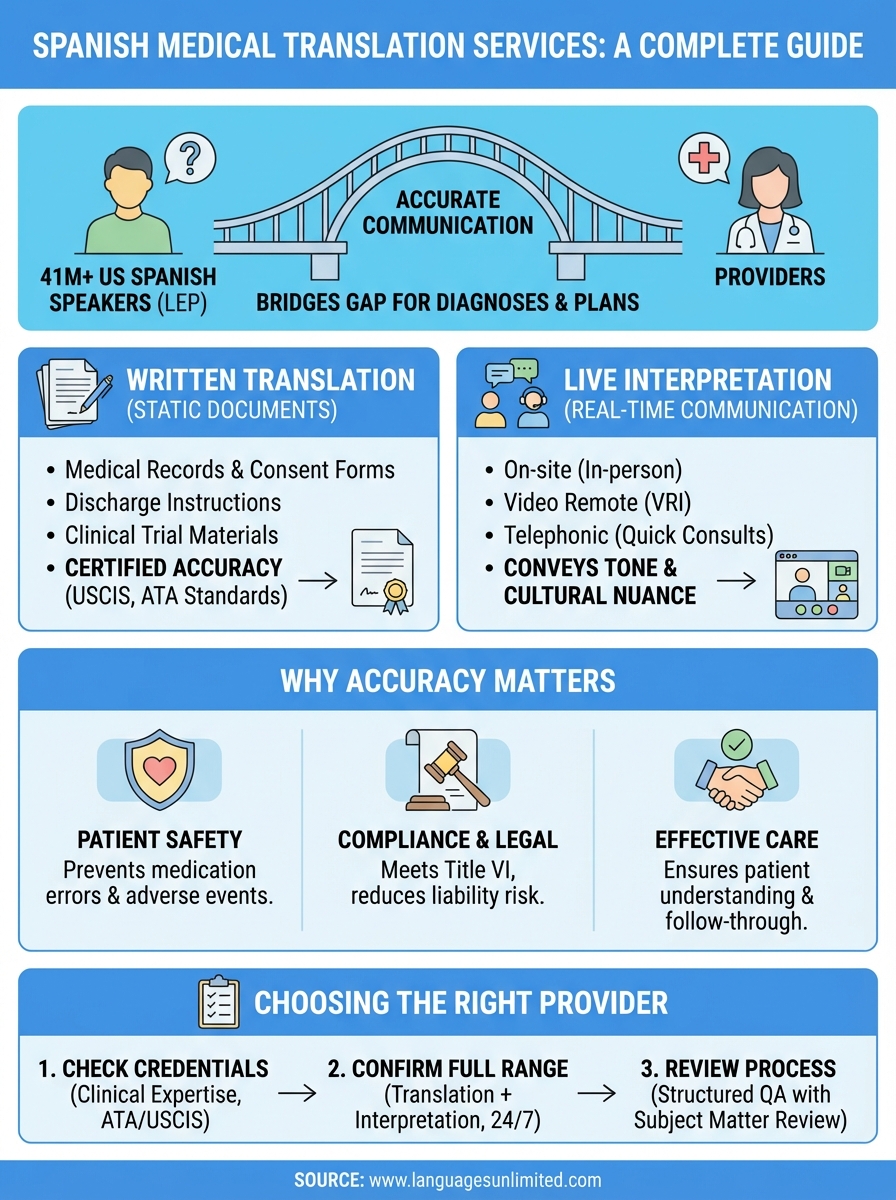
More than 41 million people in the United States speak Spanish as their first language, and a significant number of them have limited English proficiency. When these individuals seek medical care, the accuracy of communication isn’t just important, it’s critical. That’s exactly where Spanish medical translation services come in, bridging the gap between patients and providers so that diagnoses, treatment plans, and medical histories are understood correctly on both sides.
A mistranslated medication dosage, a misunderstood allergy, or an unclear surgical consent form can have serious, sometimes life-threatening, consequences. Healthcare organizations need more than bilingual staff or general-purpose translators; they need certified professionals who understand medical terminology and the regulatory requirements that govern patient communication in clinical settings.
At Languages Unlimited, we’ve provided medical translation and interpretation services since 1994, supporting hospitals, clinics, and healthcare systems across all 50 states with a network of over ten thousand language professionals. This guide breaks down what Spanish medical translation services include, why certification matters, how to choose a qualified provider, and what to expect from the process, whether you need translated medical records or real-time interpretation during patient encounters.
What Spanish medical translation services include
Spanish medical translation services cover a broad range of tasks, from converting written documents to providing real-time language support during patient encounters. Understanding the full scope helps you identify exactly which services your organization needs and ensures you work with a provider who can handle each type with the right level of clinical and regulatory expertise.
Document translation
Document translation focuses on converting written medical content from English to Spanish or Spanish to English with complete accuracy. Common examples include patient intake forms, discharge instructions, clinical trial materials, medical records, and informed consent documents. For immigration or legal purposes, you may also need certified translations that meet USCIS standards, meaning the translator formally attests to the accuracy and completeness of the translated document.
Certified medical translations carry legal weight, so working with a provider that meets both USCIS and ATA standards protects your organization and your patients.
Providers who specialize in this work assign translators with backgrounds in medicine or clinical documentation, not generalists, because a single terminology error in a surgical consent form or medication guide can create serious patient safety and liability risks.
Real-time interpretation
Real-time interpretation supports live communication between Spanish-speaking patients and English-speaking providers. Your team can access this through on-site interpreters who are physically present during appointments or procedures, video remote interpreting (VRI) for telehealth or urgent situations, and telephonic interpretation for quick consultations when no interpreter is available on location. Each format serves a different clinical context, and experienced providers match the right delivery method to your setting.
Effective interpretation goes beyond translating words. Interpreters in medical settings must convey tone, urgency, and cultural nuance accurately, all of which directly affect how patients understand their care and follow through on treatment.
Why accurate Spanish medical language matters
Medical language is precise by design. Terms like "hypertension," "contraindicated," or "NPO" carry specific clinical meanings, and a single mistranslation can shift that meaning in ways that directly affect care decisions. When you work with Spanish-speaking patients, the accuracy of your language support carries the same weight as any clinical decision your team makes.
Patient safety depends on precision
A medication name, dosage, or allergy warning that gets translated incorrectly can lead to adverse events before anyone realizes an error occurred. Spanish medical translation services built for healthcare assign linguists who understand clinical terminology and context, not just vocabulary.
Patients rely on translated instructions to take medication correctly, recognize warning signs, and follow through on post-visit care. When that content is inaccurate, patients can’t do any of those things reliably, regardless of how strong the clinical care itself was.
Compliance and liability require accuracy
Healthcare organizations must meet Title VI of the Civil Rights Act requirements, which mandate meaningful access to care for patients with limited English proficiency. Inaccurate translations create legal exposure and can trigger compliance violations that carry significant financial consequences.
The Joint Commission identifies communication failures as a leading root cause of serious adverse events in hospitals.
Translation vs interpreting in healthcare
Many healthcare teams use "translation" and "interpretation" interchangeably, but these are two distinct services that address different communication needs. Understanding the difference helps you request the right support and ensures your patients receive care that meets their language needs accurately.
Translation: written content
Translation applies to static, written materials such as discharge summaries, consent forms, medical records, and patient education handouts. A qualified translator works from a source document and produces an accurate written version in the target language. When you use Spanish medical translation services for written content, you need linguists with clinical knowledge who can handle terminology with precision.
Interpretation: live communication
Interpretation covers real-time verbal or signed exchanges between a patient and a provider. This happens during appointments, procedures, emergency encounters, and follow-up consultations. Interpreters must process complex clinical language quickly and convey meaning without altering tone or urgency. On-site, video remote, and telephonic formats all fall under this category depending on your clinical setting.
Choosing the wrong service type for the situation, such as handing a patient a translated document when they need a live interpreter, can undermine care quality even when the language itself is accurate.
How to choose a Spanish medical language provider
Not every language company is equipped to handle clinical content or real-time medical encounters. When evaluating Spanish medical translation services, you need to apply the same rigor you would to any clinical vendor relationship.
Check credentials and clinical expertise
Your provider should hold recognized certifications such as ATA membership and USCIS approval for certified translations. Look for translators and interpreters who have verifiable medical backgrounds or specialized clinical training, not generalists who treat medical as one category among many others. Ask directly how they screen their linguists for healthcare work and what quality assurance steps they follow before delivering translated documents.
A provider that can’t clearly explain its vetting process is a provider you should not trust with patient-facing content.
Confirm service range and turnaround
Working with a single provider that covers both document translation and real-time interpretation saves time and reduces overhead for your team. Confirm the provider can handle your specific language pair, specialty area, and volume requirements without outsourcing to unknown subcontractors.
Response time and after-hours availability, especially for urgent clinical situations, should also factor into your decision. Ask about turnaround guarantees and coverage commitments before you sign any agreement.
How a medical translation project works
Understanding the workflow helps you plan timelines and set internal expectations before you submit materials. Most Spanish medical translation services follow a structured process that keeps your project on track and your patient-facing content accurate from start to finish.
Submitting your materials
You start by sending your source documents and specifying the target language, document type, and intended use. If you need certified translations for compliance or legal purposes, flag that upfront so the right credentials are attached. Your provider will review scope, confirm turnaround time, and assign a linguist with the appropriate clinical background for your content type.
Review and delivery
Once the translator completes the draft, a qualified reviewer checks it against the source for accuracy, terminology consistency, and formatting. Clinical documents go through an additional layer of subject matter review before delivery, especially for high-stakes materials like consent forms or medication guides.
Skipping the review stage to save time is a common mistake that increases the risk of terminology errors reaching patients.
Your final deliverable arrives in the format your team needs, whether that is a print-ready PDF or an editable file, ready to use in your clinical workflow.
Next steps for healthcare teams
If your organization serves Spanish-speaking patients, the time to put a reliable language solution in place is before you need it urgently. Spanish medical translation services work best when your team has already vetted a provider, established a workflow, and confirmed coverage for both written documents and real-time interpretation needs.
Start by auditing your current language support. Identify the gaps where patient-facing content lacks accurate Spanish translations, and flag the clinical scenarios where live interpretation access is inconsistent or delayed. Then look for a provider with verified clinical expertise, ATA membership, and USCIS approval who can cover both sides of your language needs under one relationship.
Languages Unlimited has supported healthcare teams across all 50 states since 1994 with a network of over ten thousand language professionals. Contact our team to discuss your specific needs and get your language program in place.