



A contract negotiation with overseas partners. A medical consultation with a non-English-speaking patient. A legal proceeding requiring immediate ASL support. These moments can’t wait for a translator to be scheduled days in advance. On-demand interpretation solves this problem by connecting you with qualified interpreters within minutes, not hours or days.
Whether you need phone-based interpretation for a quick call or video remote interpreting (VRI) for face-to-face communication, on-demand services provide real-time language access when timing matters most. This flexibility has made it essential for healthcare facilities, law firms, government agencies, and businesses operating across language barriers, situations where miscommunication carries real consequences.
At Languages Unlimited, we’ve provided interpretation services since 1994, building a network of over ten thousand language professionals covering hundreds of languages and dialects, including ASL. This article breaks down exactly how on-demand interpretation works, the differences between phone and video options, and how to determine which format fits your specific needs.
What on-demand interpretation is and is not
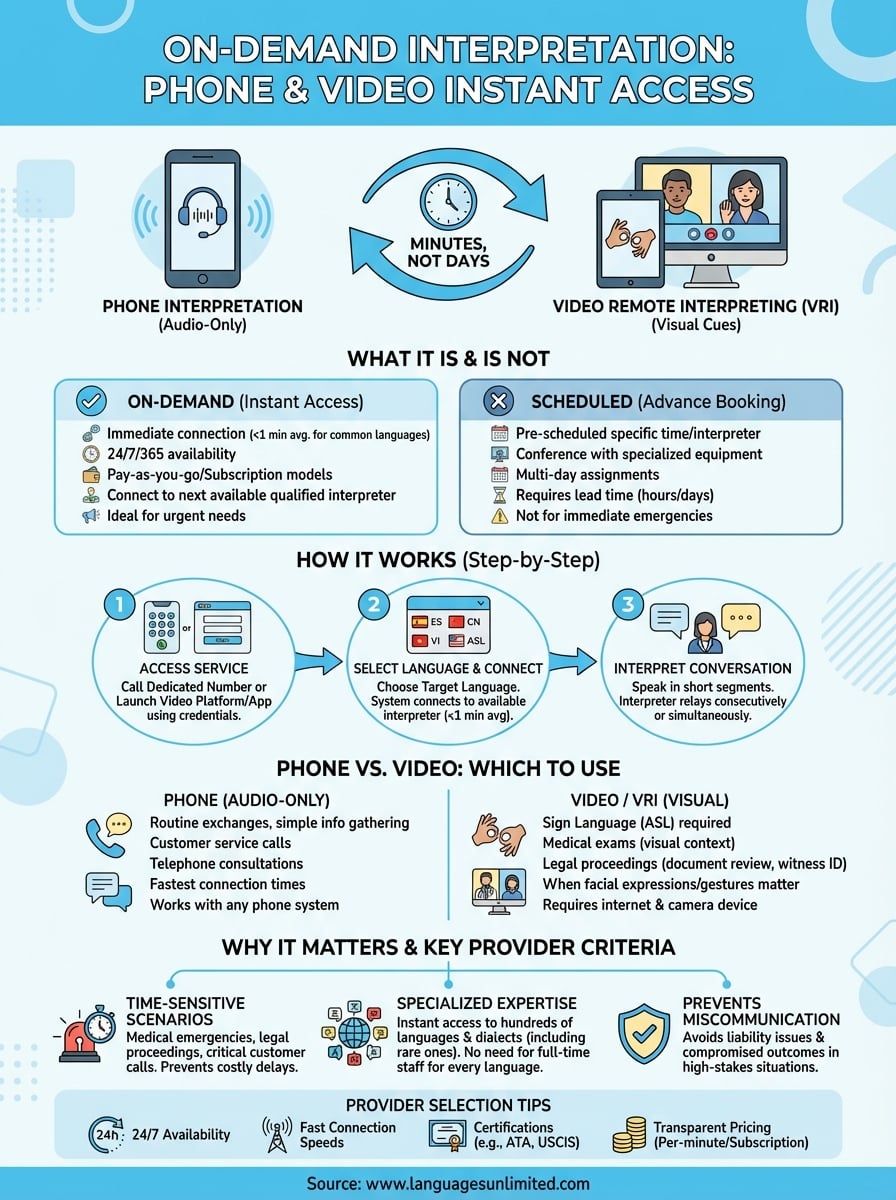
On-demand interpretation connects you with a qualified interpreter within minutes through phone or video, without requiring advance scheduling or booking. You call a service number or launch a video platform, select your target language, and an interpreter joins your conversation immediately or within seconds. This service operates 24/7/365, making it accessible whenever language barriers emerge, whether during business hours or at 3 a.m. The key distinction lies in immediate availability, not days or weeks of lead time.
What qualifies as on-demand
Your interpretation request qualifies as on-demand when you need instant access without pre-scheduling. Phone interpretation typically connects you with an interpreter in under one minute for common languages like Spanish, Mandarin, or Vietnamese. Video remote interpreting (VRI) connects you through a tablet, computer, or smartphone, allowing visual communication essential for sign language or medical examinations where facial expressions and gestures matter. Both formats rely on pay-as-you-go or subscription models rather than hourly bookings, and you connect with the next available interpreter from a pool rather than requesting specific individuals.
True on-demand services provide immediate access without requiring you to schedule interpreters hours or days ahead of time.
What falls outside on-demand
Pre-scheduled interpretation appointments don’t fit the on-demand model, even if booked the same day. If you reserve a specific interpreter for a set time, you’re using traditional scheduled services. Similarly, conference interpretation with specialized equipment or multi-day assignments requiring consecutive or simultaneous interpretation setups exceed on-demand scope. These situations need interpreters who prepare in advance, review specialized terminology or documents, and coordinate with venue teams, something instant phone or video connections can’t accommodate.
Why on-demand phone and video interpreting matters
Your hospital admits a patient who speaks Hmong at 2 a.m. Your legal team discovers a witness only communicates in Brazilian Portuguese minutes before a deposition. Your customer service center receives calls in over twenty languages daily. These situations require immediate interpretation, and on-demand phone and video interpreting provides instant language access without the delays of scheduled appointments or the limitations of bilingual staff availability.
Time-sensitive scenarios that can’t wait
Medical emergencies, legal proceedings, and customer interactions operate on strict timelines where miscommunication creates serious consequences. A misunderstood medication instruction in an emergency room or an incorrectly translated legal statement can lead to liability issues and compromised outcomes. On-demand interpretation eliminates the bottleneck of scheduling interpreters days ahead, giving you immediate access to qualified professionals when seconds count.
Immediate language access prevents costly delays and ensures accurate communication during time-critical situations.
Access to specialized language expertise
You gain instant connections to interpreters covering hundreds of languages and dialects, including rare languages that traditional staffing can’t accommodate. Your organization avoids the expense of maintaining full-time bilingual staff for every possible language while still meeting accessibility requirements and compliance standards when needed.
How on-demand interpreting works step by step
On-demand interpretation follows a straightforward process that takes you from initial contact to completed conversation within minutes. Understanding each step helps you prepare your team and ensures smooth communication when language barriers arise. The workflow remains consistent whether you choose phone or video, with minor variations in platform access.
Accessing the service
You begin by calling a dedicated phone number for phone interpretation or launching a video app or web portal for VRI. Most providers give you unique access credentials, account numbers, or client codes that route your request to your organization’s specific settings and billing. Your team simply keeps these credentials accessible at reception desks, in patient rooms, or on mobile devices.
Selecting language and connecting
After accessing the service, you select your target language from a menu or tell the system which language you need. The platform immediately searches for available interpreters in your chosen language. Connection times average under one minute for common languages and may take slightly longer for rare dialects. Once connected, the interpreter confirms the language, introduces themselves, and asks how they can assist.
The entire process from initial access to connected interpreter typically completes in under two minutes for common languages.
Conducting your interpreted conversation
You speak directly to the other party in short, clear segments, allowing the interpreter to relay your message accurately. The interpreter works in consecutive mode, translating after each person speaks, or in simultaneous mode for some video platforms where they speak over the original audio.
Phone vs video vs VRI: which one to use
Your choice between phone and video interpreting depends on whether visual communication adds value to your interaction. Phone interpretation handles most routine exchanges efficiently, while video remote interpreting (VRI) becomes essential when facial expressions, gestures, or visual elements matter to accurate understanding. Both formats offer the same instant availability that defines on-demand interpretation.
Phone interpretation for audio-only needs
You should use phone interpretation for straightforward verbal exchanges where visual cues aren’t necessary. Customer service calls, basic information gathering, telephone consultations, and simple explanations work perfectly through audio-only connections. Phone interpretation typically provides the fastest connection times and works with any phone system without requiring special equipment or internet bandwidth. Your staff can initiate calls from desk phones, mobile devices, or landlines, making it accessible across your entire organization without technical barriers.
Video interpreting when visual matters
Video and VRI become necessary when communication relies on seeing the speakers. Sign language interpretation requires video connections to display hand movements and facial expressions. Medical examinations where doctors need to observe patient reactions or point to body parts benefit from visual context. Legal proceedings involving document review or witness identification gain clarity through video. These scenarios justify the slightly longer connection times and equipment requirements that video platforms demand.
Choose video interpretation whenever visual communication prevents misunderstandings or enhances accuracy beyond what audio alone provides.
How to choose a provider and set it up
Selecting the right on-demand interpretation provider requires evaluating language coverage, connection speed, and pricing structure against your organization’s actual needs. You need a provider who offers 24/7 availability in your required languages while maintaining consistent interpretation quality across all time zones. Setup typically takes under one week from initial contact to full deployment.
Key selection criteria
You should verify the provider covers your specific languages and dialects, not just major languages. Ask about average connection times and whether they guarantee interpreters for rare languages within specific timeframes. Check if they hold relevant certifications like ATA membership or USCIS approval when handling legal or immigration-related interpretation. Review their pricing model to determine if per-minute billing or monthly subscriptions align better with your usage patterns.
Focus on providers who demonstrate proven expertise in your industry and offer transparent pricing without hidden connection fees.
Setting up your account
Your provider assigns unique access credentials and phone numbers specific to your organization. They configure language preferences, billing details, and any specialized terminology or industry requirements your team needs. Most providers offer training sessions to walk your staff through the connection process and best practices for working with interpreters effectively.
Key takeaways and next steps
On-demand interpretation gives you immediate language access through phone or video connections, eliminating scheduling delays when communication can’t wait. You choose phone interpretation for audio-only conversations and video or VRI when visual communication adds clarity and prevents misunderstandings. Connection times average under one minute for common languages, and services operate 24/7/365 to handle emergencies, legal proceedings, customer interactions, or business needs at any hour.
Your next step involves evaluating your organization’s language requirements and usage patterns to determine which format fits your specific operations best. Consider whether you need rare language support, how frequently interpretation requests occur throughout your day, and whether visual communication matters for your typical scenarios. Contact our team to discuss your needs and get your on-demand interpretation service configured with access to over ten thousand qualified interpreters covering hundreds of languages and dialects.