



A patient arrives at the emergency room unable to describe their symptoms in English. A specialist needs to discuss a complex diagnosis with a family whose first language is Mandarin. These situations happen daily across American healthcare facilities, and the solution often comes down to one essential resource: a medical phone interpreter.
Over-the-phone interpretation connects healthcare providers with qualified linguists within seconds, making it possible to deliver accurate, compliant care regardless of language barriers. For hospitals, clinics, and private practices, this service isn’t just convenient, it’s often legally required under federal civil rights laws.
This guide explains how medical phone interpreting works, when to use it, and what to look for in a provider. At Languages Unlimited, we’ve supported healthcare organizations with telephonic interpretation since 1994, covering hundreds of languages through our network of over ten thousand professionals. Here’s what you need to know to get started.
What a medical phone interpreter does
A medical phone interpreter serves as the linguistic bridge between healthcare providers and patients who don’t share a common language. When you dial into an interpretation service, you reach a trained professional who facilitates communication in real time, translating spoken words accurately while preserving medical terminology and cultural context.
Core responsibilities during a call
The interpreter’s primary job is to convert everything said by both parties without adding, omitting, or altering information. You’ll hear them relay symptoms, diagnoses, treatment plans, and questions in both directions, maintaining the same tone and intent as the original speaker. They handle technical medical vocabulary, idiomatic expressions, and even emotional nuances that matter in patient care.

Beyond word-for-word translation, these interpreters follow strict protocols. They maintain patient confidentiality under HIPAA regulations, disclose any potential conflicts of interest, and clarify cultural references that might cause confusion. If a medical term has no direct equivalent in the target language, they explain the concept rather than leave gaps in understanding.
Medical phone interpreters translate not just words but meaning, ensuring both provider and patient truly understand each other.
What they don’t do
Your interpreter won’t offer medical advice, advocate for either party, or make decisions on anyone’s behalf. They stay neutral and accurate, functioning purely as a communication tool. This distinction matters because it keeps the provider-patient relationship intact while removing the language barrier that would otherwise prevent effective care.
Why phone interpreting matters in healthcare
You face real consequences when language barriers prevent accurate communication with patients. Misunderstood symptoms lead to wrong diagnoses, incorrect medication instructions cause adverse events, and patients who can’t communicate effectively avoid seeking care altogether. A medical phone interpreter solves these problems immediately, giving you access to qualified linguists who make accurate care possible regardless of what language your patient speaks.
Legal requirements you must meet
Federal law requires healthcare facilities that receive federal funding to provide language assistance services to patients with limited English proficiency. Title VI of the Civil Rights Act makes this mandatory, not optional. You risk compliance violations and penalties if you rely on family members, bilingual staff members without proper training, or translation apps instead of professional interpreters. Phone interpreting gives you a defensible solution that meets these legal standards while protecting both your organization and your patients.
Professional phone interpretation isn’t just good practice, it’s a legal obligation for most healthcare providers.
Impact on care quality
Research shows that professional interpretation improves clinical outcomes and patient satisfaction scores. When patients understand their diagnosis and treatment plan, they follow medical advice more consistently and report fewer preventable complications. You also reduce the length of hospital stays and emergency room visits when clear communication happens from the first interaction.
How over-the-phone medical interpreting works
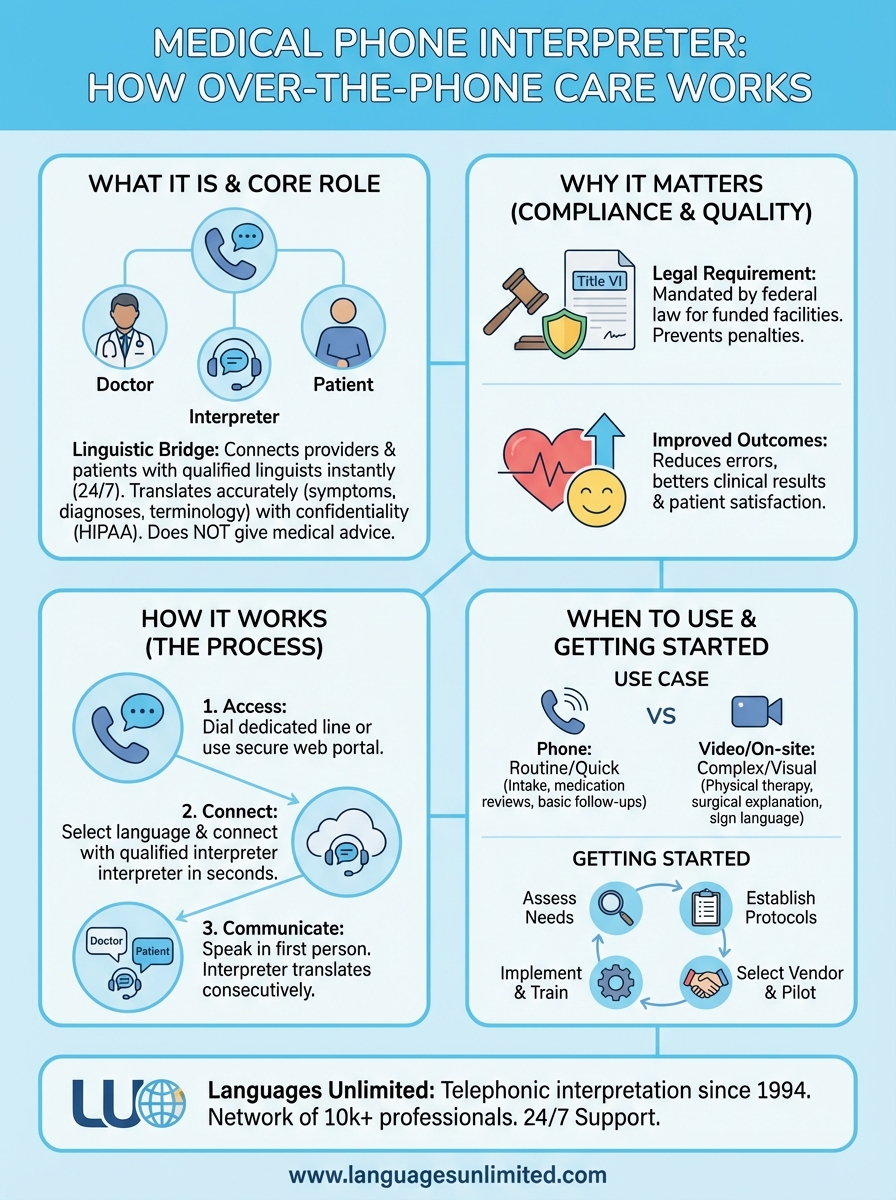
The process starts when you dial a dedicated phone line or access your provider’s service through a secure web portal. You’ll enter a unique facility code, select the language you need, and connect with a qualified medical phone interpreter within seconds. Most services operate 24/7, giving you access to linguists across hundreds of languages whenever an urgent situation arises.
The live call connection
Once connected, you introduce yourself and the patient to the interpreter, then speak directly to your patient as you normally would. The interpreter translates your words in first person ("I need to examine your abdomen" rather than "The doctor says he needs to examine your abdomen"), which keeps the conversation natural and maintains your direct relationship with the patient. You pause after each complete thought, giving the interpreter time to render your message accurately.
Over-the-phone interpretation happens in real time, with interpreters working in consecutive mode to maintain accuracy.
Your interpreter handles both sides of the conversation, switching between languages as each person speaks. This consecutive interpreting approach ensures nothing gets lost or misunderstood. You control the pace of the call, and you can ask the interpreter to clarify terminology or slow down if needed.
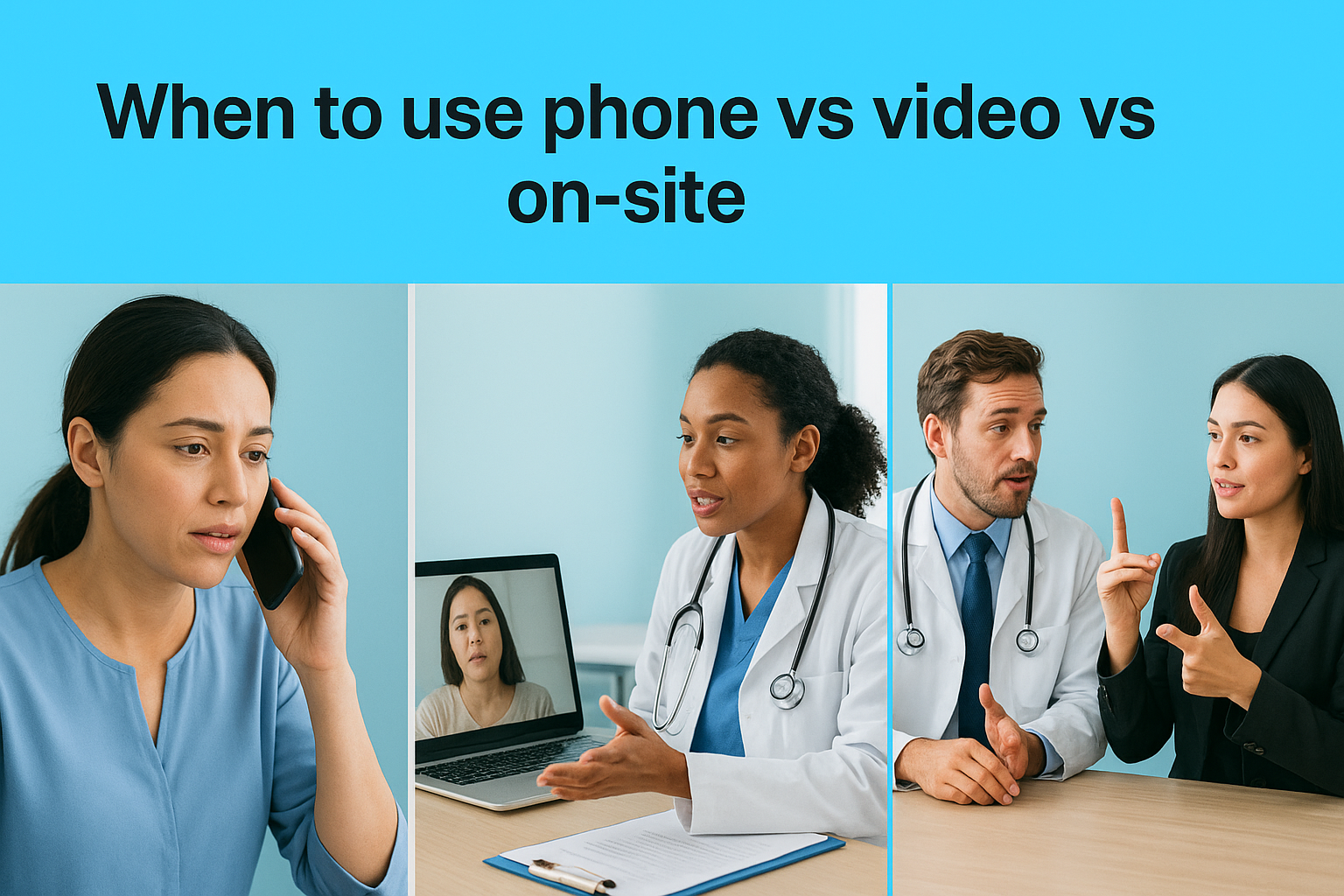
When to use phone vs video vs on-site
You choose your interpreting method based on clinical complexity, visual needs, and availability constraints. Each approach serves specific situations better than the others, and understanding these distinctions helps you deliver faster, more effective care while managing your facility’s budget.
Quick consultations and routine visits
Phone interpretation works best for straightforward appointments where visual cues aren’t critical. You’ll use it during intake interviews, medication reviews, follow-up calls, and basic symptom assessments where the conversation centers on verbal information. A medical phone interpreter connects within seconds and costs less than video or on-site options, making it ideal for high-volume settings like emergency departments and urgent care clinics.
Phone interpreting gives you immediate access to hundreds of languages without the scheduling delays of on-site services.
Complex visual procedures
Video interpreting becomes necessary when you need to demonstrate physical therapy exercises, explain surgical diagrams, or interpret sign language. You’ll also choose video when facial expressions and body language matter for accurate diagnosis. On-site interpreters serve extended procedures like surgeries, labor and delivery, psychiatric evaluations, and complex family meetings where multiple people participate. The higher cost justifies itself when physical presence improves communication quality and patient safety outcomes.
How to set up a phone interpreting program
You start by assessing your current language demands and identifying gaps in your existing services. Look at patient demographics, track how often staff members request interpreters, and review any incidents where language barriers caused delays or complications. This data tells you which languages you need most frequently and helps you build your business case for a formal program.
Establish clear protocols
Your staff needs written procedures that explain exactly when to call for a medical phone interpreter, how to access the service, and what information to provide. Create simple job aids that list the dial-in number, facility code, and step-by-step instructions for different scenarios. Train your front-desk staff, nurses, and physicians on these protocols during orientation and through regular refresher sessions, emphasizing that family members and untrained bilingual staff shouldn’t serve as interpreters for clinical conversations.
Documented protocols ensure every staff member knows how to access interpretation services immediately when needed.
Select a vendor and implement the service
Compare providers based on language coverage, interpreter qualifications, average connection time, and pricing models. Request references from similar healthcare facilities and verify that interpreters hold relevant certifications. Once you choose a vendor, conduct a pilot program in one department before rolling out facility-wide, gathering feedback to refine your approach.
A simple way to get started
You don’t need a complex implementation plan to begin using medical phone interpreter services today. Start by contacting a qualified provider who can walk you through the setup process, answer your specific questions about compliance requirements, and help you understand the costs involved based on your facility’s needs. Most providers offer trial periods or demo accounts that let your staff test the service before you commit to a long-term contract.
Languages Unlimited has provided telephonic interpretation to healthcare facilities since 1994, with access to over ten thousand qualified interpreters covering hundreds of languages. Our team handles the technical setup, trains your staff on best practices, and provides 24/7 support when you need assistance during implementation. Contact us to discuss your facility’s specific requirements and receive a customized quote based on your patient demographics and expected call volume. We’ll help you build a program that meets federal compliance standards while improving patient care outcomes.