



A misinterpreted medication dosage. A patient who doesn’t understand their diagnosis. A family left confused about a surgical consent form. In medical settings, the stakes of miscommunication aren’t abstract, they’re life-altering. That’s exactly why the medical interpreter code of ethics exists: to establish clear boundaries and professional standards that protect both patients and providers during every interpreted encounter. These ethical guidelines aren’t suggestions. They’re the foundation that separates trained medical interpreters from anyone who simply speaks two languages.
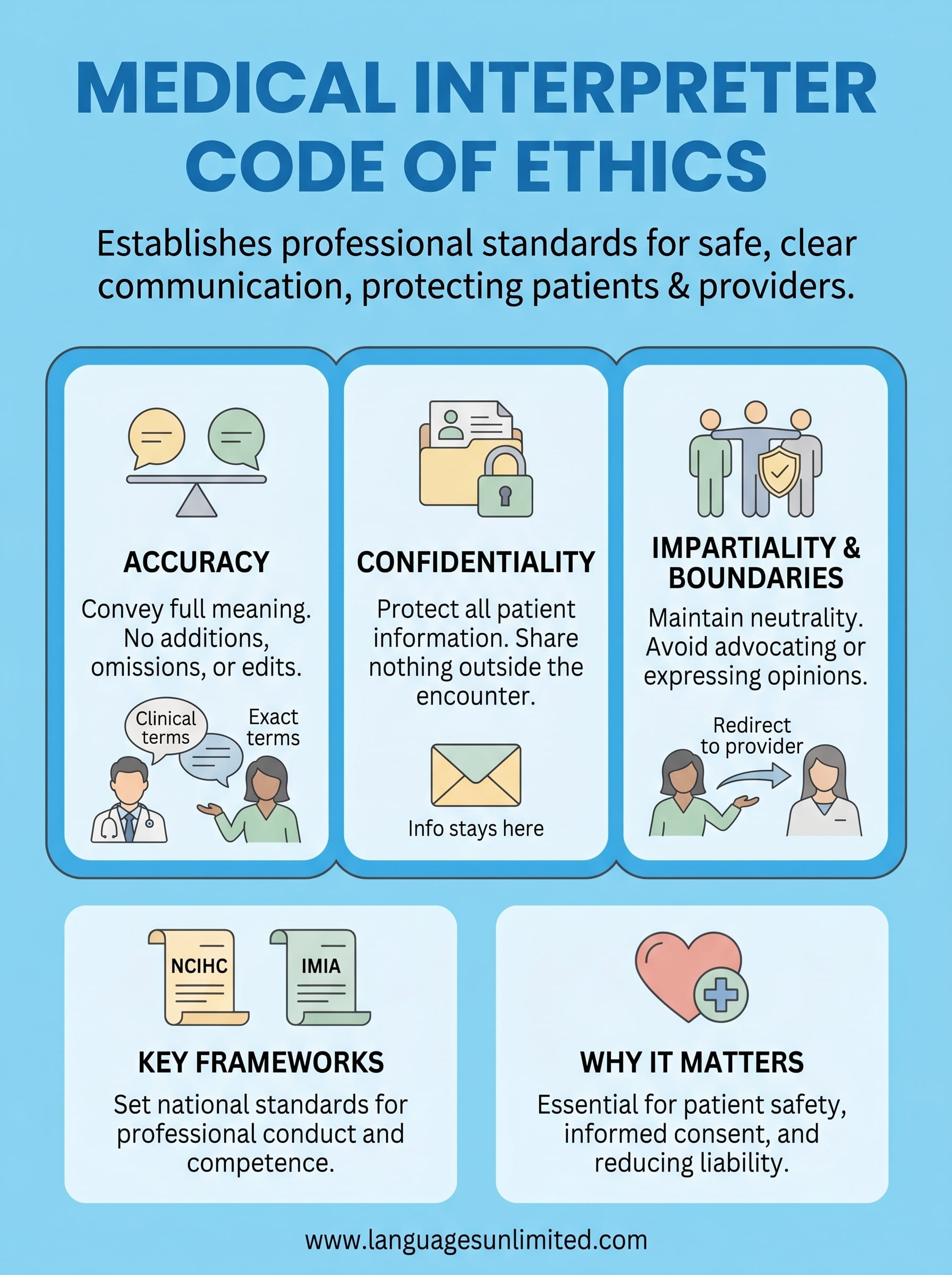
Organizations like the National Council on Interpreting in Health Care (NCIHC) and the International Medical Interpreters Association (IMIA) have published formal codes that outline principles such as accuracy, confidentiality, impartiality, and professional boundaries. Understanding these principles matters whether you’re an interpreter, a healthcare administrator, or an organization coordinating language access. At Languages Unlimited, we’ve provided professional interpretation services since 1994, working with hospitals, clinics, and healthcare systems nationwide, so we know firsthand how critical ethical compliance is in clinical environments.
This article breaks down the core ethical principles that govern medical interpreting, explains where they come from, and shows how they apply in real-world healthcare scenarios.
What the medical interpreter code of ethics covers
The medical interpreter code of ethics is a formal framework that defines how professional interpreters must behave during healthcare encounters. Two primary organizations publish the most widely referenced codes in the United States: the National Council on Interpreting in Health Care (NCIHC) and the International Medical Interpreters Association (IMIA). Both documents share overlapping principles, but each takes a distinct approach to how those principles are structured and explained.

The NCIHC code
Published in 2004, the NCIHC’s National Code of Ethics for Interpreters in Health Care identifies nine core ethical principles, ranging from accuracy and confidentiality to impartiality and respect for persons. The NCIHC code is built around the idea that interpreters carry a dual obligation: to the patient who needs clear communication and to the healthcare provider who depends on accurate information to make clinical decisions.
When either of those obligations gets compromised, the quality of care suffers directly.
The IMIA code
The IMIA code approaches ethics through seven guiding principles, including accuracy, confidentiality, impartiality, and respect for the patient’s right to self-determination. It also places significant weight on professional development and ongoing competency, emphasizing that ethical conduct isn’t a one-time commitment. You maintain it across every encounter, every patient, and every clinical setting.
Together, these two frameworks give healthcare organizations, interpreters, and administrators a clear reference point for evaluating professional behavior. When you understand what both codes require, you’re better equipped to hire qualified interpreters, build compliant language access programs, and protect patients from the consequences of unethical interpretation.
Why ethics matter in healthcare interpreting
Ethics in medical interpreting aren’t a minor procedural concern. When an interpreter deviates from professional standards, the consequences fall directly on patients who already face language barriers, health challenges, and unfamiliar medical systems. The medical interpreter code of ethics exists because healthcare communication directly affects clinical outcomes, informed consent, medication safety, and patient dignity. Without a clear ethical framework, every interpreted encounter carries unnecessary risk for both the patient and your organization.
Unethical interpretation is not just a professional failure. It is a patient safety event.
When the ethical standard breaks down
Healthcare settings demand complete accuracy and neutrality from every interpreter on your team. If an interpreter softens a difficult diagnosis, adds personal opinions, or omits critical information to ease the patient’s distress, the provider loses the accurate picture they need to make sound clinical decisions. Your organization’s liability also increases when interpreters operate outside established ethical boundaries, since documentation, consent forms, and care decisions all depend entirely on what was communicated during the encounter.
Patients working through an interpreter are already in a vulnerable position. When that interpreter follows a recognized ethical framework, patients engage openly and honestly with their providers. Your clinical staff benefits too, because clear and complete communication reduces errors, improves treatment compliance, and supports better patient outcomes overall.
Core principles with plain-English examples
The medical interpreter code of ethics centers on principles that guide every decision an interpreter makes during a clinical encounter. Knowing what these principles require in concrete terms helps you set clear expectations for your language access program and protect patients during interpreted visits.
Accuracy
Accuracy means the interpreter conveys the full meaning of what is said, without adding, omitting, or altering anything. If a provider uses technical language, the interpreter asks for clarification from the provider rather than independently simplifying the message for the patient.
An interpreter who edits for ease is no longer interpreting; they are making clinical decisions on behalf of the provider.
A practical example: a surgeon describes surgical risks using clinical terms. Your interpreter renders those exact terms in the target language and requests that the surgeon rephrase if the patient needs clarification, rather than substituting their own wording.
Confidentiality and Impartiality
Confidentiality means the interpreter never shares patient information outside the encounter. Impartiality means the interpreter avoids advocating for either party. Both principles protect the integrity of every clinical conversation you facilitate.
Your interpreter’s personal opinions or cultural preferences cannot shape how information is delivered during the encounter. Staying neutral keeps communication accurate and preserves trust between patients and providers throughout the clinical relationship.
How to apply the code in real encounters
Applying the medical interpreter code of ethics requires deliberate preparation before the encounter starts and consistent behavior throughout every clinical interaction. Knowing the principles is only part of the work. Your responsibility is to put them into practice under real conditions, often in high-pressure environments where patients are anxious and time is short.

Before the encounter
Preparation directly affects how well you maintain ethical standards during the session. Review any available clinical context beforehand, confirm your role with the care team, and clarify what type of interpretation is expected. Setting clear expectations before the encounter reduces ambiguity and limits situations where ethical principles get tested unexpectedly.
- Confirm the clinical topic with the scheduling team in advance
- Clarify whether consecutive or simultaneous interpretation is required
- Ask about any known patient communication preferences
During the encounter
Your conduct during the interpreted session determines whether patients receive accurate, complete information at every stage of the conversation. Maintain neutral posture and intervene only to request clarification from the provider, never to substitute your own wording for theirs.
Stopping to ask the provider for clarification is always appropriate. Editing their message to simplify it for the patient is never acceptable under any recognized ethical framework.
If a patient directs personal questions toward you, redirect them to their provider immediately and return to your interpreting role without engaging further.
Common ethical dilemmas and what to do
Even experienced interpreters face situations where the right action isn’t immediately clear. The medical interpreter code of ethics gives you a framework for navigating these moments without compromising your professional role or the patient’s care.
When the situation feels unclear, return to the core principles: accuracy, impartiality, and confidentiality.
When a patient asks you to take their side
Patients sometimes ask interpreters to advocate for them or present their case more favorably to the provider. Your role does not include advocacy during the clinical encounter. Redirect the patient to their provider or patient advocate and continue interpreting accurately without editorializing.
This situation tests impartiality directly. Staying neutral in your delivery protects both the patient’s right to accurate communication and the provider’s ability to make sound clinical decisions based on what the patient actually said.
When a family member insists on interpreting
Family members frequently offer to interpret for a loved one, especially in urgent situations. Relying on untrained family members creates serious accuracy and confidentiality risks, and it also puts the family member in an emotionally difficult position during sensitive conversations.
Notify the clinical team immediately and explain that a qualified interpreter is required to meet both ethical and federal language access standards. Your clear explanation protects the patient’s right to accurate, unbiased medical communication.
Key takeaways
The medical interpreter code of ethics sets the professional standard for every interpreted healthcare encounter. Accuracy, confidentiality, impartiality, and professional boundaries aren’t optional guidelines. They’re the foundation of safe, effective communication between patients and providers, and ignoring them creates real risk for everyone involved.
Your organization benefits directly when interpreters follow a recognized ethical framework. Patients share information more openly, providers make better clinical decisions, and your language access program stays compliant with federal standards and professional guidelines from organizations like the NCIHC and IMIA.
Whether you manage a hospital, run a clinic, or coordinate language services for a healthcare system, working with qualified professional interpreters who follow a formal code of ethics is the most effective way to protect patient outcomes and reduce liability. If your organization needs reliable, professionally trained medical interpreters, contact Languages Unlimited to learn how we can support your language access program nationwide.