



A contract mistranslated by a single word can void an agreement, delay an immigration case, or expose a company to liability. That’s why the legal translation definition matters far beyond academic curiosity, it carries real consequences for people, businesses, and institutions that depend on accurate multilingual legal documents every day.
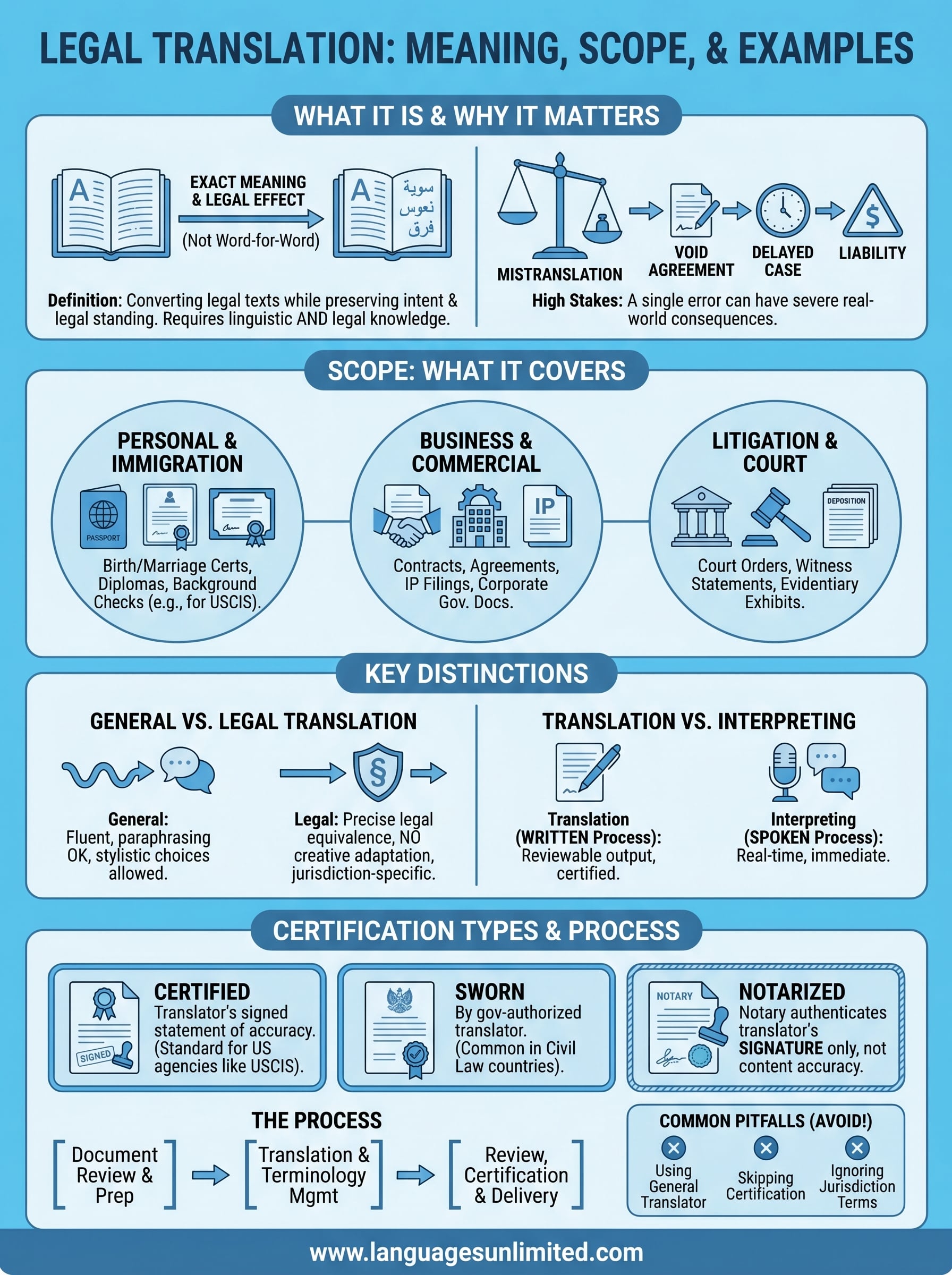
Legal translation is the process of converting legal texts from one language to another while preserving their exact meaning, intent, and legal effect. It sounds straightforward, but it’s one of the most demanding specializations in the translation industry. Legal systems differ from country to country, terminology rarely has a one-to-one equivalent across languages, and even small errors can change the enforceability of a document. This is what separates legal translation from general translation, and why it requires professionals with both linguistic skill and legal knowledge.
At Languages Unlimited, we’ve provided certified legal translation services since 1994, working with law firms, government agencies, courts, and individuals across all 50 states. Our network of over ten thousand language professionals handles everything from immigration paperwork and court filings to international contracts and regulatory documents. That hands-on experience across hundreds of languages and legal contexts is what informs this guide.
In this article, you’ll find a complete breakdown of what legal translation means in practice, which documents fall under its scope, why specialized expertise is non-negotiable, and real examples that show how legal translation works across different industries and use cases. Whether you’re a legal professional, a government administrator, or someone navigating the immigration process, this guide will give you the clarity you need to make informed decisions.
Why legal translation matters
When a document carries legal weight, every word counts. Contracts, court filings, immigration petitions, and regulatory submissions all depend on precise language to hold up in legal proceedings. A mistranslation doesn’t just cause confusion; it can invalidate a contract, delay a visa application by months, or create liability where none existed before. Understanding the legal translation definition helps you see why this discipline demands a level of care that general translation simply cannot provide.
The stakes of a single mistranslation
Most people assume that translation is a matter of swapping words from one language to another. In legal documents, that assumption is dangerous. A single incorrectly translated term can shift the meaning of an entire clause, and courts interpret documents based on what’s written, not what was intended. Translation errors in legal and diplomatic contexts have caused real-world consequences, from contract disputes to collapsed international negotiations, precisely because documents carry the force of their words.
Accuracy in legal translation is not a quality preference; it is a legal requirement that can determine the outcome of a case, a business deal, or an immigration petition.
Legal translators must account for context, jurisdiction, and the legal effect of every phrase they render in the target language. When you submit a translated document to a court or government agency, that translation is treated as an official record. Any errors in it become your errors, and they carry consequences that are difficult or sometimes impossible to reverse.
Legal systems don’t translate word for word
One of the core challenges in legal translation is that legal concepts are not universal. Common law systems used in the United States and the United Kingdom approach contracts, liability, and precedent very differently than civil law systems found across most of Europe and Latin America. When you translate a legal document across these systems, you’re not just changing the language; you’re navigating two entirely different frameworks for how law operates.
Terminology compounds this problem considerably. A concept like "injunction" in U.S. law has no direct equivalent in many other legal traditions. Translators must find the closest functional equivalent, explain the concept in a footnote, or flag the discrepancy for legal counsel. Getting this wrong produces a document that reads correctly to a native speaker but carries a different legal meaning than what was intended, which is arguably worse than an obvious error.
Who depends on accurate legal translation
The range of people and organizations that rely on legal translation is wider than most assume. Immigration applicants need certified translations of birth certificates, marriage licenses, and criminal records for USCIS submissions. Law firms handling international arbitration need contracts and evidentiary documents translated with the highest degree of accuracy. Government agencies processing foreign-language materials need translations that meet federal standards and hold up under scrutiny.
Here’s a breakdown of the main groups that depend on accurate legal translation and what they typically require:
| Who | What they need |
|---|---|
| Immigration applicants | Certified translations of personal documents for USCIS |
| Law firms | Contracts, court filings, deposition transcripts |
| Corporations | International agreements, regulatory compliance documents |
| Government agencies | Foreign-language records, policy documents, testimony |
| Healthcare institutions | Patient consent forms, medical-legal records |
Each of these groups faces real consequences when a translation is inaccurate, incomplete, or improperly certified. For immigration applicants in particular, a rejected translation can delay a case by months or require the entire submission to restart from the beginning. For businesses, a flawed contract translation can expose them to legal disputes across multiple jurisdictions. In both cases, the cost of getting it right the first time is far lower than fixing it afterward.
What legal translation covers
The legal translation definition extends well beyond courtroom filings. It includes any text where accuracy, completeness, and proper certification can affect the outcome of a legal, administrative, or regulatory process. Knowing what falls under this category helps you identify when you need a specialist rather than a general translator.
Personal and immigration documents
If you’re applying for a visa, green card, or citizenship, you’ll almost certainly need certified translations of personal documents. USCIS requires that any foreign-language document submitted with an immigration petition include a complete English translation along with a signed certification from a qualified translator. Errors or omissions in these translations can result in a request for evidence or an outright rejection of your application.
Common personal documents that require legal translation include:
- Birth certificates and death certificates
- Marriage licenses and divorce decrees
- Adoption papers and custody agreements
- Criminal background records and police clearances
- Academic transcripts and diplomas submitted for legal purposes
A rejected translation doesn’t just slow your case down. It can force you to restart the entire filing process and add months of waiting time to your timeline.
Business and commercial documents
Companies operating across borders deal with a wide range of legally binding materials that require accurate translation. Contracts, licensing agreements, intellectual property filings, corporate governance documents, and terms and conditions all fall under legal translation when they carry enforceable obligations. When your business enters an international agreement, the translated version of that contract must carry the same legal weight and binding meaning as the original, because both parties rely on their respective language versions when disputes arise.
Regulatory compliance documents follow the same standard. If you submit materials to a foreign regulatory authority or receive foreign-language compliance documentation, those records require the same rigor and precision as any formal legal filing in your home jurisdiction.
Litigation and court materials
Legal proceedings frequently involve documents in more than one language, and courts hold translated materials to the same standard as originals. Deposition transcripts, witness statements, evidentiary exhibits, and court orders all require professional legal translation when parties or evidence cross language lines. The translator must preserve not just meaning but also tone, structure, and any legally significant formatting that affects how a document is interpreted under the applicable jurisdiction.
In complex litigation, even minor translation inconsistencies across multiple documents can create contradictions that opposing counsel will exploit. That’s why attorneys working on cross-border cases treat translation quality as part of their overall case strategy, not an afterthought.
Legal translation vs interpreting vs general translation
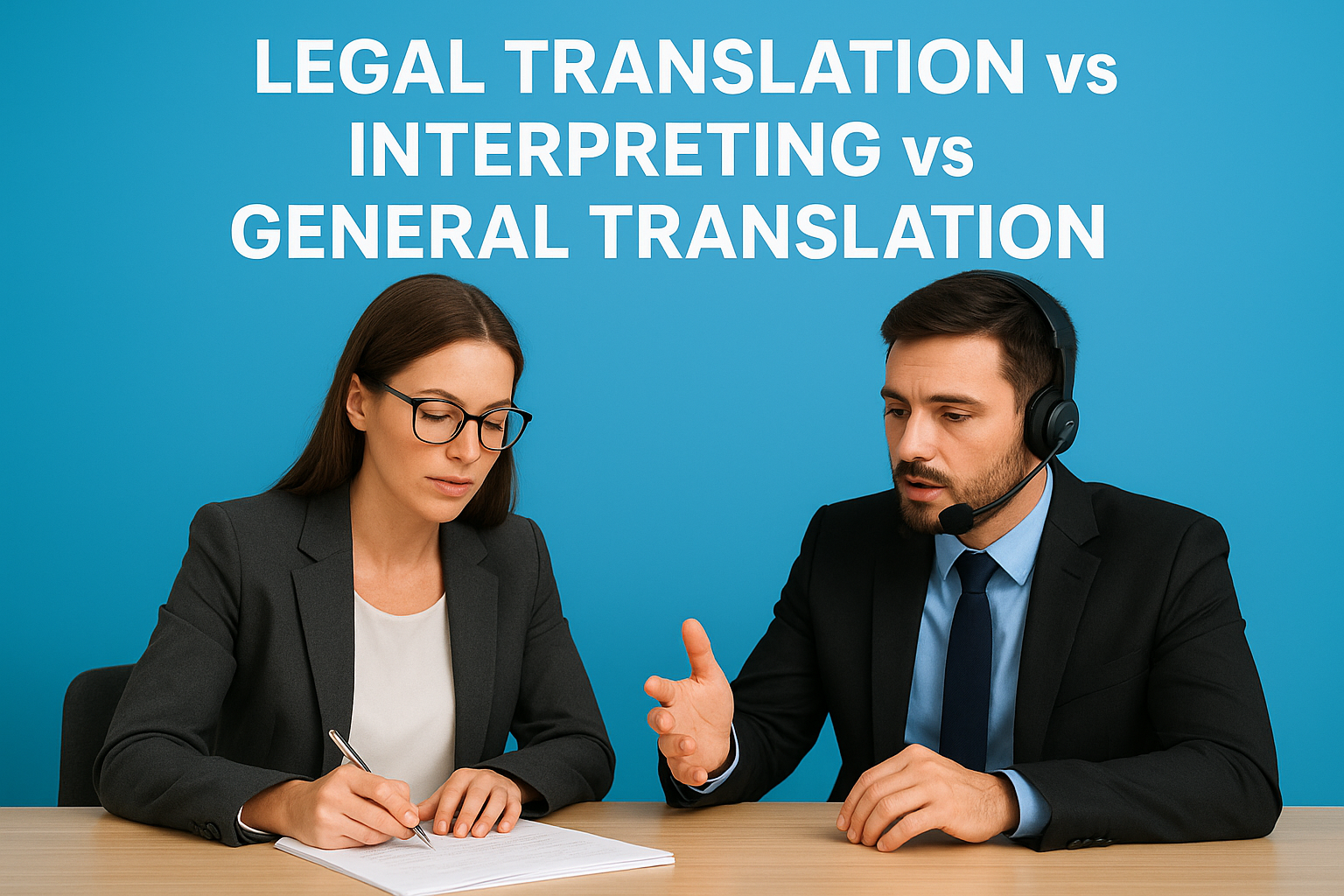
The terms "translation," "interpreting," and "legal translation" often get used interchangeably, but they describe distinct disciplines with different skill sets, tools, and professional standards. Understanding those differences helps you request the right service for your specific situation and avoid costly mistakes that come from mismatching the service to the need.
Legal translation vs general translation
General translation covers a broad range of content, from marketing copy and technical manuals to website text and personal correspondence. In those contexts, a translator can make stylistic choices, paraphrase for clarity, and adapt tone to suit the target audience. Legal translation operates under a fundamentally different standard. Every word must carry the same legal meaning and effect as the original, with no room for paraphrase, interpretation, or creative adaptation.
The legal translation definition is built on precision: you need the document to mean exactly the same thing in the target language as it does in the source language, down to the structure of individual clauses.
A general translator working on a legal document without specialized training will often produce text that reads fluently but shifts the legal meaning of specific terms. Courts, government agencies, and legal counsel rely on exact equivalents, not approximate ones. For documents like contracts, court filings, and immigration records, that distinction can make or break your case.
Legal translation vs legal interpreting
Legal interpreting and legal translation both require deep familiarity with legal terminology, but they serve completely different functions. Translation is a written process: a translator works with source documents and produces a written output that can be reviewed, revised, and certified before submission. Interpreting is a real-time spoken process: an interpreter converts speech from one language to another during depositions, hearings, courtroom proceedings, or client consultations.
The professional skills required for each service are not interchangeable. A skilled legal translator may not be qualified to interpret in a live courtroom setting, and an experienced court interpreter may not be equipped to produce a certified written translation of a complex international contract. Both services require specialized legal knowledge, but they apply that knowledge in very different formats and under very different conditions.
When you work with Languages Unlimited, you can access both legal translation and legal interpreting through a single provider, which simplifies coordination across complex multilingual legal matters.
Certified, sworn, and notarized translations
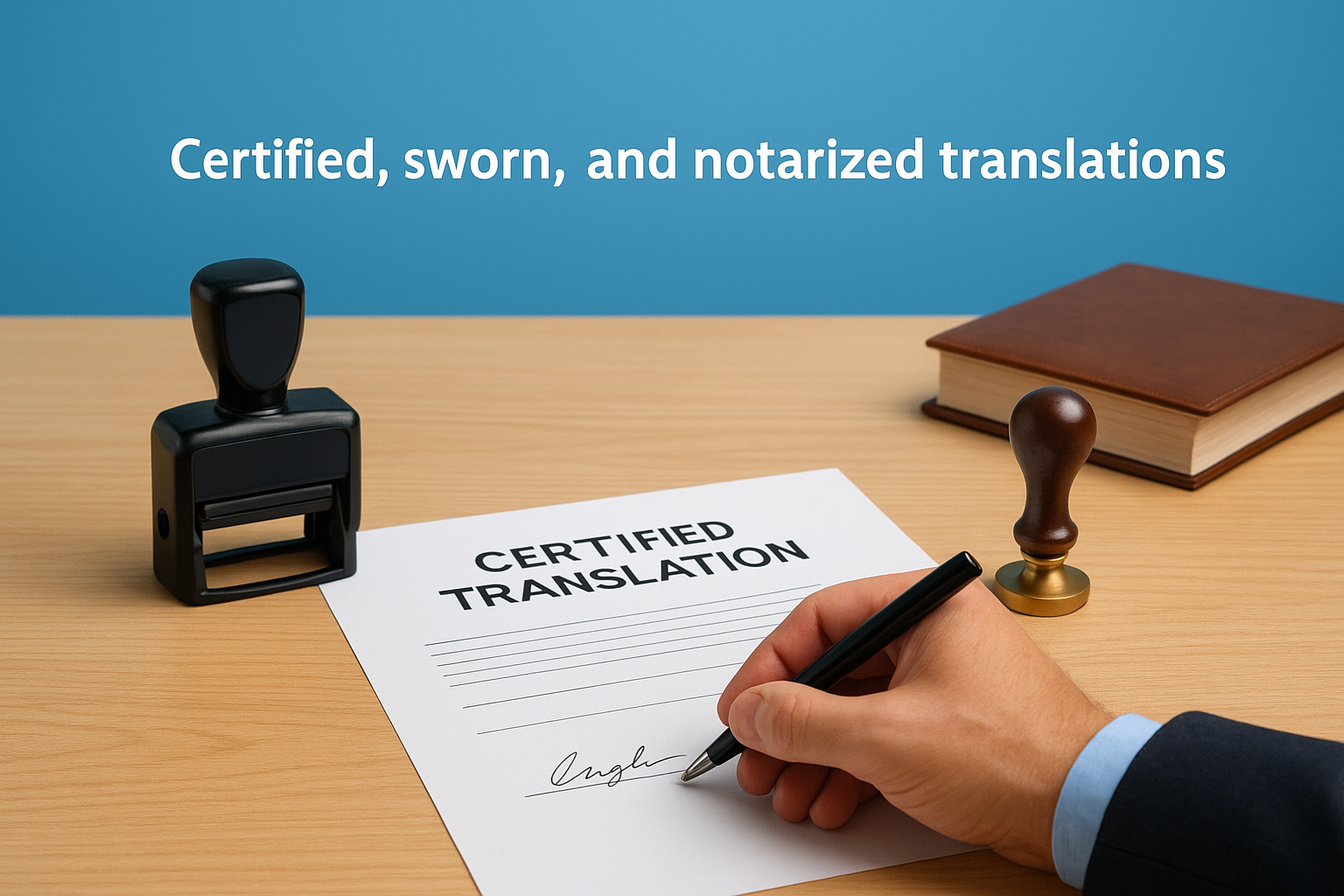
When you submit translated documents to U.S. government agencies, courts, or immigration authorities, a standard translation is rarely enough. Depending on the context, you may need a certified, sworn, or notarized translation, and each of these carries a specific meaning within the broader legal translation definition. Knowing which one applies to your situation prevents delays, rejections, and unnecessary costs.
What a certified translation is
A certified translation includes a signed statement from the translator or translation agency declaring that the translation is complete and accurate to the best of their knowledge. In the United States, this is the standard format required by USCIS for immigration filings, and it’s what most courts and government agencies expect when you submit foreign-language documents. The certification doesn’t require a government license; it requires the translator to attest to their own qualifications and the accuracy of their work.
A certified translation is not about who produced it; it’s about the formal statement of accuracy that accompanies it and makes it acceptable for official use.
Languages Unlimited produces USCIS-approved certified translations across hundreds of languages, with each document carrying a signed certification that meets federal requirements. Every certified translation we deliver includes a statement of accuracy, the translator’s credentials, and a dated signature, so your submission holds up without question.
Sworn and notarized translations
Sworn translations are used in countries where translators must be officially registered or authorized by a government body to produce legally valid translations. Spain, Germany, and many Latin American countries use this system. In those jurisdictions, only a government-appointed sworn translator can produce a translation that carries legal validity for court or official use. If you’re dealing with documents that originate from or need to be used in those countries, you need to verify whether sworn translator credentials are required.
Notarized translations add another layer of verification: a notary public certifies the translator’s signature, confirming that the person who signed the certification is who they claim to be. This doesn’t verify the translation itself, but it does authenticate the identity and signature of the translator for jurisdictions or institutions that require it. Some courts, academic institutions, and foreign government agencies specifically request notarized translations alongside or instead of standard certified ones. Always confirm with the receiving institution exactly which format they require before submitting.
How the legal translation process works
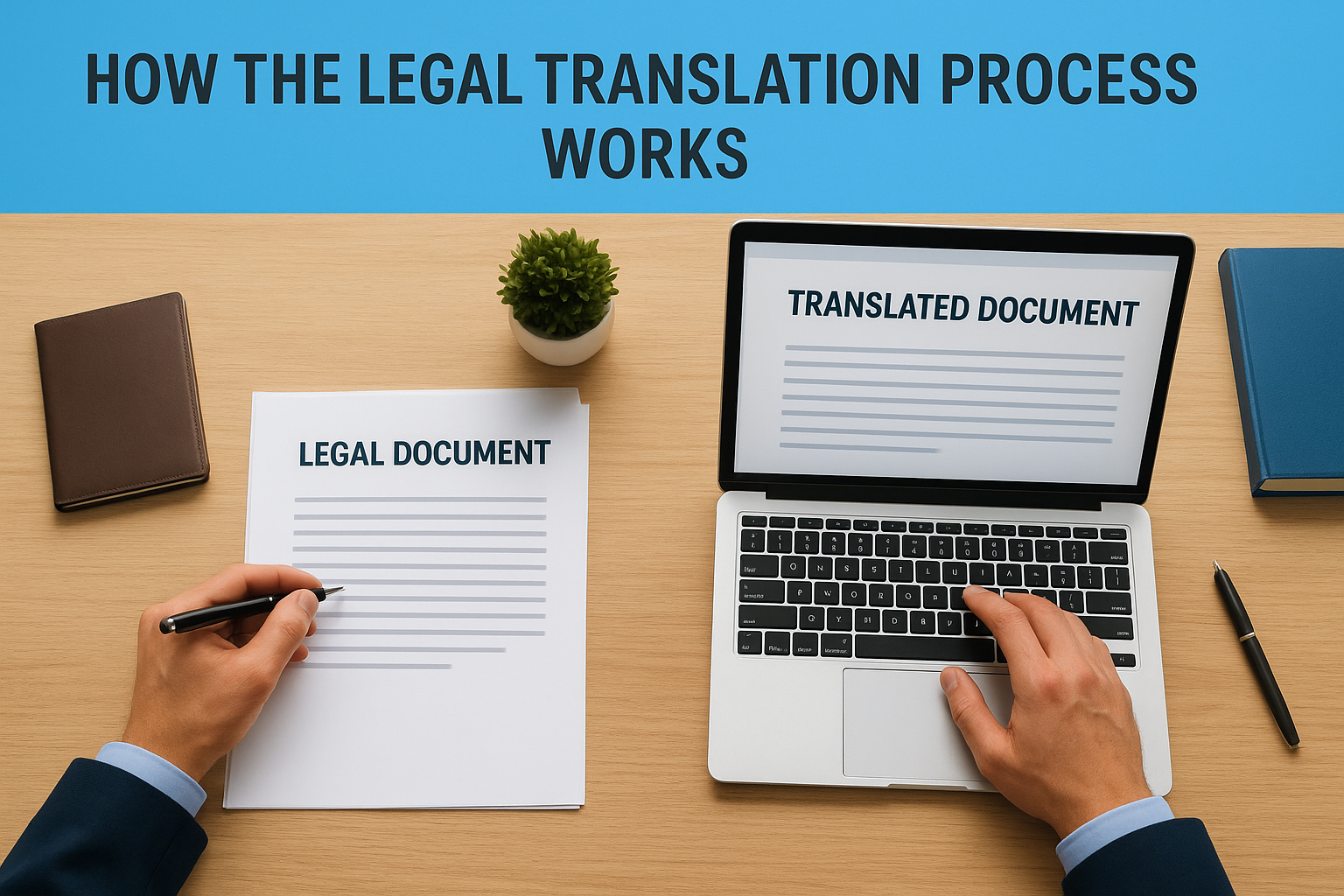
Understanding the legal translation definition in practical terms means knowing what actually happens between receiving a source document and delivering a certified translated file. The process is more structured than general translation, and each stage exists for a specific reason tied to accuracy, consistency, and legal acceptability. When you work with a professional legal translation provider, the workflow typically follows a set sequence that reduces errors and ensures the final document meets the requirements of the receiving institution.
Document review and preparation
Before any translation begins, a qualified legal translator reviews the source document in full to identify its type, jurisdiction of origin, legal purpose, and any terminology that may require special handling. This step is not optional. A contract governed by German law uses different structural conventions than one governed by California law, and a birth certificate from Mexico requires different handling than one from Brazil, even though both are Spanish-language documents.
During this stage, the translator also flags any unclear sections, missing pages, or formatting issues that could affect the final output. Catching these problems before translation starts saves significant time and prevents errors from propagating through the entire document.
Translation and terminology management
With the document reviewed, the translator begins converting the text into the target language while maintaining the exact legal meaning and structure of the original. Skilled legal translators maintain glossaries for recurring terms within a case or project, which keeps terminology consistent across multiple documents. That consistency matters when courts or agencies compare different translated files in the same proceeding.
Inconsistent terminology across related legal documents is one of the most common sources of disputes in cross-border litigation, and professional translators prevent it through disciplined terminology management.
For complex or high-volume projects, a second translator typically reviews the work before it moves forward, adding an independent check on both accuracy and legal equivalence.
Review, certification, and delivery
Once the translation is complete, it goes through a final quality review before certification. The translator or agency signs a certification statement attesting to the completeness and accuracy of the translation, which is the form required for USCIS submissions, court filings, and most government agency submissions in the United States. If notarization is required, that step is coordinated at this stage before the document is delivered to you.
Your final package includes the translated document, the signed certification, and any required credentials, formatted to meet the specific submission standards of the institution receiving it.
Common pitfalls and how to avoid them
Even when you understand the legal translation definition and know you need a specialist, specific mistakes still derail submissions, delay proceedings, and create legal exposure. Most of these errors are avoidable once you know where they typically occur. The three pitfalls below account for the majority of problems that legal professionals, businesses, and individuals encounter when managing translated legal documents.
Using a general translator for legal documents
Hiring a general translator for legal work is the most expensive mistake you can make, not in upfront costs but in downstream consequences. General translators produce fluent text, but fluency and legal accuracy are different standards. A phrase that reads naturally in the target language may carry a different legal meaning than the source term, and neither party will notice until a dispute arises or a government agency rejects the submission.
The fix is straightforward: verify that anyone you hire for legal translation has documented experience with legal documents in the relevant jurisdiction and language pair. Ask for credentials, samples, and confirmation that they understand the legal system governing the document, not just the language it’s written in.
Skipping certification requirements
Different institutions have different requirements for what makes a translation officially acceptable. Submitting a standard translation when USCIS requires a certified one, or delivering a certified translation when a foreign court requires a sworn one, results in automatic rejection regardless of how accurate the translation itself is.
Always confirm the exact certification format required by the receiving institution before you commission a translation, because fixing a rejected submission takes far longer than getting it right the first time.
Before any translation project begins, contact the receiving agency, court, or institution directly and ask for their specific requirements in writing. Keep that documentation on file so you can confirm the translation you receive meets their stated standard.
Ignoring jurisdiction-specific terminology
Legal terminology is not consistent across jurisdictions, even within the same language. Spanish legal documents from Mexico, Spain, and Argentina use different terms for overlapping concepts, and translating without accounting for the target jurisdiction produces documents that confuse rather than clarify.
When you commission a legal translation, specify the jurisdiction where the document will be used, not just the target language. A qualified legal translator will adapt their terminology choices to match the legal system that will receive and interpret the document, which is what makes the translation functionally accurate rather than just linguistically correct.
Real-world examples and mini glossary
Putting the legal translation definition into concrete scenarios makes it far easier to recognize when you need this service and what it should deliver. The examples below draw from situations that legal professionals, businesses, and individuals encounter regularly, and the glossary that follows gives you a quick reference for the terms you’ll encounter most often when working with legal translation providers.
Real-world examples
Consider a company negotiating a supply agreement with a manufacturer in South Korea. Both parties sign versions of the contract in their own language, but a clause defining "material breach" gets translated using a term that Korean commercial law interprets more narrowly than U.S. courts would. When a dispute arises, both sides cite their version as definitive, and the inconsistency forces arbitration that could have been avoided with a properly qualified legal translator from the start.
A mistranslated clause in a cross-border contract doesn’t become a problem when you sign it; it becomes a problem when something goes wrong and both parties read the same agreement differently.
Another common scenario involves immigration document submissions. An applicant submits a birth certificate from Guatemala with a translation produced by a bilingual friend. USCIS issues a Request for Evidence because the translation lacks a signed certification and omits a field from the original document. The application stalls for months, not because the translation was inaccurate, but because it didn’t meet the required certification format. Working with a credentialed provider from the beginning would have prevented the delay entirely.
Mini glossary of core legal translation terms
Familiarizing yourself with the terminology that appears in legal translation work helps you communicate more precisely with your provider and understand what you’re receiving. The table below covers the terms you’ll encounter most frequently across immigration, litigation, and commercial translation contexts.
| Term | What it means |
|---|---|
| Certified translation | A translation accompanied by a signed statement from the translator attesting to its completeness and accuracy |
| Sworn translation | A translation produced by a government-authorized translator, required in many civil law countries |
| Notarized translation | A translation where a notary authenticates the translator’s signature, not the content itself |
| Source document | The original document being translated |
| Target language | The language the document is being translated into |
| Legal equivalence | The principle that a translated term must carry the same legal meaning and effect as the original |
| USCIS-approved translation | A certified translation that meets the specific format and completeness standards required for U.S. immigration filings |
Where to go from here
The legal translation definition covers far more ground than most people expect before they need it. You now have a clear picture of what legal translation means, which documents fall under its scope, why certified and sworn formats carry different requirements, and where common mistakes tend to happen. That knowledge directly reduces your risk whether you’re submitting immigration documents, handling cross-border contracts, or managing multilingual litigation materials.
Your next step is simple: identify the documents you need translated, confirm the certification requirements of the receiving institution, and work with a provider who has documented legal expertise in the relevant language pair and jurisdiction. Getting those three things right before you commission a translation prevents the delays and rejections that come from working with unqualified providers or submitting the wrong format.
If you’re ready to move forward, contact Languages Unlimited to discuss your legal translation needs with a specialist who can guide you through the right solution.