



Selling products or services to the federal government represents a massive opportunity, the U.S. government is the largest buyer of goods and services on the planet. But before you can compete for that work, you need to determine whether your business is actually GSA ready for government contracting. That means understanding the requirements, preparing your documentation, and building a pricing strategy that holds up to federal scrutiny.
At Languages Unlimited, we know this process firsthand. As a GSA Schedule contract holder ourselves, we went through every step outlined in this guide, from registering in SAM.gov to negotiating pricing with GSA contracting officers. Our GSA contract allows us to provide translation, interpretation, and staffing services to federal agencies across all 50 states. The process took preparation, patience, and attention to detail, but it opened doors to government partnerships that continue to grow decades later.
This guide breaks down exactly what it takes to get GSA ready, whether you’re a small business exploring federal sales for the first time or an established company looking to expand into government markets. You’ll learn how to assess your eligibility, gather the right documentation, build a compliant offer, and navigate the application from start to finish. No vague advice or theory, just the practical steps based on current GSA requirements and real experience going through the process.
Let’s walk through it.
What “GSA ready” means for your business
Being GSA ready is not the same as simply wanting a government contract. The General Services Administration uses the Multiple Award Schedule (MAS) program to pre-vet vendors, which means your business has to meet a specific set of administrative, financial, and compliance standards before GSA will even review your offer. “GSA ready” means your business can demonstrate that it meets those standards with actual documentation, not just intent.
The difference between eligible and prepared
Many businesses assume that because they have a legal business entity and a product or service, they’re ready to apply. Eligibility is the floor, not the ceiling. You need to be eligible, meaning you meet the basic legal requirements, but you also need to be prepared, meaning you have your registrations active, your financial records organized, and your pricing strategy built before you submit anything to GSA.
Being eligible to apply is not the same as being ready to win a contract. The companies that move through the GSA application process quickly are the ones who prepared everything before they clicked submit.
Think of it this way: if GSA asks for two years of financial statements and you haven’t reconciled your books in six months, you are eligible but not prepared. The distinction matters because an incomplete or disorganized application delays your contract, sometimes by months.
The four pillars of GSA readiness
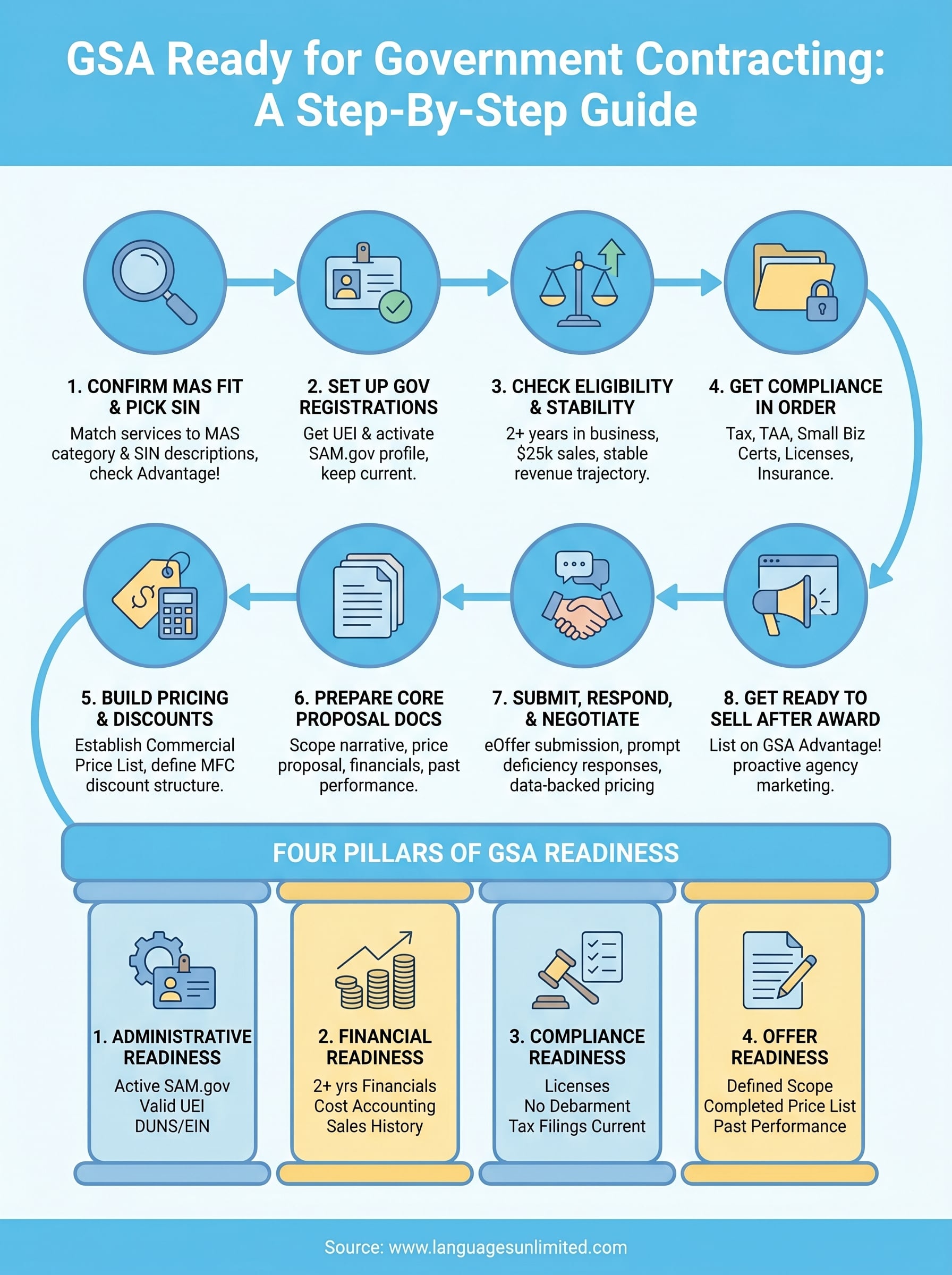
Every business preparing for government contracting through GSA needs to address four core areas. These are not sequential steps at this stage but rather parallel tracks you need to evaluate at the same time:
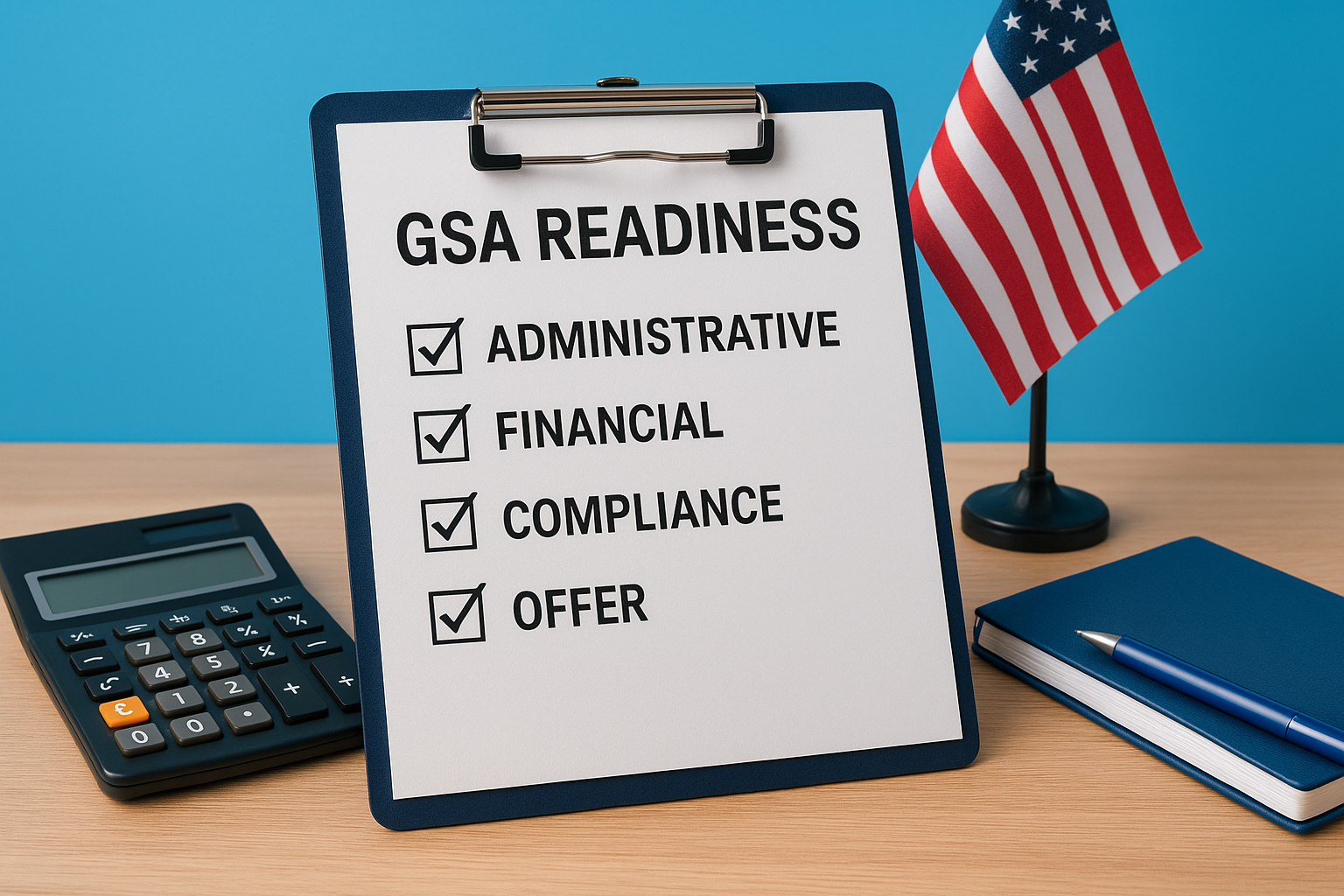
- Administrative readiness: Active SAM.gov registration, a valid UEI number, and a DUNS/EIN on file
- Financial readiness: At least two years of auditable financials, a clear cost accounting approach, and documented sales history
- Compliance readiness: Proper business licenses, no debarment or suspension history, and tax filings current with the IRS
- Offer readiness: A defined scope of services or products, a completed price list, and supporting documentation like past performance references
If any of these four areas has a gap, that gap will surface during the GSA review process. It is far better to identify and fix those gaps now than to receive a deficiency letter from a contracting officer weeks after you submit.
Why readiness matters before you apply
The GSA MAS application process is not a quick form you fill out in an afternoon. GSA contracting officers review your offer package in detail, and they will issue what’s called an “amendment” or “deficiency” request if your submission is incomplete or unclear. Each back-and-forth exchange can add weeks to your timeline. Businesses that go into the process fully prepared consistently see faster approvals, better negotiated rates, and fewer deficiency requests.
Your readiness level also affects the quality of your final contract. For example, if you submit a pricing matrix without adequate commercial sales data to support your rates, GSA may push back on your prices or require you to offer deeper discounts than you had planned. Building your pricing strategy on solid data before you apply puts you in a stronger negotiating position from day one.
What GSA readiness looks like in practice
A business that is genuinely GSA ready has done the following before starting the application: confirmed their SAM.gov registration is active and current, identified the specific Special Item Number (SIN) that matches their services, pulled together two to three years of financial statements, compiled a list of at least three relevant past performance references, and built a commercial price list with documented customer discounts. That is the baseline. Everything covered in the steps that follow builds toward that point so you arrive at the application with confidence, not questions.
Step 1. Confirm MAS fits your offer and pick a SIN
Before you invest time building your GSA application, you need to verify that the Multiple Award Schedule (MAS) program actually covers what your business sells. MAS covers a wide range of products and services, but it does not cover everything, and submitting an offer under the wrong category will get your application rejected. Your first move is to confirm that your offer fits within the MAS structure and then identify the exact Special Item Number (SIN) that matches your core services.
Check if the MAS program covers your category
The MAS program is organized into large categories, with each category broken into subcategories and individual SINs. GSA publishes the full category structure in the MAS Roadmap, which you can use to browse all available categories and confirm your services appear. Common MAS categories include IT products and services, professional services, facilities, transportation, and human capital services, which includes language and staffing solutions like the ones Languages Unlimited offers under government contracting for translation and interpretation. Review the GSA MAS Roadmap to better understand the steps involved in preparing for a Multiple Award Schedule contract.
If your services span multiple categories, you can apply for more than one SIN in a single application, which is more efficient than submitting separate offers.
A practical way to check fit is to search GSA’s Advantage! catalog for companies already selling services similar to yours. If you find active MAS vendors offering what you provide, that confirms your category is viable and gives you real examples to benchmark your own offer against.
How to find and select the right SIN
Once you confirm your category, drill down to the specific SIN. Each SIN has a written description, and your services need to match that description closely. Use the table below as a starting framework for how to evaluate a SIN before you commit to it:
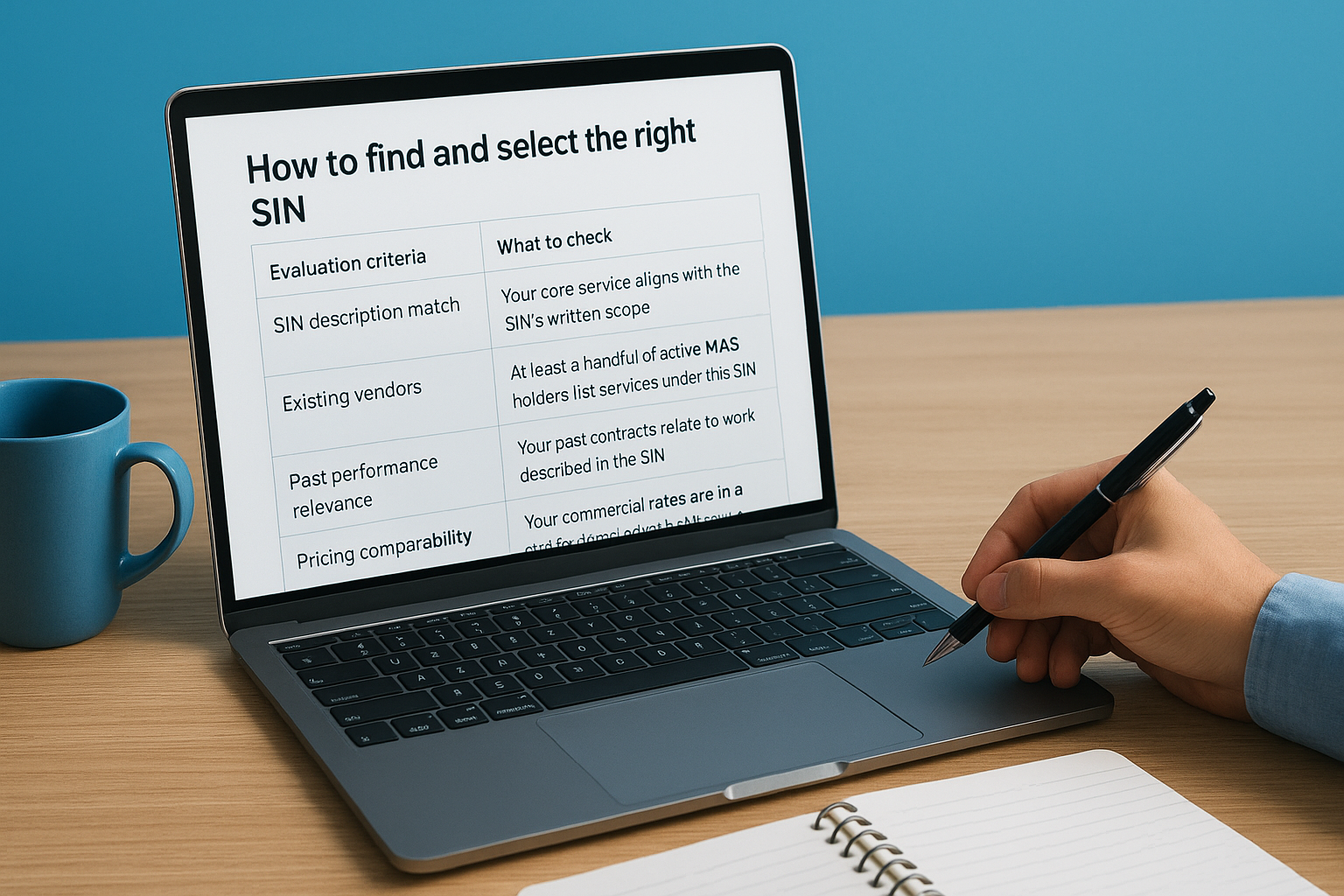
| Evaluation criteria | What to check |
|---|---|
| SIN description match | Your core service aligns with the SIN’s written scope |
| Existing vendors | At least a handful of active MAS holders list services under this SIN |
| Past performance relevance | Your past contracts relate to work described in the SIN |
| Pricing comparability | Your commercial rates are in a similar range to existing MAS pricing |
After you identify a candidate SIN, read the full SIN description in GSA’s eLibrary and compare it line by line against your service offering. If your description matches roughly 80 percent or more of the SIN scope, you have a strong fit. If the match feels forced or requires significant stretching of your actual services, look at adjacent SINs before you decide.
Step 2. Set up your government registrations
Government registrations are the administrative foundation of any GSA ready government contracting effort. Without active, verified registrations, GSA cannot award you a contract, and your application will not move forward. You need to complete two primary registration steps: obtaining your Unique Entity Identifier (UEI) and activating your profile in SAM.gov, the System for Award Management. Both are free to complete directly through official government portals.
Get your UEI and activate SAM.gov
Your UEI is the identifier the federal government uses to recognize your business across all contracting systems. SAM.gov replaced DUNS numbers as the source for UEIs in April 2022, so if you have an older record that references a DUNS number, you need to verify that your SAM.gov profile now reflects your assigned UEI instead.
Registering through any third-party site that charges a fee for SAM.gov registration is unnecessary. The official registration at SAM.gov is free.
To complete your SAM.gov registration, work through the following checklist in order:
- Legal business name and physical address matching your IRS records exactly
- Employer Identification Number (EIN) verified with the IRS
- NAICS codes that reflect your primary business activities (you can list more than one)
- Banking information for electronic funds transfer if you expect to receive federal payments
- Points of contact, including a government business point of contact and an electronic business point of contact
- Representations and certifications, which are the legal attestations SAM.gov requires you to complete annually
After you submit, SAM.gov typically takes one to three business days to activate a new registration, though IRS verification can extend that timeline. Plan for up to two weeks if your EIN has never been used in a federal system before.
Keep your registration current before you apply
One of the most common reasons GSA applications stall is an expired or inactive SAM.gov registration. Your SAM.gov registration expires every 12 months, and you must renew it before it lapses. If it expires mid-application, your submission cannot be processed.
Set a calendar reminder 60 days before your expiration date so you have time to log in, review your information, and renew without rushing. When you renew, also verify that your NAICS codes, points of contact, and banking information are still accurate. Any mismatch between your SAM.gov data and the information in your GSA offer package will trigger questions from the contracting officer and slow your approval. Treat SAM.gov as a living record, not a one-time task.
Step 3. Check eligibility and business stability
GSA evaluates two things when they review your offer: whether you meet the minimum eligibility requirements and whether your business demonstrates financial and operational stability. Both matter. A business that meets eligibility on paper but shows erratic revenue or thin margins will face scrutiny during the review process. Confirm both before you start building your application.
Core eligibility requirements
GSA’s baseline eligibility requirements for the MAS program are straightforward, but each one has teeth. You must be a U.S.-based business entity (a sole proprietor, partnership, corporation, or limited liability company), you must have been in business for at least two years, and you must have at least $25,000 in annual sales in the category you plan to offer under your schedule. These are not negotiable minimums. If you do not meet them, GSA will reject your application without moving to substantive review.
Use this checklist to confirm your eligibility status before you invest time in the full application:
- Business has been operating for two or more years
- Annual revenue in your offer category meets or exceeds $25,000
- Business is registered as a legal U.S. entity with a valid EIN
- No active debarment or suspension listed in SAM.gov
- No outstanding federal tax liens or delinquencies with the IRS
What “business stability” means to GSA
Beyond the hard eligibility cutoffs, GSA contracting officers look at whether your business is financially stable enough to sustain a long-term federal contract. MAS contracts run for a base period of five years with three five-year option periods, meaning GSA wants confidence that you will still be operating and delivering at year three or year seven. They assess this by reviewing your financial statements, profit and loss history, and the overall trajectory of your revenue.
Being GSA ready for government contracting requires you to show a pattern of stable or growing revenue, not just the minimum $25,000 threshold. If your financials show a significant revenue drop during the review period, be prepared to explain it in writing. GSA may ask for a narrative explanation alongside your financial documents, so having a clear, factual account of any downturns and how you addressed them protects your application from unnecessary delays.
Prepare a one-page business narrative that summarizes your company history, core service lines, and revenue trajectory. You may not need to submit it with your initial offer, but having it ready gives you a strong resource if GSA issues a deficiency request.
Pulling together two to three years of reviewed or compiled financial statements before you start your application is the single most effective thing you can do to accelerate the review. Audited financials carry the most weight, but compiled financials prepared by a licensed CPA are acceptable for most MAS submissions.
Step 4. Get your compliance items in order
Compliance is where many GSA ready government contracting applicants stall. GSA does not just review your offer on its merits; it also verifies that your business operates within the legal and regulatory frameworks federal agencies require. Missing or incomplete compliance documentation is one of the most common triggers for deficiency letters, and addressing it before you submit saves you significant time and back-and-forth with your contracting officer.
The key compliance documents GSA requires
Your compliance package needs to cover several distinct areas, and each one requires specific documentation. Pulling these items together before you begin your offer prevents last-minute scrambling and gives you a clear picture of whether any gaps exist. Below are the core compliance items GSA will expect you to address:
| Compliance item | What you need |
|---|---|
| Tax compliance | IRS confirmation of no outstanding federal tax liens or delinquencies |
| Debarment check | Active SAM.gov registration showing no excluded parties status |
| Small business certifications | Current SBA certifications if you plan to self-certify as a small business |
| Licenses and registrations | State business licenses relevant to your service category |
| Insurance documentation | Proof of general liability coverage appropriate to your offer |
Verify your SAM.gov exclusions status before you submit. If your business name, EIN, or a key principal appears on the excluded parties list for any reason, your application stops immediately.
Each of these items should be in a dated, organized file so you can attach or reference them quickly when GSA requests supporting documentation during the review phase.
How Trade Agreements Act (TAA) compliance applies to your offer
If your offer includes products rather than services, you must verify that those products comply with the Trade Agreements Act (TAA). The TAA restricts which countries of origin are acceptable for products sold to the federal government. Services are generally not subject to the same restrictions, but if your offer blends both products and services, review each product line individually.
For service-based businesses, TAA compliance still surfaces in how you describe your delivery model. For example, if you use offshore subcontractors to fulfill any portion of a federal contract, you need to understand how GSA and your end-client agency will evaluate that arrangement. Documenting your delivery chain clearly in your offer prevents misunderstandings during contract performance. A short written explanation of how your services are delivered, by whom, and from where, gives the contracting officer the context they need to evaluate your offer accurately without issuing unnecessary deficiency requests.
Step 5. Build your pricing and discounts strategy
Pricing is where many GSA ready government contracting applicants underestimate the work involved. GSA does not simply accept the rates you want to charge; it negotiates your prices against your commercial price list and actual sales history, and it expects you to document both before you submit. Getting your pricing strategy right before the application means you walk into negotiations with a defensible position rather than guessing under pressure from a contracting officer.
Establish your commercial price list first
Your commercial price list (CPL) is the document that shows GSA what you charge your non-government customers. This is your starting point, and it needs to reflect real, current pricing rather than aspirational rates you have never actually charged. Pull your invoices from the past 12 to 24 months and identify the consistent rates you applied across multiple customers. If your pricing varies significantly by client, build a rate card that reflects your most commonly charged amounts and be ready to explain any outliers.
Use this template as a baseline structure for your commercial price list:
| Service or product description | Unit of measure | Commercial rate | Notes |
|---|---|---|---|
| [Service name] | Per hour / per page / per unit | $[rate] | Volume or contract discounts available |
| [Service name] | Per hour / per page / per unit | $[rate] | Standard rate for non-contract clients |
Keep your CPL clean, consistent, and dated with an effective date at the top. GSA contracting officers compare your MAS offer price to this document, so any inconsistency between the two will prompt a question.
Understand the pricing discount structure GSA expects
GSA requires you to disclose what discounts you extend to your Most Favored Customer (MFC), meaning the category of commercial buyer who gets your best pricing. You then offer GSA pricing that is at least as favorable as what your MFC receives. This is called the Price Reduction Clause, and it governs your pricing for the life of your contract.

If you ever lower your commercial rates below your MFC threshold after award, you are contractually required to notify GSA and apply the same reduction to your schedule pricing.
Document your MFC category clearly before you submit. For most service businesses, this is a large-volume commercial buyer or a preferred-client account. Spell out exactly who that customer category is, what discount they receive, and how you calculated it. Attach representative invoices or contracts as supporting evidence. A clear, well-supported discount disclosure protects your pricing position during negotiation and prevents pricing disputes once your contract is active.
Step 6. Prepare the core proposal documents
Your proposal documents are the actual submission package you upload to GSA’s eOffer system, and the quality of that package directly determines how smoothly your review goes. Every GSA ready government contracting application requires a specific set of core documents, and submitting a complete, well-organized package gives the contracting officer everything they need to evaluate your offer without issuing deficiency requests.
The documents GSA expects in your offer package
Before you open eOffer, pull together every required document and verify each one is current, signed where applicable, and labeled clearly. Disorganized or mislabeled attachments are a common reason applications stall at the initial review stage. The table below outlines the core documents you need to prepare:
| Document | What it covers |
|---|---|
| Commercial price list (CPL) | Your standard rates charged to non-government customers |
| GSA price proposal template | Your offered MAS rates aligned to the SIN you selected |
| Past performance references | At least three relevant contracts with contact information |
| Financial statements | Two to three years of reviewed or compiled statements |
| Relevant experience narrative | Summary of your qualifications and delivery capability |
| Authorized negotiator letter | Names and signatures of the people authorized to negotiate on your behalf |
Keep all documents in a single organized folder before you start uploading so you are not searching for files mid-submission.
How to write your scope of work narrative
Your scope of work narrative is a written description of exactly what you are offering under your selected SIN. This document should be specific, not generic. Write it so a contracting officer who knows nothing about your business can read it and understand precisely what services you deliver, how you deliver them, and what qualifies you to do so.
A vague or overly broad scope narrative is one of the top reasons GSA contracting officers issue deficiency letters, so write yours at the SIN level, not the company level.
Use this template structure as your starting framework:
Company Name: [Your business name]
SIN(s): [SIN number and title]

Overview:
[2-3 sentences describing your core service and who you serve]

Services Offered:
- [Specific service 1 with brief description]
- [Specific service 2 with brief description]
- [Add as many as apply to your SIN]

Delivery Method:
[Explain how services are delivered: on-site, remote, hybrid, etc.]

Qualifications:
[Relevant certifications, years of experience, and notable past performance]
Keep your narrative between one and three pages. Longer does not mean stronger. A focused, well-organized scope document signals to the contracting officer that your business understands exactly what it is offering and can deliver on that commitment from day one of contract performance.
Step 7. Submit, respond, and negotiate with GSA
Once your documents are organized and your pricing is locked, you submit your complete offer package through GSA’s eOffer portal, which is the official system for all MAS submissions. This step is not just uploading files. It starts a formal review process where a GSA contracting officer is assigned to your offer, reads through every document, and determines whether your submission meets program requirements before moving to negotiation.
Submit your offer through eOffer
GSA’s eOffer system walks you through the submission in sections, including your business profile, representations and certifications, SIN selection, price proposal, and document attachments. Complete every section in order and avoid skipping optional fields, since incomplete sections frequently trigger review delays. Before you click the final submit button, download a PDF copy of your full submission for your records so you have a reference point if the contracting officer asks questions about specific line items.
Respond to deficiency requests promptly
After your initial submission, your contracting officer will issue a deficiency letter if any part of your offer is incomplete, unclear, or inconsistent. This is not a rejection. It is a formal request for clarification or additional documentation, and how quickly you respond directly affects how fast your contract moves toward award.
Plan to respond to any deficiency request within five to ten business days. Delays on your end extend the overall timeline, and contracting officers manage multiple offers simultaneously.
When a deficiency request arrives, read it in full before responding. Address every point the contracting officer raised in your response, number your answers to match their numbered items, and attach all supporting documents clearly labeled. A disorganized or partial response will generate a follow-up request and add more weeks to your timeline. Treat each deficiency response as a professional, structured document, not a quick email reply.
Negotiate your MAS pricing
After GSA resolves any deficiencies, the contracting officer moves into price negotiation. They will compare your offered rates to existing MAS pricing in your SIN category and push for rates that represent fair value to the government. This is where your commercial sales data becomes your most important asset.
Staying GSA ready through government contracting negotiations means bringing documentation to support every rate you proposed. If the contracting officer requests a lower rate on a specific service, counter with actual invoices, market rate comparisons, or a written explanation of your cost structure. You do not have to accept every concession. You have the right to negotiate, and a well-supported position gives you standing to hold your rates where the data justifies it.
Step 8. Get ready to sell after award
Winning your GSA Schedule contract is a milestone, but it does not generate revenue on its own. Federal agencies do not automatically find you or contact you simply because your contract is active. You have to actively market your schedule, list your offerings correctly, and build relationships with contracting officers and agency buyers. This is where being GSA ready for government contracting transitions from preparation into active sales execution.
List your contract on GSA Advantage!
Your first priority after award is uploading your approved price list to GSA Advantage!, the online catalog where federal buyers browse and purchase from MAS vendors. GSA gives you a specific window after award to complete this upload, and missing that deadline can affect your contract standing. Log into the Schedules Input Program (SIP) to build and submit your catalog file.
Use this checklist to complete your GSA Advantage! listing correctly:
- Contract number listed on every product or service entry
- SIN code matched exactly to each line item in your price list
- Unit pricing that matches your negotiated MAS rates without rounding errors
- Service descriptions written clearly enough for a buyer who has never heard of your company to understand what they are purchasing
- Delivery or performance terms included for every line item
Review your listing after upload to confirm everything displays correctly in the live catalog before your first agency contact sees it.
Market your schedule to federal buyers
A published catalog entry gets you visible, but direct outreach to agency procurement contacts is what actually moves you from “listed vendor” to “awarded contractor.” Start by identifying the agencies most likely to buy your services. Use beta.SAM.gov to search for past contracts in your SIN category and find the agencies that have already purchased similar services. Those agencies have established budget and buying patterns, which makes them your strongest starting targets.
Your GSA contract number is a sales tool. Lead with it in every agency introduction so buyers know immediately that you are pre-vetted and ready to transact without a new procurement process.
Build a short agency outreach template you can customize for each target:
Subject: [Your Company Name] - GSA Schedule Contract [Your Contract #]

We hold an active GSA Multiple Award Schedule contract under SIN [SIN number],
covering [brief service description].

We work with [relevant agency type] to [specific outcome you deliver].

[One sentence on a relevant past performance example]

I would welcome a brief call to discuss how we can support [Agency Name]'s
upcoming needs. Are you available [date range]?
Track every outreach contact, follow up within two weeks, and log agency responses so you build a repeatable pipeline rather than a one-time effort.
Next steps
You now have a complete picture of what it takes to be GSA ready for government contracting, from confirming your SIN to actively selling after award. The eight steps in this guide cover every major phase of the process, but knowing the steps and executing them are two different things. The businesses that win GSA contracts fastest are the ones that treat each step as a concrete task with a deadline, not a general goal to revisit someday.
Start with what you can confirm today: check your SAM.gov registration status, pull two years of financial statements, and identify the SIN that best matches your services. Those three actions alone will tell you exactly how far you are from a complete offer package. If your business provides translation, interpretation, staffing, or related language services and you want guidance from a team that has been through this process, reach out to Languages Unlimited to discuss how we work with federal agencies nationwide.