



Whether you’ve stumbled across Roderick Jones’ well-known textbook or you’re simply trying to understand what the profession involves, getting conference interpreting explained clearly makes a real difference. Conference interpreting is the specialized practice of converting spoken language from one language to another in real time during multilingual events, summits, international forums, large-scale business meetings, and similar high-stakes settings. It demands a rare combination of linguistic precision, subject-matter knowledge, and composure under pressure that separates it from everyday bilingual communication.
At Languages Unlimited, we’ve worked with conference interpreters since 1994, deploying professionals across simultaneous, consecutive, and remote interpreting assignments for government agencies, corporations, and institutions nationwide. That experience has given us a front-row seat to what this discipline requires, and what separates competent interpreters from outstanding ones. Our network of over ten thousand language professionals means we see these skills in action every day, across hundreds of languages and countless event types.
This article breaks down the core skills, primary modes, and practical realities of conference interpreting for anyone new to the subject. You’ll learn what simultaneous and consecutive interpreting actually look like in practice, what qualifications matter most, and how the profession continues to evolve with technology like video remote interpreting. If you’re a hiring organization evaluating interpreter services or someone considering the career path, this guide gives you a solid foundation to build on.
Why conference interpreting matters
Multilingual communication at high-stakes events is not a convenience, it is a necessity. When government delegates from different countries sit at the same table, or when a global corporation briefs international partners, every word carries weight. A misunderstood clause in a trade negotiation or a mistranslated policy directive produces real, measurable consequences. Conference interpreting creates the conditions for all parties to engage fully, on equal terms, in their own language.
When every participant can follow the conversation in their native language, discussions are more precise, agreements are more durable, and relationships are more genuine.
When language barriers become operational problems
Organizations often underestimate how quickly communication gaps create friction. If your team is presenting technical findings to a multilingual audience, relying on bilingual staff members to improvise is a significant risk. Professional conference interpreters bring subject-specific vocabulary and real-time accuracy that untrained bilingual staff simply cannot replicate at the pace a live event demands.
Expecting attendees to follow along in a second language reliably produces confusion and disengagement. Participants miss nuances, ask for repeated clarification, and leave meetings with different understandings of the same conversation. That is a direct operational cost, not a hypothetical one.
The global events landscape demands it
International conferences, government summits, academic forums, and cross-border business meetings have grown in scale and complexity. With conference interpreting explained across its full scope, you see quickly that this is not a niche service. It is a core infrastructure requirement for any event where participants do not share a common language.
Your planning decisions about interpretation directly affect participant engagement, decision quality, and your organization’s credibility. Organizations that underinvest in professional interpretation routinely spend more time correcting post-event misunderstandings than any short-term savings were worth.
Modes of conference interpreting
Conference interpreting breaks down into distinct modes, and choosing the right one shapes everything from your budget to the physical setup of your event. With conference interpreting explained across these modes, you can match the service type to your specific situation rather than defaulting to a generic approach.
Simultaneous and consecutive
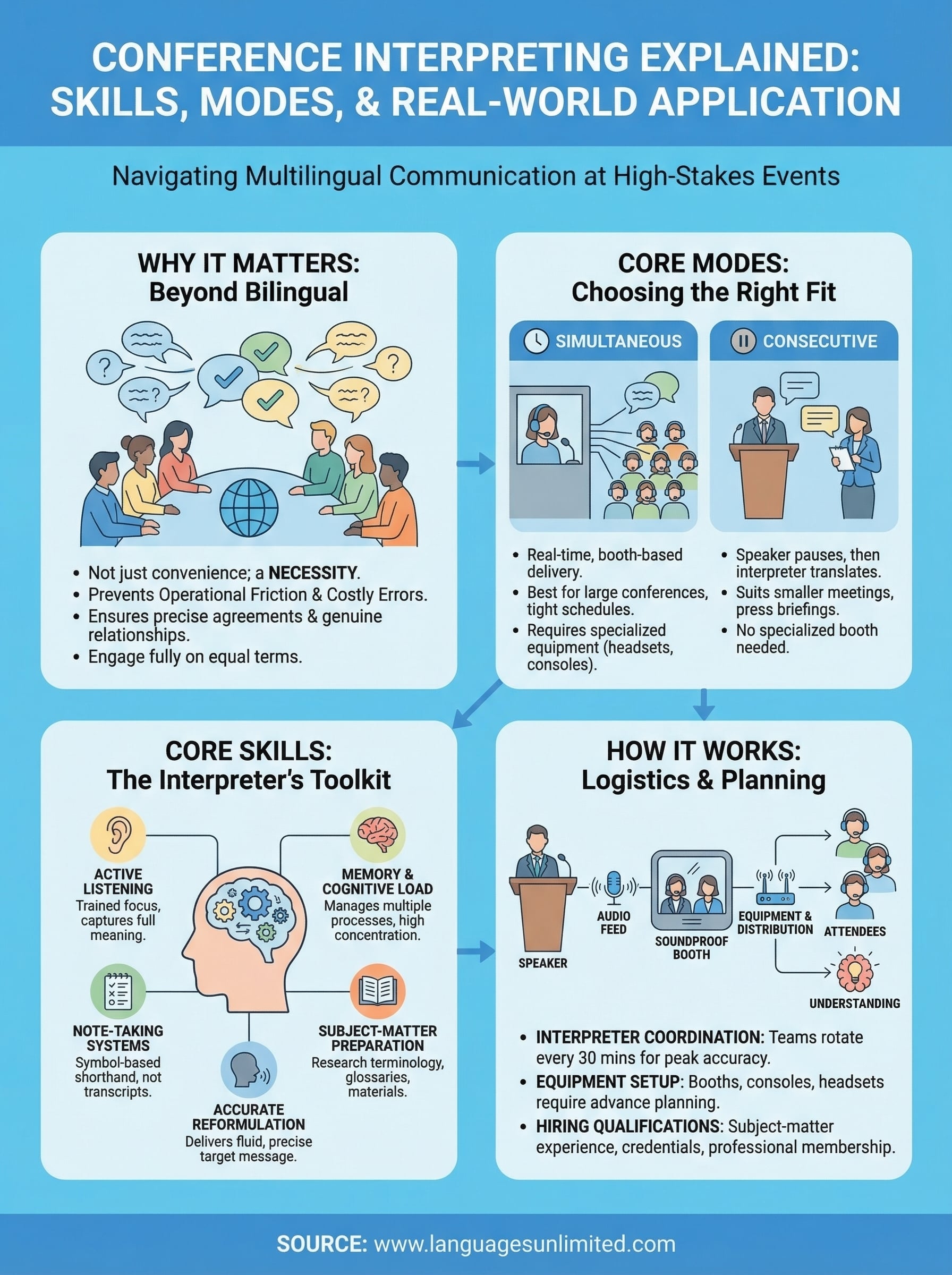
Simultaneous interpreting is the mode most people associate with large international conferences. Interpreters work in real time from a soundproof booth, delivering the interpreted message within seconds of the speaker’s words. Attendees listen through headsets. This mode works well for large audiences with tight schedules.
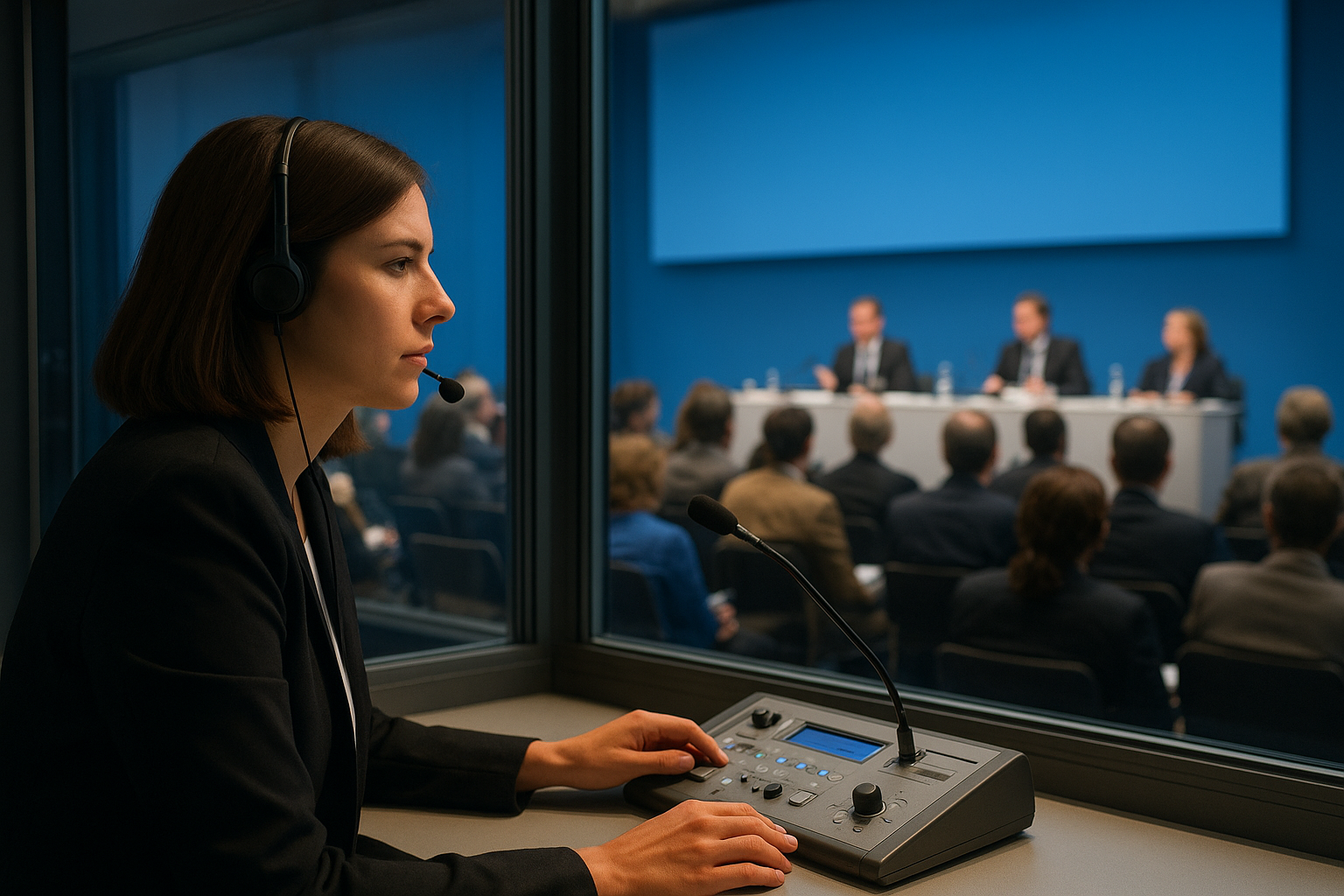
Consecutive interpreting takes a different shape. The speaker delivers a segment, pauses, and the interpreter then reproduces the message in the target language. This mode requires no specialized booth equipment and suits smaller settings like bilateral meetings, press briefings, or working groups where a natural pause in delivery is acceptable.
For most large international events, simultaneous interpreting is the standard because it keeps the session moving without interrupting the speaker’s rhythm.
A third option worth knowing is whisper interpreting, where the interpreter sits beside one or two listeners and whispers the interpretation in real time. It suits small delegations that need language support without a full booth setup.
Core skills and techniques interpreters use
Conference interpreting explained at the skill level reveals how demanding the work actually is. Interpreters do not simply know two languages; they manage multiple cognitive processes simultaneously, from listening and comprehending to reformulating and speaking, often while taking notes or monitoring their own output for accuracy. The cognitive load is significant, which is why professional conference interpreters typically work in pairs and rotate every 30 minutes during simultaneous assignments.
The most common mistake organizations make is assuming any bilingual speaker can fill this role. That assumption leads to errors at precisely the moments when accuracy matters most.
Active listening and memory
Professional interpreters train extensively in active listening techniques and structured note-taking systems. In consecutive mode, notes are not full transcripts; they are symbol-based shorthand that captures meaning, structure, and emphasis so the interpreter can reconstruct the full message accurately after the speaker finishes.
Subject-matter preparation
Before any assignment, skilled interpreters research the topic thoroughly, reviewing terminology glossaries, technical documents, and speaker materials whenever possible. This preparation is the difference between fluid, accurate delivery and hesitation at critical moments. If you are hiring for a medical conference, expect interpreters to know the relevant clinical vocabulary before they step into the booth.
How conference interpreting works at real events
At a large international conference, logistics and interpreter coordination run behind the scenes so attendees rarely notice the complexity involved. You typically find soundproofed booths at the back or sides of the room, each staffed by two interpreters rotating throughout the session. Attendees select a language channel on a wireless receiver and listen through a headset while the speaker continues uninterrupted.
Getting this setup right requires advance planning, not last-minute arrangements.
Equipment and booth setup
Simultaneous interpreting equipment includes interpreter consoles, headsets, wireless receivers, and soundproof booths built to ISO standards. Your venue may already have permanent booths installed, but many events require portable booth systems brought in and configured by an audio-visual team.
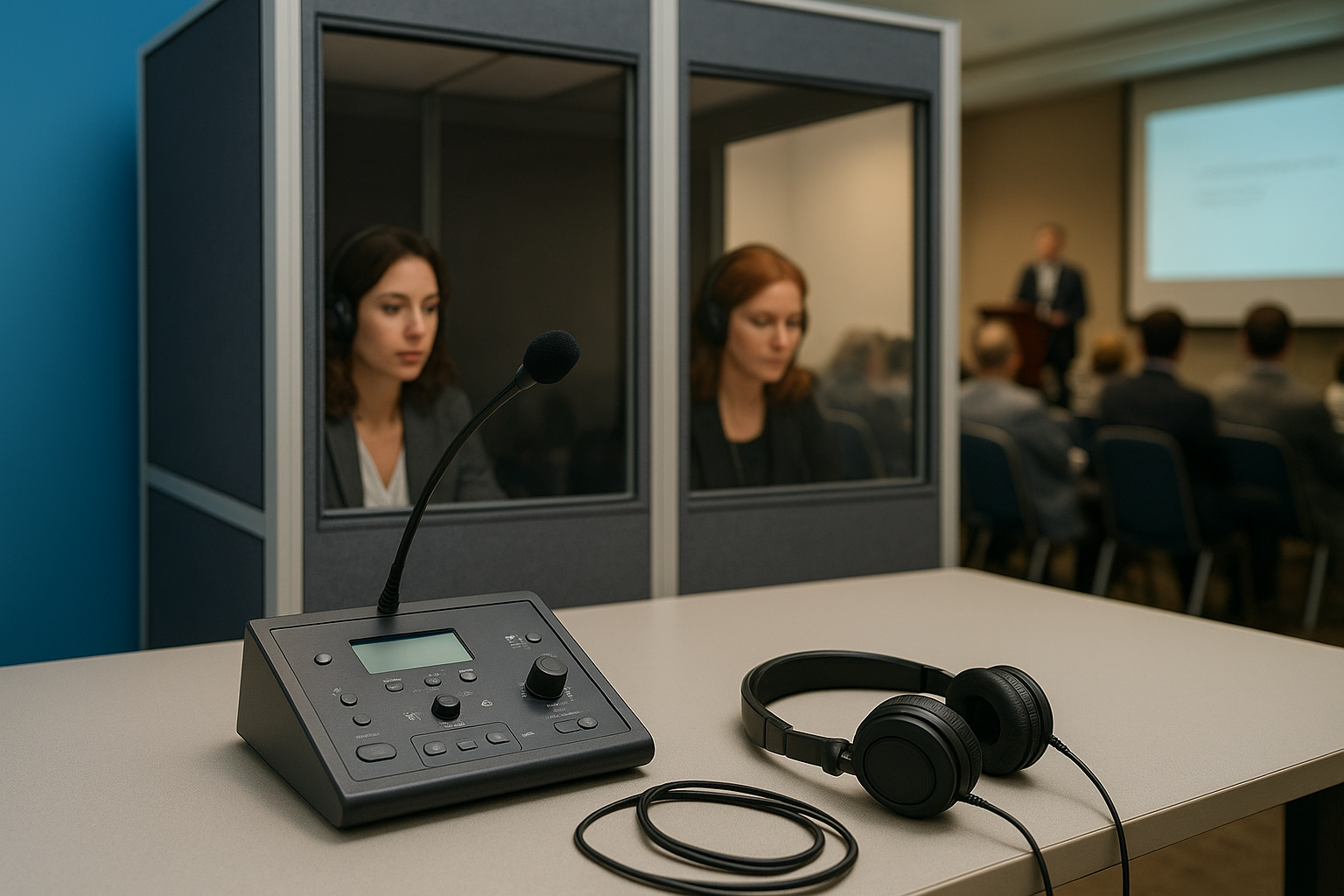
Common booth and equipment components include:
- Interpreter consoles with microphones and output controls
- Wireless receivers distributed to attendees by language channel
- Soundproofed booths (permanent or portable, depending on the venue)
Interpreter rotation and team coordination
With conference interpreting explained in a real working environment, the rotation schedule becomes clear quickly. Interpreters switch every 25 to 30 minutes to sustain peak accuracy and concentration across long sessions.
Your lead interpreter coordinates handoffs between team members and stays in direct contact with event organizers to handle any mid-session adjustments.
How to hire and plan conference interpreting
With conference interpreting explained across its core modes and skills, the practical question becomes how to hire qualified professionals and set your event up for success. Start by identifying your language pairs, session length, and audience size well before the event date. Those three factors determine your booth requirements, interpreter count, and equipment needs.
What to look for in a conference interpreter
Relevant subject-matter experience is the first qualification to verify. An interpreter with a background in your industry handles terminology with greater confidence and needs less preparation time. Key qualifications to confirm include:
- Prior experience in your field (legal, medical, technical, or policy)
- Consecutive and simultaneous interpreting credentials
- Membership in a recognized professional association
Hiring interpreters who specialize in your subject area reduces the risk of terminology errors at critical moments.
Planning your logistics early
Equipment sourcing, booth installation, and receiver distribution all require advance coordination. Confirm with your venue whether permanent booths exist or whether you need portable systems arranged through your language services provider. Key planning steps include:
- Book interpreters and equipment at least two to three weeks out
- Share speaker materials and terminology glossaries in advance
- Confirm attendee headset distribution logistics with your AV team
Next steps
With conference interpreting explained across its core modes, required skills, and practical logistics, you now have enough grounding to make informed decisions, whether you are planning a multilingual event or evaluating interpretation as a career. The gap between a well-interpreted conference and a poorly managed one comes down to preparation and the quality of professionals you bring in. Every decision you make before the event, from selecting the right mode to sharing terminology materials early, directly affects how well your attendees follow and retain the conversation.
If you are ready to staff an upcoming event or need guidance on which interpreting setup fits your specific situation, Languages Unlimited has been placing qualified conference interpreters since 1994. Our network covers hundreds of languages, and our team can help you identify the right professionals and equipment well before your event date. Contact our team to get your project moving.