



Procurement decisions for language services, translation, interpretation, staffing, often start with two documents that look similar but serve very different purposes. If your organization is navigating RFP and RFI support for the first time, or if past procurement cycles left you frustrated with mismatched vendors, understanding the distinction between these two tools matters more than most people realize. Getting it wrong can waste weeks of your team’s time and attract proposals that miss the mark entirely.
An RFI (Request for Information) helps you explore what’s available. An RFP (Request for Proposal) asks qualified vendors to compete for your business with detailed bids. Knowing when to use each one, and how to structure them, gives you a real advantage in selecting the right partner. At Languages Unlimited, we’ve responded to RFPs and RFIs from government agencies, healthcare systems, legal firms, and educational institutions since 1994. That experience on the vendor side has given us a clear view of what separates effective procurement from wasted effort.
This article breaks down the core differences between RFIs and RFPs, walks through when to use each, and shares practical tips for evaluating vendors during the selection process. Whether you’re sourcing interpretation, translation, bilingual staffing, or accessibility services, these guidelines will help you build a procurement process that actually delivers results.
RFI vs RFP: definitions and key differences
Both documents are part of a formal procurement process, but they operate at different stages and ask very different things of vendors. Confusing the two is a common mistake, and it typically results in too much complexity too early or not enough vendor information to make a smart decision. Before you build out any RFP and RFI support process, you need a clear working definition of each document and a firm sense of how they relate to one another.
What is an RFI?
An RFI, or Request for Information, is a preliminary document you send to vendors when you’re still exploring the market. You use it to gather general information about what vendors offer, how they operate, and whether they’re worth inviting into a formal bidding process. An RFI is not a commitment on either side. It’s a structured conversation that helps you narrow your list of potential partners before you invest time writing a detailed proposal request.
For example, if your hospital system is considering adding Video Remote Interpreting (VRI) services but you’re unsure which vendors can operate at the scale you need, an RFI lets you ask those questions openly. You learn about capacity, certifications, pricing models, and relevant experience without locking anyone into a formal bid. This discovery phase protects your team’s time downstream.
What is an RFP?
An RFP, or Request for Proposal, is a formal document you issue once you know what you need. It asks qualified vendors to submit detailed proposals that respond to specific requirements, timelines, evaluation criteria, and pricing structures. The vendors who respond are competing for your business, which means the quality and specificity of your RFP directly affects the quality of the proposals you receive.
A vague RFP produces vague proposals. The more clearly you define your requirements, the easier it becomes to compare vendors on equal footing.
If your organization needs a certified translation vendor for USCIS-approved documents across multiple states, an RFP lets you specify language pairs, turnaround expectations, compliance requirements, and volume. Vendors then respond with tailored proposals you can evaluate side by side.
Key differences at a glance
The table below summarizes the core distinctions so you can quickly identify which document fits your current stage of procurement.
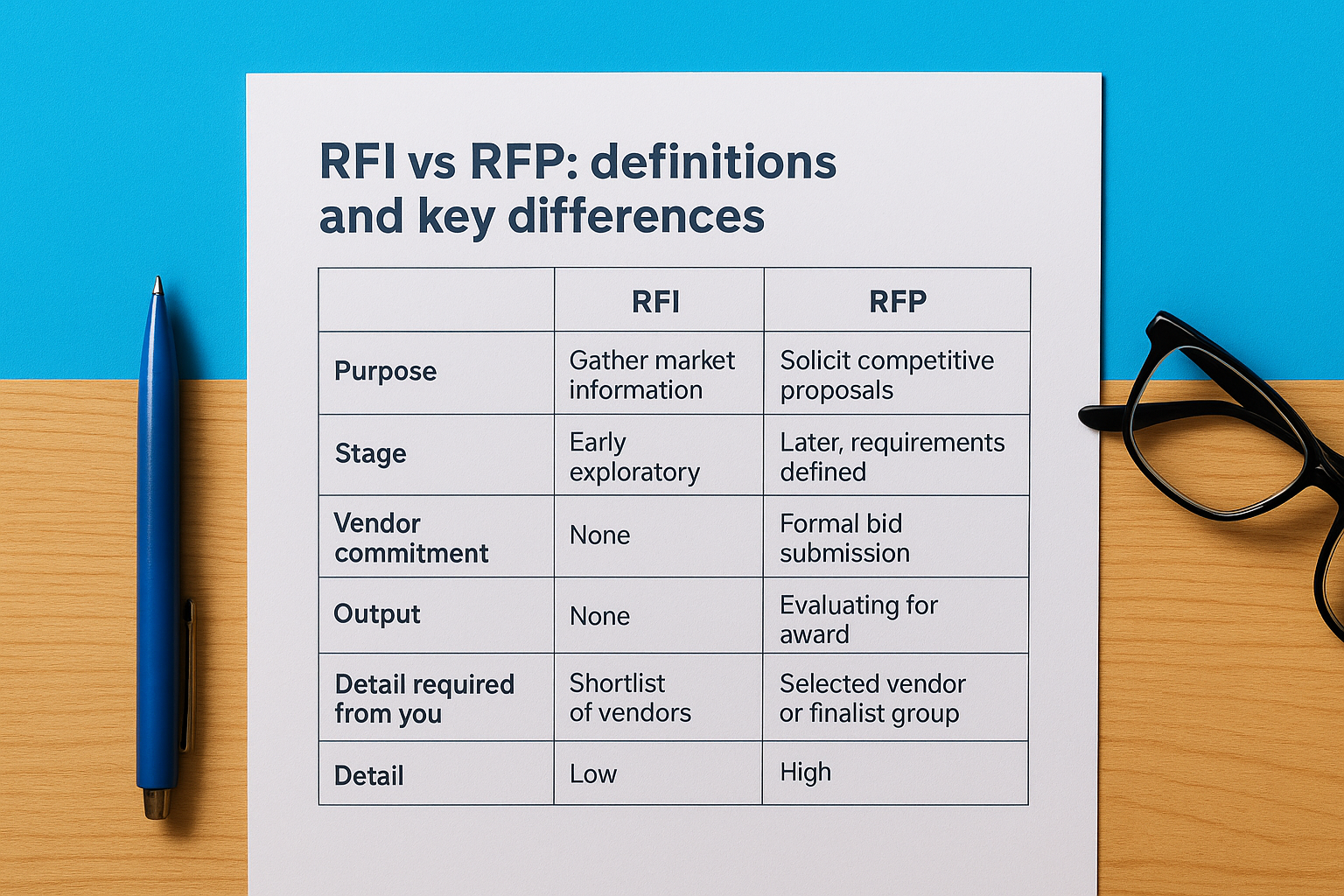
| Factor | RFI | RFP |
|---|---|---|
| Purpose | Gather market information | Solicit competitive proposals |
| Stage | Early, exploratory | Later, requirements defined |
| Vendor commitment | None | Formal bid submission |
| Your commitment | None | Evaluating for award |
| Output | Shortlist of vendors | Selected vendor or finalist group |
| Detail required from you | Low | High |
Using the right document at the right stage keeps your procurement process focused and prevents you from overwhelming vendors or yourself with premature complexity.
When to use an RFI, an RFP, or an RFQ
Choosing the right document for your procurement stage is one of the most practical decisions you’ll make. Many organizations skip the RFI entirely and jump straight to an RFP, which often means writing a detailed document before they understand the market. Others issue an RFI when they already know what they want, which wastes vendor time and delays the process. A third document, the Request for Quotation (RFQ), enters the picture when price is your primary evaluation factor.
Use an RFI when you’re still exploring
If your organization hasn’t worked with a particular service category before, an RFI is the right starting point. You might be evaluating whether a vendor can support telephonic interpretation across multiple locations or handle over 200 language pairs at scale. An RFI lets you gather that information without committing to a full bid cycle.
- You’re unsure which vendors meet your scale or compliance requirements
- You want to benchmark pricing models before setting your budget
- You need to build a shortlist before writing an RFP
Use an RFP when your requirements are clear
Once you’ve done your market research, an RFP gives vendors the structure they need to respond competitively. Your requirements should be specific enough that every vendor responds to the same scope. This is where strong rfp and rfi support from your procurement team makes a real difference in the quality of bids you receive.
The cleaner your RFP, the less time you spend sorting through proposals that don’t match your actual needs.
Use an RFQ when price drives the decision
An RFQ works best when the service is well-defined and vendor qualifications are already confirmed. You’re essentially asking how much a fixed scope will cost, which fits best for routine translation projects with established language pairs and quality standards already in place.
Issuing an RFQ too early, before you’ve confirmed a vendor’s capabilities and compliance record, leads to cost comparisons that don’t account for meaningful quality differences. Use it after you’ve completed your vetting through an RFI or RFP.
Why RFI and RFP support matters
Most procurement failures happen before a single proposal arrives. Unclear requirements, missing evaluation criteria, and rushed timelines push vendors to guess at what you need, which means you end up reviewing bids that don’t address your actual situation. For language services in particular, where compliance requirements and language pair coverage vary significantly by vendor, a poorly structured process produces results that cost you time to untangle.
The cost of skipping preparation
When organizations move forward without structured rfp and rfi support, they typically encounter two problems. First, they attract responses from vendors who aren’t qualified for the work. Second, they receive proposals that are so inconsistent in format and scope that direct comparison becomes nearly impossible. Both problems push the decision timeline back and often result in a vendor selection based on price alone rather than capability.
A procurement process that saves you two weeks on the front end can cost you six months of poor vendor performance on the back end.
Evaluation criteria need to be defined before the document goes out, not after responses arrive. If your organization is sourcing interpretation services for a healthcare setting, criteria like HIPAA compliance, language pair depth, and response time under pressure matter far more than general pricing.
What structured support changes
Good procurement support helps you design documents that match your actual needs to the stage of the process. It also helps you anticipate vendor questions before they come in, which reduces back-and-forth during the open period and keeps your timeline on track. Organizations that invest in structured preparation consistently receive stronger proposals, shorter evaluation cycles, and fewer surprises after contract award.
Language services procurement has real complexity that general procurement templates rarely account for. Certifications, interpreter qualifications, and compliance documentation all vary significantly by vendor, and knowing what to ask for, and when to ask it, directly shapes the quality of partners you bring to the table.
How to run an RFI or RFP that gets good bids
The structure of your document determines the quality of what comes back. If your requirements are vague or your evaluation criteria aren’t defined upfront, vendors fill gaps with assumptions that rarely match what you actually need. Strong rfp and rfi support starts with document design, long before any vendor sees your request.
Define your requirements before you write anything
Your internal team needs to agree on scope, volume, timelines, and compliance requirements before the document goes out. For language services, that means knowing which language pairs you need, what certifications matter (ATA membership, USCIS approval, GSA contract status), and whether your environment carries specific obligations like HIPAA for healthcare or Section 508 for federal accessibility compliance.
Skipping internal alignment before issuing your RFI or RFP is the single most common reason procurement cycles stall.
List your mandatory requirements in priority order so vendors understand what’s required versus what’s preferred. This keeps proposal evaluation consistent across reviewers and makes scoring defensible.
Set a realistic timeline and communicate it clearly
Vendors need enough time to prepare accurate, detailed proposals. Rushing the response window produces thin bids from vendors who prioritize speed over quality. Build your procurement timeline around these key dates:
- Question submission deadline
- Published answers date
- Proposal submission deadline
- Evaluation period end date
Ask the right questions for language services
Language services procurement has specific needs that general templates miss. Ask vendors to document their interpreter credentialing process, explain how they handle after-hours requests, and confirm their coverage for less common language pairs. Vague open-ended prompts give vendors too much room to redirect attention away from weak areas.

Request verifiable references from clients in your industry, whether that’s healthcare, legal, or government. The questions you include shape the information you receive, and targeted questions consistently produce proposals that are far easier to compare and score.
Vendor selection tips for language services
Once proposals arrive, your evaluation criteria should already be set. Strong rfp and rfi support means building your scoring rubric before you open a single document, so your team compares vendors on consistent, defined terms rather than price alone.
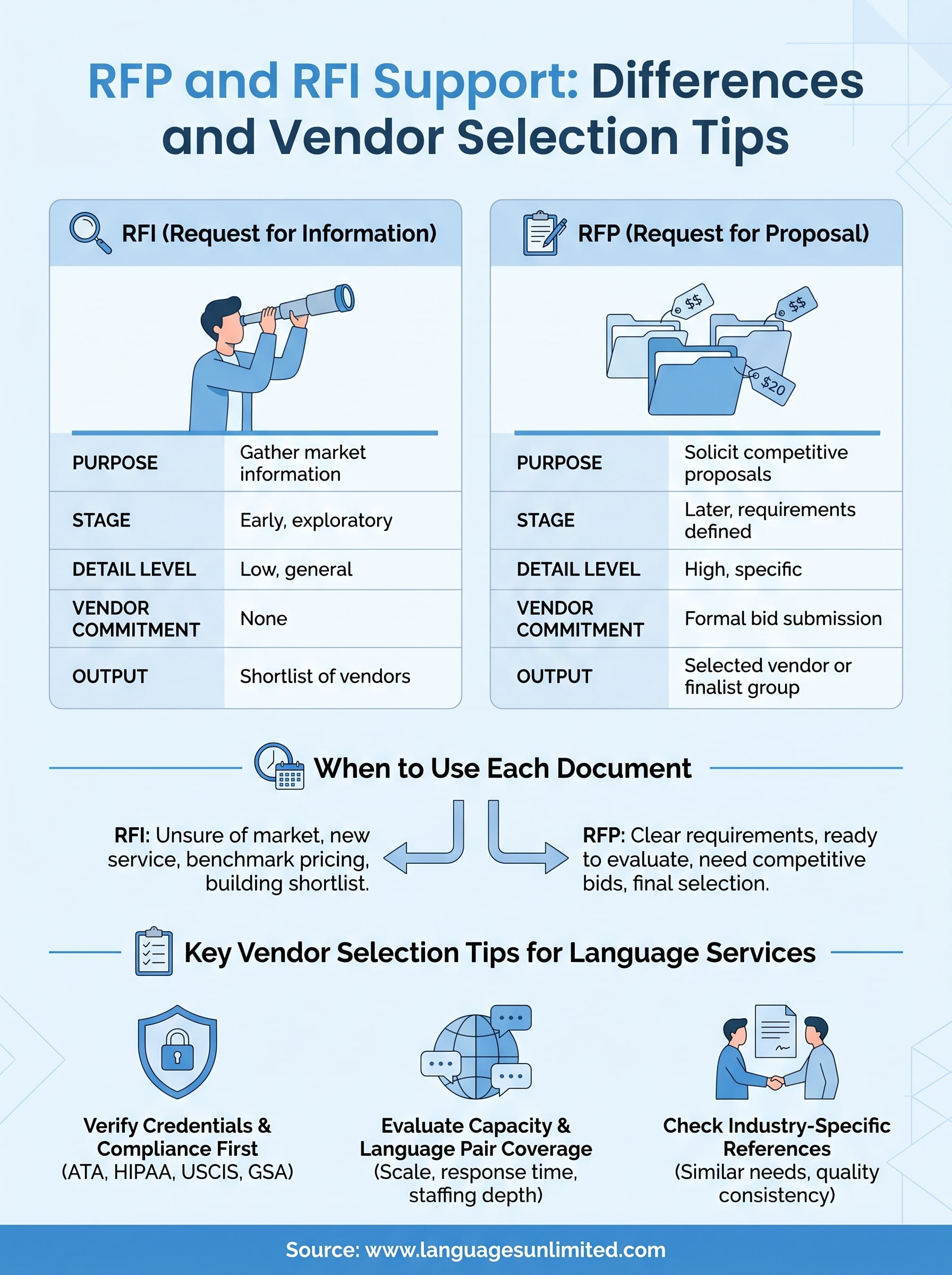
Verify credentials and compliance first
Certifications and compliance documentation are your first filter. Confirm that vendors hold credentials relevant to your sector, including ATA membership, USCIS approval, or a GSA contract for government work. HIPAA compliance matters in healthcare settings, and Section 508 capability is required for federal accessibility work. Vendors who can’t document these clearly shouldn’t advance past initial screening.
- ATA membership: professional translation standards
- USCIS approval: immigration and legal document translation
- GSA contract: government procurement
- HIPAA and Section 508: healthcare and federal compliance
Evaluate capacity and language pair coverage
Vendor capacity determines whether a partner can support you at scale, not just on a small initial project. Ask for specific numbers on interpreter availability and typical response times for urgent requests in your target languages.
Staffing depth across your required languages signals how a vendor performs under real pressure. A network of ten thousand or more language professionals gives you far more flexibility when volume increases or a less common language pair comes up than a smaller operation can offer.
Coverage gaps in less common languages are where vendor limitations surface fastest, so ask about those directly.
Check references from your industry
Industry-specific references carry more weight than a general client list. A vendor who has served healthcare systems, legal firms, or government agencies already understands the compliance expectations and terminology those environments demand.
Request two or three references from clients with similar needs and ask direct questions about turnaround reliability and quality consistency over time. Those conversations tell you far more than any proposal document can.
Next steps
You now have a clear framework for structuring your procurement process, from knowing when to issue an RFI versus an RFP, to evaluating vendors on credentials, capacity, and industry-specific references. Strong rfp and rfi support starts before you draft a single document, and the decisions you make during preparation determine the quality of everything that follows. The biggest mistakes in language services procurement, vague requirements, missing compliance filters, and rushed timelines, are also the most preventable ones.
If your organization is preparing to source translation, interpretation, bilingual staffing, or accessibility services, Languages Unlimited has been responding to government, healthcare, and legal RFPs since 1994. That track record means we understand exactly what procurement teams need to see in a proposal. Reach out to our team to discuss your requirements, confirm our credentials, or ask questions before your next procurement cycle opens. Contact Languages Unlimited today to get started.