



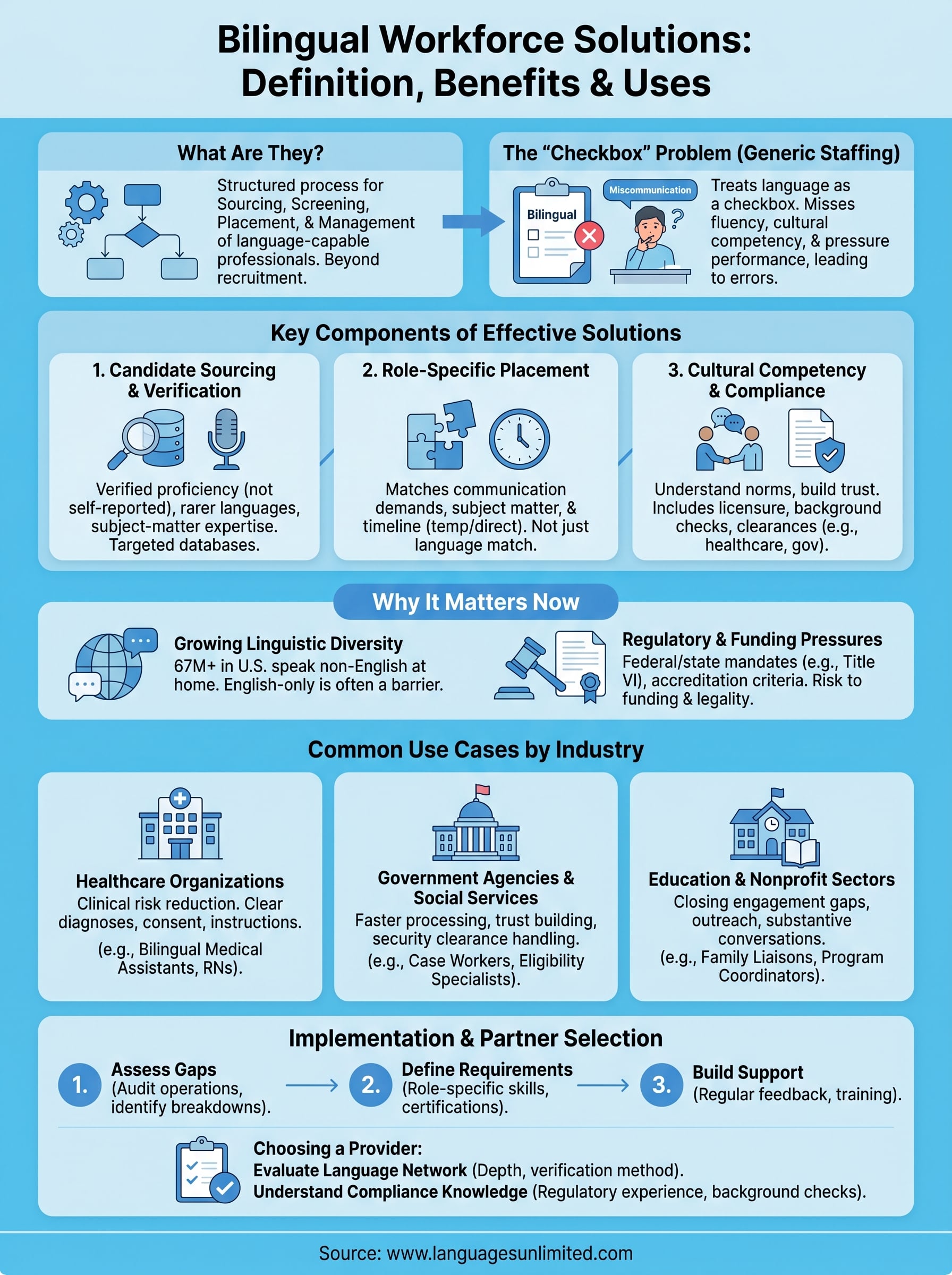
Hiring someone who speaks two languages isn’t the same as building a team that can actually bridge communication gaps. Bilingual workforce solutions go further than recruitment, they encompass the sourcing, screening, placement, and management of language-capable professionals who can serve diverse populations across healthcare, government, education, and the private sector. For organizations struggling to connect with the communities they serve, getting this right changes everything, from patient outcomes to public trust.
The challenge is that most staffing firms treat bilingual hiring as a checkbox. They’ll confirm a candidate speaks Spanish or Mandarin, but they won’t assess dialect fluency, cultural competency, or the ability to perform under pressure in both languages. That gap between "bilingual on paper" and bilingual in practice creates real problems, miscommunication in hospitals, bottlenecks in government offices, and frustrated clients walking out the door. The demand for qualified bilingual professionals continues to outpace supply, making the right staffing partner essential.
At Languages Unlimited, we’ve operated at the intersection of language services and workforce placement since 1994. Our network spans over ten thousand language professionals across more than 200 languages, and our staffing solutions are built on the same standards we bring to certified translation and interpretation, accuracy, compliance, and cultural competence. This article breaks down what bilingual workforce solutions actually are, how organizations use them, and what to look for when choosing a provider.
What bilingual workforce solutions include
Bilingual workforce solutions cover a broader scope than most organizations expect when they first start looking for language-capable staff. The term describes a structured set of services that helps you find, vet, place, and retain professionals who can operate fluently in two languages within a specific work context. That last part matters: fluency in a social setting is very different from the precision required in a hospital exam room or a government benefits office.
Candidate sourcing and language verification
The first layer involves finding candidates who actually meet the bar. Most general staffing firms pull from the same talent pools and apply a basic language filter, but that process misses a lot. Specialized bilingual staffing providers maintain dedicated databases of language-qualified professionals, segmented by language pair, dialect, industry experience, and verified proficiency level. A fluent Spanish speaker who worked in retail is not automatically qualified to handle patient intake at a clinic.
Language verification done right goes beyond a self-reported checkbox. It includes structured assessments that test vocabulary, comprehension, and the ability to communicate clearly under real-world conditions.
Sourcing also accounts for rarer language combinations that most staffing firms cannot fill. If your organization serves a community that speaks Haitian Creole, Somali, or Tagalog, a provider with a wide-reaching professional network will outperform a generalist firm consistently.
Role-specific placement
Once candidates are vetted, the placement process matches them to roles based on more than just language match. A well-structured placement process considers the specific communication demands of the position, the subject matter involved, and whether the role requires independent work or close team coordination. A bilingual medical assistant needs very different skills than a bilingual case manager or a bilingual HR coordinator.
Placement also covers employment type and timeline, including direct hire, temp-to-hire, and contract arrangements. This flexibility matters because workforce needs shift quickly. A hospital system managing a surge in a particular patient population may need qualified bilingual staff within days, not weeks.
Cultural competency and compliance screening
Language ability alone does not guarantee effective communication. Cultural competency refers to a professional’s ability to understand the norms, expectations, and sensitivities of the communities they serve, and to adapt their communication accordingly. Providers that include cultural competency screening give you candidates who can build genuine trust, not just transfer words from one language to another.
Compliance screening runs alongside this. Depending on your industry, you may need to verify professional licensure, background checks, security clearances, or specific certifications before placing someone in a client-facing or regulated role. A provider with experience in healthcare and government staffing understands these requirements and builds them into the placement process from the start, so you are not chasing documentation after the fact.
Why bilingual workforce solutions matter now
The workforce landscape has shifted significantly over the past decade. Demographic change, expanding compliance requirements, and growing public expectations have all pushed organizations to prioritize language access in ways they previously could not afford to ignore. If your team cannot communicate with the people it serves, you are not just leaving value on the table, you are creating real operational and legal exposure.
The U.S. population is more linguistically diverse than ever
More than 67 million people in the United States speak a language other than English at home, according to U.S. Census Bureau data. That number has grown consistently, and it spans not just Spanish but dozens of other languages, including Arabic, Chinese, Vietnamese, Tagalog, and Haitian Creole, across every region of the country.
This shift means that organizations in healthcare, education, and government are increasingly serving communities where English-only communication is a barrier, not a baseline.
For employers, this creates a straightforward problem: if your front-line staff cannot communicate with patients, clients, or community members in their preferred language, service quality drops and trust erodes. Bilingual workforce solutions address this directly by placing professionals who can meet people where they are, not just linguistically, but culturally.
Regulatory and funding pressures are increasing
Federal and state language access requirements now apply to a wide range of organizations that receive public funding. Title VI of the Civil Rights Act requires federally funded programs to provide meaningful access to people with limited English proficiency. Hospitals, social service agencies, courts, and schools all fall under this mandate, and enforcement has grown more active.
Beyond federal requirements, accreditation bodies and grant programs increasingly evaluate language access capabilities as part of their criteria. Failing to demonstrate that your workforce can serve diverse populations can put funding, contracts, and accreditation status at risk. Organizations that build qualified bilingual capacity into their staffing strategy are better positioned to meet these standards without scrambling every time a review comes around.
Common use cases by industry and role
Bilingual workforce solutions look different depending on the setting, but the core need is consistent: qualified professionals who can communicate accurately with the people they serve. The industries below represent the highest-demand areas where language gaps create the most serious consequences.
Healthcare organizations
Hospitals, clinics, and public health agencies face some of the highest stakes when communication breaks down. A bilingual medical assistant, patient care representative, or intake coordinator does more than translate words; they help patients understand diagnoses, consent forms, and medication instructions without confusion or delay. Errors in this environment carry real clinical risk.

When a patient cannot clearly communicate symptoms or a clinician cannot explain a treatment plan, the outcome gap between English-speaking and limited-English-proficient patients widens fast.
Bilingual CNAs, LPNs, and RNs are also in strong demand at facilities serving Spanish-speaking, Vietnamese, or Arabic-speaking patient populations. Healthcare staffing that includes language-qualified candidates helps you reduce reliance on ad hoc interpretation and build consistent communication capacity into your care team.
Government agencies and social services
Federal, state, and local agencies that interact with the public need bilingual staff across administrative, benefits, and case management roles. A bilingual case worker or eligibility specialist can move through interviews and documentation faster, reduce processing errors, and build trust with applicants who might otherwise disengage from the process entirely.
For agencies with security clearance requirements, sourcing cleared bilingual personnel adds another layer of complexity that most general staffing firms are not equipped to handle. Specialized providers with government experience understand how to navigate those requirements while still meeting language access obligations.
Education and nonprofit sectors
Schools and nonprofits often serve the most linguistically diverse populations with the fewest internal resources to address it. Bilingual instructional aides, family liaisons, and program coordinators help organizations close gaps in family engagement, service access, and community outreach. These roles require professionals who can hold substantive conversations in both languages, not just exchange basic information, and who understand the cultural context behind what they are hearing.
How to implement bilingual workforce solutions
The most common mistake organizations make is jumping straight to hiring without mapping out where language gaps actually exist in their operations. A structured implementation approach saves time and reduces the risk of placing the wrong person in the wrong role, which creates bigger problems than the original gap you were trying to close.
Assess your language access gaps first
Audit your current operations before you post a single job description, and identify where communication breakdowns happen most often. Look at patient complaints, case processing delays, client feedback, or staff reports. These are the places where bilingual capacity will deliver the most immediate impact. Document which departments, roles, and language pairs are involved so you can build a sourcing strategy around real needs rather than assumptions.
Skipping this step often results in bilingual hires placed in low-contact roles while high-demand areas remain underserved.
Define the roles and proficiency requirements
After identifying the gaps, write role-specific requirements that go beyond "speaks Spanish." Specify the subject matter the candidate will work with, the formality level required, and whether they need to handle written communication in both languages or only spoken interaction. For regulated industries like healthcare or government services, include any certifications, licensure, or clearance requirements upfront so your staffing partner can filter accurately from the start.
Separating minimum proficiency thresholds from preferred qualifications gives you flexibility when the talent pool is tight while still maintaining a clear standard for what the role demands.
Build in ongoing support
Placing a bilingual professional in a role is not the finish line. Regular check-ins and performance feedback help you identify early whether communication gaps are closing or new ones are forming. Organizations that treat bilingual workforce solutions as a one-time hire often find the same problems resurfacing within six to twelve months.
Structured feedback loops between supervisors, clients, and the bilingual staff member allow you to adjust responsibilities, provide additional training, or scale the team as demand shifts.
How to choose a provider and stay compliant
Choosing the right provider for bilingual workforce solutions is not a decision you should make based on price alone. The provider you select becomes an extension of your organization, and gaps in their screening standards or compliance knowledge will show up in your workforce quickly. Before you commit to any arrangement, evaluate whether the provider can actually deliver at the depth your roles require.
Evaluate the provider’s language network and vetting process
Not all staffing firms have genuine reach across 200-plus languages and dialects, and fewer still have structured processes to verify proficiency in subject-matter-specific contexts. Ask directly how they test language ability, whether those tests are standardized or conversation-based, and how they assess cultural competency alongside fluency. A provider that cannot answer these questions clearly is likely applying a surface-level filter.
The depth of a provider’s professional network determines whether they can fill urgent, specialized, or rare-language roles quickly, or leave you waiting for weeks.
You should also ask for references from clients in your specific industry. A firm with a strong track record in government staffing may not have the same experience placing bilingual clinical staff in a hospital environment. Relevant industry experience tells you whether they understand the compliance standards and role demands that apply to your organization.
Understand what compliance requires from your staffing partner
Language access compliance is not just your responsibility. If your organization falls under Title VI of the Civil Rights Act, the Americans with Disabilities Act, or state-specific language access mandates, your staffing partner needs to understand how those requirements affect candidate screening, documentation, and placement timelines. A provider who treats compliance as an afterthought can put your organization at risk even when they fill a role on time.
Before signing a contract, confirm that the provider handles background checks, licensure verification, and any clearance requirements as part of their standard intake process. Chasing paperwork after a candidate starts is a sign the provider’s process was not built with regulated industries in mind.
Next steps
Building a bilingual workforce requires more than a good intention; it requires a structured approach backed by a provider with real depth in language screening, cultural competency, and compliance. The organizations that get the most out of bilingual workforce solutions are the ones that start by identifying their actual communication gaps, define role-specific language requirements, and then partner with a firm that can fill those roles accurately and quickly.
If you are ready to move beyond surface-level hiring and build a team that can genuinely serve diverse populations, Languages Unlimited can help. We have placed language-qualified professionals across healthcare, government, education, and the private sector since 1994, drawing from a network of over ten thousand vetted language professionals in more than 200 languages. Our team understands the compliance standards that apply to your industry and builds them into every placement from day one. Contact our team today to talk through your specific staffing needs.