



Government agencies at the federal, state, and local level face hiring challenges that most private-sector employers never encounter. Between civil service regulations, security clearance requirements, and strict compliance frameworks, filling open positions is rarely as simple as posting a job and picking a candidate. That’s where government recruiting services come in, specialized staffing and recruitment firms that understand the rules, timelines, and expectations unique to the public sector hiring process.
For agencies that serve multilingual communities or operate in culturally diverse regions, the challenge goes a step further. Finding candidates who are not only qualified but also language-capable and culturally competent requires access to talent pools that general staffing firms simply don’t have. At Languages Unlimited, we’ve spent decades building exactly that kind of network, placing bilingual and multilingual professionals in government roles across all 50 states, from administrative support to healthcare and social services positions.
This article breaks down how government recruiting services work, what sets them apart from conventional staffing, and what agencies should look for when choosing a recruitment partner. Whether you’re a procurement officer, an HR director at a federal agency, or a program manager trying to fill critical vacancies, this guide will give you a clear, practical understanding of how public agencies hire, and how the right recruiting partner can make that process faster and more effective.
What government recruiting services are
Government recruiting services are specialized staffing and search firms that focus on filling roles within public sector organizations. Unlike general staffing agencies, these firms understand the rules and compliance requirements that govern how federal, state, and local agencies hire, including civil service classifications, position grade structures, and security clearance protocols. They don’t just match resumes to job descriptions; they navigate a hiring environment built on regulations that can delay or derail a placement if handled incorrectly. For agencies facing urgent vacancies or workforce shortages, that expertise makes a real difference.
The core focus of public sector recruitment
At their foundation, government recruiting services exist to solve a specific problem: government agencies need qualified people, but the process of identifying, vetting, and onboarding those people is far more complex than in the private sector. These firms maintain [active talent pipelines](https://www.languagesunlimited.com/government-staffing/) built specifically for public sector roles, meaning they aren’t starting from scratch each time an agency opens a position. That pre-built access shortens timelines and increases the likelihood that the candidates you receive are already familiar with government work environments.
The most effective government recruiters don’t just fill vacancies; they understand the regulatory constraints agencies operate under and build their entire process around those requirements.
Where language capability fits in
Many government agencies serve populations that speak languages other than English. For those organizations, finding candidates who meet all technical and compliance qualifications is only part of the equation. Bilingual and multilingual professionals are in high demand across public health departments, courts, social services offices, and federal agencies, yet most standard recruiting firms lack access to that specific talent pool.
That gap is where a partner like Languages Unlimited delivers value most clearly. Combining staffing depth with verified language expertise, this approach makes it possible to place candidates who satisfy both regulatory requirements and the communication needs of the communities your agency serves.
What these services typically cover
Government recruiting services cover a broad range of functions that go well beyond posting a job listing. A qualified provider manages candidate sourcing, compliance screening, and skills verification, handling the steps that agencies often lack the internal bandwidth to run efficiently. That scope becomes even more critical when your vacancies require candidates who speak specific languages or understand particular cultural contexts.
Position types and roles
Most providers place candidates across a wide range of public sector roles, including administrative support, healthcare, legal services, social work, and program management. For agencies with language requirements, they also source bilingual and multilingual professionals who meet both the technical and communication qualifications your positions demand.
Choosing a recruiting partner with a deep bench of language-capable candidates means your agency spends less time searching and more time serving.
Compliance and vetting support
Your recruiting partner should handle more than resume review. Background checks, security clearance coordination, and regulatory compliance verification are standard expectations in government hiring. A strong provider builds those steps directly into their process rather than leaving them to you. Key vetting tasks typically include:

- Identity and employment history verification
- Security clearance processing for roles that require it
- Language proficiency screening for multilingual positions
Why government hiring works differently
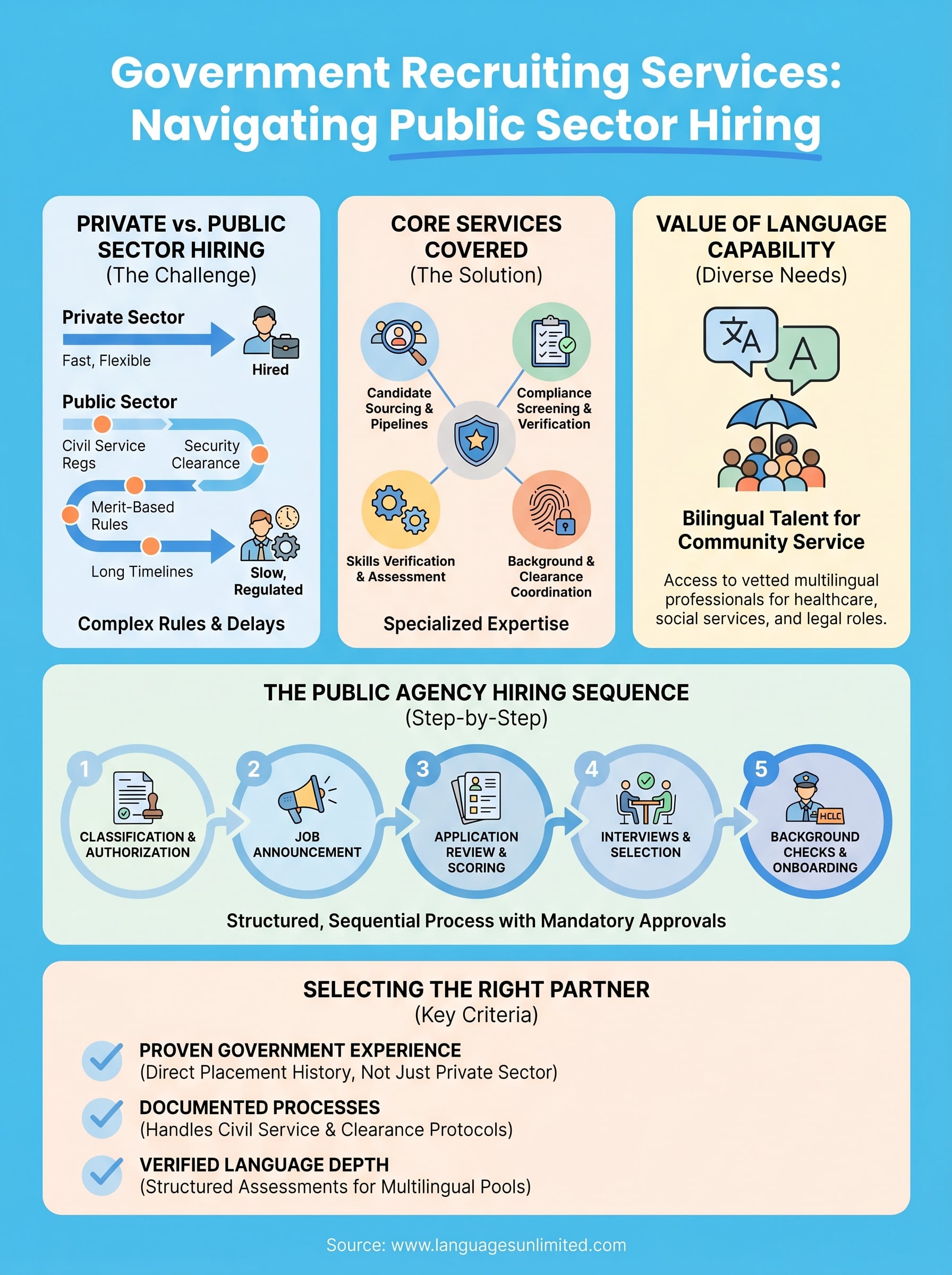
Government hiring operates under a fundamentally different set of rules than private-sector recruitment. Civil service laws, merit-based selection requirements, and budget authorization processes all create checkpoints that don’t exist in corporate hiring. When you work with a specialized firm offering government recruiting services, that firm already understands these structural differences and builds them into every search it runs.
Regulatory requirements shape every step
Public agencies can’t simply hire whoever they want, whenever they want. Federal and state regulations mandate that hiring decisions follow specific procedures, from how a position gets classified to how candidates are ranked and selected. Skipping or mishandling any of those steps can result in compliance violations, grievances, or rescinded offers that set your agency back significantly.
Timelines are longer and less flexible
Private-sector hiring can move in days. Government hiring often takes weeks or months, because each phase of the process requires formal approvals and documentation. Your recruiting partner needs to set realistic expectations from the start and manage candidate pipelines accordingly to avoid losing strong candidates to faster-moving employers.
Agencies that understand this timeline reality from the beginning are far better positioned to land qualified candidates before they accept other offers.
How public agencies hire step by step
Government hiring follows a structured sequence that agencies rarely have the flexibility to shortcut. Understanding each phase helps you set accurate timelines and avoid the frustration of stalled placements. A qualified government recruiting services partner guides you through every stage rather than handing off candidates and stepping away.
Working with a recruiter who knows this process end-to-end means fewer surprises and faster resolution when complications arise.
The typical hiring sequence
Each phase in the government hiring process carries specific documentation and approval requirements that your team must complete before moving to the next step. Here is how the process typically unfolds:
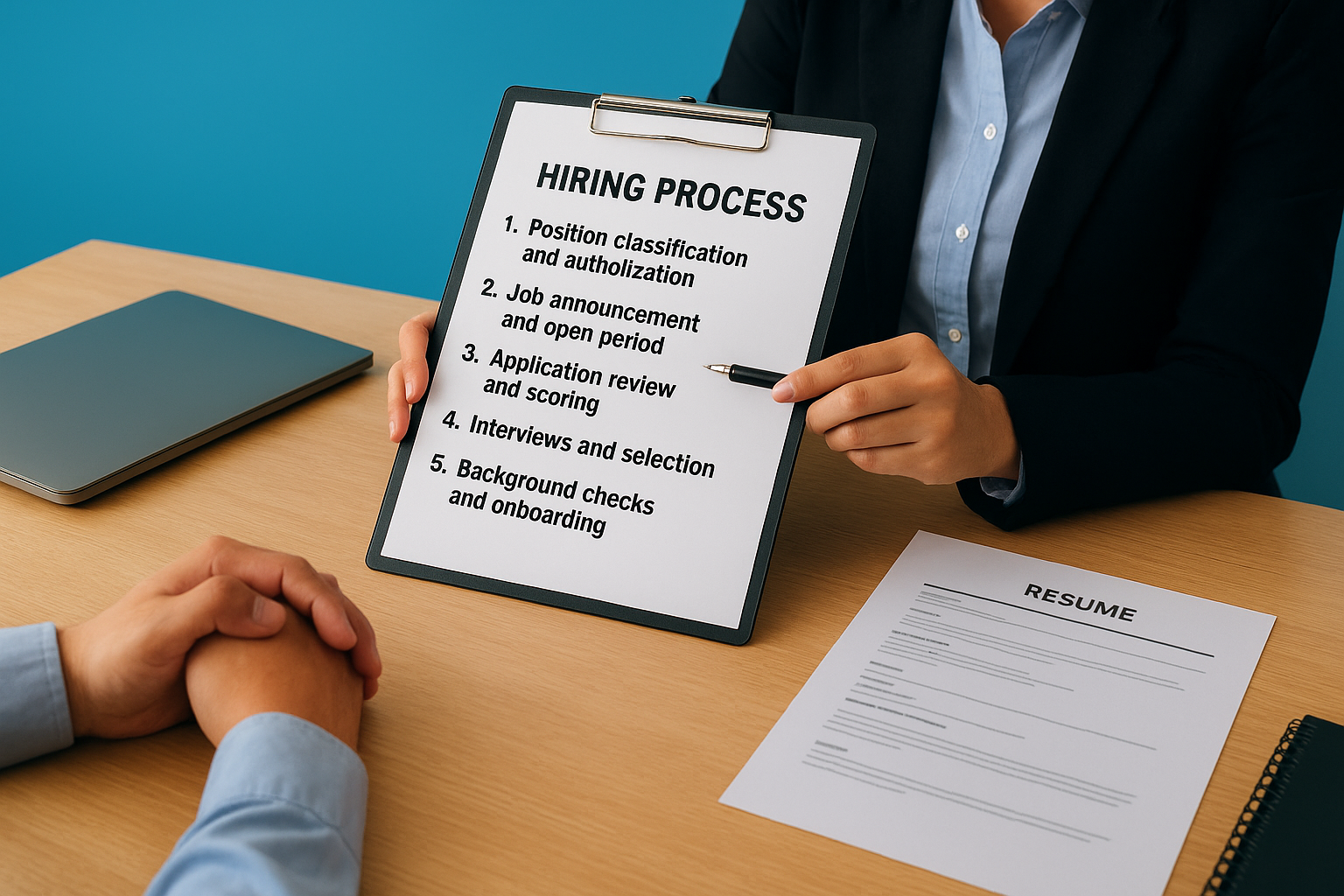
- Position classification and authorization – The role gets formally defined, graded, and approved for funding.
- Job announcement and open period – The vacancy is posted through official channels for a required window.
- Application review and scoring – Candidates are ranked based on merit criteria and qualifications.
- Interviews and selection – A certificate of eligible candidates is issued before interviews begin.
- Background checks and onboarding – Clearance and compliance verification happens before the confirmed start date.
How to select a recruiting and language partner
Not every staffing firm that claims government experience actually has it. When evaluating government recruiting services, you need a partner who can demonstrate a direct placement history in public sector roles, not just private-sector work repackaged with different terminology. Ask for specific examples of agencies they’ve served, the types of positions they’ve filled, and how they managed security clearance coordination throughout the process.
The right partner reduces your hiring burden; the wrong one creates more administrative work than it resolves.
Look for proven government experience
Your partner should show you documented processes for civil service compliance and merit-based selection. If they cannot explain how they handle position classification requirements or candidate ranking protocols, they are not prepared for government work. Ask directly for references from public sector clients and confirm those engagements involved roles similar to the ones you need to fill.
Verify language and cultural depth
For agencies serving diverse communities, language capability verification is non-negotiable. Ask how your prospective partner screens for bilingual proficiency and whether they conduct structured language assessments rather than relying on candidate self-reporting. A firm with a large, vetted multilingual talent pool will consistently outperform one that treats language skills as an afterthought.
Final takeaways
Government hiring is slower, more regulated, and more complex than most organizations expect. Civil service requirements, merit-based selection rules, and security clearance protocols all add layers that general staffing firms are not equipped to handle. When you work with specialized government recruiting services, you get a partner who already understands those layers and builds their entire process around them.
For agencies serving diverse or multilingual communities, the hiring challenge goes beyond compliance. You need candidates who bring both the technical qualifications and the language capability your population requires. A recruiting partner with a deep, vetted multilingual talent pool closes that gap faster than any general staffing approach can.
Choosing the right partner from the start saves your agency significant time, money, and administrative strain. If your organization is ready to fill critical vacancies with qualified, language-capable professionals, contact Languages Unlimited to discuss how we can support your next hiring effort.