



Choosing the right technology for translation and localization management can make or break a multilingual content strategy. Phrase localization platform is one of the most widely discussed tools in this space, an AI-powered solution designed to help teams translate, manage, and automate content across languages and markets. But what exactly does it offer, and who is it built for?
At Languages Unlimited, we’ve been providing professional translation, interpretation, and staffing services since 1994, working with over ten thousand language professionals across more than 200 languages. That experience gives us a grounded perspective on the tools organizations use to manage localization workflows, including platforms like Phrase. Whether you’re a government agency, healthcare provider, legal firm, or enterprise team evaluating your options, understanding what Phrase brings to the table matters.
This article breaks down Phrase’s core features, pricing structure, and real-world use cases so you can determine whether it fits your needs. We’ll cover how its translation management system (TMS) works, what sets its AI and automation capabilities apart, and where it falls short. You’ll also find practical context on how platform-based localization compares to working with a full-service language provider, because the right choice often depends on your project’s complexity, compliance requirements, and the level of human expertise involved.
What the Phrase Localization Platform does
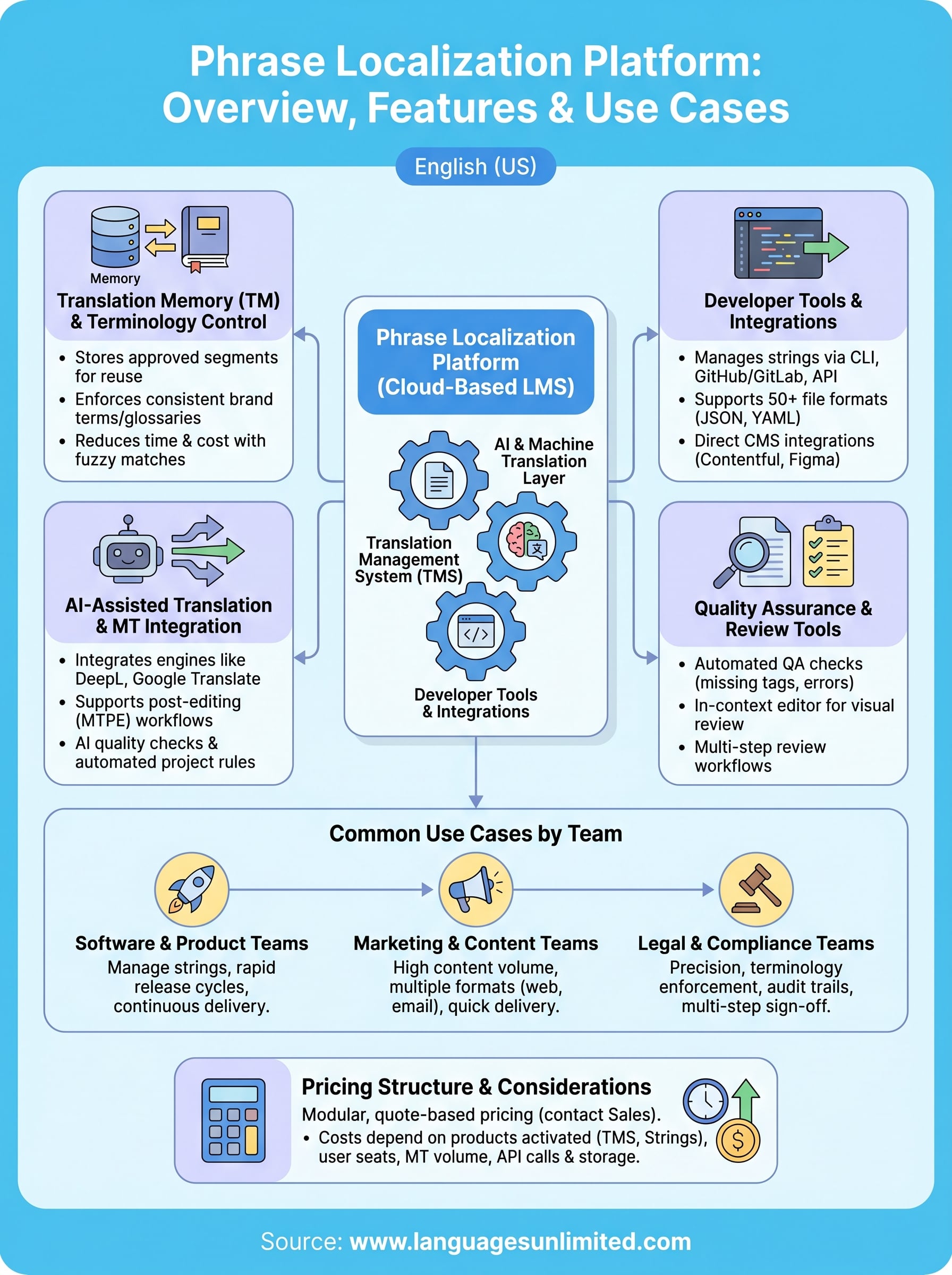
Phrase is a cloud-based localization management system built for organizations that need to translate large volumes of content across multiple languages and keep that content in sync over time. At its core, the phrase localization platform combines a translation management system (TMS), a machine translation layer, and a set of developer tools into one connected workspace. Teams use it to centralize translation projects, automate repetitive steps in the workflow, and reduce the time it takes to get content into a new language and live in front of an audience.
Translation Memory and Terminology Control
One of the most practical functions Phrase offers is translation memory (TM), which stores every previously approved translation segment and surfaces it automatically when a similar string appears in a new project. This cuts both time and cost because translators are not re-translating content that already has a vetted equivalent. Paired with TM, Phrase’s glossary and terminology management tools let you define brand-specific terms, product names, and preferred phrasing so that every translator working in the system uses consistent language.
Consistent terminology across a large content library is one of the hardest problems in multilingual operations, and translation memory directly addresses it by recycling approved work rather than starting from scratch.
Here is what these foundational tools handle in practice:
- Matching new source text against stored translation segments at the segment level
- Flagging fuzzy matches (partial similarities) for human review rather than auto-applying them
- Enforcing glossary terms so brand names or legal language never gets altered by accident
- Providing match rate reports so project managers can estimate costs before committing
AI-Assisted Translation and Machine Translation Integration
Phrase integrates with multiple machine translation (MT) engines, including Google Translate, DeepL, and Microsoft Translator, so you can route content through automated translation as a first pass before a human reviewer refines it. This post-editing model, sometimes called MTPE, is faster than full human translation and less error-prone than using raw machine output without review. Phrase also layers its own AI quality checks on top of MT output, flagging segments where the machine translation falls below a confidence threshold.
Beyond raw speed, the AI tools inside Phrase handle automatic project creation rules, which means the platform can detect new source content, spin up a translation job, assign it to the right linguist or vendor, and push the finished file back to your content system with minimal manual steps. For teams managing dozens of locales at once, this automation reduces the operational overhead significantly.
Developer Tools and Integrations
Phrase was built with engineering teams in mind from the start. Its Strings product (formerly Phrase Strings) gives developers a way to manage localization files directly inside their existing code repositories through CLI tools, GitHub and GitLab integrations, and a REST API. When a developer pushes a new build with updated strings, Phrase can pull those strings in automatically, route them for translation, and push the finished file back once translation is complete.
The platform also supports over 50 file formats, including JSON, YAML, XLIFF, and Android XML, which means most development stacks can connect without custom preprocessing. For non-technical content teams using tools like Figma, Contentful, or Adobe Experience Manager, Phrase provides direct integrations that pull content out of those tools, send it through the translation workflow, and return it formatted and ready to publish.
Why teams use a localization platform
Managing translation without a dedicated system works fine at low volume. But as soon as your content library grows, your language count increases, or your release cadence picks up, the manual approach breaks down fast. Spreadsheets, email threads, and disconnected file transfers create version control problems, missed deadlines, and inconsistent terminology across markets. A localization platform consolidates all of that into a single workflow where source content, translation jobs, reviewer assignments, and delivery move through a defined process without falling through the cracks.
Handling Scale Without Adding Headcount
When you publish content in ten or twenty languages, the operational load grows in proportion to the number of locales you support. A platform like the phrase localization platform lets your team scale output without hiring a coordinator for every language pair. Automated routing rules assign work to the right linguist or vendor the moment new content enters the system, and machine translation engines handle a first pass on high-volume, lower-stakes content so human reviewers focus their time where accuracy matters most.
This matters especially for product teams pushing frequent software releases. Every sprint cycle may generate hundreds of new strings that need to reach users in multiple languages simultaneously. Without automation, that process bottlenecks your release schedule.
The real productivity gain from a localization platform is not just speed; it is the elimination of the coordination work that slows everything down before translation even begins.
Reducing Errors and Protecting Brand Consistency
Translation errors in legal notices, medical instructions, or product documentation carry real consequences. A platform enforces style guides and approved glossaries at every step, so no translator replaces a regulated term with a local equivalent that changes meaning. It also keeps audit trails on every translation decision, which matters when you need to demonstrate compliance with regulatory requirements or explain a translation choice during a review.
Your brand tone can drift badly when you work with different vendors across different projects without a shared reference. A platform stores and enforces approved language at the segment level, meaning the same phrase always translates the same way across all content types and all markets. That consistency across markets is difficult to achieve through manual vendor management alone.
Core features and modules in Phrase
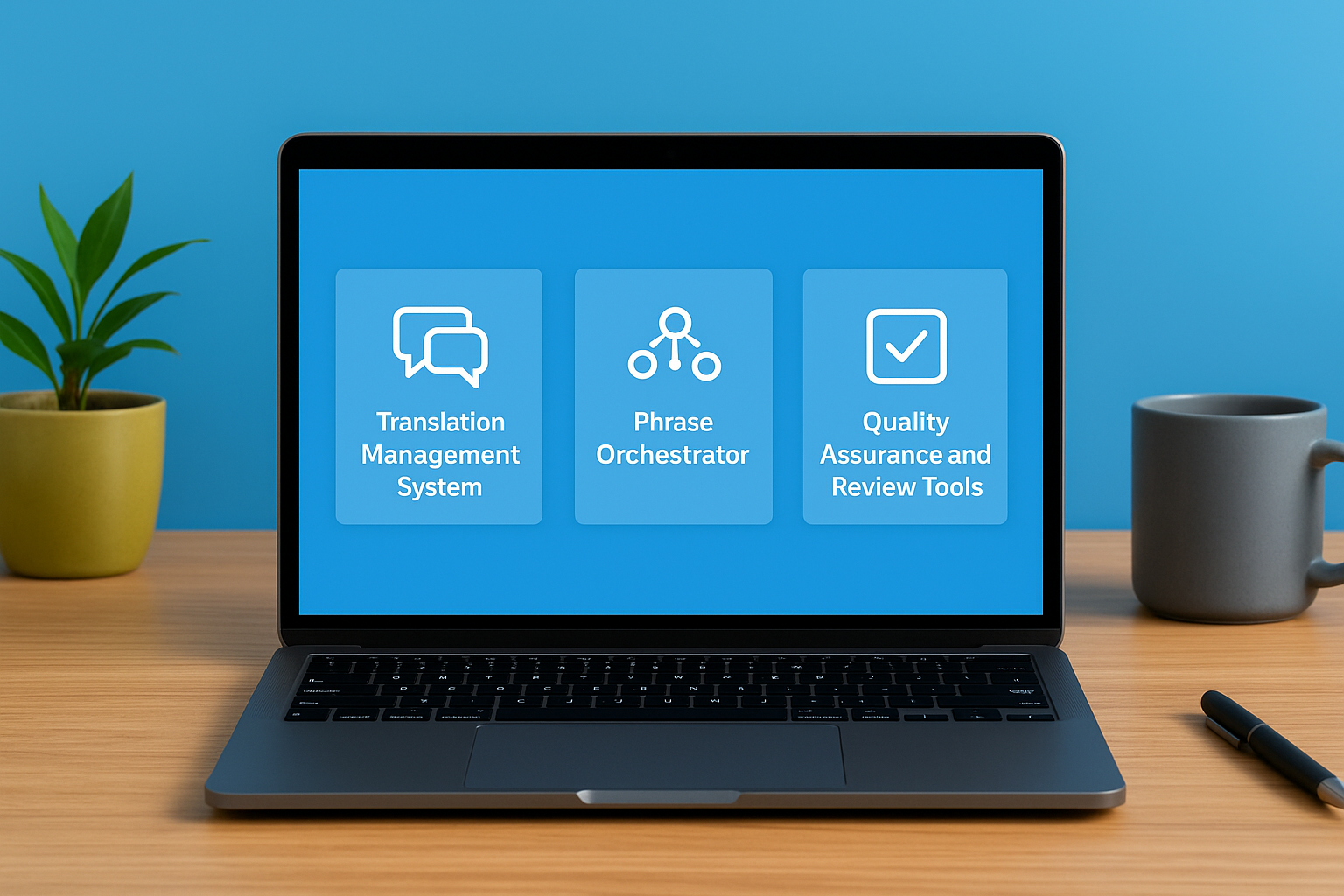
The phrase localization platform is organized around several distinct modules, each targeting a specific part of the localization workflow. Understanding what each module does helps you decide which combination fits your team’s structure and content volume before you commit to a plan.
Translation Management System (TMS)
Phrase’s TMS layer is the backbone of the entire platform. It handles job creation, linguist assignment, file processing, and delivery tracking inside one interface. When you upload a source file, the system segments it, checks it against your translation memory, applies glossary rules, and routes it to the appropriate translator or vendor based on your predefined workflow. The TMS also supports multi-step review workflows, so a translator, editor, and proofreader can each work through a file in sequence without any manual handoffs between stages.
- Segment-level translation memory matching
- Glossary enforcement across all jobs and linguists
- Multi-step reviewer assignment with role-based access
- Automated file format detection for over 50 supported formats
Phrase Orchestrator
Phrase Orchestrator sits above the TMS and handles the logic that decides how content flows through your entire localization operation. You configure rules that determine whether a string goes directly to machine translation, routes to a human translator first, or skips translation entirely if a 100% translation memory match exists. This conditional routing allows teams with high content volume to process thousands of strings per day without a project manager touching every individual job.
The Orchestrator’s value comes from removing decision-making friction at scale, not just speeding up individual translation tasks.
Quality Assurance and Review Tools
Built into every workflow, the QA module runs automated checks before any translation is marked complete. It scans for missing tags, untranslated segments, inconsistent terminology, and formatting errors that would break a live product or document. Your review team also benefits from Phrase’s in-context editor, which lets reviewers see translations displayed inside the actual UI or webpage layout. That catches layout-breaking text and mistranslated labels that a raw text review would miss entirely, and it cuts down the correction cycles that typically add days to a project timeline.
Pricing and plans: what you actually pay for
Phrase does not publish a simple tiered pricing page with flat monthly rates. Instead, the phrase localization platform uses a modular, quote-based pricing model where your cost depends on which products you activate, how many users need access, and what volume of content you process. You should expect to contact Phrase’s sales team for a formal quote, and you should come prepared with specifics about your language count, content volume, and integration requirements before that conversation.

How Phrase Structures Its Costs
Phrase prices its products separately, which means you pay for what you actually use rather than bundling features you do not need. The TMS module, Phrase Orchestrator, and Phrase Strings each carry their own licensing costs, so a software team that only needs developer-facing string management pays a different rate than an enterprise content team running full multi-step review workflows through the TMS. This modular approach gives you flexibility, but it also means your total contract value can grow quickly if your use case spans multiple products.
Getting a realistic cost estimate from Phrase requires knowing your exact workflow requirements upfront, because vague inputs lead to quotes that shift significantly once implementation begins.
Phrase does offer a free trial that lets you test the core TMS features without committing to a contract. The trial gives your team enough access to evaluate the interface, test integrations, and get a feel for the translation memory and glossary tools before any purchase decision.
What Drives Your Actual Bill
Your bill scales with a few key variables. Seat count is the most direct driver: every linguist, project manager, and reviewer who needs platform access adds to your cost. Beyond seats, machine translation volume matters if you route content through integrated MT engines, since providers like DeepL and Google Translate charge per character and Phrase passes those costs through.
Storage and API call volume can also push costs higher for teams with heavy automation or large translation memory databases. If you connect Phrase to multiple content management systems through its API, that integration traffic adds up over time. Before signing a contract, ask Phrase specifically how they calculate charges for MT usage, API calls, and additional user seats so you are not caught off guard when your content volume spikes during a product launch or market expansion.
Common use cases by team
Different teams reach for a localization platform for different reasons, and understanding those distinct use cases helps you decide whether the phrase localization platform fits the work your team actually does. The features that matter most to a software engineering team are not the same ones that drive value for a legal department or a global marketing operation, so it helps to look at each scenario separately.

Software and Product Teams
Software teams use Phrase primarily to manage localization strings across application builds and keep pace with rapid release cycles. When your engineers push new features weekly, you need a system that pulls updated strings from your repository automatically, sends them for translation, and returns finished files in time for the next deployment. Phrase’s GitHub and GitLab integrations handle that loop without requiring manual file exports between each sprint.
Here are the core tasks this team relies on Phrase to handle:
- Syncing string files between code repositories and translation workflows
- Managing multiple locales inside a single continuous delivery pipeline
- Enforcing consistent UI terminology across platform versions and updates
Marketing and Content Teams
Marketing teams deal with a different challenge: high content volume across many formats, from website copy and landing pages to email campaigns and regional ads. Your content editors need translations delivered fast and in the right tone for each market, which requires automation for bulk content and human review for anything customer-facing. Phrase’s Contentful and Adobe Experience Manager integrations let editors trigger translation directly from tools they already use, without handing files back and forth manually.
When your campaign launches on a fixed date across multiple markets, any delay in one locale’s translation can cost you the entire window.
Legal and Compliance Teams
Legal and compliance teams prioritize precision over speed, because a mistranslated contract term or regulatory phrase carries real liability. These teams rely on Phrase primarily for its terminology enforcement and audit trail features, which lock specific legal terms to approved translations and log every change made to a segment throughout review. That documentation matters when your legal department needs to demonstrate due diligence during an audit or dispute.
Your compliance reviewers benefit from multi-step sign-off workflows that require a qualified subject matter expert to approve each segment before it leaves the platform. That structured process reduces the risk of unreviewed machine translation reaching a finalized legal document.
How to evaluate and roll out Phrase
Evaluating the phrase localization platform starts before you ever speak to a sales rep. Before your first demo call, document your current translation workflow in detail: how content enters the process, who reviews it, how finished files get delivered, and where delays most often occur. That documentation gives you a clear lens for assessing whether Phrase’s features solve your actual problems or simply add new complexity to a process that needs structural fixes first.
The biggest implementation mistakes happen when teams configure a platform around their existing broken process instead of using the rollout to redesign that process from the ground up.
Start with a scoped pilot
Running a full deployment across all your locales and content types from day one is a reliable way to create confusion and frustration. Instead, pick a single content type and two or three language pairs for your pilot. That scope is narrow enough to surface real integration issues, workflow gaps, and terminology problems without overwhelming your team or your vendors. Document every friction point during the pilot and use that list to refine your configuration before you expand to additional locales.
During your pilot, track two metrics closely: time from content upload to final delivery, and the percentage of segments where translation memory returns a usable match. Those two numbers tell you whether the platform is actually compressing your timeline and reducing your per-word cost, which are the core operational promises Phrase makes to new customers.
Map your workflow before you configure anything
Phrase provides a large number of configuration options across routing rules, review steps, and machine translation triggers. Configuring those options without a clear map of your intended workflow produces a system that reflects improvised decisions rather than a deliberate process, and that system becomes harder to maintain as your content volume grows. Spend time with your project managers, translators, and developers before touching any settings, and document exactly which content types require human review, which can use machine translation with light editing, and which need multi-step sign-off from a subject matter expert.
Once that workflow map exists, your configuration work becomes straightforward because every setting has a specific purpose tied to a real requirement. Your team will also onboard faster because the system behaves in a predictable, consistent way that matches the documented process they already trained on.
Next steps
The phrase localization platform works well for teams with high content volume, fast release cycles, and the technical resources to configure and maintain an automated workflow. Before you commit to any platform, be clear about whether your bottleneck is workflow automation or the quality of the translation itself, because a platform solves the first problem but cannot substitute for the human expertise the second one requires.
If your projects involve legal documents, certified translations, medical records, or regulated content, a platform alone will not cover everything you need. Accuracy, compliance, and context-specific judgment still depend on qualified human professionals working inside a structured process. That is where a full-service language provider adds the most value.
Languages Unlimited has supported organizations across healthcare, government, and legal sectors since 1994 with professional translation, interpretation, and bilingual staffing solutions. If you want to talk through your specific language needs, reach out to our team and we will help you find the right approach.