



Your website might be your best salesperson, but it’s only closing deals with people who can read it. If you’re serving multilingual audiences or expanding into new markets, finding the best website translation services can mean the difference between real growth and missed revenue. And with more businesses competing globally in 2026, accurate, natural-sounding translations aren’t optional anymore.
The problem? There are dozens of options out there, from AI-powered platforms to full-service human translation providers, and they all claim to deliver quality. Some are built for speed, others for precision, and a few try to do both. Choosing the wrong one can lead to awkward phrasing, cultural missteps, or translations that technically say the right words but completely miss the meaning.
At Languages Unlimited, we’ve been providing professional translation and localization services since 1994, working with over ten thousand linguists across hundreds of languages. That experience gives us a sharp eye for what separates good translation from bad. In this guide, we break down seven website translation services worth considering in 2026, comparing features, pricing, and best use cases so you can pick the right fit for your business.
1. Languages Unlimited
Languages Unlimited has been operating since 1994, making it one of the most experienced language services providers in the US. With a network of over ten thousand linguists covering hundreds of languages and dialects, it brings a human-driven approach that most platform-based tools cannot match for accuracy, complexity, or precision.
Best for
This service is the right fit if your website content touches sensitive subject matter, including legal disclaimers, medical information, government communications, or regulated industries where an automated translation error carries real consequences. It’s also a strong choice for organizations that need certified translations or USCIS-approved document handling alongside their web content work.
How it handles website translation projects
Rather than a plug-in widget or automated pipeline, Languages Unlimited manages website translation as a coordinated project. You work with a dedicated project manager who scopes the content, assigns qualified linguists for your language pair, and oversees delivery. This structure means complex sites with technical or industry-specific terminology get routed to translators with directly relevant expertise, not just general fluency.

Quality controls and linguistic expertise
Every project runs through a multi-step review process that includes translation, editing, and proofreading by separate linguists. Languages Unlimited is an official member of the American Translators Association (ATA), which means quality standards are not aspirational. Translators are vetted for both linguistic accuracy and subject matter knowledge before they’re assigned to your project.
When your website serves a legal, medical, or government audience, the cost of a mistranslation is not just embarrassing. It can create serious liability.
Compliance, privacy, and sensitive content
Holding GSA contract status, Languages Unlimited handles content for federal and state agencies, hospitals, and legal firms on a routine basis. That track record means it understands data sensitivity and confidentiality requirements in ways that most software platforms do not address at the same depth. If your website includes personal, clinical, or regulatory content, that operational experience matters considerably.
Turnaround times and project workflow
Turnaround depends on content volume and language complexity, but the project management structure keeps timelines clear from the start. You receive a defined scope, a realistic delivery window, and a consistent point of contact. For urgent or high-volume projects, Languages Unlimited scales by drawing from its large linguist network without dropping its review standards.
Pricing and what affects cost
Pricing is custom-quoted based on word count, language pair, subject matter, and turnaround requirements. Specialized languages or technical content typically carry a higher per-word rate. You can also request certified translations for specific pages or documents, which adds to the total but may be required for legal or compliance purposes.
Limitations to know
Languages Unlimited does not offer a self-serve SaaS platform with live CMS integrations or automated content syncing. If you need real-time translation updates pushed to a multilingual website without human involvement, you will need a different tool. For businesses prioritizing speed and automation over precision and compliance, one of the platform-based options reviewed below may be a better operational fit.
2. Smartling
Smartling is a cloud-based translation management system built for enterprise teams that need to localize websites, apps, and digital content at scale. It sits on the more technical end of the best website translation services landscape, with a strong emphasis on workflow automation and continuous localization.
Best for
This platform works best for mid-to-large companies with dedicated development resources and ongoing multilingual content needs. It fits SaaS businesses and global brands especially well, since those teams update web content frequently and need translations to keep pace automatically.
How the platform translates and publishes websites
Smartling captures your web content through a JavaScript snippet or direct CMS integration, then routes it through its Translation Management System. Translated content can be published back to your site without manual file handling, which keeps your workflow tight and reduces operational overhead.
Translation quality options and review workflows
The platform supports multiple translation tiers, from machine translation with post-editing to fully human translation. You can configure custom review steps and approver roles, so your team controls how much human oversight each content type receives before it goes live.
If you publish high-stakes content across multiple markets, structured review workflows in Smartling help prevent errors from reaching your audience at scale.
SEO and technical considerations
Smartling handles hreflang tags and URL structure for multilingual sites, which helps search engines index your translated pages correctly. Your team still needs to review localized metadata and target keywords for each market to get meaningful search performance in local results.
Integrations and developer requirements
Smartling connects with Contentful, Sitecore, and Adobe Experience Manager, along with several other enterprise CMS platforms. Initial setup typically requires developer involvement, particularly for configuring API connections or the JavaScript snippet.
Pricing approach and cost drivers
Smartling uses a subscription-plus-usage model. Your costs scale with word volume, language count, and which automation features you activate. Pricing is not publicly listed, so you need to request a custom quote directly from their sales team.
Limitations to know
Smartling’s setup complexity and enterprise pricing put it out of reach for smaller businesses or one-time projects. If your team lacks technical resources or a sizable localization budget, a lighter platform will serve you better.
3. Weglot
Weglot is a translation platform built around speed and simplicity. It sits among the more accessible options in the best website translation services category, handling both automatic translation and human review without requiring developer expertise to get started.
Best for
This platform works well for small to mid-size businesses that want a multilingual website without heavy technical overhead. If you run a marketing site, an e-commerce store, or a blog and need translations live quickly, Weglot is designed for that pace.
How the translation layer works on your site
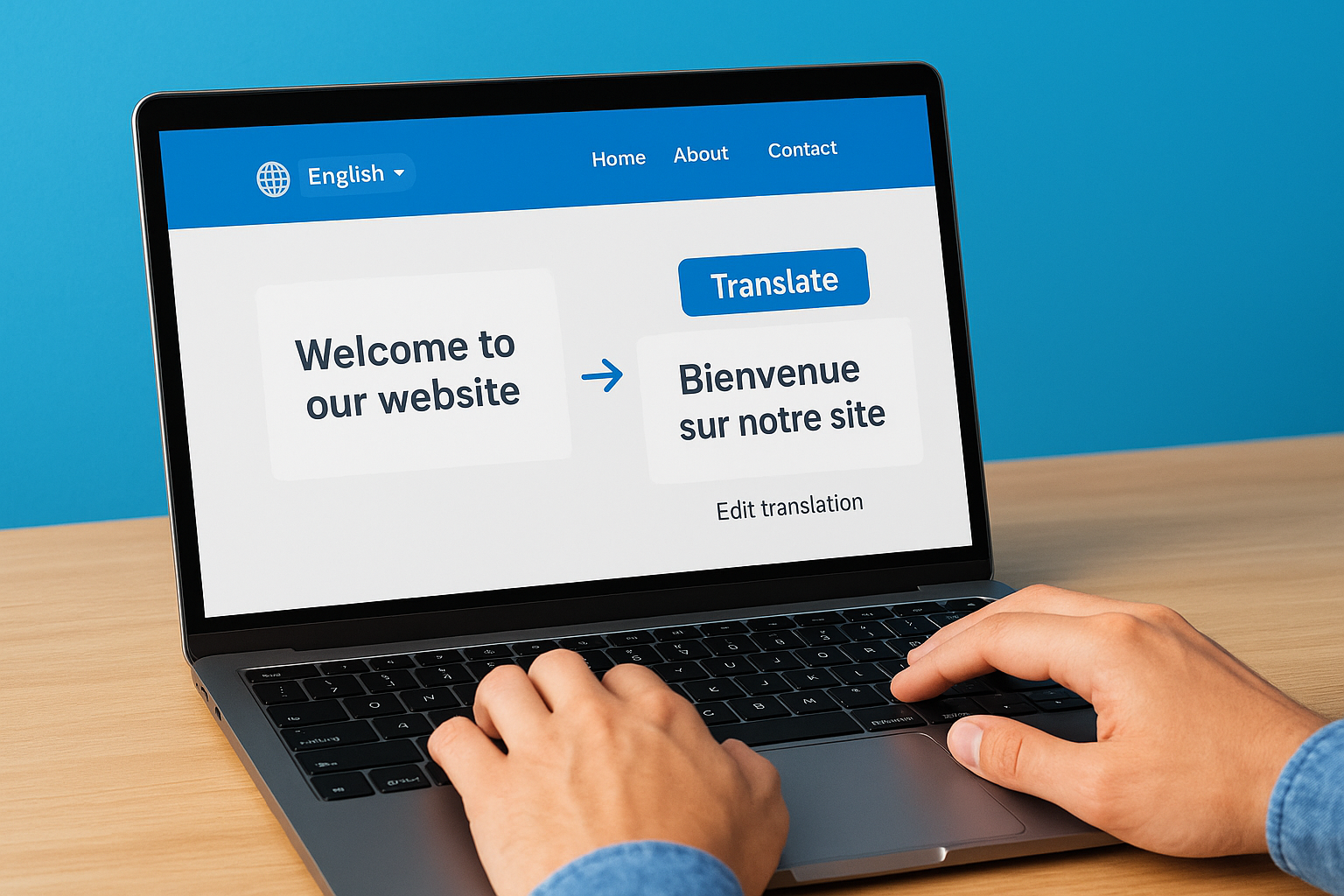
Weglot uses a proxy-based translation layer that sits over your existing site. It detects and translates content automatically, then serves translated versions at dedicated language subdomains or subdirectories without touching your original codebase.
Translation editing and team collaboration
You can edit any translated string directly in Weglot’s visual editor, which shows you the live page while you make changes. Team members can leave comments and flag strings for review, though the collaboration features stay fairly basic compared to enterprise-grade localization tools.
If you manage translations across a small internal team, Weglot’s visual editor keeps the review process fast and accessible without a steep learning curve.
Multilingual SEO features
Weglot automatically generates hreflang tags and dedicated URLs for each language version of your site, which helps search engines index translated pages correctly. You can also edit translated meta titles and descriptions directly from the dashboard.
Setup requirements and supported platforms
Setup takes minutes on most platforms. Weglot integrates natively with WordPress, Shopify, Squarespace, and Webflow, typically through a plugin or a single script tag that requires no custom development work.
Pricing tiers and what counts toward usage
Pricing is based on word count and the number of target languages you activate. Each plan includes a word limit, and going beyond that threshold requires a plan upgrade, so estimate your content volume before committing.
Limitations to know
The translation memory and glossary tools in Weglot are limited compared to platforms built for larger localization programs. Because the tool leans heavily on machine translation as a first pass, human review remains essential for any content where accuracy carries real consequences.
4. Lokalise
Lokalise is a translation management platform designed for product and engineering teams that manage web, mobile, and software localization. Among the best website translation services built for technical teams, it provides a structured environment where developers, translators, and product managers can work in the same system without stepping on each other.
Best for
Lokalise fits software companies and product teams that treat localization as part of their development cycle rather than a separate project. If your website shares content with a web app or mobile product, Lokalise handles both in one workspace.
How it manages website and product localization
Lokalise pulls content through API connections, file uploads, or direct integrations with your codebase or CMS. Translated strings flow back to your site through the same pipeline, which keeps your development and localization cycles in sync without requiring manual file transfers.
Workflow automation and approvals
You can configure automated task assignments and approval gates that route content through the right people based on language, content type, or project stage. This reduces the back-and-forth that slows down localization when teams are working across time zones.
Structured approval workflows mean your translated content gets reviewed by the right person every time, not just whoever is available.
Terminology and consistency tools
Lokalise includes a built-in glossary and translation memory that enforce consistent terminology across all your content. These tools are especially useful when your website uses product-specific language or technical terms that need to stay uniform across languages and updates.
Integrations for web teams
The platform connects with GitHub, GitLab, Figma, and major CMS platforms, which makes it practical for teams running modern web stacks. Developers can trigger localization tasks directly from pull requests, which keeps translation aligned with your release schedule.
Pricing tiers and typical add-on costs
Lokalise offers tiered subscription plans based on team size and feature access. Human translation services and advanced automation features typically come at additional cost on top of the base plan.
Limitations to know
Lokalise is not built for non-technical teams who need a simple setup. Organizations without developer resources or an established localization workflow will find the platform harder to configure and maintain than lighter alternatives.
5. Localize
Localize is a translation management platform built around real-time content detection and an approachable setup process. It sits in a middle position among the best website translation services available today, offering more automation than a traditional agency while remaining easier to configure than heavy enterprise tools.
Best for
Localize works well for growth-stage companies and SaaS businesses that want automated translation workflows without a full development sprint to get started. If your team updates web content frequently and needs translations to stay current without manual intervention, this platform is built for that pattern.
How it detects, translates, and updates content
Localize detects new or changed content on your site automatically through a JavaScript snippet. When your site updates, the platform queues that content for translation and publishes it back to the live site, keeping your translated versions current without requiring manual file uploads or developer intervention on each cycle.
In-context editing and quality checks
The platform includes a visual in-context editor that lets you see translated content directly on your live page while making edits. This helps catch layout issues and mistranslations at the same time, which reduces the number of review cycles your team has to run before content goes live.
Editing translations directly on the live page is one of the more practical quality control approaches available in browser-based localization tools.
Team controls and permissions
Localize gives you role-based access controls that let you assign different permissions to translators, reviewers, and administrators. This keeps your workflow structured without exposing full platform controls to every contributor on the project.
Integrations and technical setup
Setup requires adding a single JavaScript snippet to your site header. The platform connects with Zendesk, Segment, and several CMS and support tools, giving your team reasonable integration coverage without needing custom API work in most cases.
Pricing plans and scaling considerations
Localize uses tiered subscription pricing based on the number of phrases under management and languages activated. Costs rise as your content volume grows, so audit your site’s word count carefully before committing to a plan.
Limitations to know
Localize offers lighter terminology management than platforms built specifically for large localization programs, which can create consistency issues across extensive content libraries. Teams working with highly technical or regulated content will likely need to supplement the platform with a dedicated human review process to maintain accuracy.
6. MotionPoint
MotionPoint is a fully managed website translation platform that handles the entire localization process on your behalf. Rather than giving you tools to manage translation yourself, it operates as a turnkey solution where their team owns the operational workload from content capture to publication.
Best for
MotionPoint fits large enterprises and global brands that want translated web experiences without building or managing an internal localization function. If your organization serves multiple international markets and your priority is consistent output with minimal internal overhead, this managed model removes most of the day-to-day operational burden.
How it delivers translated web experiences
MotionPoint uses a proxy technology that intercepts your website traffic and serves translated versions to visitors in their target language. Your original site stays unchanged, and MotionPoint handles content detection, translation, and delivery through its own infrastructure.

Translation, localization, and managed service model
The platform combines machine translation with human post-editing, and MotionPoint assigns dedicated linguists and project managers to your account. This is one of the few options among the best website translation services that genuinely functions as a managed service rather than a self-serve tool.
When you need translated web content delivered consistently across dozens of markets without building an internal localization team, a managed service model removes a significant operational burden.
SEO and site performance considerations
MotionPoint generates separate URLs for each language version of your site, which supports proper multilingual indexing. Their infrastructure is designed to deliver translated pages with minimal impact on load times, though performance can vary depending on your site’s existing architecture.
Implementation and IT involvement
Your IT team’s involvement is relatively light after initial setup, since MotionPoint manages the proxy layer independently. The initial configuration does require coordination with your web and IT teams to ensure the proxy routes traffic correctly across your domains.
Pricing model and budgeting tips
MotionPoint operates on a custom enterprise pricing model based on word volume, language count, and service tier. Budget accordingly for ongoing managed service fees, which reflect the hands-on operational support included with the platform.
Limitations to know
MotionPoint is not designed for small or mid-size businesses, and the pricing reflects that. Teams that want direct control over their translation workflow or a lower-cost entry point will find this model a poor match for their needs.
7. BLEND Localization
BLEND Localization is a language services company that combines human translation with technology-assisted workflows. It serves businesses that need professional-grade localization across web content, marketing materials, and software, positioning itself as a hybrid option among the best website translation services available today.
Best for
This service works best for mid-size businesses and marketing teams that want access to professional human translators without full enterprise overhead. It suits companies running ongoing multilingual content programs across several markets at the same time.
How it runs translation and localization programs
BLEND manages translation projects through its online platform and project management layer, routing content to specialized translators based on language pair and subject matter. You submit content, and their team handles assignment, translation, and delivery without requiring you to manage individual linguists directly.
Quality management and subject matter expertise
The company uses a two-step translation and editing process that pairs translators with independent editors. Translators are matched to projects based on industry background, which improves accuracy for content in marketing, technology, and e-commerce verticals.
Matching translators to subject matter rather than just language pair is one of the more reliable ways to maintain terminology consistency across long-running content programs.
Workflow, tooling, and integrations
Their platform supports file-based and API-based content submission, which gives your team flexibility depending on how your site is structured. BLEND integrates with several CMS and project management tools, reducing manual handoffs between your content team and their translators.
SEO and multilingual content operations
You can submit translated metadata and alt text alongside body content, which supports proper on-page optimization for each target market. Your team still needs to conduct market-specific keyword research to ensure translations align with how local audiences actually search.
Pricing model and what drives total cost
Costs are based on word count and language pair, with rates varying by content type and turnaround speed. Rush delivery and specialized subject matter expertise both increase per-word costs, so plan your project timeline accordingly.
Limitations to know
BLEND does not offer the real-time proxy translation or automated CMS syncing that platform-first tools provide. If your site updates frequently and you need translations published automatically, you will need a different solution built around continuous localization.
Next Steps
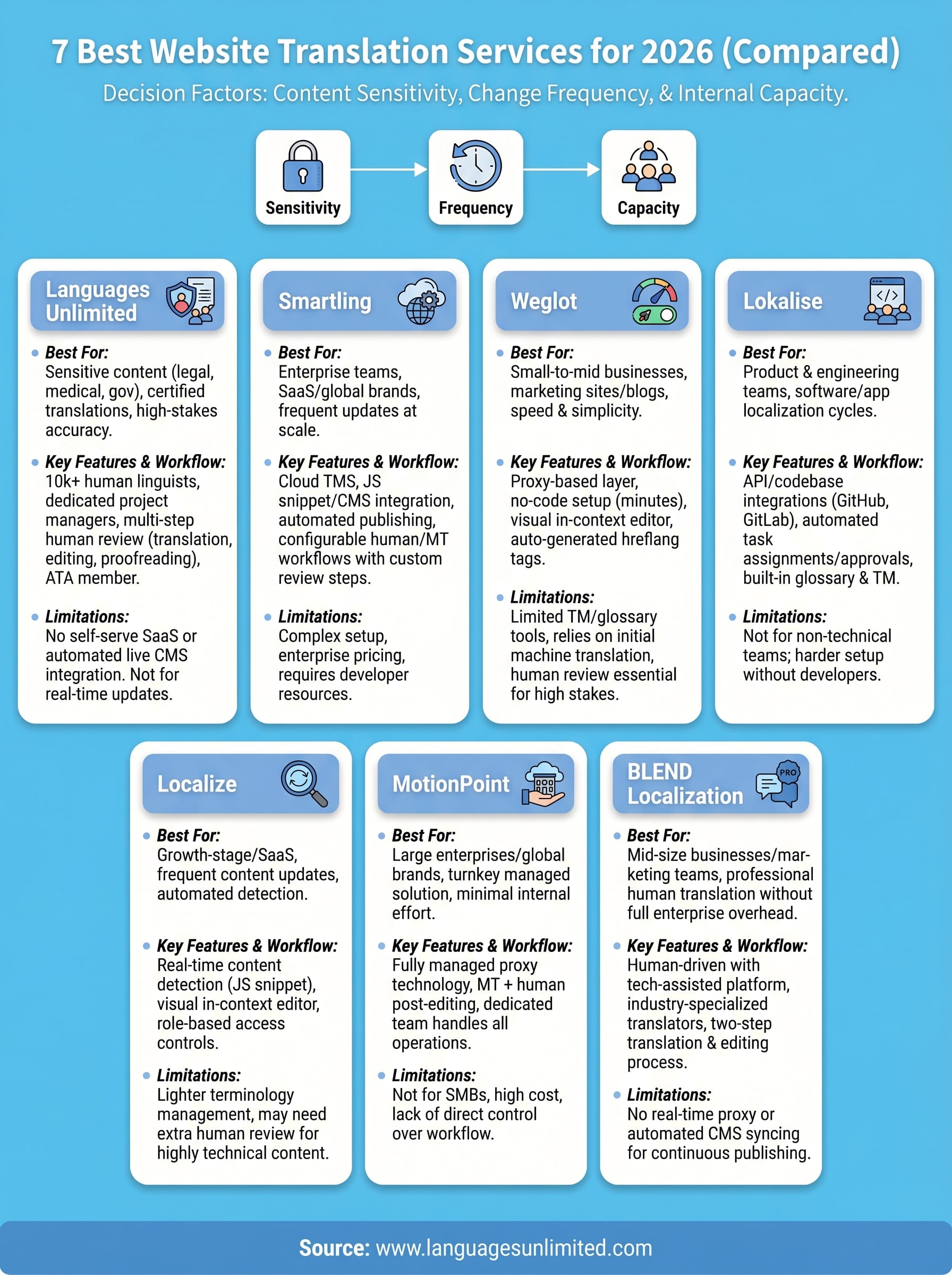
The best website translation services available in 2026 range from fully managed human translation to automated proxy platforms, and each option serves a different type of organization. Your decision comes down to three core factors: how sensitive your content is, how often it changes, and how much internal capacity your team has to manage the process.
Platform-based tools like Weglot and Localize work well when you need speed and automation for standard marketing content. But if your website carries legal, medical, or government information where a translation error carries real consequences, a professional human translation service gives you the precision and compliance coverage that automated tools cannot reliably match. Languages Unlimited brings over 30 years of experience and a network of more than ten thousand vetted linguists to every project, covering hundreds of languages and dialects.
Contact the Languages Unlimited team to get a custom quote and find the right approach for your content, target languages, and project timeline.