



When you hire a translation provider, how do you know their process actually delivers accurate, reliable results? The ISO 17100 translation standard answers that question. It’s the internationally recognized benchmark that defines what a professional translation workflow should look like, from translator qualifications to revision steps to project management protocols. For organizations in legal, medical, and government sectors, where a single mistranslation can have serious consequences, understanding this standard matters.
At Languages Unlimited, we’ve built our operations around the kind of rigorous quality controls that ISO 17100 codifies. Since 1994, our network of over ten thousand language professionals has served clients across all 50 states with certified translation, interpretation, and transcription services, backed by ATA membership, USCIS approval, and a GSA contract. Quality isn’t a marketing line for us; it’s built into how we work.
This article breaks down what ISO 17100 actually requires, how it differs from other standards, why it benefits both providers and clients, and what the certification process involves. Whether you’re vetting a translation vendor or considering certification yourself, you’ll find the details you need here.
What ISO 17100 is and what it covers
ISO 17100 is an international standard published by the International Organization for Standardization (ISO) that sets requirements for translation service providers. First released in 2015, it replaced the earlier European standard EN 15038 and established a globally consistent framework for how professional translation work should be structured, resourced, and delivered. It applies to any organization offering translation services, regardless of size or location.
The Origins and Scope of the Standard
The ISO 17100 translation standard grew out of a need to unify regional quality frameworks into a single international benchmark. Before 2015, translation quality requirements varied significantly by country and region, which created confusion for clients and providers working across borders. ISO 17100 resolved that by defining specific requirements in four core areas: human resources, translator competencies, operational processes, and project management systems.
A single standard covering these four areas gives you a consistent way to evaluate any translation provider, no matter where they operate.
This standard applies to human translators only, meaning it governs work where a qualified professional performs or revises the translation. It does not cover raw machine translation output unless a qualified human has post-edited that output to meet the standard’s revision requirements.
What the Standard Explicitly Excludes
ISO 17100 does not cover interpretation, transcription, or other language services outside of translation. It also does not specify quality metrics like acceptable error rates, leaving those to individual service agreements. What it does define is the minimum process and qualification structure a provider must follow to claim conformance.
You can find the full published standard through the ISO official website, where individual standards are available for purchase or preview.
Why ISO 17100 matters for quality and risk
Working with a provider that follows the ISO 17100 translation standard gives you a concrete way to manage quality before a project starts. Instead of trusting a vendor on reputation alone, you can verify that their process, qualifications, and review steps meet a documented international benchmark.
Reducing Errors in High-Stakes Contexts
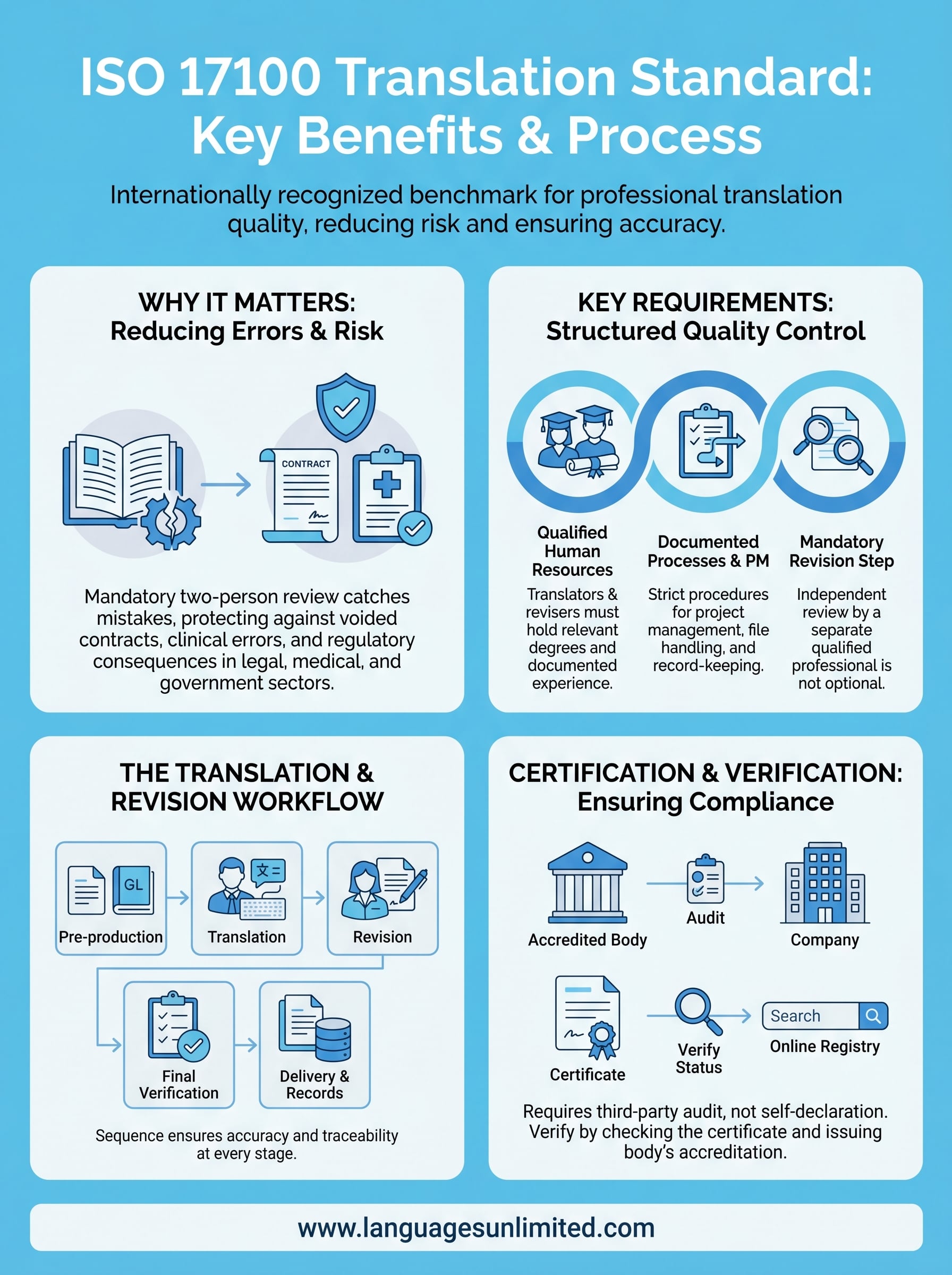
In legal and medical settings, a mistranslation is not just an inconvenience. A wrongly translated contract clause can void an agreement, and an inaccurate patient record can affect clinical decisions. ISO 17100 requires both translation and independent revision by qualified professionals, which builds a two-person review into every project and catches errors a single translator might miss.
Requiring a separate revision step is one of the most practical safeguards ISO 17100 builds into the translation process.
Protecting Your Organization from Risk
When you engage a non-certified provider, you absorb additional liability if that translation causes downstream harm. Choosing a provider that conforms to ISO 17100 documents your due diligence, which matters in regulated industries like healthcare, legal services, and government contracting.
That paper trail protects you if a translation is ever disputed or audited. For organizations facing regulatory scrutiny, documented quality assurance in your vendor selection process is a meaningful layer of protection.
Core ISO 17100 requirements for translation providers
The ISO 17100 translation standard sets out specific requirements across three areas: human resources qualifications, core translation processes, and project management systems. Meeting all three is what separates a provider that simply claims quality from one that has actually structured quality into their daily operations.
Translator and Reviser Qualifications
ISO 17100 requires that every translator holds recognized credentials, such as a relevant degree in translation or a subject-matter field combined with documented professional experience. Revisers must meet separate qualification criteria and cannot be the same person who performed the translation. Accepted qualifications under the standard include:

- A degree in translation or linguistics
- A degree in a relevant subject field plus professional translation training
- Five or more years of documented professional translation experience
Project Management and Documentation
Beyond individual qualifications, the standard requires providers to maintain documented project management procedures covering client agreements, file handling, and final delivery. You must also retain records demonstrating compliance for each project, including confirmation of translator and reviser credentials and any corrections applied based on client feedback.
Documented procedures give you a verifiable audit trail, which matters in regulated industries where you need to show exactly how a translation was produced.
Keeping these records current is not optional under the standard; it is a core operational requirement that auditors and clients can request at any time.
How the ISO 17100 translation workflow works
The ISO 17100 translation standard defines a structured sequence of steps that every compliant provider must follow for each project. Understanding this workflow helps you set accurate expectations for timelines and quality checkpoints before you sign a contract with any provider.
The Translation and Revision Steps
The workflow opens with pre-production tasks: reviewing source files, confirming client requirements, and preparing reference materials or glossaries. A qualified translator then performs the translation. After that, a separate reviser, who had no involvement in the original translation, reviews the output against the source document for accuracy and consistency. This two-person review structure is not optional under ISO 17100; it is a mandatory requirement for every project regardless of scope or complexity.
The mandatory revision step is what separates an ISO 17100-compliant workflow from a provider that simply delivers a first draft.
Final Verification and Delivery
Following revision, a final review step addresses any remaining issues flagged during the process. The project manager then completes delivery tasks, which include formatting checks, client feedback review, and file handoff. Providers must document each stage, so you receive completed work backed by a clear, traceable record of who reviewed what and when during production.
How certification works and how to verify it
Getting certified to the ISO 17100 translation standard requires an audit by an accredited third-party certification body, not a self-declaration. The provider applies, undergoes a documentation review, and then receives an on-site or remote audit where the auditor checks actual processes against the standard’s requirements.
The Audit Process
During the audit, the certification body reviews translator and reviser credentials, project management documentation, and records from completed projects. If the provider’s processes meet every requirement, they receive a certificate with a defined validity period, typically three years, with annual surveillance audits in between.
Certification is only as reliable as the accreditation body behind it; look for bodies accredited through recognized national accreditation organizations.
Verifying a Provider’s Certification Status
You can confirm a provider’s certification status by requesting their current certificate directly and checking the issuing body’s public registry. Accreditation bodies in the United States, such as those operating under the ANSI National Accreditation Board (ANAB), maintain searchable directories where you can look up any certified organization.
When verifying, ask for:
- The certificate number and expiry date
- The issuing accreditation body’s name
- Confirmation the certification scope covers translation services
Wrap-up and next steps
The ISO 17100 translation standard gives you a practical, verifiable benchmark for evaluating any translation provider. It covers translator qualifications, mandatory revision steps, project management procedures, and certification verification, so you’re not left guessing whether a vendor’s quality claims actually hold up under scrutiny.
Choosing a provider that conforms to ISO 17100 protects your organization, reduces the risk of costly errors, and gives you a documented record of due diligence. Legal, medical, and government clients especially benefit from working with providers whose workflows match this level of rigor, since inaccurate translations in those fields can affect contracts, clinical decisions, and regulatory compliance.
Languages Unlimited has operated with rigorous quality controls since 1994, serving clients across all 50 states with certified translation and language services. If you’re ready to work with a provider that takes quality seriously, contact our team to discuss your project needs.