



A court interpreter does far more than repeat words in another language. Court interpreter responsibilities span a demanding set of duties that directly affect whether non-English-speaking individuals receive fair treatment under the law. From accurately conveying witness testimony to maintaining strict ethical standards, these professionals serve as a critical link between the justice system and the people it’s meant to protect. Getting any part of this role wrong can compromise an entire case.
Whether you’re exploring a career in court interpretation, building a job description, or evaluating how interpreters fit into your courtroom operations, understanding these responsibilities matters. Courts across the United States depend on qualified interpreters to uphold due process rights, and the standards they must meet are specific, measurable, and non-negotiable.
At Languages Unlimited, we’ve provided professional interpretation services since 1994, placing skilled interpreters in legal settings across all 50 states. That experience has given us a clear view of what this role truly requires. This article breaks down the core duties, ethical obligations, and essential skills that define a competent court interpreter, so you know exactly what to expect and what to look for.
Why court interpreter responsibilities matter
Court proceedings carry serious consequences. When a defendant, witness, or victim cannot understand what’s happening in their own case, due process breaks down entirely. Court interpreter responsibilities exist precisely to prevent that from happening. Qualified interpreters ensure that every party fully understands the proceedings, regardless of the language they speak. This isn’t a convenience; it’s a constitutional right protected under the Sixth Amendment and reinforced by the Court Interpreters Act of 1978, which requires federal courts to provide certified interpreters in criminal proceedings.
The legal stakes of poor interpretation
Errors in court interpretation don’t just cause confusion. They can lead to wrongful convictions, overturned verdicts, or costly mistrials that set cases back by months or longer. A misinterpreted phrase during cross-examination can change the meaning of a statement entirely. When you rely on an unqualified interpreter, you put the integrity of the judicial record at direct risk.
A single mistranslated word during testimony can undermine months of legal preparation and cast doubt on an entire proceeding.
Courts across the United States rely on standards set by bodies like the National Center for State Courts to define what competent interpretation looks like. These benchmarks exist because the consequences of falling short are too serious to ignore.
Why accountability defines the role
Understanding what court interpreters do also means recognizing who bears accountability when something goes wrong. Interpreters work under oath, and their output becomes part of the official court record. If you are a court administrator, legal professional, or case manager, you need interpreters who treat that accountability as a core professional obligation. Certification, documented experience, and formal ethical training are not optional upgrades; they are the minimum standard for anyone operating in a legal setting.
Core duties before, during, and after court
Court interpreter responsibilities don’t start when the session begins or end when it adjourns. Preparation, active interpretation, and post-session tasks each carry distinct demands, and competent interpreters treat all three phases with equal seriousness.
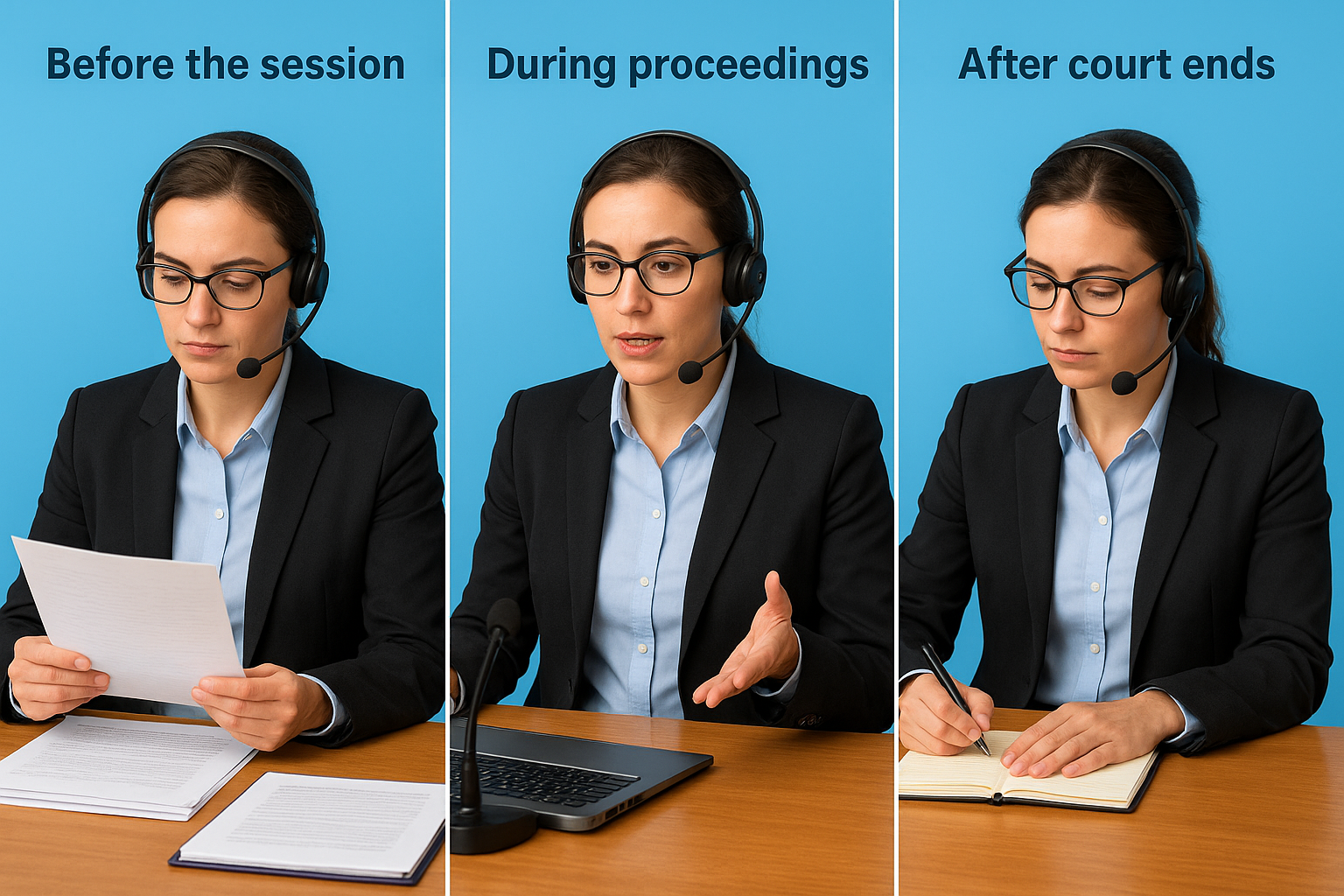
Before the session
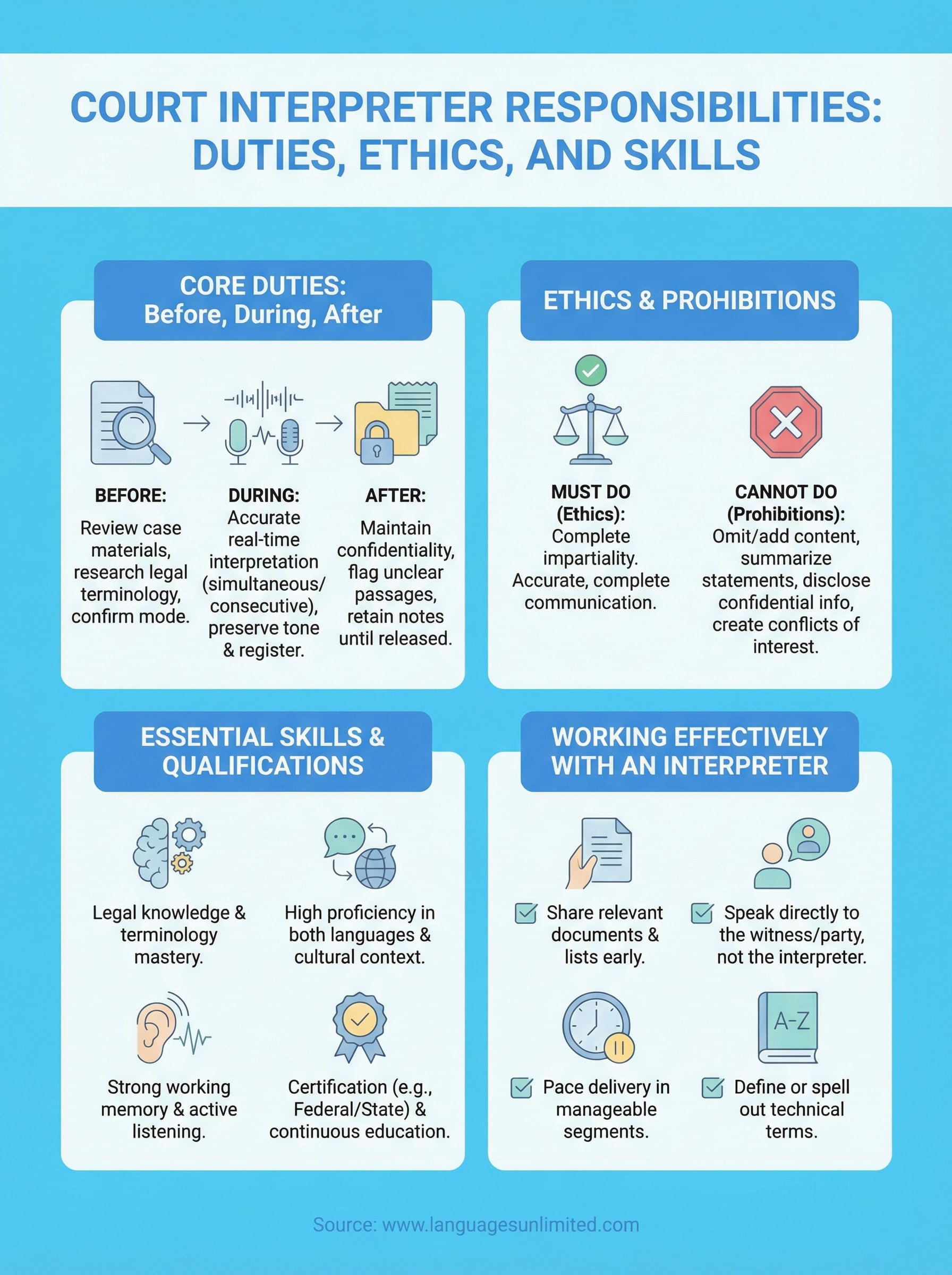
Interpreters review case materials and specialized legal terminology before appearing in court. This preparation step includes studying any documents you share in advance, which directly improves accuracy during the proceedings. Common pre-session tasks include:
- Reviewing evidence summaries and witness lists
- Researching technical or industry-specific vocabulary
- Confirming the interpretation mode required (simultaneous or consecutive)
During proceedings
Simultaneous or consecutive interpretation happens in real time, covering everything from witness testimony to judicial rulings. Interpreters render each statement accurately, preserving tone, register, and legal intent without adding, omitting, or editorializing anything.
Accurate interpretation during testimony isn’t just about language; it’s about preserving the legal meaning of every statement on record.
After court ends
Post-session duties include flagging unclear passages to the court officer when needed and maintaining strict confidentiality about all proceedings. Interpreters also retain detailed session notes until formally released, ensuring the official record stays reliable and complete.
Ethics rules and what interpreters cannot do
Ethics form the backbone of court interpreter responsibilities. Interpreters work under strict professional codes that define not just what they must do, but what they are explicitly prohibited from doing. Violating these rules can invalidate proceedings and directly harm the people interpreters are meant to serve.
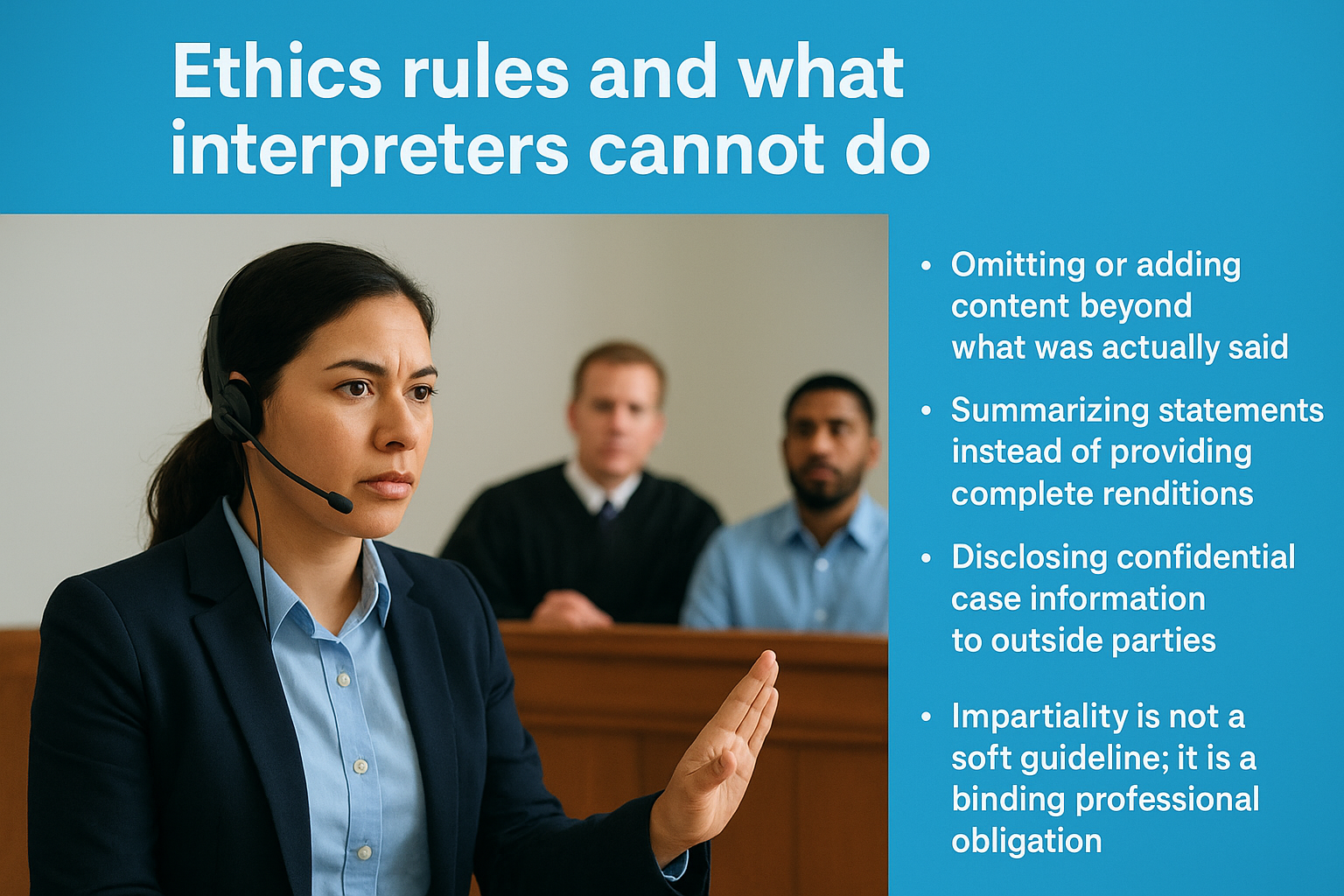
The core ethical obligations
Interpreters must remain completely impartial throughout every proceeding. They cannot advocate for any party, offer personal opinions, or build relationships with defendants, attorneys, or witnesses outside the courtroom. Their sole function is to deliver accurate, complete communication between all parties, nothing more and nothing less. Courts hold interpreters personally accountable for every word they render on the record.
Impartiality is not a soft guideline; it is a binding professional obligation that every court interpreter must uphold without exception.
What interpreters are prohibited from doing
Several specific behaviors fall entirely outside the boundaries of this role. You should confirm that any interpreter you work with understands these prohibitions before they set foot in your courtroom:
- Omitting or adding content beyond what was actually said
- Summarizing statements instead of providing complete renditions
- Disclosing confidential case information to outside parties
- Accepting assignments that create a conflict of interest
Skills and qualifications that shape accuracy
Court interpreter responsibilities demand a specific combination of abilities that go well beyond speaking two languages. Certified interpreters must demonstrate high-level proficiency in both languages, deep familiarity with legal terminology, and the mental stamina to sustain accuracy through lengthy proceedings. These qualifications directly shape whether your courtroom record stays reliable.
The difference between a qualified court interpreter and an unqualified one isn’t just linguistic; it determines whether the legal process works as intended.
Language fluency and legal knowledge
Fluency alone does not qualify someone for this role. Legal vocabulary in both languages must be mastered, including terms that carry precise technical meanings in formal settings. Qualified interpreters also understand cultural context, ensuring that tone and register match what the original speaker intended.
Consistent accuracy under pressure also requires strong working memory and active listening skills. Interpreters must process, retain, and render full statements in real time without pausing to reconstruct meaning after the fact.
Certification and professional training
Your interpreter’s credentials signal readiness to perform under real pressure. In the United States, the Federal Court Interpreter Certification Examination sets the benchmark for federal criminal proceedings. State-level programs carry similar rigor. Look for interpreters who also maintain continuous education in evolving legal terminology and procedural standards.
How to work effectively with a court interpreter
Understanding court interpreter responsibilities helps you work alongside interpreters more effectively. Before the session begins, share all relevant documents, case summaries, and witness lists with your interpreter as early as possible. The more context they have, the more accurately they can prepare specialized legal vocabulary and anticipate terminology that may arise during proceedings.
Your preparation directly affects the interpreter’s ability to deliver accurate, complete renditions on the record.
Communicate directly with the witness or party
Always direct your questions and statements toward the witness or defendant, not the interpreter. Saying "ask him if he was present" forces the interpreter to shift roles unnecessarily. Speaking directly keeps the record clean and preserves the interpreter’s impartiality throughout the session.
Pace your delivery and allow for completion
Speak in clear, manageable segments so the interpreter can render each statement completely before you continue. Avoid speaking over the interpreter or interrupting mid-rendition. If you use technical legal terms, spell them out or define them when clarity is uncertain. These small adjustments protect the accuracy of the judicial record and help every party follow the proceedings without gaps or confusion.
Key takeaways
Court interpreter responsibilities cover every phase of a legal proceeding, from preparation through post-session duties, and each phase carries real consequences for the people involved. Qualified interpreters work under oath, follow strict ethical codes, and bring certified language skills and legal knowledge to every assignment. Their accuracy protects due process, and their impartiality keeps the judicial record intact.
Working effectively with a court interpreter means sharing materials early, speaking directly to witnesses, and pacing your delivery so nothing gets lost on the record. When you choose a certified, experienced interpreter, you protect your case and the people depending on it.
If you need qualified court interpreters or professional legal interpretation services across any U.S. jurisdiction, Languages Unlimited has placed skilled interpreters in legal settings since 1994. Reach out to our team today and let us match you with the right interpreter for your specific needs. Contact Languages Unlimited to get started.