



A single mistranslated word in a contract can void an agreement, trigger a lawsuit, or delay someone’s immigration case by months. That’s the reality of legal translation, a discipline where precision isn’t optional, it’s everything. Whether you’re a lawyer handling cross-border litigation, a healthcare administrator managing multilingual compliance documents, or an individual submitting paperwork to USCIS, having legal translation explained clearly matters more than most people realize. It’s not just about converting words from one language to another; it’s about preserving legal meaning across entirely different legal systems.
At Languages Unlimited, we’ve provided certified and USCIS-approved translations since 1994, working with law firms, government agencies, courts, and individuals across all 50 states. Our network of over ten thousand language professionals handles legal documents daily, contracts, depositions, immigration filings, patents, and court transcripts in hundreds of languages. That hands-on experience gives us a grounded perspective on what legal translation actually demands.
This article breaks down what legal translation means, why it’s uniquely challenging compared to other types of translation, and what practical steps you can take to get it right. We’ll also touch on the well-known academic reference Legal Translation Explained by Enrique Alcaraz Varó and Brian Hughes, which has shaped how professionals and scholars think about the field. Whether you need a foundational understanding or actionable guidance, you’ll find both here.
What legal translation means in practice
Legal translation is the process of converting legal documents and content from one language into another while preserving both the precise wording and the underlying legal intent. That second part is what separates legal translation from general translation work. A legal document doesn’t exist in isolation; it exists within a specific legal system, and legal systems differ significantly from country to country. A term like "consideration" in an English-language contract carries a specific common law meaning that has no direct equivalent in many civil law systems. When you get legal translation explained properly, this is the first concept you encounter: language and law are inseparable.
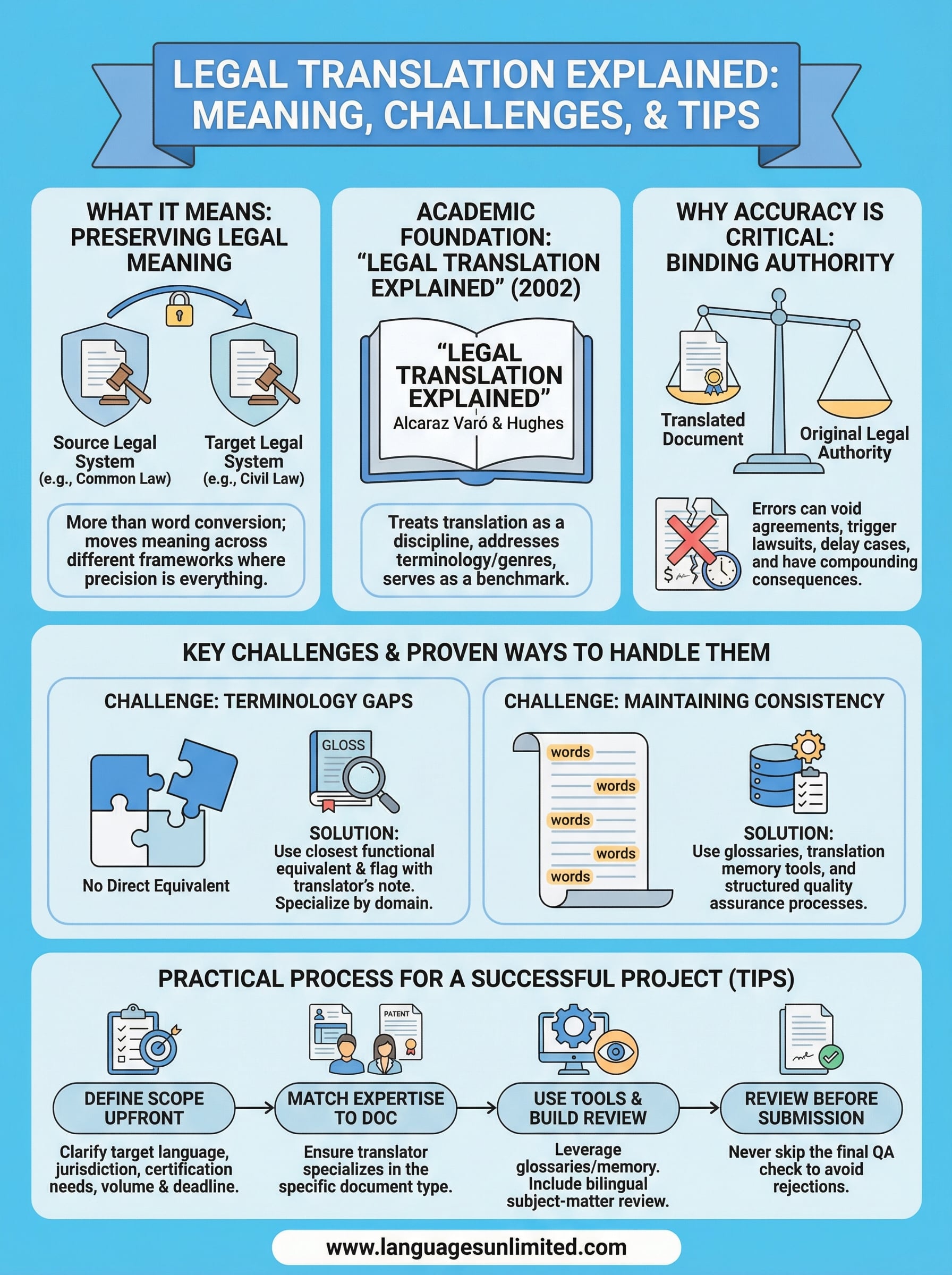
Legal translation doesn’t just move words between languages; it moves legal meaning across legal systems, and that distinction shapes every decision a qualified translator makes.
The types of documents legal translation covers
This discipline applies to a wide range of materials, and the specific document type affects how a translator approaches the work. Contracts, court filings, depositions, immigration documents, patents, corporate bylaws, regulatory filings, and compliance reports all fall under this category. Each document type carries its own terminology requirements and formatting conventions. A certified translation for a USCIS immigration filing, for example, must meet specific formatting standards and include a signed statement of accuracy from the translator, while a patent translation demands deep familiarity with both legal and technical language.

The stakes vary depending on the document, but the margin for error stays the same: near zero. If you submit a mistranslated birth certificate to a government agency or file an incorrectly translated contract in litigation, the consequences can range from costly delays to full rejection or adverse legal outcomes. Accuracy at the document level means accuracy at every clause, date, name, and legal term within it.
How legal translators approach the work differently
A qualified legal translator doesn’t just speak two languages fluently. They understand the legal frameworks on both sides of the translation. That means knowing how a term functions in its source legal system and then finding the closest functional equivalent in the target system, or explaining the gap when no equivalent exists. This approach requires both linguistic expertise and legal literacy, which is why professional legal translators often specialize by jurisdiction or document type.
You should also know that legal translation is rarely a solo task. Qualified providers build in review steps, subject-matter checks, and quality assurance processes before a document reaches you. That workflow is what separates a professional legal translation service from a rushed turnaround that cuts corners on accuracy and compliance.
What the book Legal Translation Explained focuses on
Legal Translation Explained, written by Enrique Alcaraz Varó and Brian Hughes and published in 2002 as part of the St. Jerome "Translation Practices Explained" series, is one of the most widely cited academic texts on the subject. The book treats legal translation as a discipline in its own right, not simply a subset of general translation practice. If you’ve searched for "legal translation explained" in an academic context, this is likely the text you encountered in course syllabuses or scholarly bibliographies.
Core arguments the book makes
Alcaraz and Hughes argue that legal language is a specialized register with its own grammar, syntax, and vocabulary, and that translators must develop genuine familiarity with it before attempting to move between legal systems. They dedicate significant attention to common law versus civil law distinctions, showing how the same concept can carry completely different legal weight depending on the system. The book also examines legal genres such as contracts, statutes, and court documents separately, recognizing that each type demands a different translation approach.
The book’s central insight is that legal texts carry institutional authority, which means a translation error doesn’t just misrepresent language, it potentially misrepresents the law itself.
Why practitioners still reference it
The book holds up because it addresses real translation problems with concrete examples rather than abstract theory alone. It walks through source text analysis, terminology management, and the reasoning behind specific translation choices, which gives working translators a practical framework they can apply immediately. You’ll also find it useful as a benchmark for professional standards, since many academic programs and translation certification bodies reference its framework when defining what competent legal translation looks like. For anyone moving into specialized legal work, it remains a foundational starting point.
Why accuracy matters in legal translation
When you have legal translation explained to you in full, one theme shows up consistently: the documents involved carry real legal authority. A contract, court order, or immigration filing isn’t informational text that a reader can interpret loosely. It is a binding instrument, and every word in it has weight. Accuracy in legal translation isn’t a quality preference; it’s the minimum requirement for the document to function as intended.
Legal documents carry binding authority
Courts, agencies, and institutions treat translated legal documents as legally equivalent to their source versions. When a translation reaches a judge, a USCIS officer, or a corporate attorney, that person acts on what the translation says, not on what the original might have meant. If the translated text misrepresents a clause, omits a term, or uses a word with the wrong legal connotation, the receiving party makes decisions based on that flawed version. That creates risk not just for the document itself, but for the people whose rights or obligations depend on it.
A translated legal document doesn’t get treated as a draft or an approximation; the authority of the original transfers fully to the translation.
Errors create compounding consequences
One inaccurate term rarely stays contained. A single mistranslation in a contract clause can affect every provision that references it, meaning a small error at one point multiplies across the document. In immigration filings, inaccuracies can trigger requests for additional evidence, cause delays, or result in outright rejection. In litigation, a poorly translated deposition or exhibit can undermine your legal position entirely. The cascading nature of these errors is why experienced legal translators treat every term as critical, regardless of how minor it appears in isolation.
Key challenges and proven ways to handle them
Once you have legal translation explained at a foundational level, the practical challenges become clearer. Legal translation is difficult not because translators lack skill, but because the source material is inherently complex, deadlines are often tight, and the consequences of getting it wrong are significant. Understanding where these challenges come from helps you prepare for them before a project starts.
Terminology gaps between legal systems
The most common challenge is terminology without a direct equivalent in the target legal system. Common law and civil law traditions use different structural concepts, and some terms simply don’t transfer cleanly. When a translator encounters a gap, they have two responsible options: use the closest functional equivalent and flag the difference, or add a translator’s note explaining the discrepancy. Both approaches maintain transparency, which is essential when the document carries legal authority.
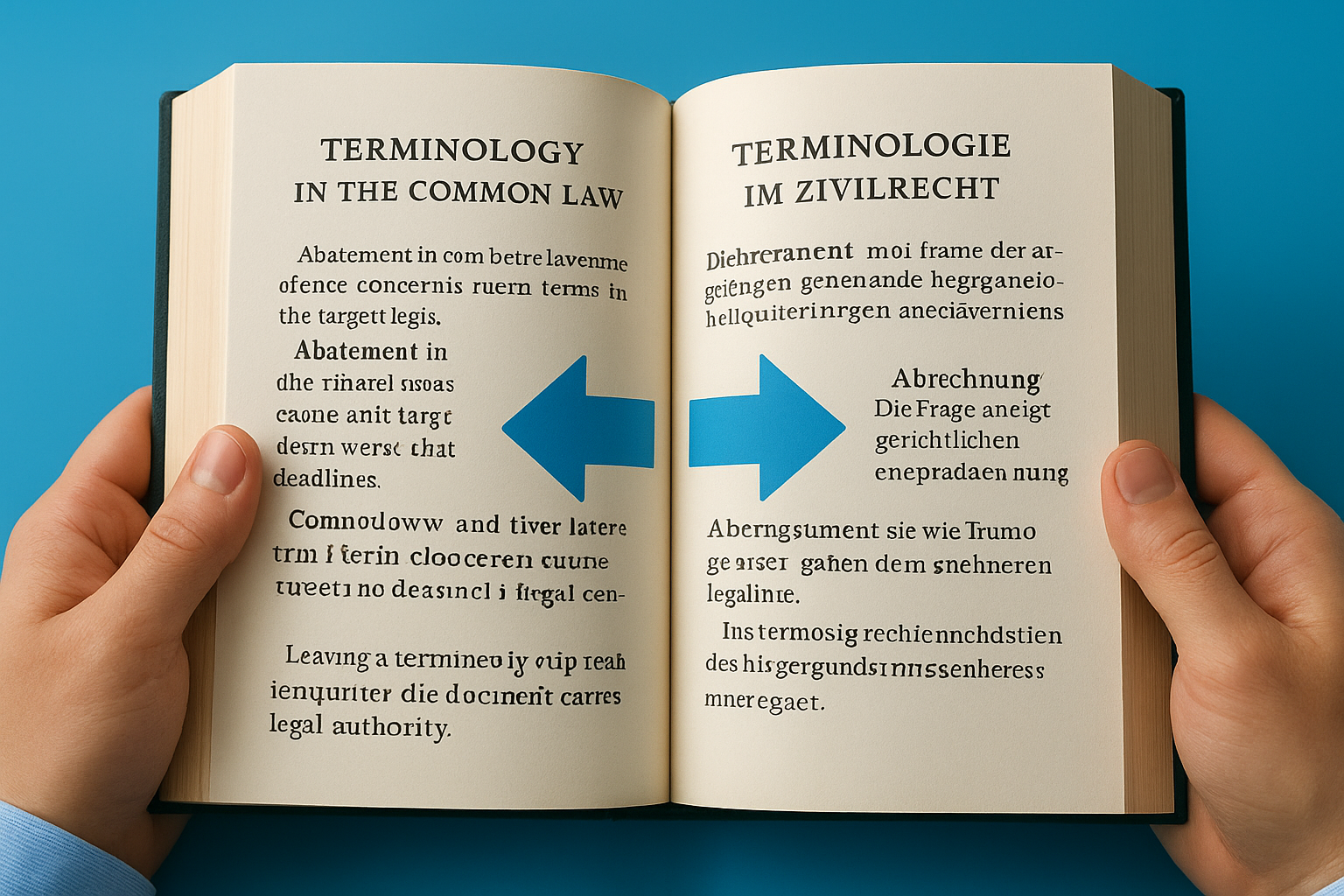
Leaving a terminology gap unaddressed is far more dangerous than flagging it openly; courts and agencies can work with disclosed limitations, but they can’t work around hidden errors.
You can reduce this risk by hiring translators who specialize in the specific legal domain and jurisdiction involved. A translator who works primarily in immigration law handles USCIS filings differently than one whose background is in commercial contracts. Matching expertise to document type is one of the most effective quality controls available.
Maintaining consistency across large documents
Long legal documents present a consistency problem. A term translated one way on page three needs to appear the same way on page forty. Many providers use terminology glossaries and translation memory tools to track word choices throughout a document and enforce consistency automatically. You should ask any provider you work with whether they maintain a glossary for your project, particularly if the work spans multiple documents or an ongoing engagement.
How to run a legal translation project end to end
Running a legal translation project well comes down to preparation, clear communication, and structured review. Most problems that surface at the end of a project, missed deadlines, inconsistent terminology, rejected filings, trace back to decisions made at the start. Once you have legal translation explained to your team and your provider, the rest of the process follows a predictable sequence.
Define scope and requirements before work begins
Before you send a single document, clarify what the translation needs to accomplish. Confirm the target language, the receiving jurisdiction, and any formatting or certification requirements. If the translation is for USCIS, you need a signed certification statement from a qualified translator. If it’s for litigation, confirm whether the court or opposing counsel has specific submission standards. Providing this information upfront prevents rework and keeps the project on schedule.
The clearest briefs produce the most accurate translations; ambiguity at the start compounds into errors by the end.
Also confirm document volume and turnaround time at the outset. Large document sets or tight deadlines require providers with the staffing capacity to handle the load without cutting quality controls short.
Build in review before you submit
Never submit a translated legal document without a review step. At minimum, have a bilingual subject-matter reviewer check key terms and clause structure before the document goes to a court, agency, or counterparty. If you’re working with a professional provider, ask specifically about their quality assurance process and how they handle flagged terminology.
Keeping these steps in sequence, scope, translate, review, and submit, gives you the best chance of a clean result on the first attempt. A reliable provider documents each step and delivers a final file you can submit with confidence.
Final takeaway
Getting legal translation explained properly sets the foundation for every project decision that follows. Legal documents carry binding authority, and the translation you submit to a court, agency, or counterparty carries that same weight. That means choosing a provider with real legal expertise and a structured review process matters as much as the translation itself.
When you prepare well, define your requirements upfront, match your translator’s expertise to the document type, and build in a review step before submission, you reduce the risk of errors that compound into costly delays or rejections. Every stage of the process rewards preparation and punishes shortcuts.
If you’re ready to move forward with a legal translation project, Languages Unlimited has supported law firms, government agencies, healthcare providers, and individuals across all 50 states since 1994. Contact our team to discuss your document needs and get a clear path forward.