



When your organization serves patients, clients, or constituents who speak different languages, every second of miscommunication carries real consequences. Language line services provide on-demand telephone interpretation that connects you with a qualified interpreter, often in under a minute, bridging the gap between your team and the people you serve. These services have become essential for healthcare facilities, legal offices, government agencies, and businesses operating in multilingual environments.
But how much do these services actually cost? What types of interpretation are available, and how do you choose the right provider? Whether you’re evaluating LanguageLine Solutions specifically or comparing options across the industry, understanding the mechanics and pricing structures will help you make an informed decision. At Languages Unlimited, we’ve provided telephonic interpretation and language services since 1994, giving us firsthand insight into what organizations need from these solutions.
This guide breaks down the costs, service types, and operational details of language line services so you can find the right fit for your organization’s budget and communication needs.
Why organizations use language line services
You turn to language line services when face-to-face interpretation isn’t practical and you need to communicate clearly with someone who speaks a different language. The core appeal is simple: you pick up a phone, dial a number, and within seconds you’re connected to a qualified interpreter who can bridge the conversation. Healthcare systems use these services when a patient arrives at the emergency room and staff need immediate communication. Legal offices rely on them for client consultations that can’t wait for a scheduled interpreter. Government agencies deploy them at service windows where visitors speak dozens of different languages throughout the day.
Meeting compliance requirements without delays
Federal and state regulations often mandate that you provide language access to limited English proficiency individuals. Under Title VI of the Civil Rights Act, recipients of federal funding must ensure meaningful access to programs and services regardless of language barriers. Healthcare organizations face additional requirements through the Affordable Care Act, which strengthens language access obligations for patients. Language line services give you a practical way to meet these legal standards without maintaining a full-time interpretation staff for every language you might encounter. When an auditor reviews your language access plan, you can demonstrate that qualified interpretation is available immediately, not just during business hours.
Organizations that fail to provide adequate language access risk discrimination complaints, lawsuits, and loss of federal funding.
Accessing immediate interpretation at any hour
The operational advantage comes down to speed and availability. You get interpretation in over 200 languages, typically connecting within 60 seconds or less, regardless of whether it’s 3 PM on a Tuesday or 2 AM on Sunday. This matters when a manufacturing facility needs to communicate safety instructions to a worker who speaks Hmong, or when a hospital social worker must explain discharge procedures to a Somali-speaking family. You avoid the delays of scheduling, travel time, and coordination that come with on-site interpretation for routine interactions.
Types of language line services you can buy
Language line services have expanded beyond basic phone interpretation to include several delivery methods, each suited to different communication scenarios. Understanding the core service types helps you select the right approach for specific interactions, whether you need instant access or prefer scheduled appointments with specialized interpreters.
On-demand telephonic interpretation
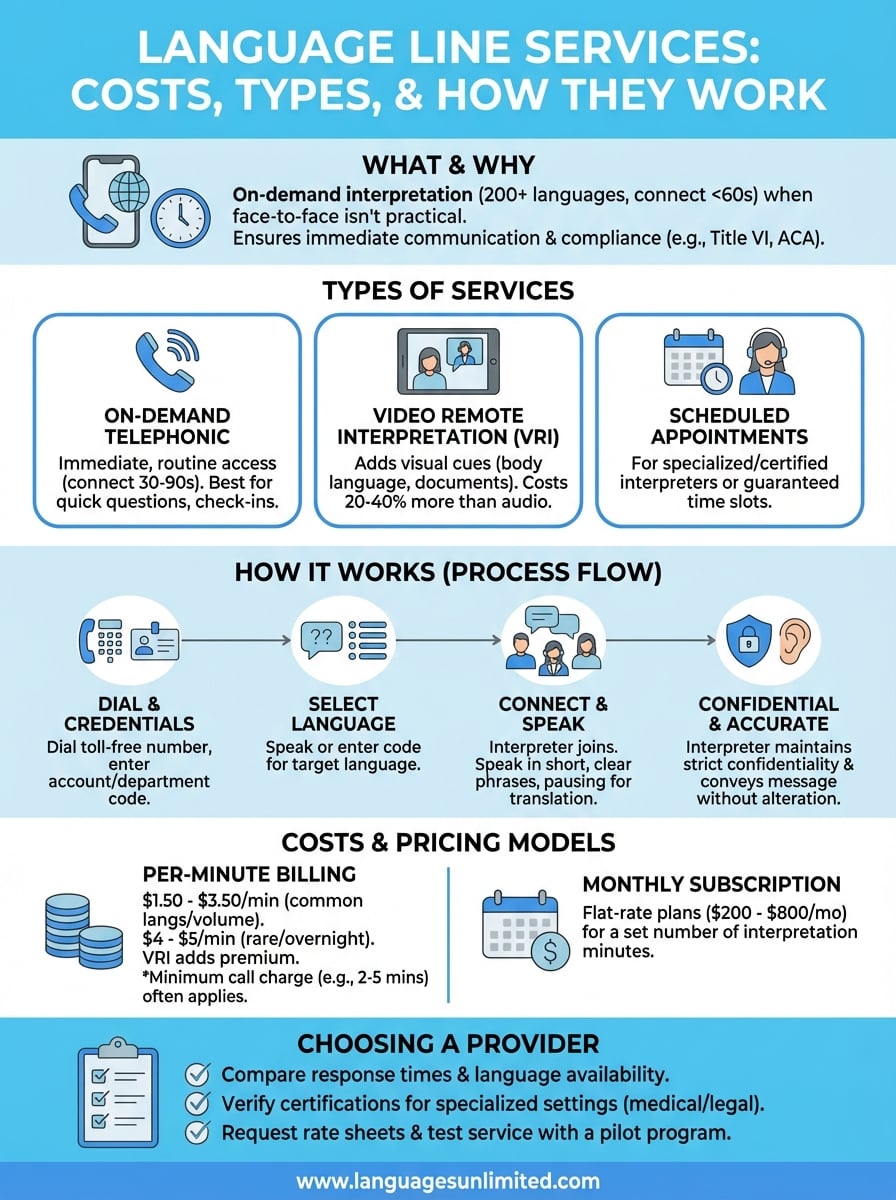
You get immediate phone-based interpretation without scheduling, typically connecting to an interpreter within 30 to 90 seconds after dialing. This service works best for routine interactions where you need quick language support: checking in patients, conducting brief consultations, or answering questions at a service desk. Providers maintain large interpreter pools across hundreds of languages, ensuring availability even for less common dialects during off-peak hours.
Video remote interpretation options
Video adds a visual component that proves essential when body language, facial expressions, or document review matter to the conversation. Medical providers use video interpretation for telemedicine appointments or when explaining complex treatment plans. Legal professionals rely on it for depositions or sensitive client meetings where visual cues enhance understanding.
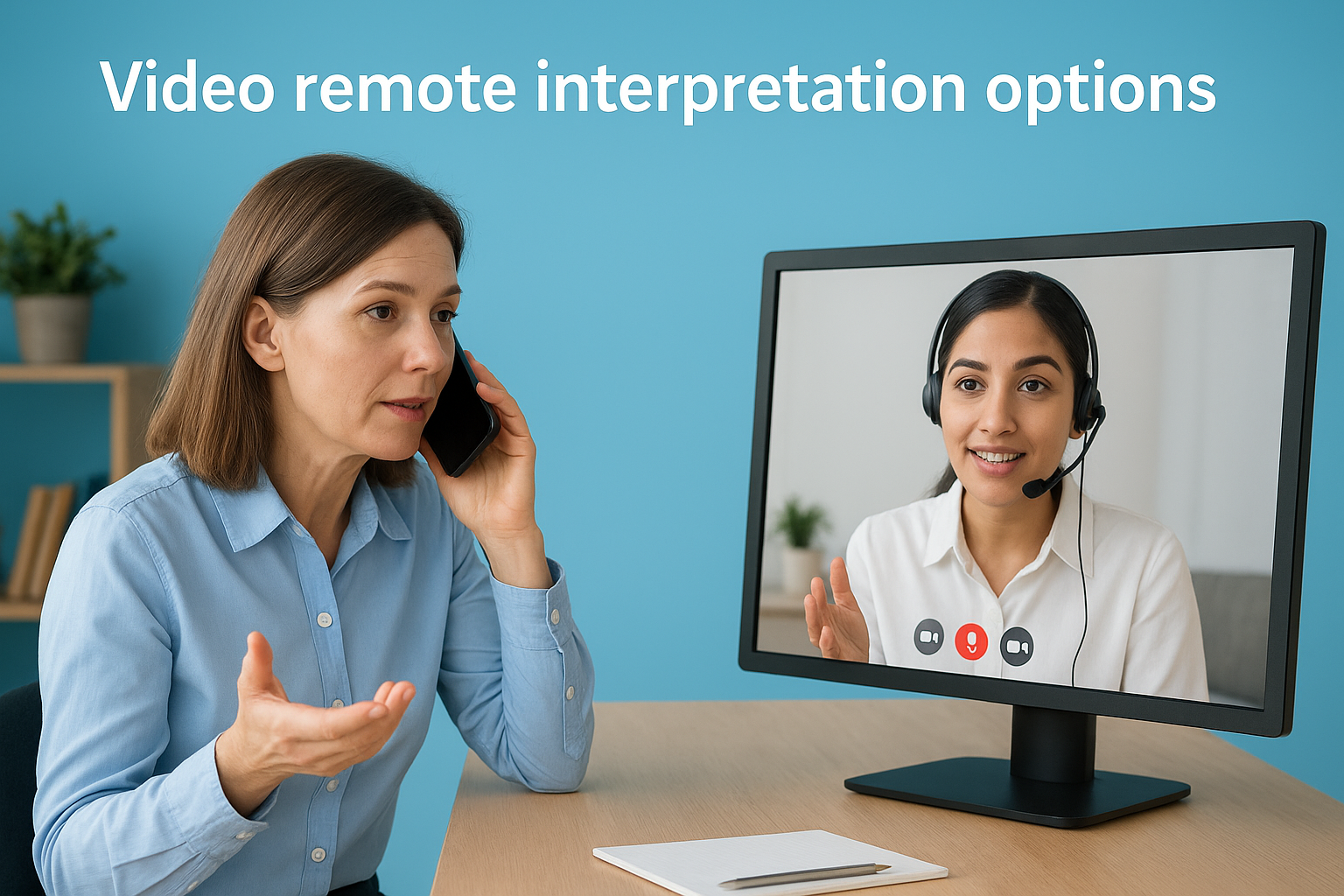
Video interpretation costs 20-40% more than audio-only services but provides value when visual communication matters.
Scheduled interpretation appointments
You arrange these calls in advance when you need specialized interpreters with specific certifications or subject matter expertise, or when you require a guaranteed time slot for an important conversation.
How language line services work in practice
The mechanics of using language line services are straightforward: you dial a toll-free number, enter your account credentials, select the target language, and wait for an interpreter to join the call. Most providers connect you within 60 seconds for common languages and two to three minutes for rare dialects. Your staff don’t need specialized training beyond understanding basic protocol: identify yourself, state the language needed, and wait for the interpreter before beginning the conversation.
The connection process from start to finish
You dial the provider’s access number from any phone in your facility, then enter your unique client code or department identifier. After selecting the target language (usually by speaking it or entering a numeric code), the system routes your call to an available interpreter. The interpreter greets you, confirms the language, and may ask about the nature of the conversation to provide appropriate context. Once connected, you speak directly in short, clear phrases, pausing after each thought to allow the interpreter to convey your message. The person you’re helping responds, the interpreter translates back to you, and this pattern continues until the conversation ends.
Professional interpreters maintain strict confidentiality and adhere to ethical standards that prohibit them from adding, omitting, or altering any part of the conversation.
Managing account access and tracking usage
Your organization receives login credentials and access codes that tie each call to specific departments or cost centers for billing purposes.
Costs and pricing models to expect
Language line services typically charge between $1.50 and $3.50 per minute for on-demand interpretation, with pricing varying based on the language requested and your organization’s call volume. Common languages like Spanish or Mandarin sit at the lower end of this range, while rare dialects and overnight hours command premium rates that can reach $4 to $5 per minute. Most providers include a minimum charge per call, usually two to five minutes, so even a 30-second conversation costs you for the full minimum period.

Per-minute billing for most services
Your organization pays for actual interpretation time from when the interpreter joins your call until the conversation ends. Providers track usage through your account portal, typically updating billing data within 24 to 48 hours after each call. Video remote interpretation adds a 20% to 40% premium over audio-only rates because it requires additional technology infrastructure and bandwidth. You can expect Spanish interpretation to cost roughly $1.75 to $2.25 per minute, while languages like Karen or Pashto may run $3 to $4 per minute due to smaller interpreter pools.
High-volume accounts often negotiate lower per-minute rates by committing to minimum monthly spending thresholds of $500 to $2,000.
Monthly subscription alternatives
Some providers offer flat-rate monthly plans that include a set number of interpretation minutes, typically ranging from $200 to $800 per month depending on your projected usage.
How to choose a provider and set it up
Your selection process starts with comparing response times, language availability, and pricing structures across potential providers. Request detailed rate sheets that break down costs by language, time of day, and service type. Ask about minimum monthly commitments and whether volume discounts apply to your projected usage. Test the service during a free trial period if available, focusing on connection speed for the languages you use most frequently.
Evaluating provider capabilities and references
You need to verify that interpreters hold appropriate certifications for specialized settings like medical or legal environments. Ask providers about their interpreter vetting process, including language proficiency testing and background screening procedures. Request client references from organizations similar to yours in size and industry. Contact these references to learn about service reliability, interpreter quality, and billing accuracy.
Organizations that skip reference checks often discover service gaps only after signing contracts and encountering critical communication failures.
Completing account setup and staff training
Your provider assigns you unique access codes and phone numbers once you sign the contract. Distribute these credentials to relevant departments along with instructions for selecting languages and tracking usage. Schedule brief training sessions where staff practice making test calls to understand the connection protocol and conversation flow before live interactions.
What to do next
You now understand how language line services operate, what they cost, and how to evaluate providers for your organization. The next step involves reaching out to potential vendors for quotes based on your specific language needs and projected call volume. Compare at least three providers to ensure you’re getting competitive pricing and adequate service levels for the languages you use most frequently.
Start with a pilot program in one department before rolling out access across your entire organization. This approach lets you identify any workflow issues, train staff on proper usage protocols, and measure actual costs against projections. Track your monthly spending and connection times for the first 90 days to verify that the service meets your operational requirements.
Ready to explore your options? Contact Languages Unlimited to discuss telephonic interpretation solutions and pricing structures that align with your organization’s budget and communication requirements.