



When someone walks into a hospital, courtroom, or social services office and doesn’t speak English, a community interpreter becomes their lifeline. These language professionals do more than translate words, they bridge cultural gaps and ensure equal access to essential services for millions of people across the United States.
If you’re considering a career in this field, you’re likely wondering what the job actually involves, what qualifications you need, and how to get started. At Languages Unlimited, we’ve worked with thousands of interpreters since 1994, and we understand what it takes to succeed in community-based interpreting roles, from healthcare settings to legal proceedings.
This guide breaks down the core duties of a community interpreter, outlines the training pathways available, and explains the certification options that can help you build a credible, rewarding career. Whether you’re exploring this profession for the first time or looking to formalize your existing skills, you’ll find the practical information you need to take the next step.
Why community interpreters matter in public services
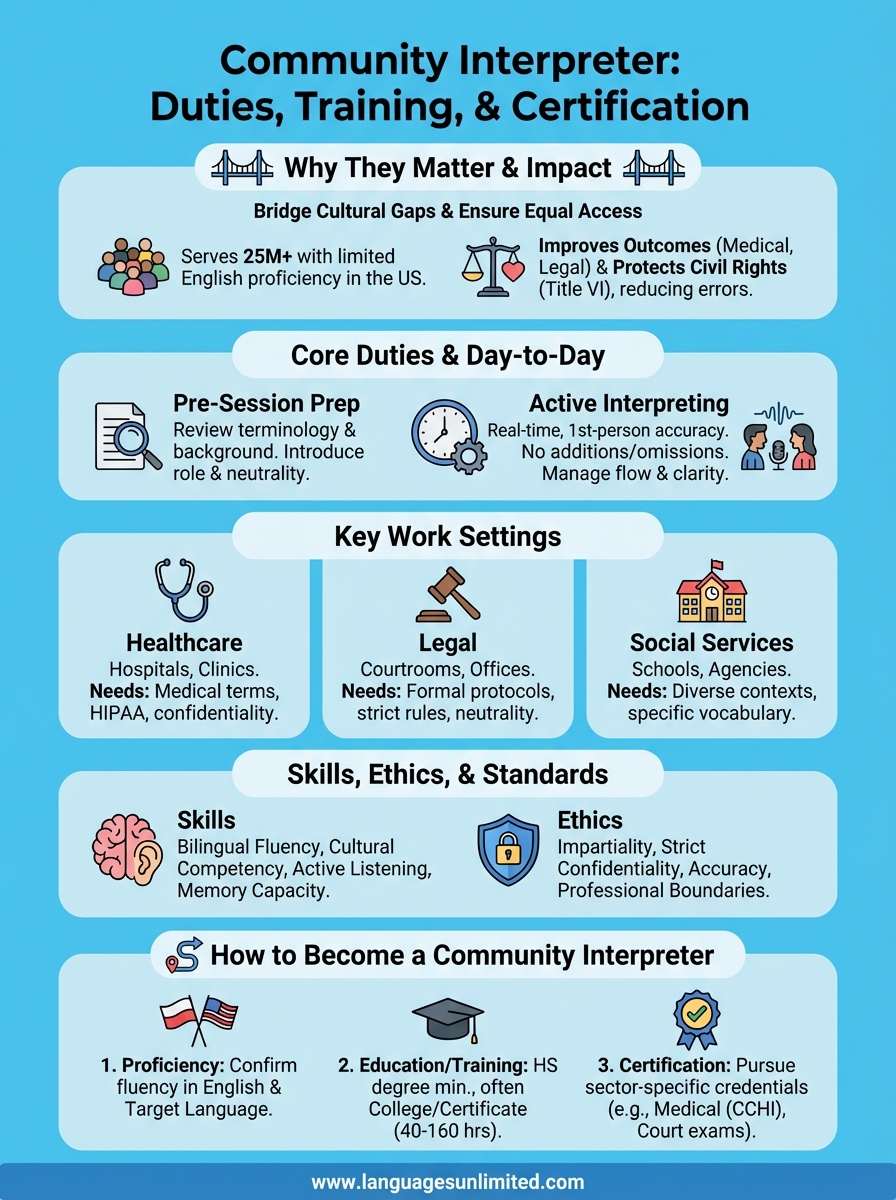
You might assume that offering services in English alone covers the needs of most Americans, but over 25 million people in the United States have limited English proficiency according to census data. When these individuals need medical care, legal representation, or government assistance, a community interpreter becomes the only way they can exercise their rights and access the help they need. Without professional language support, misunderstandings can lead to misdiagnoses, wrongful convictions, or denied benefits that affect people’s lives for years.
Legal mandates and equal access
Federal law requires public entities to provide language access under Title VI of the Civil Rights Act, which prohibits discrimination based on national origin. Hospitals receiving Medicare or Medicaid funding, courts handling criminal cases, and agencies distributing public benefits must all offer interpreter services to people who need them. You’ll find that these mandates exist because language barriers create unequal treatment, preventing residents from participating fully in civic life or receiving the same quality of services as English speakers.
Language access isn’t a courtesy in public services. It’s a civil right backed by decades of legal precedent.
Impact on outcomes and safety
Professional interpretation improves tangible results across every sector where community interpreters work. In healthcare settings, patients with interpreter support are 50% more likely to understand their diagnosis and follow treatment plans correctly. Court systems reduce wrongful convictions when defendants can explain their situation clearly through qualified interpreters. Social services connect families to resources faster when workers and clients can communicate without confusion. The presence of a skilled community interpreter transforms public services from inaccessible bureaucracies into systems that actually serve everyone in the community, regardless of the language they speak at home.
What a community interpreter does day to day
Your daily schedule as a community interpreter revolves around facilitating conversations in public service settings where language barriers prevent communication. You receive assignments through an agency or organization, review case details before each session, and travel to hospitals, courtrooms, schools, or government offices to interpret between English and your target language. Most community interpreters work with multiple clients throughout the day, moving between different locations and switching contexts rapidly as they help people navigate critical moments in their lives.

Pre-session preparation and client briefings
Before you begin interpreting, you’ll review relevant terminology and background information specific to that appointment. A medical interpretation session might require you to study anatomical terms in both languages, while a court appearance demands understanding of legal procedures and rights. You arrive early to introduce yourself to both parties, explain your role as a neutral language conduit, and clarify any ground rules about confidentiality or communication protocols.
Preparation separates adequate interpreters from excellent ones. The terminology you study beforehand determines how accurately you convey critical information.
Active interpreting in real-time situations
During the actual session, you interpret everything spoken by both parties without adding, omitting, or modifying the message. You maintain first-person speech patterns, meaning when a doctor says "I recommend this treatment," you say "I recommend this treatment" in the target language rather than "The doctor recommends." You watch for cultural references that need brief clarification and manage the flow of conversation so both parties can communicate effectively without confusion.
Where community interpreters work and what changes by setting
You work across diverse environments as a community interpreter, and each setting demands different protocols and specialized vocabulary. Healthcare facilities expect you to understand medical terminology and HIPAA privacy rules, while courtrooms require knowledge of legal procedures and formal speaking patterns. Schools, social service agencies, and immigration offices each present unique challenges that shape how you perform your role.
Healthcare facilities and medical protocols
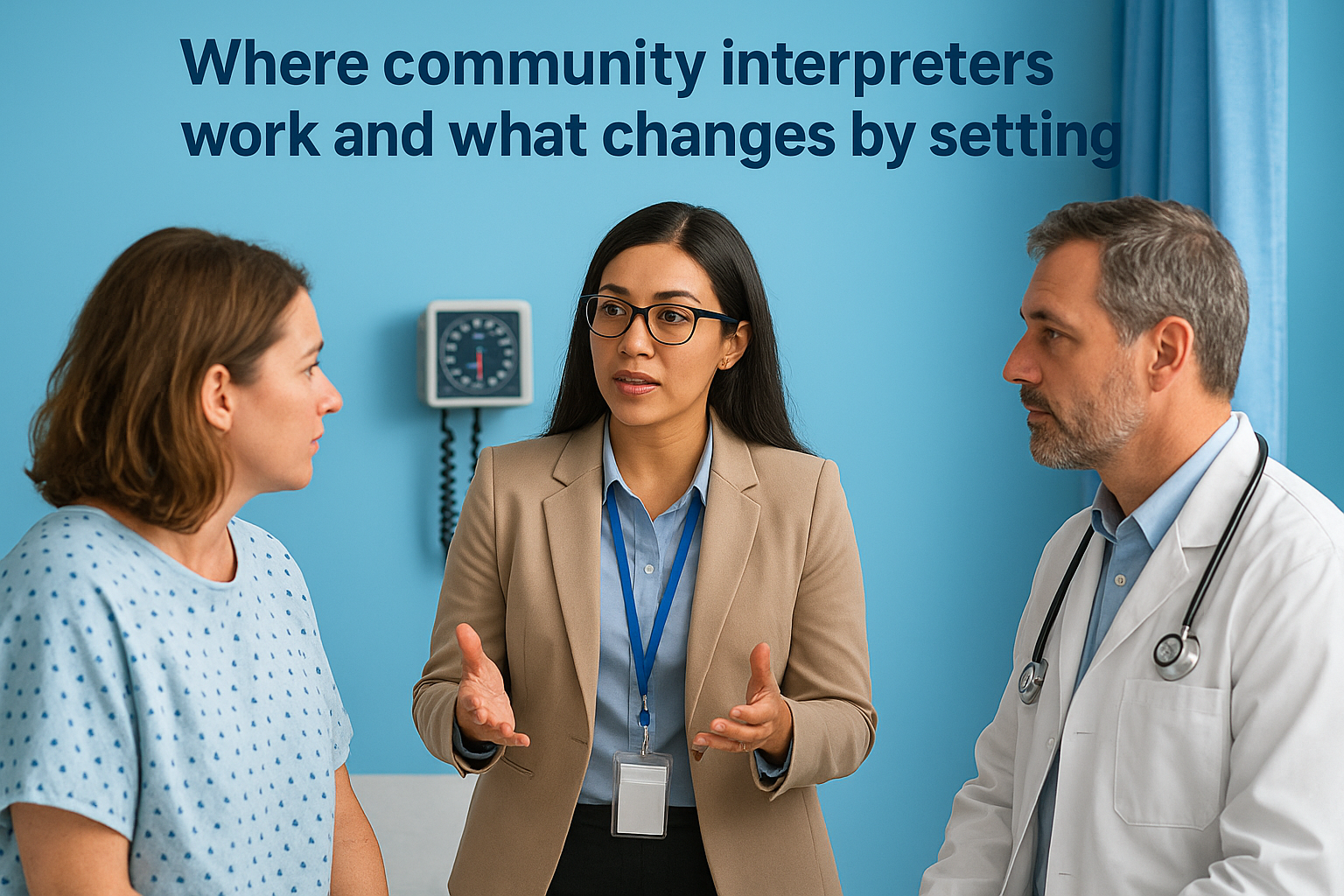
Hospitals and clinics are the most common workplaces for community interpreters, where you navigate patient consultations, emergency room visits, and mental health sessions. Medical settings require strict adherence to confidentiality standards and an understanding of anatomical terms, medication names, and treatment procedures in both languages. You position yourself within sight lines of both the provider and patient, often standing rather than sitting to facilitate clear communication during examinations.
Medical interpretation demands precision because a single mistranslated word can alter treatment decisions that affect someone’s health for life.
Legal settings and courtroom procedures
Courtrooms and legal offices require you to follow formal protocols and maintain neutrality under high-pressure circumstances. You interpret arraignments, depositions, client-attorney meetings, and trials while adhering to strict procedural rules about when you can speak. Legal interpretation often involves consecutive mode, where speakers pause after each statement to allow for interpretation, rather than the simultaneous whispering you might use in medical settings.
Skills, ethics, and professional standards to know
Mastering two languages fluently represents just the foundation of your work as a community interpreter. You need cultural competency to navigate unspoken norms that shape how people communicate about sensitive topics like illness, legal trouble, or family matters. Professional community interpreters develop active listening skills that catch nuances in tone and context, allowing them to convey not just words but the full meaning behind statements. Your memory capacity expands through training and practice, enabling you to retain complex information during consecutive interpreting sessions without taking detailed notes.
Ethical obligations and confidentiality rules
Professional standards require you to maintain complete impartiality regardless of personal opinions about what you hear during sessions. You never advocate for either party, offer advice, or insert your own commentary into interpreted conversations. Confidentiality protects everything you witness, meaning you cannot discuss case details with anyone outside the session unless legally required to report specific situations like child abuse.
Your role demands neutrality even when you hear statements that conflict with your personal values or beliefs.
Accuracy and professional boundaries
You interpret everything stated without editing, softening, or "helping" speakers express themselves better. Organizations like the National Association of Judiciary Interpreters and Translators publish codes of ethics that define acceptable conduct and outline situations where you must disclose potential conflicts of interest before accepting assignments.
How to become a community interpreter in the US
You enter the community interpreting field through multiple pathways depending on your language pair and target sector. Most employers require high school completion at minimum, though many prefer college degrees or specialized training certificates. Your journey starts with confirming fluent proficiency in both English and your target language, followed by completing formal interpreter training and obtaining relevant certifications for your chosen specialization.
Educational background and language proficiency
Begin by assessing your true fluency level in both languages, not just conversational ability but mastery of complex vocabulary, idioms, and cultural contexts. Many community interpreters pursue associate or bachelor’s degrees in interpretation, translation, or related fields that provide structured training in interpreting techniques and professional ethics. Alternatively, you can complete certificate programs offered through community colleges or professional organizations that typically run 40 to 160 hours depending on specialization.
Certification pathways and testing
Pursue certification through organizations like the National Board of Certification for Medical Interpreters or the Certification Commission for Healthcare Interpreters for healthcare roles. Court interpreting requires state-specific examinations and federal certification for those working in immigration courts. These credentials demonstrate your competence to employers and clients, opening doors to higher-paying positions and increased professional recognition.
Certification separates hobbyists from professionals in settings where mistakes carry real consequences.
What to do next
Your path forward as a community interpreter starts with selecting the training program and certification that matches your language pair and preferred work setting. Research state-specific requirements for your target sector, since medical and legal interpreting often demand different credentials depending on where you live. Connect with local interpreter associations to find mentorship opportunities and learn about job openings in your area.
Start building your professional network by attending workshops, joining online communities, and shadowing experienced interpreters when possible. Many hospitals, courts, and social service agencies offer volunteer or entry-level positions that provide real-world experience while you complete certification requirements. You gain credibility faster when you demonstrate commitment through structured training rather than relying solely on bilingual abilities.
If you need professional interpretation services for your organization or want to explore career opportunities with an established agency, reach out to our team at Languages Unlimited. We’ve connected thousands of qualified interpreters with meaningful work since 1994 and understand what it takes to build a successful career in this field.