



When a patient can’t communicate their symptoms to a doctor, or a physician’s instructions get lost in translation, the consequences can be severe, even life-threatening. That’s where medical interpreters step in. So, what is medical interpreting exactly? It’s the specialized practice of facilitating spoken communication between healthcare providers and patients who don’t share a common language, ensuring accurate and culturally appropriate exchanges in clinical settings.
At Languages Unlimited, we’ve connected healthcare facilities with qualified medical interpreters since 1994, witnessing firsthand how this profession has grown in both demand and complexity. Whether you’re considering a career in the field or seeking to understand what medical interpreters actually do, knowing the role’s scope matters, from the specific duties they perform to the certifications they need and the compensation they can expect.
This guide breaks down the essentials: the core responsibilities of medical interpreters, how the role differs from translation, what certification pathways exist, and current salary expectations across the industry.
Why medical interpreting matters in healthcare
When you walk into a hospital or clinic without speaking the primary language, every word matters. Miscommunication in healthcare settings doesn’t just create frustration; it leads to misdiagnoses, incorrect medication dosages, and patients who can’t follow critical treatment plans. Understanding what is medical interpreting helps clarify why this profession has become non-negotiable in modern healthcare delivery, particularly in diverse communities where language barriers affect patient outcomes daily.
Patient safety depends on clear communication
Medical errors linked to language barriers are documented across the healthcare industry. You might assume that gestures or a family member’s basic language skills suffice, but clinical conversations require precision that casual interpretation can’t provide. A patient who misunderstands "take two pills daily" versus "take two pills twice daily" faces serious health risks, and the responsibility for preventing these errors falls on trained medical interpreters who know medical terminology in multiple languages.
Research consistently shows that patients with limited English proficiency experience higher rates of adverse events. Professional medical interpreters reduce these incidents by ensuring you understand your diagnosis, treatment options, and follow-up care instructions accurately. They also help healthcare providers gather complete medical histories, which directly impacts the quality of care you receive from the first appointment through discharge.
Without qualified medical interpreters, healthcare facilities expose themselves to preventable medical errors and the legal liability that follows.
Legal and compliance requirements drive demand
Federal regulations under Title VI of the Civil Rights Act require healthcare facilities that receive federal funding to provide language access services. This isn’t optional; it’s a legal mandate that protects your rights as a patient. Hospitals, clinics, and medical practices face substantial penalties when they fail to offer adequate interpretation services, making qualified medical interpreters essential team members rather than optional resources.
Accreditation standards from The Joint Commission also require healthcare organizations to demonstrate competency in addressing communication needs. You’ll find that facilities serious about compliance invest in professional interpretation services, whether through on-site interpreters, video remote interpreting platforms, or telephonic interpretation systems that connect you with qualified professionals within seconds.
What medical interpreters do in a typical encounter
When you enter a medical appointment with an interpreter present, you’re seeing a professional who follows strict protocols designed to protect both accuracy and confidentiality. Medical interpreters don’t simply translate words; they facilitate complete understanding between you and your healthcare provider while maintaining neutrality. Their work begins before anyone speaks and continues after the appointment ends, encompassing preparation, interpretation, and documentation that most patients never see.

The interpreter’s role in understanding what is medical interpreting goes beyond language conversion. You’ll notice they position themselves carefully in the room, typically near you but slightly behind so the doctor maintains eye contact with you rather than the interpreter. They introduce themselves, explain their role, and confirm the languages being used. This positioning strategy ensures you remain the primary focus of the medical encounter rather than creating a three-way conversation dynamic that could compromise the patient-provider relationship.
Professional medical interpreters maintain a neutral position, interpreting everything said by both parties without adding personal opinions or medical advice.
Active interpretation and accuracy verification
During your appointment, interpreters work in first-person present tense, meaning when your doctor says "I’m going to examine your lungs," the interpreter conveys this as "I’m going to examine your lungs" rather than "The doctor says she’s going to examine your lungs." This technique keeps the conversation direct between you and your provider. Interpreters render everything spoken, including side conversations, questions, and emotional expressions, without editing or summarizing unless specifically asked to condense information.
You might notice interpreters occasionally asking for clarification or requesting speakers to slow down. These interruptions protect accuracy and represent professional standards rather than gaps in skill.
Medical interpreting vs medical translation
Understanding what is medical interpreting means recognizing how it fundamentally differs from medical translation, even though both professions involve converting information between languages. Medical interpreters work with spoken language in real time, facilitating live conversations between you and your healthcare provider during appointments, procedures, or consultations. Medical translators handle written documents, converting patient records, consent forms, prescription instructions, and discharge summaries from one language to another without the pressure of immediate interaction.
The skill sets required for each role diverge significantly. Interpreters must process and render information instantly, maintaining accuracy while managing the emotional dynamics of clinical encounters where you might feel anxious, confused, or in pain. Translators work at their own pace, able to research terminology, consult medical dictionaries, and revise their work multiple times before delivery, which means their output typically undergoes more quality control than spoken interpretation can allow.
When you need each service
You encounter medical interpreters when immediate communication is necessary, such as during emergency room visits, surgical consultations, mental health assessments, or any appointment where you and your provider must exchange information in real time. The interpreter’s presence ensures nothing gets lost in critical moments when decisions about your care happen on the spot.
Medical translation serves you differently. You receive translated documents when you need written materials to take home, review at your own pace, or submit to other institutions. Prescription labels, treatment plans, insurance documents, and medical history forms all require translation rather than interpretation because these materials inform your decisions outside the clinical setting.
Medical interpreters handle time-sensitive spoken exchanges, while translators ensure you can read and understand written healthcare materials accurately.
How medical interpreting works in real settings
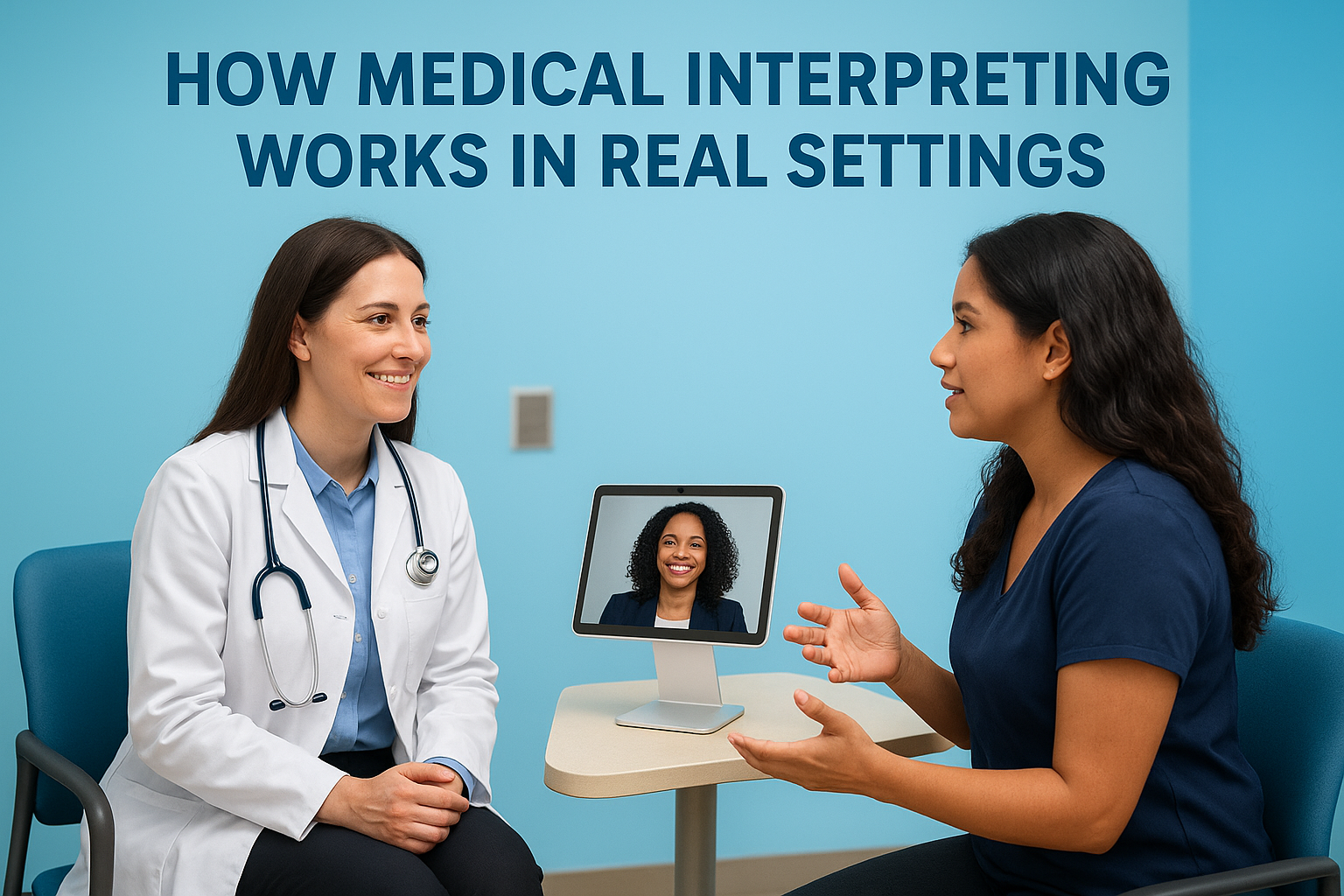
Medical interpreting happens through multiple delivery methods depending on your healthcare facility’s resources and the urgency of your situation. On-site interpretation remains the gold standard for complex procedures, surgeries, and sensitive conversations where you need an interpreter physically present in the room. Video remote interpreting (VRI) and telephonic interpretation have grown rapidly, offering immediate access to qualified interpreters when in-person services aren’t available or when you face an unexpected language barrier during your visit.
In-person interpretation in hospitals and clinics
When you schedule a procedure or appointment requiring interpretation, hospitals typically arrange for staff interpreters or contracted professionals to meet you at the designated time and location. These interpreters arrive familiar with medical terminology and the facility’s protocols, positioning themselves to facilitate direct communication between you and your care team. Major medical centers maintain interpreter departments with professionals covering multiple languages, while smaller facilities often contract with language services providers who dispatch interpreters as needed.
Remote interpretation options
Your healthcare provider might connect you with an interpreter through a tablet or phone when immediate interpretation is necessary. VRI systems allow you to see the interpreter on screen, which helps when discussing visual materials like diagrams or medication labels, though the technology requires stable internet connections that some facilities lack. Telephonic interpretation works anywhere with phone service, making it the fastest option during emergencies when understanding what is medical interpreting matters most for your safety.
Remote interpretation technologies have made qualified medical interpreters accessible within seconds, transforming how healthcare facilities address sudden language barriers.
Certification, training, and pay in the US
Breaking into medical interpreting requires understanding what is medical interpreting from a professional development perspective, which means knowing which credentials matter most and what you can expect to earn once certified. The field has established clear pathways for credentialing, though requirements vary by state and healthcare setting, with national certifications carrying the most weight across the industry.
Certification pathways and requirements
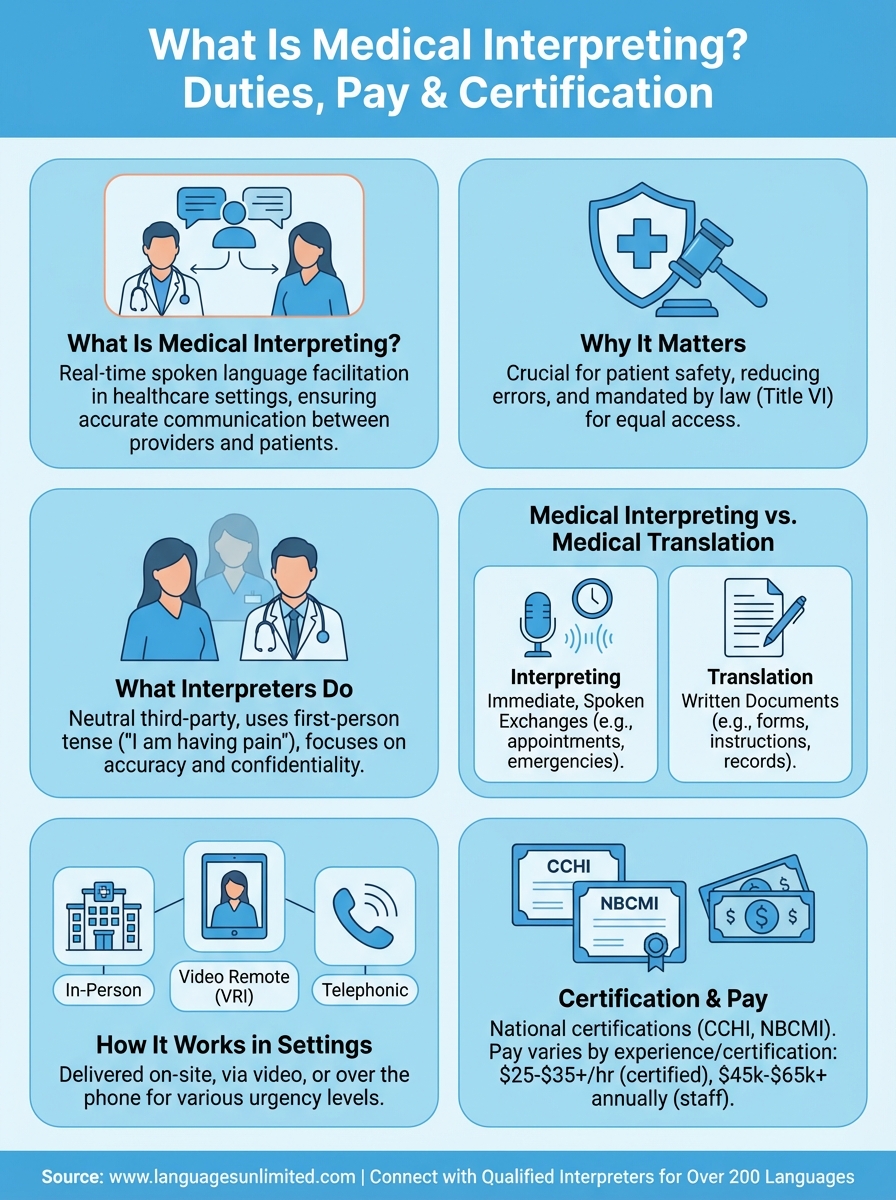
You’ll find two primary national certifications for medical interpreters in the United States. The Certification Commission for Healthcare Interpreters (CCHI) offers the Certified Healthcare Interpreter credential, requiring you to pass a written exam covering ethics, standards of practice, and medical terminology, plus an oral proficiency assessment in your language pair. The National Board of Certification for Medical Interpreters (NBCMI) provides the Certified Medical Interpreter credential through similar testing processes, with both organizations maintaining rigorous standards that healthcare facilities recognize and often require.
Training programs before certification typically span 40 to 60 hours of instruction covering medical terminology, anatomy, ethics, and interpretation techniques. You can complete these programs through community colleges, professional associations, or online platforms, though hands-on practice remains critical. Many states don’t legally require certification for medical interpreters, but major hospitals and healthcare systems increasingly mandate credentials for employment, making certification essential for career advancement regardless of legal requirements.
National certifications from CCHI or NBCMI represent the industry standard, opening doors to positions at reputable healthcare facilities that prioritize professional interpretation services.
What medical interpreters earn
Your earning potential as a medical interpreter varies significantly based on certification status, experience level, and geographic location. Entry-level interpreters without certification typically earn $15 to $20 per hour, while certified medical interpreters command $25 to $35 per hour in most markets, with rates climbing higher in metropolitan areas where demand exceeds supply.
Staff positions at hospitals offer annual salaries ranging from $45,000 to $65,000, including benefits packages that freelance interpreters must secure independently. You’ll earn more through contract work or specialized interpretation in high-demand languages, though this path requires building a client base and managing your own business operations.
Final takeaways
Understanding what is medical interpreting means recognizing it as a specialized profession that protects patient safety through accurate, real-time language facilitation in clinical settings. Professional medical interpreters bridge communication gaps that casual translation or family members cannot adequately address, ensuring you receive accurate diagnoses, proper treatment instructions, and comprehensive care regardless of the language you speak.
The field offers clear certification pathways through CCHI or NBCMI, with earning potential ranging from entry-level hourly rates to comfortable annual salaries for experienced professionals. Healthcare facilities increasingly demand certified interpreters to meet legal requirements and quality standards, making professional credentials essential for both career advancement and optimal patient outcomes.
If your healthcare organization needs qualified medical interpreters for on-site appointments, video remote sessions, or telephonic consultations, Languages Unlimited connects you with vetted professionals across more than 200 languages. Contact our team to discuss how we can support your language access requirements with interpreters who meet industry standards and understand the critical nature of medical communication.