



A patient arrives at an emergency room at 3 AM speaking only Mandarin. A multinational contract negotiation runs past midnight across time zones. An asylum seeker needs urgent legal guidance on a Sunday. These situations share one common thread: they can’t wait until business hours. 24/7 language support has become essential for organizations that serve diverse populations, and the demand for immediate multilingual access continues to grow.
Whether you manage a hospital, run a legal practice, or oversee government services, communication barriers don’t follow a schedule. When someone needs help, they need it now, in a language they understand. That’s why round-the-clock language services exist: to bridge gaps when it matters most, ensuring no critical conversation gets lost or delayed due to timing.
At Languages Unlimited, we’ve provided interpretation and translation services since 1994, supporting organizations across all 50 states with access to over ten thousand language professionals. This article breaks down what 24/7 language support actually means, the different types available, and how to implement it effectively within your organization.
What 24/7 language support means
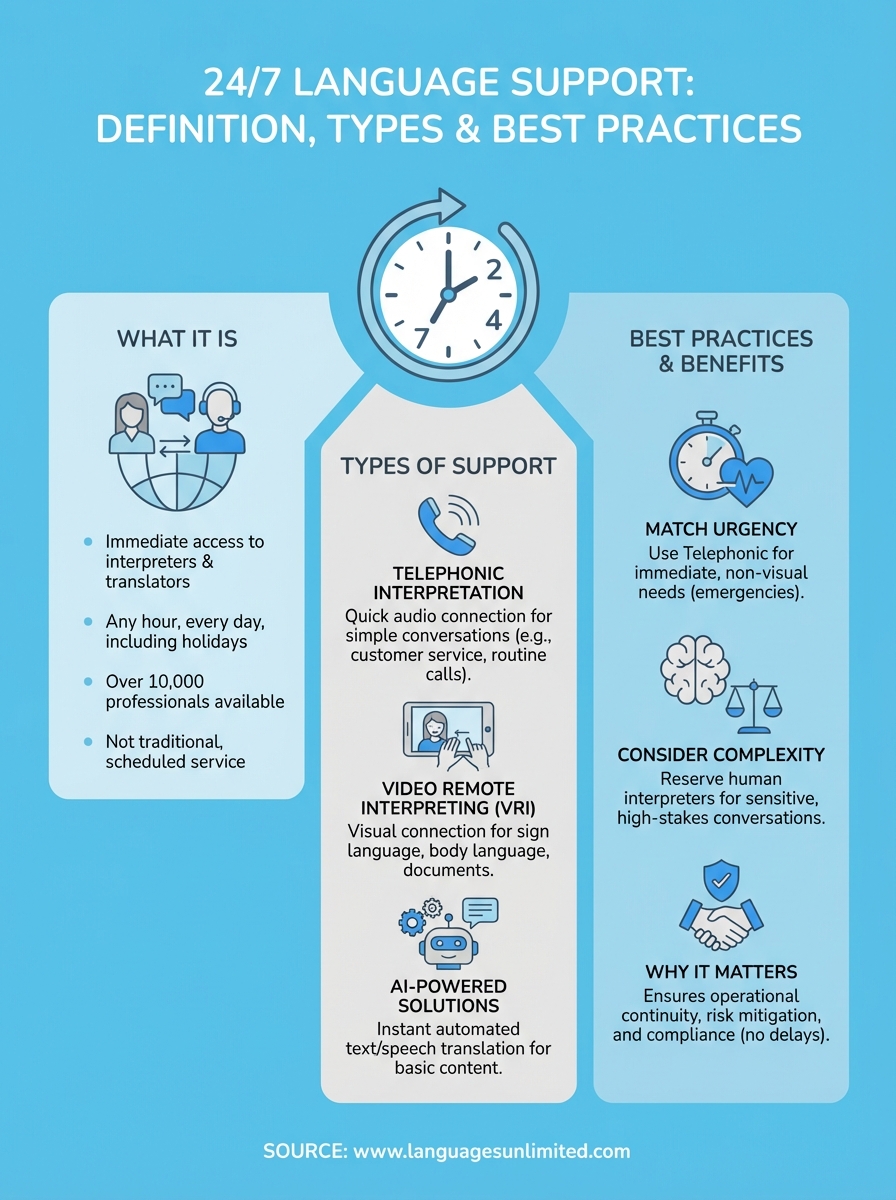
24/7 language support gives you access to professional interpreters and translators at any hour, every day of the year, including holidays. Unlike traditional language services that operate during standard business hours, these solutions connect you with qualified language professionals instantly, whether you need them at noon or midnight. You don’t schedule appointments weeks in advance or wait until Monday morning. Instead, you get immediate access to multilingual communication when the need arises.
Core components of round-the-clock support
The service relies on three essential elements to function effectively. First, you need a large network of credentialed interpreters spread across multiple time zones, ensuring someone qualified is always available. Second, reliable technology infrastructure must connect you to these professionals through phone, video, or digital platforms without delays or technical failures. Third, comprehensive quality control systems maintain consistency, ensuring the interpreter you reach at 2 AM delivers the same professional standard as one available during peak hours.
Organizations that implement 24/7 language support reduce communication delays by eliminating the wait for business hours, which proves critical in emergency situations.
The difference from traditional services
Traditional language services require advance scheduling and operate within limited timeframes, typically 9 AM to 5 PM on weekdays. You submit requests, wait for responses, and plan around interpreter availability. This model works fine for planned meetings or document translations with flexible deadlines. However, round-the-clock support flips this approach entirely. You initiate contact on demand and connect within minutes, not days. The service adapts to your schedule and urgency, rather than forcing you to adapt to provider availability. This shift makes continuous language support fundamentally different from conventional models that treat interpretation as a scheduled appointment rather than an always-available resource.
Types of 24/7 language support
Organizations can access round-the-clock language services through several distinct methods, each designed for specific communication needs. You’ll find options ranging from human-powered interpretation to technology-driven solutions, and many providers offer multiple channels to ensure you get the right support format for each situation. Understanding these types helps you choose the most effective approach when communication barriers arise.
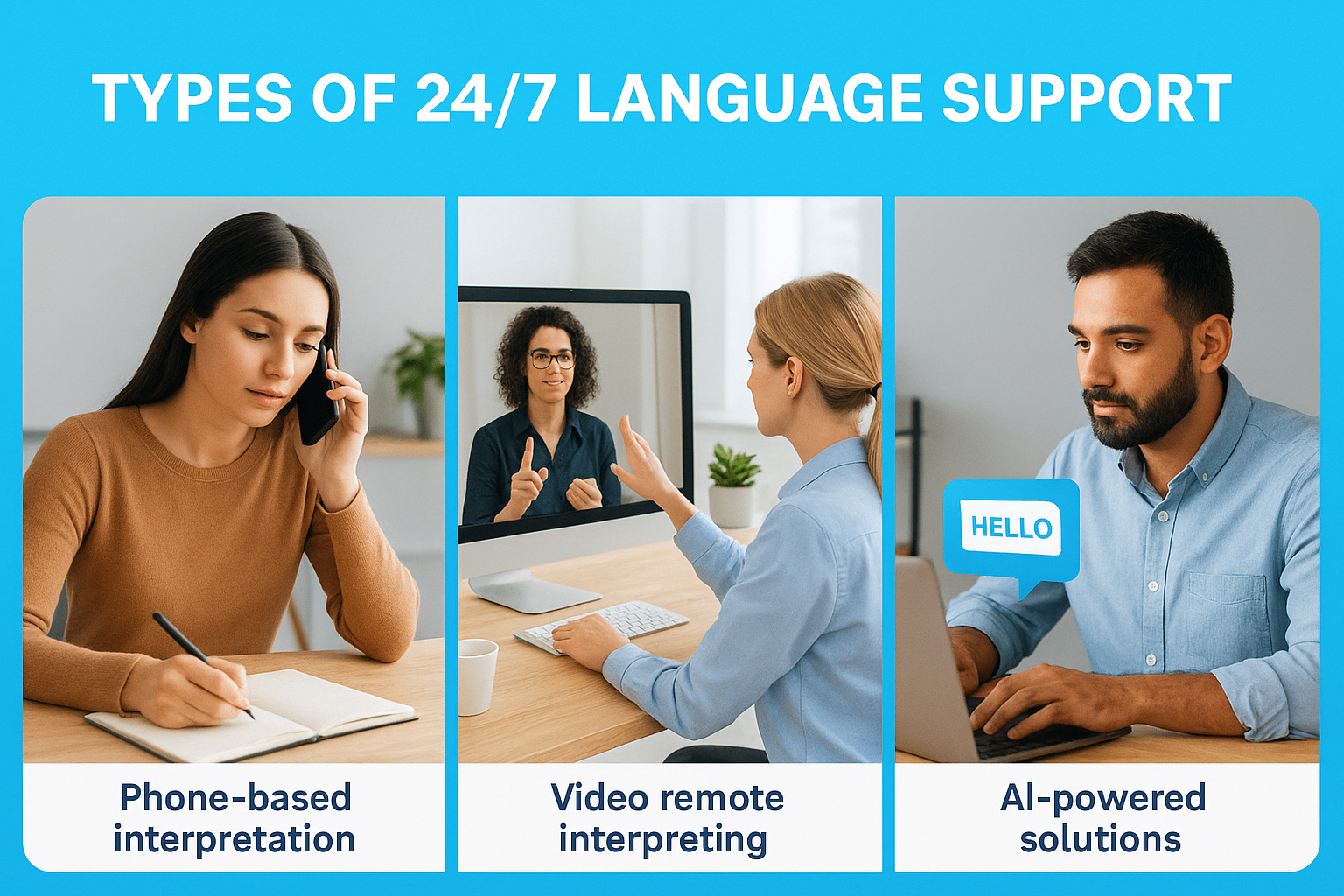
Telephonic interpretation
Phone-based interpretation connects you with a live interpreter through a simple phone call. You dial a service number, specify your needed language, and reach a qualified interpreter within seconds. This method works well for quick conversations where visual contact isn’t necessary, such as customer service calls, insurance claims, or routine medical consultations. The technology is simple, requiring only a phone line, which makes it accessible even in locations with limited internet connectivity.
Video remote interpreting
VRI platforms add visual elements to remote interpretation, allowing you to see the interpreter through video connection. This format proves essential for sign language interpretation and situations where body language, facial expressions, or document viewing matter. Healthcare providers often prefer VRI for patient consultations because doctors can observe non-verbal cues while the interpreter facilitates conversation.
AI-powered solutions
Automated translation tools use machine learning to provide instant text or speech translation without human interpreters. These systems handle basic exchanges and written content quickly, though they lack the nuance and cultural awareness that trained professionals bring. You might use AI solutions for translating website content or simple customer inquiries, then escalate complex matters to human interpreters.
Organizations typically combine multiple support types to balance speed, accuracy, and cost across different communication scenarios.
When to use each support type
Selecting the right format for 24/7 language support depends on your specific situation, the complexity of the conversation, and what’s at stake. You wouldn’t use the same approach for a life-threatening medical emergency as you would for translating a simple customer question. Matching your communication needs to the appropriate service type ensures both efficiency and accuracy while controlling costs.
Match urgency with method
Telephonic interpretation works best when you need immediate help for straightforward conversations without visual elements. Hospital emergency rooms use phone interpreting when seconds count and the situation doesn’t require seeing documents or sign language. Your customer service team can rely on this method for routine inquiries, billing questions, or appointment scheduling. The low barrier to access makes it ideal when speed matters more than visual context.
Video platforms become necessary when you need to see the other person or the interpreter. Schedule VRI for medical consultations where facial expressions reveal pain levels, legal proceedings requiring document review, or any situation involving deaf or hard-of-hearing individuals who rely on sign language.
Consider complexity and context
AI translation tools handle repetitive, basic exchanges where perfect accuracy isn’t critical. Use them for translating product descriptions, answering frequently asked questions, or providing general information on your website. Reserve human interpreters for complex conversations, sensitive topics, or situations where misunderstanding carries serious consequences.
Organizations achieve the best results by establishing clear protocols that specify which method to use based on urgency, complexity, and the potential impact of miscommunication.
Why 24/7 language support matters
You can’t predict when language barriers will create critical problems. Medical emergencies happen at night, legal deadlines span weekends, and customer inquiries come from every time zone. Organizations without round-the-clock access to interpreters face delays that damage trust, risk compliance violations, and potentially harm people who need immediate help.
Operational continuity across time zones
Your operations likely extend beyond standard business hours, whether through emergency services, customer support, or global partnerships. When you implement 24/7 language support, you eliminate communication gaps that slow down critical processes. Emergency rooms can treat patients immediately instead of postponing care until an interpreter arrives. Legal firms can respond to urgent matters without waiting for Monday morning. Customer service teams resolve issues in real time, preventing frustration and lost business.
Risk mitigation and compliance
Federal regulations and industry standards often require you to provide meaningful access to services regardless of language barriers. Failing to communicate effectively can result in serious consequences, from misdiagnosis in healthcare settings to invalid legal proceedings. Organizations face lawsuits, regulatory penalties, and reputational damage when language barriers lead to errors.
Access to qualified interpreters at any hour transforms language support from a scheduling challenge into a reliable operational resource.
How to set up 24/7 language support
You don’t need to build an internal team of interpreters to provide round-the-clock coverage. Partnering with an established language service provider gives you instant access to thousands of qualified professionals without the overhead of staffing, training, or managing interpreters across multiple shifts. Most organizations implement 24/7 language support within days by following a straightforward setup process.
Assess your specific needs
Start by identifying which departments require after-hours language access and what types of interactions they handle. Your emergency room needs different support than your customer service team. Document the languages you encounter most frequently, typical conversation duration, and whether visual elements matter. This assessment helps you choose between telephonic, video, or AI-powered solutions.
Choose and integrate your provider
Select a service that offers your required languages and delivery methods, then integrate their platform with your existing systems. You’ll receive access codes or apps that connect your team to interpreters instantly. Train staff on when and how to use each service type, establish protocols for different situations, and designate administrators who monitor usage and quality.
Organizations that document clear usage protocols during setup see faster adoption and more consistent service quality across departments.
Next steps
Implementing 24/7 language support doesn’t require months of planning or extensive infrastructure changes. You’ve learned what it means, explored the different types available, and understand when to use each method. Now you need to take concrete action to eliminate communication barriers that currently slow down your operations or create unnecessary risks.
Start by mapping out your highest-priority situations where language barriers cause delays or problems. Identify which departments need immediate access to interpreters and which types of support would serve them best. Once you’ve outlined your requirements, you can move forward with a provider who offers the coverage and languages your organization needs.
Languages Unlimited has provided round-the-clock interpretation services across all 50 states since 1994, with access to over ten thousand qualified interpreters. Our network ensures you reach a credentialed professional within minutes, regardless of the time or language. Contact our team to discuss your specific needs and get started with reliable language support that matches your schedule.