



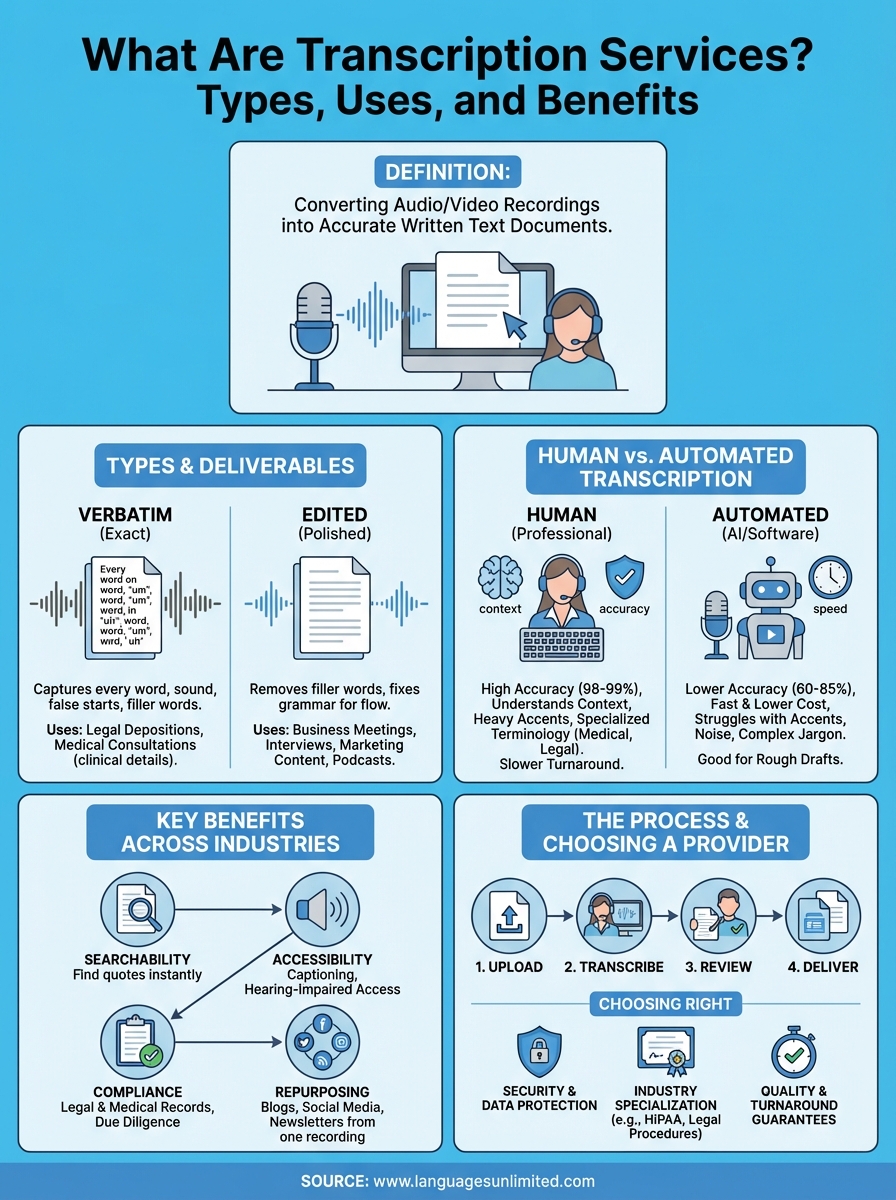
Every day, hours of spoken content, from legal depositions to medical consultations to business meetings, need to become written records. If you’ve ever wondered what are transcription services, you’re asking the right question. Transcription turns audio and video recordings into accurate, searchable text documents. At Languages Unlimited, we’ve provided professional transcription services since 1994, converting spoken language into reliable written documentation for legal firms, healthcare providers, government agencies, and businesses across all 50 states.
Whether you need a word-for-word court transcript or a polished summary of a corporate interview, understanding your options matters. The type of transcription you choose affects accuracy, turnaround time, and cost. Different industries have different requirements, medical records demand precision, while marketing content might prioritize readability.
This guide breaks down the types of transcription services available, where they’re commonly used, and the practical benefits they deliver. By the end, you’ll know exactly which approach fits your specific needs.
What transcription services are and how they work
Transcription services convert your recorded audio or video content into written text. A transcriptionist listens to your recording, then types out everything that was said, creating a text document you can read, search, and share. This applies to any spoken content, interviews, meetings, medical dictations, legal proceedings, podcasts, webinars, or lectures.
The basic transcription process
Your transcription project starts when you submit your audio or video file to a service provider. Most providers accept common formats like MP3, WAV, MP4, or MOV through a secure upload portal. You specify your requirements, such as how quickly you need the completed transcript and whether you want a verbatim record or a cleaned-up version.
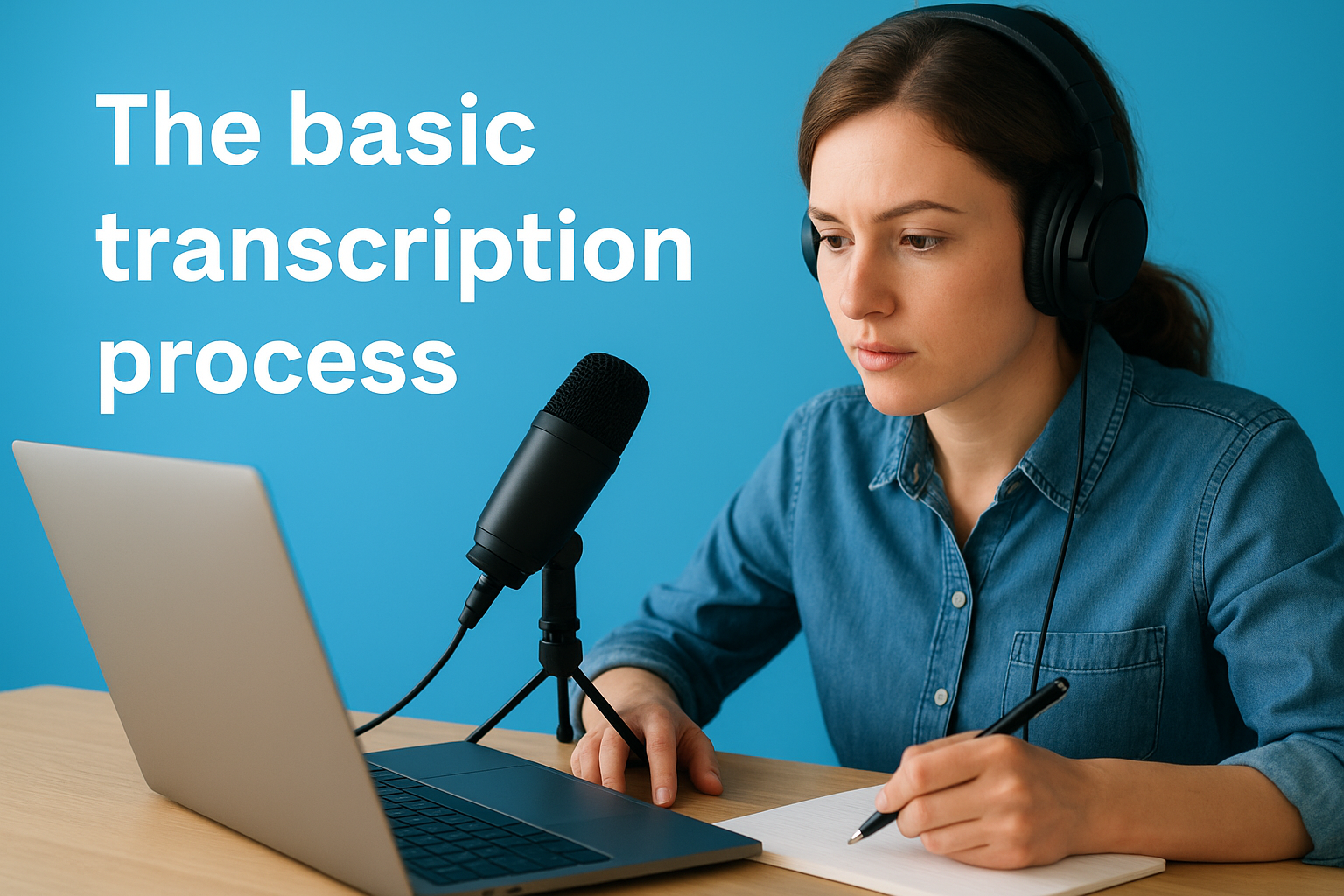
A trained transcriptionist then listens to your recording, typically using specialized software that allows them to control playback speed and rewind easily. They type out the spoken words while noting important details like speaker changes, timestamps, and unclear audio sections. Quality providers have their transcripts reviewed by a second professional to catch errors and ensure consistency.
Professional transcription involves both technical skill and subject matter knowledge to deliver accurate, reliable text documents.
Quality factors that affect accuracy
The clarity of your original recording directly impacts the final transcript quality. Background noise, multiple overlapping speakers, heavy accents, and poor audio equipment all create challenges for transcriptionists. You’ll get the most accurate results when your source file has clear audio, distinct speakers, and minimal ambient sound.
Technical terminology also matters. Medical transcriptionists need to recognize pharmaceutical names and anatomical terms. Legal transcriptionists must understand courtroom procedures and legal language. Professional providers match your project with transcriptionists who have relevant industry experience to ensure they understand context and specialized vocabulary specific to your field.
Types of transcription and common deliverables
When you order transcription, you choose between different styles based on how you’ll use the final document. Your selection affects readability, searchability, and compliance with specific industry standards. Most providers offer two main categories: verbatim transcription and edited transcription, each serving distinct purposes.
Verbatim transcription
Verbatim transcription captures every single word and sound exactly as spoken. This includes false starts, filler words like "um" and "uh," repeated phrases, grammatical errors, and non-verbal sounds such as laughter or pauses. Legal proceedings, court depositions, and law enforcement interviews typically require this format because the complete record matters. Medical professionals sometimes need verbatim transcripts when documenting patient consultations where every detail could have clinical significance.
True verbatim transcription preserves the complete spoken record, including every hesitation and utterance, creating an exact written reproduction of the original audio.
Edited transcription
Edited transcription removes filler words, fixes grammar, and creates polished, readable text while preserving the original meaning. Your transcriptionist eliminates false starts and repetitions, making the document flow naturally. This format works well for business meetings, interviews, podcasts, academic research, and corporate videos where you want professional documentation without distracting verbal quirks. You get the essential content in clear, concise language.
Most providers deliver your completed transcript as a Microsoft Word document, PDF, or plain text file. Some offer specialized formats like timestamped transcripts where each paragraph shows when that section occurred in the recording, or speaker-labeled versions that identify who said what throughout the conversation.
When to use transcription and key benefits
You need transcription whenever spoken content must become a permanent written record. Understanding what are transcription services means knowing when they solve real problems for your organization. Legal firms use transcription for depositions, court hearings, and client consultations where accurate documentation protects against liability. Healthcare providers transcribe patient encounters, diagnostic reports, and surgical notes to maintain complete medical records. Businesses rely on transcripts for board meetings, training sessions, customer interviews, and compliance documentation.
Common use cases across industries
Academic researchers convert interviews and focus groups into analyzable text data. Media companies transcribe podcasts and videos to create searchable content that improves accessibility and search engine visibility. Government agencies document public hearings, council meetings, and official proceedings. You’ll also find transcription valuable for creating captions, archiving institutional knowledge, and making recorded content accessible to hearing-impaired audiences.
Primary benefits you gain
Transcription makes your audio content searchable, allowing you to find specific quotes or information instantly instead of listening through hours of recordings. You improve accessibility by providing text alternatives to audio-only formats. Legal and medical professionals meet compliance requirements with proper documentation. Marketing teams repurpose one recording into multiple content formats, blog posts, social media updates, and email newsletters, maximizing your content investment.
Professional transcription transforms time-sensitive spoken information into durable, searchable documents that serve your organization for years.
Human vs automated transcription and accuracy
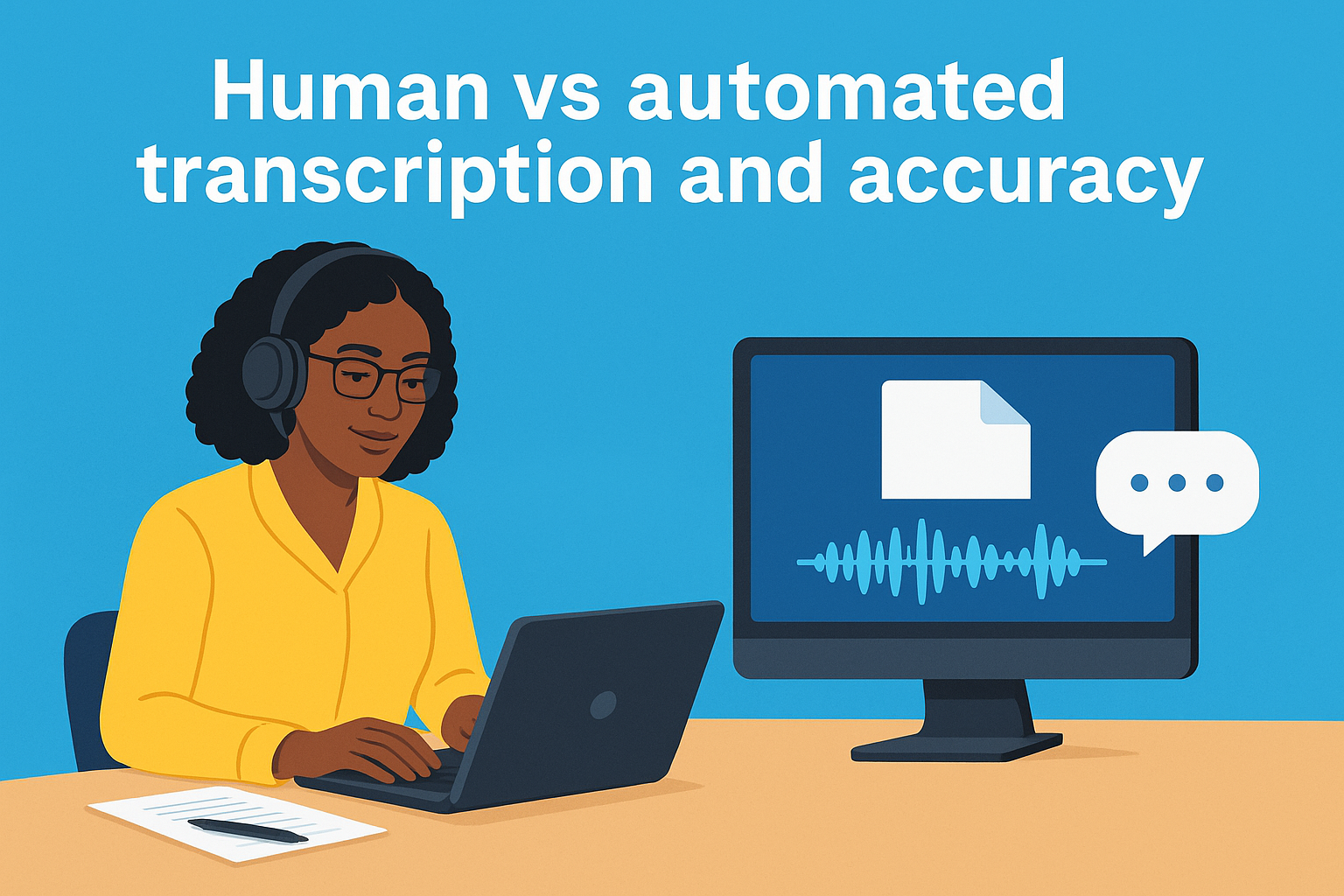
You face a fundamental choice when you need transcription: hire professional human transcriptionists or use automated software. Understanding what are transcription services means recognizing how each approach handles accuracy, context, and specialized terminology. Human transcriptionists deliver 98-99% accuracy for clear audio with proper industry knowledge, while automated systems typically achieve 60-85% accuracy depending on audio quality and speaker accents. Your decision affects both cost and reliability.
Human transcription advantages
Professional transcriptionists understand context, recognize industry jargon, and distinguish between similar-sounding words based on meaning. They identify different speakers accurately, interpret heavy accents and regional dialects, and handle overlapping conversations in meetings or interviews. Medical and legal transcriptionists know specialized vocabulary that automated systems often misinterpret. You get consistent formatting and proper punctuation that reflects the speaker’s intended meaning.
Human transcriptionists apply contextual understanding and subject matter expertise that automated systems cannot replicate, especially for specialized fields requiring precise terminology.
Automated transcription capabilities
Automated transcription software processes recordings quickly and costs less than human services. You receive completed transcripts within minutes instead of hours or days. Modern AI-powered tools handle straightforward recordings with clear speakers and minimal background noise reasonably well. These systems work best for general business content, simple interviews, or creating rough drafts that you’ll edit later. However, they struggle with technical terminology, multiple speakers, and poor audio conditions.
How to choose a transcription provider
Selecting the right transcription partner affects your accuracy, turnaround time, and data security. When evaluating providers, you need to verify their industry experience, particularly if you work in specialized fields like legal, medical, or technical sectors. Understanding what are transcription services means recognizing that quality varies significantly between providers based on their expertise and quality control processes.
Industry specialization and certifications
Your provider should demonstrate specific experience in your field. Medical transcriptionists need knowledge of clinical terminology and HIPAA compliance, while legal providers must understand courtroom procedures and maintain strict confidentiality. Ask potential providers about their quality assurance processes, whether they use multiple reviewers, and if they guarantee accuracy rates. Professional providers often maintain certifications or memberships in organizations like the American Translators Association.
Specialized industry knowledge separates adequate transcription from truly reliable documentation that meets your professional standards.
Security and turnaround capabilities
You must confirm that your provider uses secure file transfer protocols and maintains proper data protection measures, especially for sensitive legal, medical, or proprietary business information. Review their turnaround time options to ensure they match your deadlines. Some projects need 24-hour delivery, while others allow standard processing times. Compare pricing structures, but remember that the cheapest option rarely delivers the accuracy you need for professional documentation.
Final takeaways
Now you understand what are transcription services and how they convert your audio and video recordings into accurate written documents. You’ve learned the difference between verbatim and edited transcription, when each format serves your needs best, and why human transcriptionists deliver higher accuracy than automated tools for specialized content.
Professional transcription gives you searchable records, ensures compliance with legal and medical requirements, and makes your content accessible to wider audiences. The right provider brings industry expertise, proven quality assurance processes, and secure data handling protocols to protect your sensitive information.
Your choice of transcription partner directly affects both accuracy and long-term reliability. Languages Unlimited delivers professional transcription services backed by over 30 years of experience serving legal firms, healthcare providers, government agencies, and businesses across all 50 states. Our certified transcriptionists handle complex terminology and maintain strict confidentiality standards. Contact us today to discuss your specific transcription needs and receive a customized quote for your next project.