



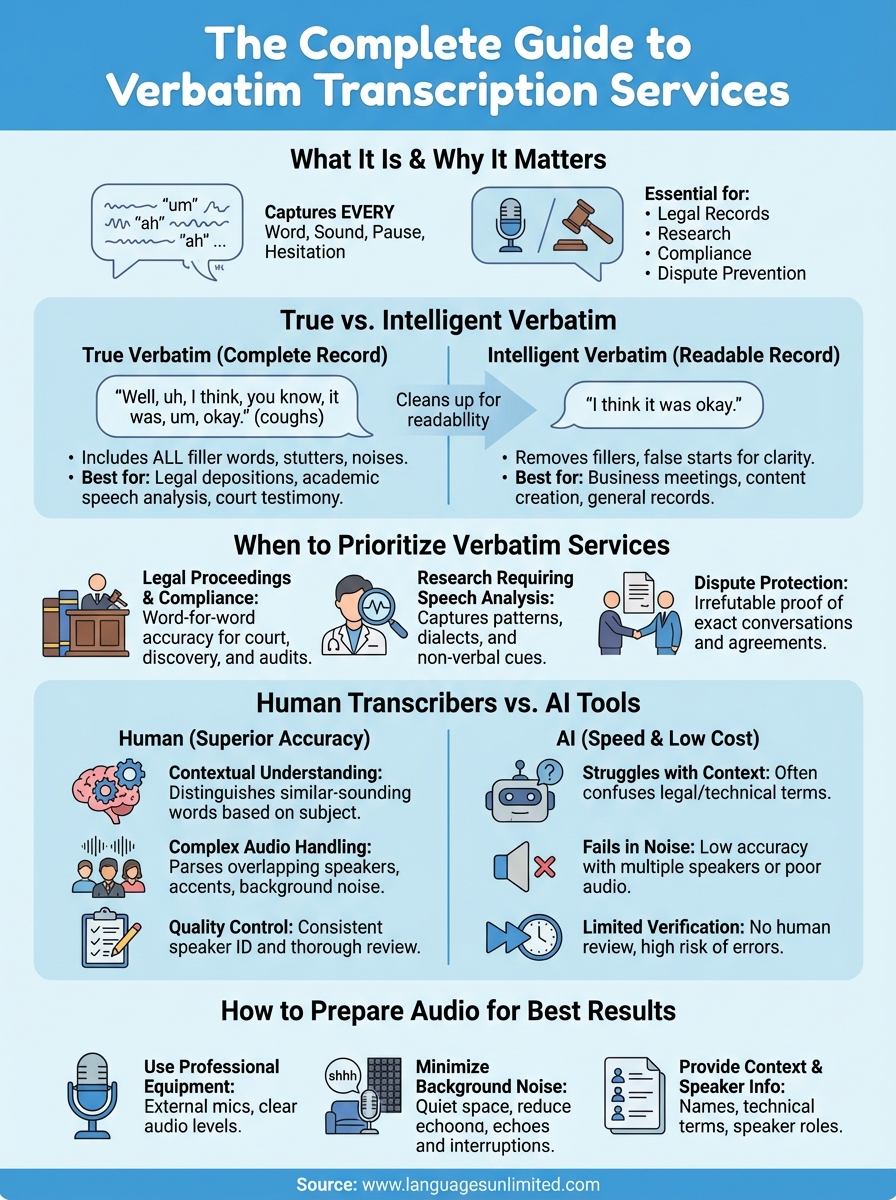
Verbatim transcription services convert every spoken word, sound, and pause from your audio or video files into written text. Unlike standard transcription that cleans up speech, verbatim transcription captures everything exactly as it was said, including stutters, false starts, filler words like "um" and "ah," background noises, and even laughter. This precise documentation matters when you need a complete legal record, want to analyze speech patterns for research, or require certified court transcripts that meet strict admissibility standards.
Choosing the right transcription approach can save you time and money while delivering the accuracy your project demands. This guide walks you through the key decisions you’ll face when ordering verbatim transcription. You’ll learn when to use true verbatim versus intelligent verbatim, how to evaluate professional services against automated tools, and what preparation steps guarantee the best results. Whether you’re handling depositions, conducting academic research, or documenting medical consultations, you’ll know exactly how to get transcripts that meet your standards.
Why verbatim transcription ensures complete accuracy
Verbatim transcription captures every spoken element from your recordings, which means nothing gets lost in translation from audio to text. Standard transcription services edit out hesitations, repetitions, and nonverbal sounds to create readable documents, but this editing process removes critical context that can change meaning. When you need a complete record, these seemingly minor details often become the most important evidence in legal cases, the revealing data points in research studies, or the subtle cues that clarify intent in business negotiations.
Legal proceedings demand every word on record
Courts require word-for-word documentation because a witness’s hesitation before answering can indicate uncertainty, while a spontaneous outburst might reveal their true state of mind. You need verbatim transcription services when deposing witnesses, recording testimony, or creating official court records that might face scrutiny years later. A single "um" or pause can invalidate an entire defense strategy if opposing counsel proves the transcript was edited or incomplete.
Attorneys regularly challenge transcripts that don’t match audio recordings exactly, and judges dismiss evidence when they discover discrepancies between what was actually said and what appears on paper. Your case depends on defensible documentation that shows every word, sound, and silence exactly as it occurred. False starts and corrections matter too because they demonstrate a speaker’s thought process and can reveal inconsistencies in their story.
Research accuracy depends on capturing natural speech
Academic researchers and medical professionals analyze speech patterns, linguistic markers, and communication disorders that require complete verbatim records. You can’t study stuttering patterns if the transcriptionist removes the stutters, and you can’t analyze cognitive decline if filler words disappear from the text. Medical transcription for psychiatric evaluations needs every hesitation and verbal tic documented because these elements serve as diagnostic indicators.
"Incomplete transcripts compromise your research validity and make your findings impossible to replicate or verify."
Linguists studying dialect variations, second language acquisition, or sociolinguistic patterns need transcripts that preserve grammatical errors, non-standard pronunciations, and regional speech features. The data you collect becomes worthless when someone edits out the exact phenomena you’re trying to study.
Context preservation protects you from disputes
Business negotiations and insurance claims often hinge on what was actually said versus what people remember saying. You protect yourself with verbatim records that capture tone, emotion, and the exact phrasing of verbal agreements. A claim adjuster might later dispute whether someone admitted fault or expressed uncertainty, and your complete transcript serves as irrefutable proof of the conversation.
How to choose between true and intelligent verbatim
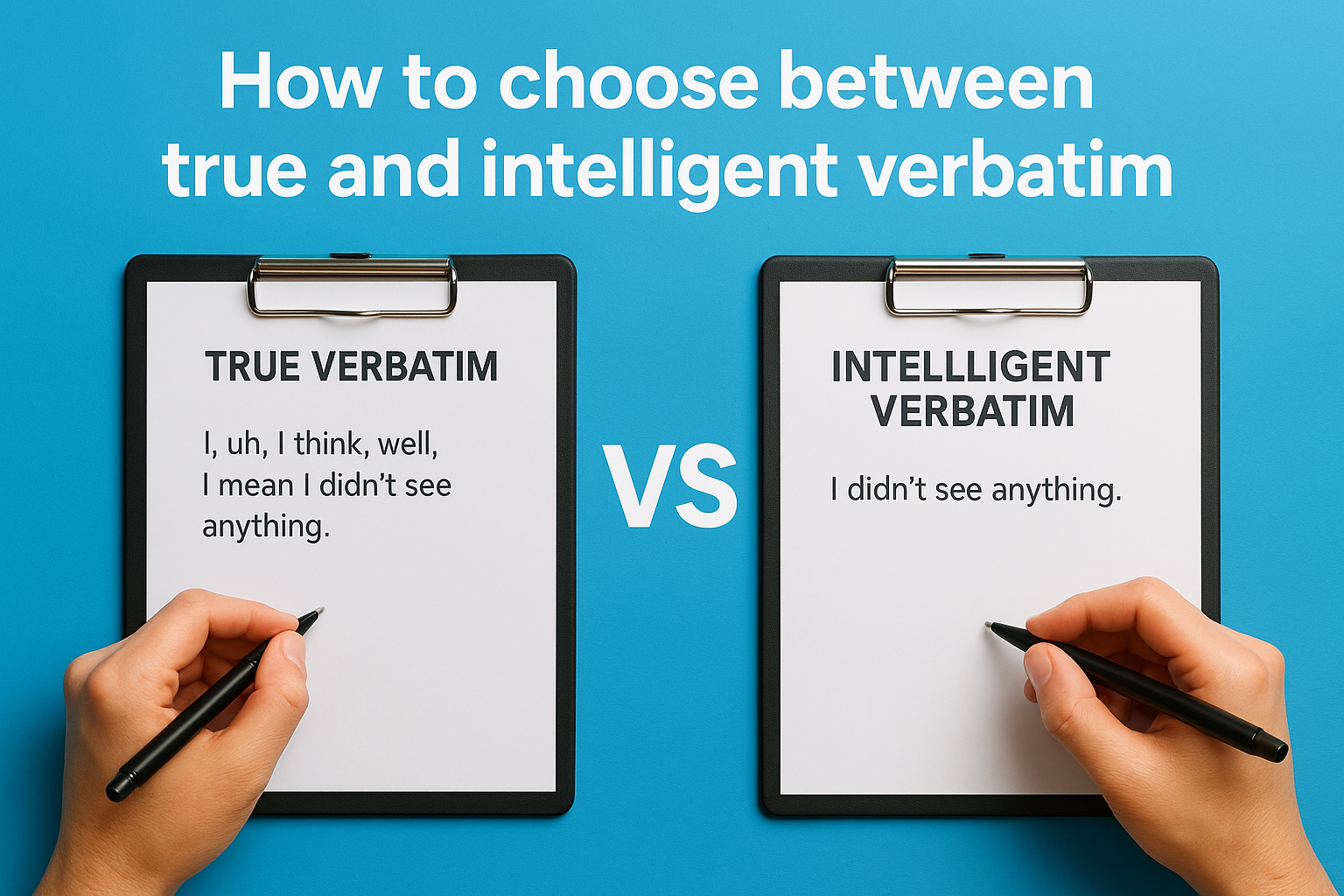
You face a choice between true verbatim and intelligent verbatim when ordering transcription, and your decision affects both cost and usability. True verbatim records absolutely everything including filler words, false starts, and background sounds, while intelligent verbatim removes these elements to create cleaner, more readable documents. Your project requirements determine which format delivers the value you need.
True verbatim captures everything spoken
True verbatim transcription preserves every utterance and sound from your recording, including stutters, repeated words, incomplete sentences, and nonverbal sounds like coughs or laughter. You choose this format when you need a complete legal record for court proceedings, depositions, or any situation where the exact manner of speech matters as much as the content. The transcript shows "I, uh, I think, well, I mean I didn’t see anything" rather than cleaning it up to "I didn’t see anything."
"True verbatim protects you from legal challenges because opposing parties cannot claim you altered or omitted statements from the record."
Intelligent verbatim removes distractions
Intelligent verbatim creates readable transcripts by eliminating filler words, false starts, and repetitions while keeping the complete meaning intact. You save money with this approach because transcriptionists work faster when they don’t document every "um," "ah," and "you know" that appears in natural speech. Your final document reads smoothly and works well for meeting minutes, interview content, or business documentation where you need the substance without the clutter.
Match your choice to your project needs
Select true verbatim for legal depositions, court testimony, research studies, and medical evaluations where speech patterns matter. Choose intelligent verbatim for business meetings, podcast transcriptions, content creation, and general documentation where readability outweighs forensic detail. When you’re unsure which format verbatim transcription services should provide, ask yourself whether anyone might later dispute what was said or whether you’re analyzing how it was said.
When to prioritize verbatim services for your projects
You need verbatim transcription services when the exact manner of speech carries legal weight, research value, or financial consequences. Standard transcription works fine for general documentation, but certain situations demand complete accuracy that captures every word, pause, and hesitation exactly as spoken. Understanding when to invest in verbatim services prevents costly mistakes and protects you from disputes about what was actually said.
Legal proceedings and compliance documentation
Court cases, depositions, and legal discovery processes require word-for-word accuracy that holds up under scrutiny. You must order verbatim transcription when creating official court records, deposing witnesses, documenting arbitration hearings, or recording statements that might become evidence. Any editing or omission gives opposing counsel ammunition to challenge the transcript’s validity and potentially exclude crucial testimony from consideration.
"A single discrepancy between your transcript and the original recording can undermine your entire legal position."
Regulatory compliance and insurance investigations also demand verbatim records because investigators compare transcripts against recordings to verify accuracy. Your compliance audit trail needs complete documentation that shows exactly what employees said during workplace investigations or safety incidents.
Research requiring speech analysis
Academic studies analyzing conversation patterns, linguistic development, or communication disorders need unedited verbatim transcripts. You cannot study speech disfluencies if someone removes the stutters, and you cannot analyze second language acquisition when grammatical errors disappear from the text. Medical professionals diagnosing cognitive impairments or psychological conditions rely on hesitations, word-finding difficulties, and speech patterns that only verbatim transcription preserves.
Market researchers conducting focus groups need verbatim records when they’re studying emotional reactions and spontaneous responses rather than just collecting opinions. The "ums" and pauses reveal uncertainty that cleaned-up transcripts hide.
Why human transcribers outperform AI tools
Automated transcription tools promise speed and low cost, but they cannot match the accuracy human transcribers deliver for verbatim work. AI software struggles with overlapping speakers, accents, technical terminology, and poor audio quality that professional transcriptionists handle routinely. You risk getting transcripts filled with errors and guesses when you rely on automation for projects that demand precision.
Context understanding that AI misses
Human transcribers apply contextual knowledge to distinguish between words that sound identical but have different meanings based on the subject matter. AI tools frequently confuse "statute" with "statute," "plaintiff" with "plaintive," or medical terms with common words because they lack understanding of legal and technical contexts. Your court transcript becomes unreliable when the software mistakes "voir dire" for "waive a deer" or converts specialized medical terminology into nonsensical phrases.
"Professional transcribers research unfamiliar terms and verify spellings rather than guessing, which automated systems cannot do."
Accuracy in complex audio environments
Background noise, multiple speakers talking simultaneously, and telephone recordings create challenging conditions where AI accuracy drops below 70%. Human transcribers parse overlapping dialogue, identify individual speakers even when voices sound similar, and capture whispered asides or off-mic comments that matter in legal proceedings. You need this level of precision when transcribing depositions where side conversations or emotional reactions provide critical evidence.
Speaker identification and quality control
Professional transcribers distinguish between speakers throughout long recordings and maintain consistency in how they label each person. They catch their own errors through review processes that verbatim transcription services require, whereas AI produces whatever the algorithm generates with no verification or quality checks. Your final transcript undergoes human review for accuracy, formatting, and completeness rather than arriving as raw machine output that you must verify yourself.
How to prepare your audio for the best results
You control the accuracy and turnaround time of your transcripts by submitting clean, well-recorded audio files. Professional transcribers work faster and make fewer errors when they can hear every word clearly, which means your preparation directly impacts both cost and quality. Taking simple steps before you hit record saves you from paying for multiple revision rounds or receiving transcripts filled with inaudible markers.
Choose the right recording equipment
You need dedicated recording devices or professional microphones rather than relying on smartphone built-in mics for important recordings. External microphones capture voices with better clarity and reduce ambient noise that makes transcription difficult. Position your recording device within three feet of speakers and test audio levels before starting to ensure voices register clearly without distortion or clipping.
Minimize background noise and interruptions
Record in quiet spaces away from air conditioning units, traffic noise, and echo-prone rooms that muddy audio quality. You achieve better results when you turn off electronics that hum, close windows to block outside sounds, and use sound-dampening materials like curtains or carpets in hard-surfaced rooms. Ask participants to silence phones and avoid shuffling papers near microphones during recording sessions.
"Clear audio with minimal background interference can reduce transcription time by 30% and improve accuracy to above 98%."
Provide context and speaker information
You help transcribers deliver accurate verbatim transcription services by including a speaker list with correct name spellings and any technical terminology they’ll encounter. Send reference materials about specialized topics, industry jargon, or acronyms that appear in your recording. Note the number of speakers and their roles so transcribers can properly label dialogue and distinguish between voices that sound similar.
Securing professional transcription
You now understand that verbatim transcription services deliver complete accuracy when every word, pause, and hesitation matters in your legal cases, research studies, or compliance documentation. Your choice between true and intelligent verbatim depends on whether you need forensic detail or readable content, while proper audio preparation cuts costs and improves accuracy regardless of which format you select. Professional human transcribers consistently outperform automated tools because they apply contextual understanding, speaker identification skills, and quality controls that AI software cannot replicate.
The investment in professional verbatim transcription pays for itself by preventing legal disputes, protecting research integrity, and creating defensible records that hold up under cross-examination or regulatory review. Your next step involves finding a certified transcription provider who understands the stakes of your project and delivers the precision your situation demands. Contact our team to discuss your specific transcription needs and receive a detailed quote based on your audio quality, turnaround requirements, and verbatim format preferences.